What Is CV Analytics? A Guide for Job Seekers
CV analytics is the process of using AI and data science to automatically extract, evaluate, and score resume content so recruiters can identify the best candidates faster and with less bias. The industry term for this practice is “resume analytics” or “AI-powered CV analysis,” and both phrases describe the same core workflow. Natural language processing (NLP) and machine learning parse each resume, map skills and experience to job requirements, and produce an objective match score. Understanding what CV analytics means gives you a real advantage: you can format your resume to score higher, use the right keywords, and avoid the invisible filters that eliminate most applicants before a human ever reads their name.
What is CV analytics and how does it work?
CV analytics is defined as the automated analysis of resume data using AI techniques, including NLP, machine learning, and large language models (LLMs). The process starts with resume parsing. A parser reads a PDF or DOCX file, identifies structural elements like job titles, dates, skills, and education, and converts them into structured data fields. That structured output feeds a scoring engine, which ranks candidates against the job description.
Plugin-based architectures handle diverse document formats more reliably than basic parsers. A plugin system treats each file type as a separate module, so a PDF resume and a DOCX resume both produce clean, consistent output. Inconsistent parsing is one of the most common failure points in CV analytics, and architecture quality is the main reason results vary across platforms.

Modern systems use LLMs with constrained outputs to reduce errors. Schema-enforced JSON extraction forces the model to return data in a fixed structure, which minimizes hallucination and keeps downstream analysis reliable. Without schema enforcement, an LLM might invent a skill or misread a date, corrupting the candidate’s score.
Once data is extracted, a scoring model weights each factor. AI calculates match scores by weighting skills at 40%, experience at 25%, industry relevance at 15%, education at 10%, and location at 5%. That weighting reveals something practical: your skills section carries the most influence, not your job titles or degree.
Pro Tip: Format your resume with clearly labeled sections (“Skills,” “Work Experience,” “Education”) so parsers extract data cleanly. Unusual layouts, text boxes, and graphics confuse most parsers and lower your score before a recruiter sees your name.
What are the main benefits of CV analytics for job seekers and recruiters?
The clearest benefit of CV analytics is speed. Unified extractor architectures process resumes 75% faster than legacy methods. That speed matters because modern job roles attract over 500 applications quickly, making manual review unsustainable. Without AI, a recruiter reviewing 500 resumes at five minutes each would spend over 40 hours on a single role.
For recruiters, the benefits break down into three categories:
- Speed: AI screens hundreds of resumes in minutes, not days.
- Consistency: Every resume is evaluated against the same criteria, with no variation based on reviewer fatigue or mood.
- Bias reduction: AI-driven CV analysis addresses unconscious bias and human errors that affect manual screening. Standardized scoring removes the influence of name, photo, or formatting style on initial ranking.
For job seekers, understanding CV analytics changes how you write your resume. A resume optimized for AI parsing scores higher in automated screening, which means more interviews. Knowing that skills carry 40% of the match score tells you exactly where to invest your editing time.
The table below contrasts manual resume review with AI-driven CV analytics across key dimensions.
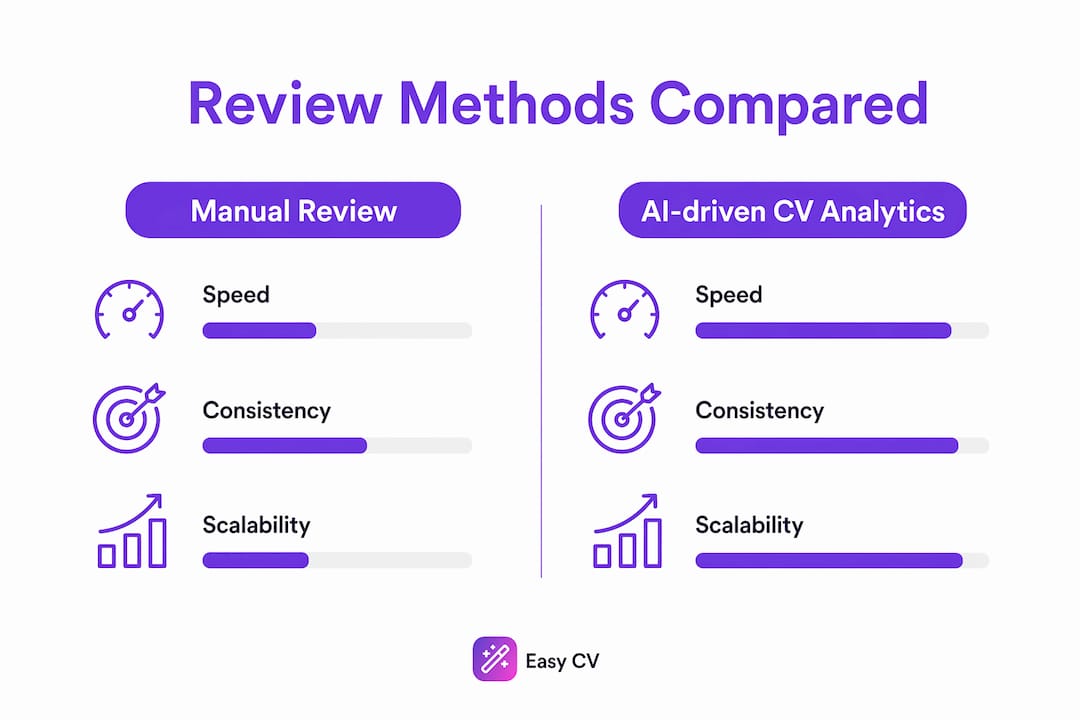
| Dimension | Manual review | AI-driven CV analytics |
|---|---|---|
| Speed | Hours to days per batch | Minutes for hundreds of resumes |
| Consistency | Varies by reviewer | Standardized across all candidates |
| Bias risk | High (unconscious bias) | Reduced through standardized scoring |
| Skill identification | Subjective | Keyword and NLP-based extraction |
| Scalability | Limited by human capacity | Handles high-volume hiring efficiently |
Pro Tip: Tailor your skills section to mirror the exact language in the job description. AI parsers match keywords literally, so “project management” and “managing projects” may score differently depending on the system.
What are the common challenges and limitations of CV analytics?
CV analytics is not error-free. AI misses contextual nuances that a human reader catches immediately. A resume that describes “leading a cross-functional team during a product launch” may not score for “team leadership” if the parser does not recognize the phrase as equivalent. Context inference is still a weak point in most systems.
Common limitations include:
- Parsing errors: Unusual fonts, columns, or embedded graphics cause extraction failures. Data that cannot be parsed cannot be scored.
- Skill inference gaps: AI identifies explicit keywords but often misses implied competencies. A candidate with ten years of financial modeling experience may not score for “Excel” if the word never appears.
- Hallucination risk: Without schema enforcement, LLMs occasionally generate data that was not in the original resume, corrupting the candidate record.
- Recency bias in training data: Models trained on historical hiring data may replicate past patterns, including the biases those patterns contain.
- Overreliance on keywords: A resume stuffed with keywords but lacking substance can outscore a genuinely qualified candidate who writes naturally.
The best hiring outcomes come from combining AI screening with human judgment. Recruiters who use AI as decision support rather than a final verdict get the speed benefit without sacrificing the contextual reading that humans do well. Continuous model updates and high-quality training data reduce these gaps over time, but they do not eliminate them.
How can understanding CV analytics help you improve your resume?
Knowing how CV analytics works gives you a concrete editing framework. The scoring model weights skills most heavily, so your skills section is the highest-return area to improve. List skills explicitly, use the exact terminology from the job description, and place the section near the top of your resume where parsers encounter it early.
Practical steps to align your resume with CV analytics processes:
- Mirror job description language: Copy key phrases from the posting directly into your resume where they accurately describe your experience. Parsers match text, not intent.
- Use standard section headings: “Work Experience,” “Education,” and “Skills” are universally recognized. Creative labels like “My Story” or “What I Bring” confuse parsers.
- Avoid tables and text boxes: Most parsers read left to right, top to bottom. Columns and boxes break that flow and cause data loss.
- Quantify achievements: AI systems extract numbers as signals of impact. “Increased sales by 30%” scores better than “improved sales performance.”
- Submit in the right format: PDF is the safest choice for most systems, but some applicant tracking systems prefer DOCX. Check the job posting for guidance.
Tailoring your CV to each job description is the single most effective way to improve your match score. A generic resume sent to 50 jobs will consistently score lower than a targeted resume sent to 10. Easy-cv builds this tailoring into its workflow, generating a customized CV and cover letter for each application automatically.
Improving your CV for job boards also means understanding that different platforms use different scoring models. LinkedIn, Indeed, and niche job boards each apply their own ranking logic. A resume that performs well on one platform may rank lower on another if the keyword weighting differs.
Resume analytics in your job search goes beyond formatting. Some platforms show you engagement data: how many recruiters viewed your resume, how long they spent on it, and whether they clicked through to your profile. That data tells you whether your resume is generating interest or getting filtered out before a human sees it.
A professional headshot also plays a role in the human review stage that follows AI screening. Once your resume clears the automated filter, a recruiter looks at your full profile. First impressions at that stage matter.
Key Takeaways
CV analytics gives job seekers a measurable way to improve their resume’s performance in automated screening systems.
| Point | Details |
|---|---|
| Skills carry the most weight | AI scoring models weight skills at 40%, making your skills section the highest-impact area to improve. |
| Formatting affects parsing accuracy | Standard section headings and clean layouts prevent data loss during automated extraction. |
| Tailor every application | A resume matched to the job description scores higher than a generic one sent to multiple roles. |
| AI works best alongside humans | Automated screening handles volume; human judgment catches context that AI misses. |
| Speed advantage is real | Unified extractor architectures process resumes 75% faster, so optimized resumes reach recruiters sooner. |
Why I think most job seekers are solving the wrong problem
Most job seekers focus on making their resume look good. They spend hours on fonts, colors, and layout. CV analytics research shows that effort is largely wasted at the screening stage. A beautifully designed resume with columns and icons often scores lower than a plain, well-structured document because the parser cannot read it cleanly.
The real problem to solve is data legibility, not visual appeal. Your resume needs to be readable by a machine before it reaches a human. That means explicit keywords, standard headings, and quantified achievements. Once you clear the AI filter, then design and presentation matter.
Using AI for resume writing is the fastest way to close this gap. AI writing tools understand how parsers read content and generate text that scores well without sacrificing readability. The job seekers who adapt to this reality will consistently outperform those who do not.
The balance between technology and human judgment in hiring is still shifting. AI handles volume, but the final hiring decision almost always involves a person. The professionals who win are those who optimize for both: a resume that clears the AI filter and a profile that impresses the human on the other side.
— Andras
Put CV analytics to work with Easy-cv
Easy-cv applies the principles of CV analytics directly to your job search. The platform’s AI writing assistant generates resume content tailored to each job description, so your skills section mirrors the exact language recruiters and their systems are scanning for.
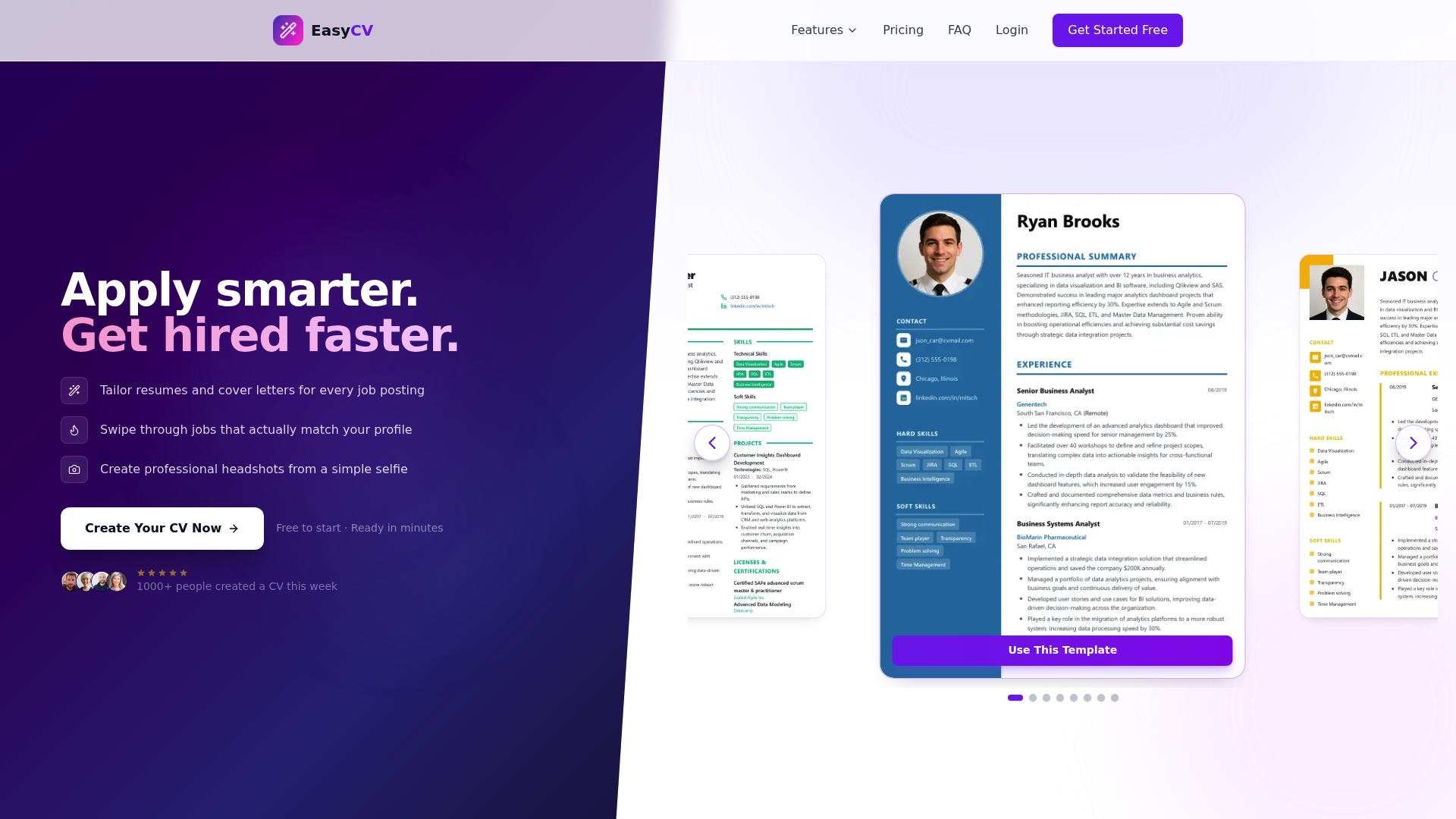
Easy-cv aggregates over 10 million job opportunities per month and pairs each listing with an AI-tailored CV and cover letter. The built-in job tracker keeps your applications organized, and ATS-friendly templates give your resume the clean structure that parsers require. Whether you are applying for your first role or your fifteenth, Easy-cv’s AI CV builder removes the guesswork from resume optimization and puts data-driven application quality within reach. Explore the full platform features to see how each tool supports your search.
FAQ
What does CV analytics mean?
CV analytics means using AI and data science to automatically extract, evaluate, and score resume content. The goal is faster, more consistent candidate screening with less human bias.
How does AI score a resume in CV analytics?
AI assigns a match score by weighting skills at 40%, experience at 25%, industry relevance at 15%, education at 10%, and location at 5% against the job description requirements.
Can CV analytics be wrong?
Yes. AI parsers miss contextual nuances, misread unusual formatting, and occasionally infer skills that are not explicitly stated. Human review remains necessary for final hiring decisions.
How do I format my resume for CV analytics systems?
Use standard section headings, avoid tables and text boxes, list skills explicitly using job description language, and submit in PDF or DOCX format as specified by the employer.
What is the difference between CV analytics and an ATS?
An applicant tracking system (ATS) stores and organizes applications. CV analytics is the layer of AI analysis that scores and ranks those applications within or alongside the ATS.