The Role of Resume Analytics in Your Job Search
Resume analytics is the practice of using data and metrics to assess, improve, and tailor your resume for higher success rates in AI and ATS-driven recruitment. The role of resume analytics has grown from a niche technical exercise into a core job search skill. Hiring pipelines now run through automated systems before a human ever reads your name. Understanding how those systems score your resume, and what signals they reward, is the difference between getting a callback and getting filtered out. This guide covers the mechanics, the metrics, and the tools that matter most in 2026.
What is the role of resume analytics in AI-driven hiring?
Resume analytics transforms subjective resume evaluation into an evidence-driven approach tailored to AI screening and recruiter preferences. That shift matters because the hiring pipeline has four distinct stages your resume must survive: parsing, keyword and semantic matching, LLM scoring, and threshold filtering. Fail at any stage and a recruiter never sees your application.
Parsing is where most candidates lose points without realizing it. An AI parser reads your resume file and extracts structured data: your name, job titles, dates, skills, and education. Parser accuracy on skills lags significantly behind headline extraction, with F1 scores in the 0.75–0.85 range versus 0.92–0.95 for headlines. That gap means a complex or non-standard format actively hurts your skill extraction score before any human judgment enters the picture.

After parsing, modern AI agents move beyond simple keyword matching. They use semantic understanding to infer related skills even when those skills are not explicitly listed. A resume that describes leading a cross-functional product launch will score credit for project management, stakeholder communication, and delivery ownership, even if none of those exact phrases appear. Context and career trajectory carry real weight.
The legal landscape adds another layer. The 2024 Mobley ruling made AI vendors liable as employers’ agents under anti-discrimination laws. That ruling pushed vendors toward evidence-based content and away from systems that reward keyword manipulation. The practical result: AI screening now penalizes stuffing and prizes genuine measurable impact.
- Parsing stage: Use standard fonts, single-column layouts, and plain text headers to minimize extraction errors.
- Semantic matching: Write rich descriptions of your work, not lists of buzzwords.
- LLM scoring: AI evaluates career trajectory and role relevance, not just term frequency.
- Threshold filtering: Resumes that fall below a score cutoff are rejected automatically before human review.
Pro Tip: Run your resume through an AI resume checklist before submitting. Catching parser-breaking elements early costs you nothing. Missing them can cost you the interview.
Key resume performance metrics: what should you actually measure?
Resume performance metrics fall into three categories: system-level performance, business outcomes, and process efficiency. The strongest resumes adapt the metric type to the role and the audience, as the best resumes balance technical precision and business impact.
System-level metrics work best for technical roles. “Reduced API response time by 40%” tells an engineering hiring manager something concrete. Business outcome metrics work across almost every function. “Generated $2.3M in new pipeline through outbound campaigns” speaks directly to a revenue-focused audience. Process efficiency metrics, such as “cut onboarding time from 14 days to 6,” show operational thinking that appeals to operations and management roles.
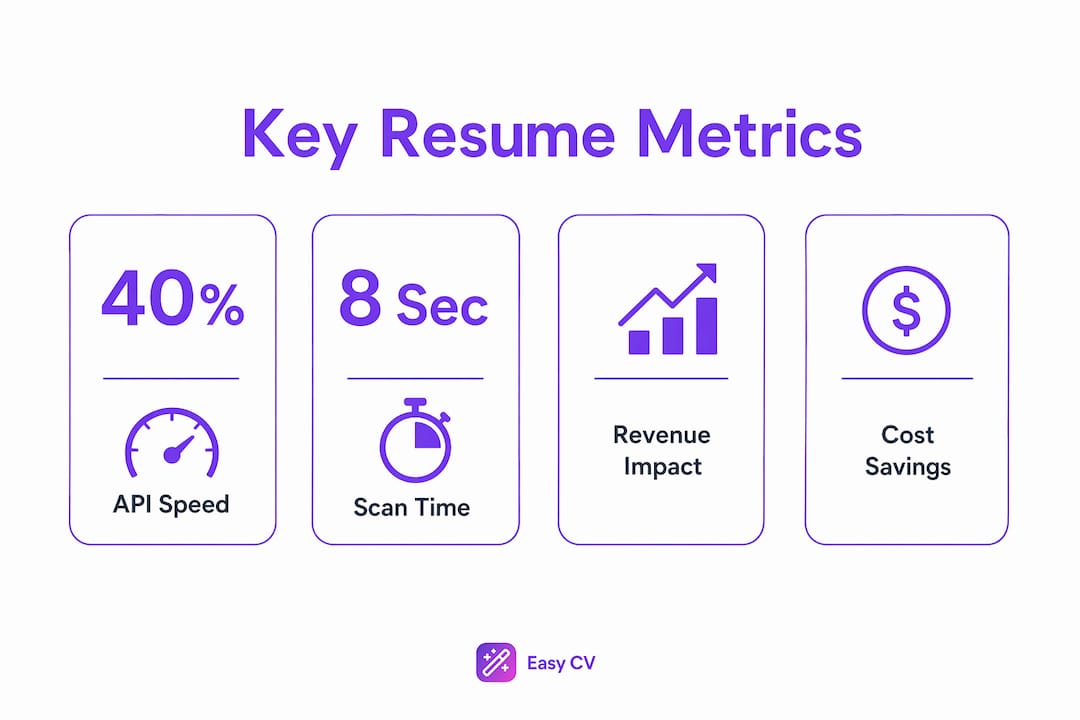
Hiring managers spend 6–8 seconds per resume on an initial scan. That time constraint means your metrics need to be visible and scannable, not buried in paragraph-style descriptions. A quantified achievement in the first line of a bullet point registers faster than a well-written sentence that buries the number at the end.
Mapping your experience to business outcomes like revenue growth or cost reduction earns recruiter recognition because it connects your work to what the company actually cares about. Vague phrases like “improved team performance” or “contributed to growth” carry no weight in either human or AI evaluation. Replace them with a number, a timeframe, and a business result.
Pro Tip: For every bullet point on your resume, ask: “What changed because of my work, and by how much?” If you cannot answer that question, the bullet needs rewriting before it goes in front of a recruiter or an AI system.
| Metric type | Best for | Example |
|---|---|---|
| System-level | Engineering, data, IT roles | Reduced database query time by 35% |
| Business outcome | Sales, marketing, finance roles | Grew ARR by $1.1M in 12 months |
| Process efficiency | Operations, HR, management roles | Cut report generation time from 4 hours to 45 minutes |
How to use resume data interpretation to optimize your content
Standard formatting is the single highest-leverage change most job seekers can make. Non-standard formats cause parser confidence scores to drop, which increases rejection likelihood before any human reads a word. Tables, text boxes, headers and footers, and graphics all introduce parsing errors. A clean, single-column layout with standard section headings removes that risk entirely.
Content optimization follows a clear sequence:
- Mirror the job description language. Pull the exact phrases the employer uses for required skills and responsibilities. AI systems score semantic similarity between your resume and the job posting. Matching their language directly improves that score.
- Describe scope, action, and outcome in every bullet. “Led” is not enough. “Led a team of 8 engineers to deliver a payment integration 3 weeks ahead of schedule, reducing transaction errors by 22%” gives AI and humans something to evaluate.
- Verify role fit before applying. Tailoring resume language to job descriptions improves semantic scoring and pass rates. Applying to roles where your experience does not align wastes your time and lowers your overall application quality metrics.
- Balance keyword relevance with context. Listing 30 skills in a row reads as stuffing to modern AI. Weave skills into accomplishment descriptions so the system can evaluate them in context.
- Use an AI-optimized template. Tools like Easy-cv generate ATS-friendly formats automatically, removing the guesswork from layout decisions. The Easy-cv AI resume builder tailors content to each job description, which addresses both the formatting and semantic matching problems at once.
Pro Tip: After tailoring your resume to a job description, read it aloud. If a sentence sounds like it was written for a robot, rewrite it for a human. The best resumes pass AI screening and still read naturally.
Comparing resume analytics tools and techniques in 2026
The resume analytics tool market splits into three categories: AI resume builders, ATS score calculators, and full analytics dashboards. Each approach has real strengths and real limitations.
AI resume builders like Easy-cv integrate analytics directly into the creation process. Easy-cv matches your content to a specific job description, flags formatting issues, and generates ATS-friendly output across 30+ languages. The AI-driven features cover keyword matching, layout correction, and writing assistance in one workflow. The limitation is that any AI builder reflects the training data it was built on, so checking its output against the actual job description is still your responsibility.
ATS score calculators, offered by various career platforms, give you a percentage match between your resume and a job posting. They are useful for a quick gut check but often rely on keyword frequency rather than semantic analysis. That means a resume stuffed with exact-match terms can score well while a richer, more accurate resume scores lower. Use score calculators as a starting point, not a final verdict.
Full analytics dashboards, available through some AI job search tools, track application outcomes over time. They show which resume versions generate more interview requests, which job categories produce the best response rates, and where your applications drop off. That longitudinal data is the most powerful form of resume analytics because it reflects real recruiter behavior, not just algorithmic predictions.
| Tool type | Strength | Limitation |
|---|---|---|
| AI resume builder | End-to-end optimization, formatting, and content | Output quality depends on job description input |
| ATS score calculator | Fast keyword gap analysis | Rewards keyword stuffing over semantic quality |
| Analytics dashboard | Tracks real application outcomes over time | Requires volume of applications to generate useful data |
Privacy is a real consideration. Any tool that stores your resume data should publish a clear data usage policy. Bias auditing is also worth checking. The Mobley ruling has pushed vendors toward more transparent systems, but not all tools have caught up. Prioritize platforms that are explicit about how they use your data and how their scoring models are validated.
Key Takeaways
Resume analytics converts guesswork into a repeatable process that improves your chances at every stage of AI and human screening.
| Point | Details |
|---|---|
| Fix formatting first | Standard single-column layouts prevent parser errors that silently lower your score. |
| Use three metric types | Match system-level, business outcome, or process efficiency metrics to the specific role and audience. |
| Tailor to each job description | Semantic matching rewards language alignment with the posting, not generic keyword lists. |
| Context beats keyword lists | AI infers adjacent skills from rich descriptions, so elaborate on outcomes rather than listing terms. |
| Track application outcomes | Longitudinal data from analytics dashboards reveals which resume versions actually generate interviews. |
What I have learned from watching AI screening evolve
The most common mistake I see job seekers make is treating resume analytics as a one-time fix. They run their resume through a score calculator, hit 80%, and call it done. That is not how it works. AI screening models update. Job descriptions shift. What scored well in january may underperform by march because the underlying model changed or the role requirements evolved.
The candidates who consistently land interviews treat their resume as a living document with a feedback loop. They track which versions they sent, which roles they applied to, and which applications generated responses. That data, even if it is just a simple spreadsheet, is the most honest form of resume analytics available.
I am also skeptical of tools that promise a specific score improvement without explaining the mechanism. ATS-optimization gimmicks provide limited value. What actually moves the needle is standard formatting, measurable impact bullets, and language that mirrors the job description. Those three things account for the majority of the 10–20% improvement that technical optimization can realistically deliver.
The legal shift from the Mobley ruling is genuinely good news for candidates who do honest work. Systems are being pushed toward rewarding real experience over manipulation. That means the best long-term strategy is also the most straightforward one: describe what you actually did, quantify the results, and format it so a machine can read it cleanly. No tricks required.
— Andras
How Easy-cv puts resume analytics to work for you
Easy-cv brings the analysis and the application into one place, so you are not bouncing between a score calculator, a writing tool, and a job board.
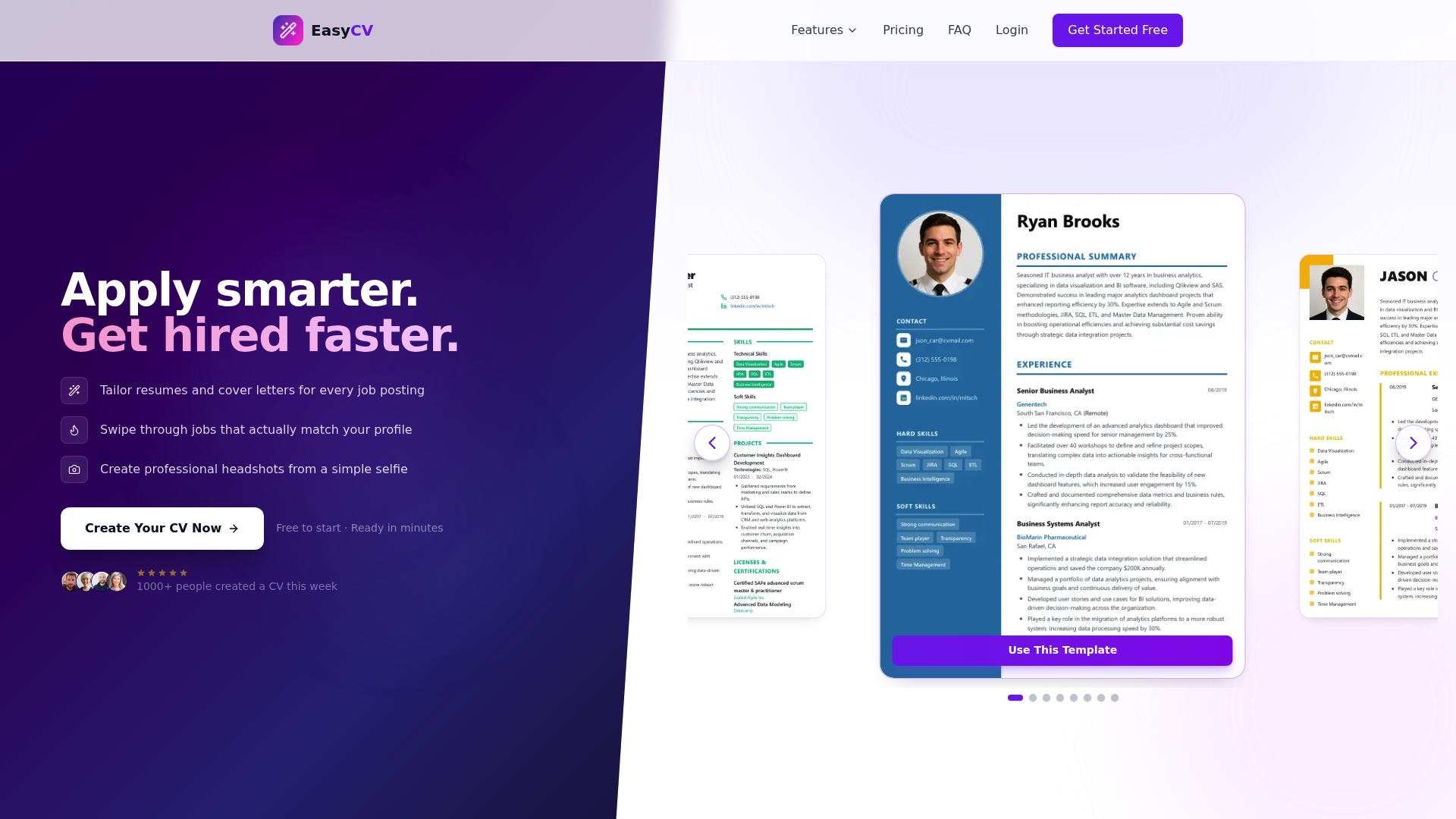
The Easy-cv AI resume builder reads the job description you are targeting and tailors your resume content and formatting to match. It flags keyword gaps, corrects layout issues that break parsers, and generates professional content in 30+ languages. The built-in job tracker keeps your application history organized, which means you can spot patterns in your response rates over time. For job seekers who want to apply analytics thinking without building a manual system from scratch, Easy-cv handles the infrastructure so you can focus on the content.
FAQ
What is resume analytics?
Resume analytics is the use of data and metrics to evaluate and improve how a resume performs in AI screening and recruiter review. It covers formatting, keyword alignment, measurable impact, and application outcome tracking.
How do ATS and AI systems score resumes?
Modern systems parse your resume into structured data, then run semantic matching against the job description, score the result with an LLM, and filter out resumes below a set threshold. Standard formatting and outcome-focused content improve scores at every stage.
What resume metrics matter most to recruiters?
Quantified achievements tied to business outcomes, such as revenue generated, costs reduced, or time saved, register fastest with both human reviewers and AI systems. Vague descriptions without numbers carry little weight.
Does keyword stuffing still work in 2026?
No. Modern AI agents use semantic understanding to evaluate context and career trajectory, not just term frequency. Stuffing can actually lower your score by signaling manipulation to systems trained to detect it.
How often should I update my resume using analytics?
Update your resume for every application using the specific job description as your guide. Review your overall application data monthly to identify which versions and role types generate the best response rates.