AI Resume Builder Based on Job Description: 2026 Guide

An AI resume builder based on job description is a tool that automatically aligns your resume’s content with the specific requirements and keywords from a job posting to improve ATS compatibility and recruiter appeal. These tools go far beyond spell-checking or formatting. They analyze the exact language a hiring manager used, identify the skills and credentials that matter most, and rewrite your resume to reflect them. Whether you are a recent graduate or a seasoned professional, using a job-specific resume builder is the fastest way to stop sending generic resumes and start getting callbacks.
How does an AI resume builder use a job description?
An AI resume builder based on job description works by extracting required keywords and rewriting your existing resume to add missing terms in the sections that matter most to ATS software. The process is more structured than most people expect.
Here is the typical workflow:
- Paste the job description into the tool. The AI scans the full text and identifies structural keywords: job titles, required skills, certifications, tools, and industry terms.
- Compare against your resume. The tool maps what the job requires against what your resume currently says, flagging gaps and mismatches.
- Rewrite bullets naturally. Rather than injecting raw keywords, a quality AI resume generator rewrites your experience bullets to include missing terms in context.
- Check ATS alignment. Most tools display a compatibility score showing how well your resume matches the job posting before you submit.
Grammarly’s Resume Builder, for example, compares your resume to a specific job description and recommends targeted rewrites for alignment instead of just injecting keywords. That distinction matters. Generic keyword insertion reads as spam to both ATS systems and human recruiters. Targeted rewriting reads as a qualified candidate.
ATS optimization depends primarily on keyword structural placement rather than action verbs. Changing “led” to “spearheaded” does nothing for your ATS score if the structural keyword “project management” is missing from your summary. AI tools that understand this distinction produce meaningfully better results.

Pro Tip: After the AI rewrites your resume, read each bullet out loud. If it sounds like a robot wrote it, edit it. The goal is a resume that passes ATS and sounds like you.
What keywords should you target and how often?
Targeting the right keywords is the core skill behind effective automated resume writing. The goal is precision, not volume.
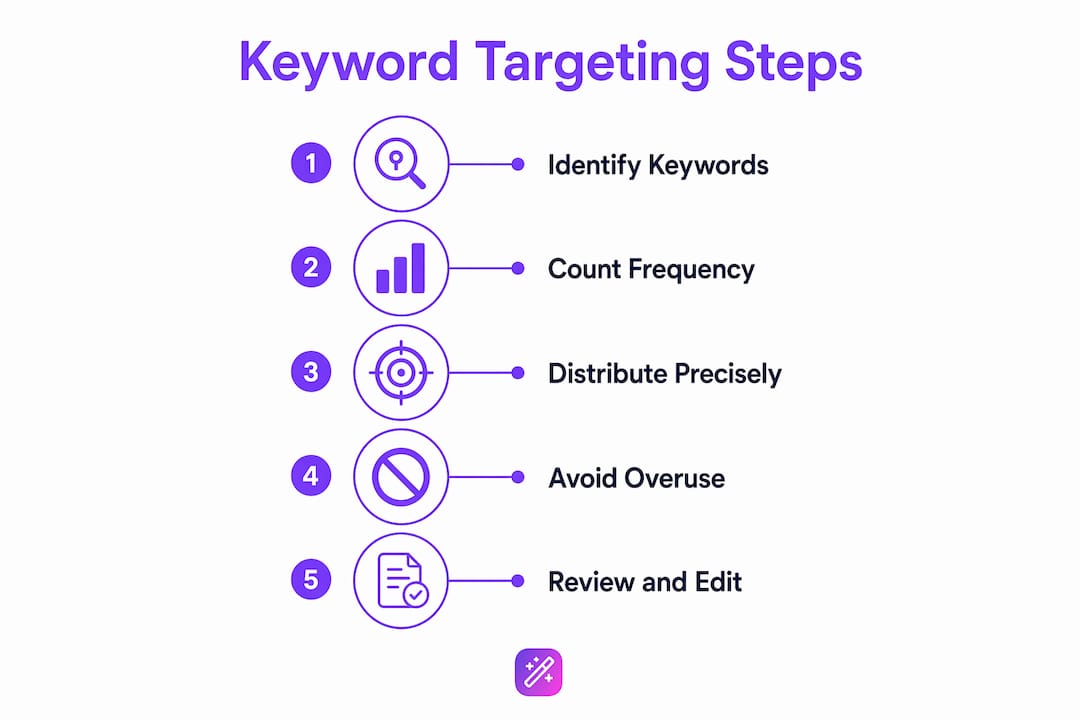
The recommended approach is to identify 8–15 genuine structural keywords from the job description. These are not buzzwords. They are the specific tools, credentials, job titles, and skills the employer listed as requirements or preferences. Think “Salesforce CRM,” “PMP certification,” or “cross-functional team leadership” rather than “motivated” or “detail-oriented.”
Key placement guidelines:
- Resume summary: Include your top 3–5 keywords here. This section gets read first by both ATS and recruiters.
- Skills section: List structural keywords directly. This is the easiest section to optimize and one of the highest-weighted by ATS parsers.
- Experience bullets: Weave keywords into your two or three most recent roles. Context matters here. “Managed Salesforce CRM for a 50-person sales team” scores better than a bare keyword.
The sweet spot for keyword frequency is 2–3 mentions per keyword, distributed across the summary, skills section, and at least one recent bullet. That depth signals relevance without triggering density penalties. Going beyond three mentions for the same term starts to look like stuffing, and modern ATS platforms penalize it.
High keyword density from AI tools like ChatGPT often triggers ATS penalties. Testing has shown that many AI-generated resumes trip Workday’s density penalty threshold. Human review after AI generation is not optional. It is the step that separates a competitive resume from a rejected one.
Pro Tip: Copy the job description into a free word frequency tool like WordCounter.net. The terms that appear most often in the JD are almost always the keywords the ATS is scanning for.
What prep work makes AI tailoring more effective?
The quality of your AI output depends directly on the quality of your input. Garbage in, garbage out applies here more than almost anywhere else in the job search process.
Follow these steps before feeding anything to an intelligent resume creator:
- Clean the job description. Strip out company boilerplate, benefits descriptions, and equal opportunity statements. What remains should be a tight “requirements block” of exact tools, certifications, titles, and skills. Mirroring exact JD tokens in critical sections helps pass modern ATS parsers without errors or misinterpretation.
- Build a fact bank. Create a structured document listing every role you have held, with specific metrics, tools used, and accomplishments. A fact bank of structured experiences supports generating multiple tailored versions by letting you select the best matching content per job without starting from scratch each time.
- Start with a complete base resume. AI cannot invent experience you do not have. Your base resume should be accurate, complete, and well-formatted before any optimization begins.
- Create role-specific versions. If you are applying for both senior and mid-level roles, maintain separate base resumes. The framing, scope, and keyword emphasis differ enough that a single version will underperform for at least one audience.
The AI resume writing workflow that produces the best results treats AI as a collaborator, not a ghostwriter. You supply the facts and the target. The AI handles the matching and language refinement.
How do you evaluate and refine ai-generated resumes?
Not all AI resume generators produce the same quality output. A May 2026 study found that GPT-written resumes scored 42 points lower under certain evaluators than resumes written by other AI styles like Gemini or Claude. That is a hire-or-reject gap caused entirely by tool choice.
The table below shows how to evaluate AI resume output across the dimensions that matter most:
| Evaluation Dimension | What to Check | Red Flag |
|---|---|---|
| ATS Alignment Score | Does the tool show a match percentage against the JD? | Score below 70% on a well-matched role |
| Keyword Placement | Are keywords in summary, skills, and bullets? | Keywords only in skills section |
| Bullet Authenticity | Do bullets sound like your actual work? | Generic phrasing with no metrics |
| Density Check | Are any keywords repeated more than 3 times? | Same term in every bullet |
| Stylistic Fingerprint | Does the resume read naturally to a human? | Stiff, formulaic sentence patterns |
AI-generated resumes carry stylistic fingerprints that influence how they are scored by different recruiters or ATS platforms. This is why testing two or three tools on the same job description is worth the extra 20 minutes. Use the alignment score as a starting point, not a final grade. A score of 85% with natural language beats a score of 95% that reads like a keyword list.
The best AI resume tool for your situation is the one whose output you can edit into something that sounds like you. If you find yourself rewriting every sentence, the tool is not saving you time.
What mistakes kill AI resume results?
Most job seekers using a custom resume builder make the same handful of errors. Knowing them in advance puts you ahead of the majority of applicants.
- Using the raw, unedited job description as input. Full JDs contain noise: company history, perks, legal disclaimers. Feed the AI a cleaned requirements block, not the full posting.
- Accepting AI output without editing. AI tools produce a draft. You produce the final resume. Always read the output and cut anything that sounds unnatural or repetitive.
- Ignoring the job title keyword. The job title itself is often the single highest-weighted keyword in ATS scoring. If the posting says “Senior Data Analyst,” that exact phrase should appear in your summary.
- Applying to roles that do not match your background. AI can optimize language, but it cannot manufacture qualifications. Targeting roles where you meet at least 70% of the stated requirements gives AI tailoring the foundation it needs to work.
- Skipping the human review step. Resume optimization for applicants works best when AI handles the structural matching and a human handles the final voice and tone check.
Pro Tip: Keep a folder with one tailored resume per application. Label each file with the company name and job title. When a recruiter calls two weeks later, you will know exactly which version they are looking at.
Key takeaways
An AI resume builder based on job description works best when you combine clean input, targeted keyword placement, and human editing to produce a resume that passes ATS and reads naturally to recruiters.
| Point | Details |
|---|---|
| Target 8–15 structural keywords | Pull exact tools, titles, and credentials from the JD, not generic buzzwords. |
| Place keywords in three locations | Summary, skills section, and recent experience bullets cover the highest-weighted ATS fields. |
| Edit every AI draft | AI output often triggers density penalties; human review removes repetition and restores your voice. |
| Test multiple AI tools | Hire rates vary by over 40 points depending on which AI wrote the resume, so compare outputs. |
| Build a fact bank | Structured experience records let you generate multiple tailored versions without starting over each time. |
What i have learned after watching thousands of resumes go through ATS
Most articles on AI resume tailoring treat ATS scores as the finish line. They are not. I have seen resumes score 92% on alignment tools and still get rejected in the first round. The reason is almost always the same: the AI optimized for the scanner, not the human reading it after the scanner.
The uncomfortable truth is that ATS is a filter, not a decision-maker. A recruiter at a mid-size company might spend 30 seconds on your resume after it clears ATS. If every bullet starts with “Leveraged cross-functional synergies,” you have passed the machine and lost the human. The best resumes I have reviewed use AI to get the structure and keywords right, then apply genuine editing to make the content specific and believable.
My other strong recommendation: do not use just one AI tool. The stylistic variance between tools is real and significant. Run the same job description through two different generators and compare the outputs side by side. You will immediately see which one produces language closer to your natural voice. That is the version worth refining.
Finally, own your narrative. AI can match your experience to a job description, but it cannot tell the story of why you are the right person for this specific role. That sentence, the one that makes a recruiter pause, still has to come from you.
— Andras
Build your next tailored resume with Easy-cv
Tailoring a resume manually for every application takes hours. Easy-cv cuts that time down to minutes by analyzing the job description and automatically aligning your resume’s keywords, skills, and structure to match what the employer is actually looking for.
Easy-cv aggregates over 10 million job opportunities per month from all major job boards, so you can find the right role and tailor your application in the same place. The AI writing assistant rewrites your content to match each posting, while ATS-friendly templates make sure your formatting never gets in the way. You can create and export multiple tailored versions, track every application, and even generate a professional headshot from a selfie. Start your first tailored resume free and see the difference a job-specific approach makes.
FAQ
What is an AI resume builder based on job description?
An AI resume builder based on job description is a tool that scans a job posting, identifies required keywords and skills, and rewrites your resume to match them. The goal is to improve both ATS compatibility and recruiter appeal for that specific role.
How many keywords should i include in a tailored resume?
Target 8–15 structural keywords from the job description, each appearing 2–3 times across your summary, skills section, and experience bullets. Exceeding three mentions per keyword risks triggering ATS density penalties.
Does AI resume tailoring actually improve interview rates?
Yes, when done correctly. AI tools that focus on structural keyword placement rather than generic rewrites produce resumes that clear ATS filters at significantly higher rates. Human editing after AI generation is required to maintain authenticity and avoid penalty-triggering density.
Can i use the same ai-tailored resume for multiple jobs?
No. Each tailored resume should match one specific job description. A fact bank of your experiences makes it faster to generate multiple versions without rewriting from scratch each time.
Which AI resume tool produces the best results?
No single tool wins for every applicant. A 2026 study showed that hire rates differ by over 40 points depending on the AI used. Test at least two tools on the same job description and choose the output that sounds most like your natural voice after editing.