What Is a Skill-Based CV and How to Write One

A skill-based CV is a resume format that leads with your most relevant skills and measurable achievements rather than listing jobs in reverse chronological order. Also called a functional CV, this structure puts your capabilities front and center, making it easier for recruiters and applicant tracking systems (ATS) to immediately see what you bring to the table. In 2026, with AI-powered screening tools parsing thousands of applications daily, leading with skills is no longer a stylistic choice. It is a competitive necessity. Research from platforms like Purdue OWL and hiring data from Fortune 500 companies confirm that skills-first formats are reshaping how candidates get noticed and shortlisted.
What is a skill-based CV vs. a traditional chronological CV?
A chronological CV lists your work history from most recent to oldest, making your career timeline the centerpiece. A skill-based CV, by contrast, organizes your experience around what you can do, grouping accomplishments under skill categories like “Project Management,” “Data Analysis,” or “Client Communication.” The work history still appears, but it is condensed and placed after the skills section rather than leading the document.
The practical difference matters more than it sounds. A career changer with five years in retail and two years in marketing will look like a weak marketing candidate on a chronological CV. On a skill-based CV, those same experiences can be reframed around transferable skills like audience targeting, budget management, and campaign execution. The skills tell the story; the timeline provides verification.

Here is a direct comparison to help you decide which format fits your situation:
| Format | Best for | Weakness |
|---|---|---|
| Chronological | Linear career progression, same-industry moves | Exposes gaps, career changes, or short tenures |
| Functional (pure skills-based) | Career changers, returning professionals | Can confuse ATS; may raise red flags with recruiters |
| Hybrid (skills + condensed history) | Most job seekers in 2026 | Requires more careful writing and tailoring |
The hybrid format combining a skills summary with condensed chronological history is the most effective and widely recommended approach across industries right now. Pure functional resumes that omit job history entirely can confuse ATS algorithms and make recruiters suspicious. The hybrid approach gives you the best of both worlds.
Why do recruiters and ATS prefer skills-first resumes in 2026?
The numbers behind this shift are hard to ignore. 68% of recruiters explicitly prefer skills-first resume formats, and 72% of Fortune 500 recruiters receive specialized training on skills-based evaluation. That is not a trend. It is a structural change in how hiring works.
The performance data reinforces the preference. Skills-first resumes show 22 to 37% stronger predictive validity for job performance compared to chronological resumes. For hiring managers trying to reduce costly mis-hires, that gap is significant. Companies that use skills-based screening report 25% higher performance ratings and 40% lower turnover among new hires. Lower turnover directly reduces recruiting costs, which is why HR departments are pushing this format from the top down.
From an ATS perspective, the mechanics are equally clear. Semantic search algorithms in 2026 rank candidates higher when skills are featured prominently and sections use standard headings. The biggest parsing errors come not from skills-first structures but from complex tables, embedded graphics, and non-standard section titles. A clean, text-based hybrid CV with clearly labeled sections like “Core Skills” and “Work History” will outperform a visually elaborate chronological CV every time.
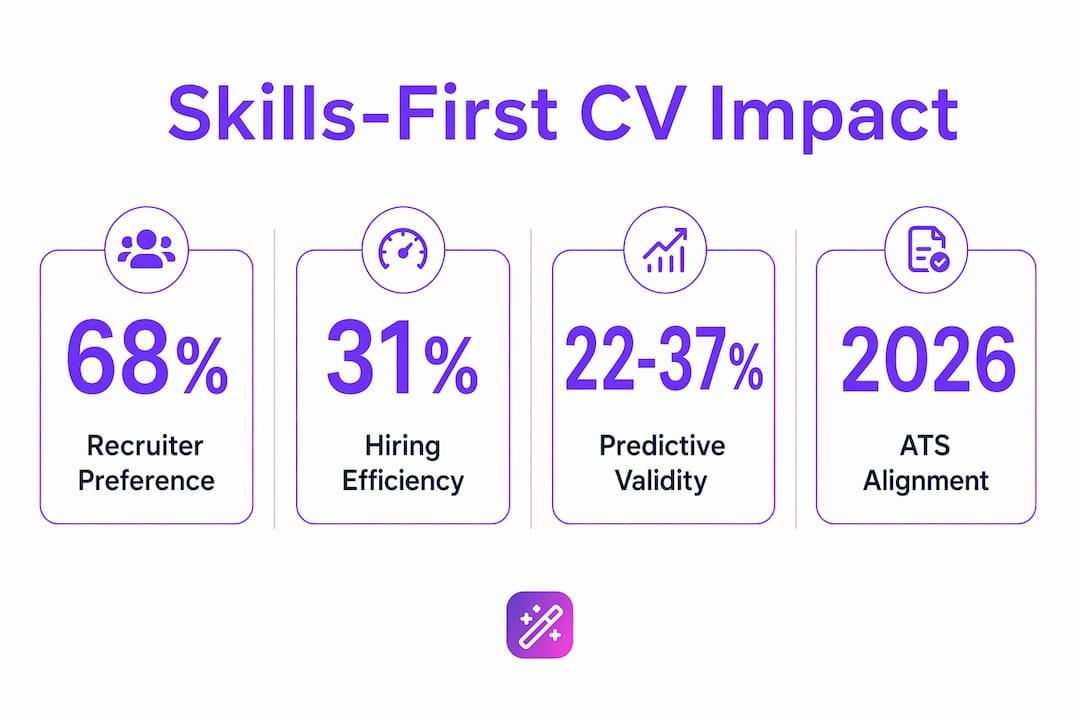
Skills-based screening also speeds up the process. Hiring efficiency increases by 31% with skills-based resume screening, and time-to-fill roles drops by 14 days on average. For candidates, a randomized controlled trial showed 28% higher callback rates for skills-first resumes in tech and creative industries. That is a measurable advantage you can build into your application strategy.
Pro Tip: When you tailor your skills section to mirror the exact language in a job description, you are not gaming the system. You are speaking the same language as the ATS and the recruiter reviewing your file.
How to create a skill-based CV that passes ATS and impresses recruiters
Building an effective skill-based CV follows a clear structure. Here is how to approach it step by step.
1. Identify your core skill categories. Group your experience into three to six primary skill categories that are directly relevant to the role you are targeting. Examples include “Digital Marketing,” “Team Leadership,” “Financial Modeling,” or “UX Research.” Avoid vague labels like “Communication Skills” without backing them up with specific accomplishments.
2. Write accomplishment bullets using a proven formula. The most effective format is: action verb + contextual skill + measurable result. For example: “Led cross-functional team of eight to deliver a product launch three weeks ahead of schedule, increasing Q3 revenue by 18%.” Using quantified achievements in skill bullet points enhances both ATS keyword relevance and human recruiter perception of your impact.
3. Include a condensed work history section. This is non-negotiable. ATS systems require clear employer names, job titles, and dates to parse CVs accurately. Omitting work history can cause automatic rejection or lower relevance scores. Keep this section brief: company name, job title, and dates are enough. The skills section does the heavy lifting.
4. Keep education and certifications on the document. Removing degrees risks automatic exclusion even when employers claim to practice skills-first hiring. Place education after your skills section to balance priorities, but do not cut it. Many ATS filters still treat degrees as hard requirements.
5. Tailor your skill categories to each job description. A skills-based CV is not a one-size-fits-all document. For a data analyst role, your “Data Visualization” and “SQL Proficiency” categories should lead. For a project manager role, “Stakeholder Management” and “Agile Delivery” should come first. This tailoring is what separates candidates who get callbacks from those who do not.
For guidance on layout and section headings that align with how ATS parse your experience, the CV formatting best practices from Easy-cv offer a practical reference point.
What do effective skill-based CV examples look like across industries?
The structure of a skill-based CV adapts depending on your industry, career stage, and the specific role you are targeting. Here are three practical scenarios to illustrate how the format works in practice.
Career changer moving from teaching to corporate training. A former high school teacher applying for a Learning and Development role would lead with skill categories like “Curriculum Design,” “Adult Learning Facilitation,” and “Performance Assessment.” Each bullet would quantify impact: “Designed a 12-week onboarding program adopted by three departments, reducing new hire ramp-up time by 30%.” The work history section lists teaching roles briefly, with dates and institutions, but the skills section reframes classroom experience as corporate-ready capability.
Returning professional after a career gap. Someone re-entering the workforce after two years away would use the skills section to highlight freelance projects, volunteer work, or upskilling during the gap. Categories like “Project Coordination” or “Digital Tools Proficiency” (covering tools like Asana, Slack, or Google Workspace) demonstrate continued relevance without drawing attention to the timeline gap.
Tech professional targeting a senior role. A software engineer moving into engineering management would organize skills around “Technical Leadership,” “System Architecture,” and “Cross-Team Collaboration.” Hard skills like Python or AWS appear within bullets as context, not as standalone lists. This signals maturity and scope beyond pure technical execution.
Here is an example of how accomplishment bullets differ between a weak and strong approach:
| Weak bullet | Strong bullet |
|---|---|
| Managed social media accounts | Grew LinkedIn following by 4,200 in six months by executing a content calendar tied to product launches |
| Led a team | Managed a team of six engineers across two time zones to ship a platform migration on schedule and under budget |
| Improved customer satisfaction | Redesigned the support ticket workflow, cutting average resolution time from 48 hours to 11 hours |
For professional services roles, recruitment specialists who work with candidates daily confirm that quantified, skills-organized CVs consistently outperform dense chronological documents in shortlisting decisions. The pattern holds across finance, consulting, and operations.
Soft skills deserve a place in your CV too, but only when backed by evidence. “Strong communicator” means nothing without a bullet like: “Presented quarterly results to a board of 12 executives, securing approval for a $500K budget increase.” The skill is the label; the achievement is the proof.
Key takeaways
A skill-based CV works best as a hybrid format that leads with grouped, quantified skill categories and supports them with a concise chronological work history, satisfying both ATS algorithms and human recruiters.
| Point | Details |
|---|---|
| Define your skill categories | Group experience into 3 to 6 specific, role-relevant categories backed by measurable achievements. |
| Use the accomplishment formula | Write every bullet as: action verb + contextual skill + measurable result. |
| Keep your work history | ATS systems require employer names, titles, and dates to avoid automatic rejection. |
| Tailor for every application | Adjust skill category order and language to mirror each job description’s priorities. |
| Hybrid beats pure functional | A skills summary combined with condensed work history outperforms both pure formats in 2026. |
Why I think most people are using skill-based CVs wrong
After reviewing hundreds of resumes and tracking what actually gets candidates through to interviews, the biggest mistake I see is not the format itself. It is the execution. Most people who switch to a skills-based CV strip out their work history entirely, thinking the skills section replaces it. It does not. Recruiters at firms like Integrity Talent Partners and hiring managers at mid-size tech companies have told me directly that a CV without verifiable employment history triggers immediate skepticism, regardless of how impressive the skills section looks.
The second mistake is treating the skills section as a keyword dump. Listing “leadership, communication, problem-solving, teamwork” without a single quantified result is worse than a chronological CV with real numbers. The format only works when the skills are proven, not just claimed.
What I have found genuinely works is the hybrid approach: a strong skills summary at the top, three to five accomplishment bullets per category, and a clean work history below. This structure satisfies the ATS on the first pass and gives the human recruiter a narrative they can follow. For anyone serious about landing more interviews, the hybrid format is not optional in 2026. It is the baseline.
The future of hiring is skills-first, but the transition is not complete. Most employers still use education and tenure as filters even when they claim otherwise. The smart play is to lead with skills while keeping the traditional signals intact. Build for the machine, write for the human, and tailor for the role.
— Andras
Build your skill-based CV faster with Easy-cv
Structuring a skills-based CV from scratch takes time, especially when you are tailoring it for multiple roles. Easy-cv removes the friction from that process entirely.
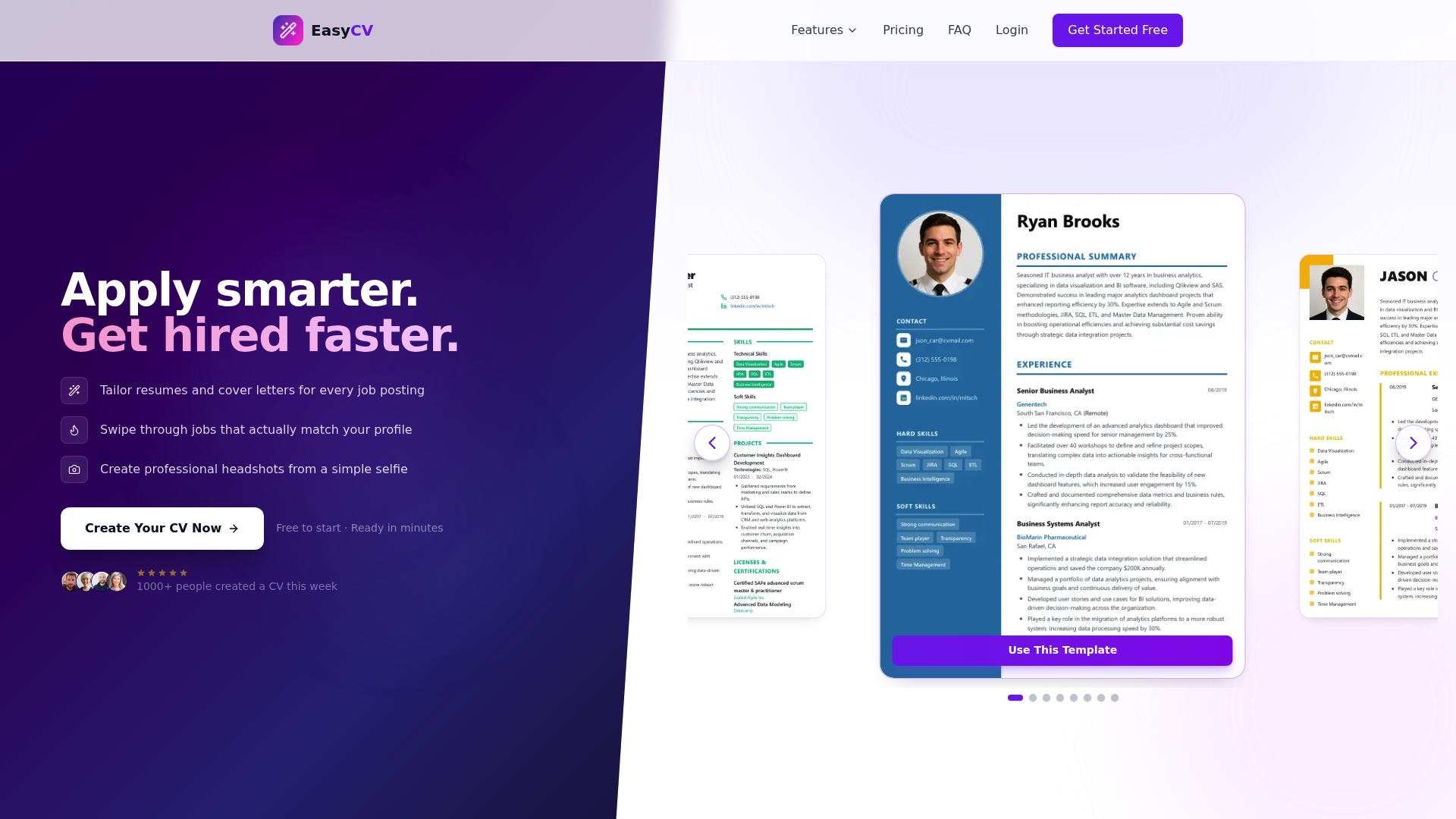
With Easy-cv’s AI-powered CV builder, you can organize your experience into skill categories, generate accomplishment bullets using the action-verb-result formula, and optimize your language to match specific job descriptions. The platform’s ATS-friendly templates support hybrid formats out of the box, so your skills section and work history are always structured correctly. You can create multiple tailored versions of your CV without starting over each time. For job seekers who want their applications to work harder with less manual effort, Easy-cv is built exactly for that.
FAQ
What is a skill-based CV in simple terms?
A skill-based CV, also called a functional CV, is a resume format that organizes your experience around skill categories and measurable achievements rather than listing jobs in chronological order. It puts what you can do ahead of where you have worked.
Is a skill-based CV better than a chronological CV?
The hybrid format combining a skills summary with a condensed work history is the most effective approach in 2026, outperforming both pure formats. Pure skills-based CVs without work history can confuse ATS systems and raise red flags with recruiters.
What should I include in a skill-based CV?
A skill-based CV should include a skills summary with 3 to 6 categories, accomplishment bullets using the action verb plus measurable result formula, a condensed chronological work history with employer names and dates, and an education section placed after skills.
Do ATS systems handle skill-based CVs well?
Yes, when formatted correctly. ATS algorithms rank candidates higher when skills are featured prominently with standard section headings. The main parsing errors come from complex graphics and non-standard titles, not from the skills-first structure itself.
Can I use a skill-based CV if I have no employment gaps?
Absolutely. Career changers, returning professionals, and candidates with linear career histories all benefit from the skills-based format. It is particularly effective when you want to reframe experience from one industry as directly relevant to another.