How to Build a Standout CV That Gets Interviews
You’re sending out CVs and hearing nothing back. The frustrating reality is that knowing how to build a standout CV separates candidates who get calls from those who don’t, regardless of qualifications. Most job seekers write CVs that describe what they did rather than what they achieved. Others use formatting that looks great but gets scrambled by automated screening software before a human ever reads it. This guide walks you through everything: preparation, formatting, writing technique, and the mistakes that quietly kill your chances.
Table of Contents
- Key Takeaways
- How to build a standout CV: preparation before you write a word
- Step-by-step guide to writing your CV
- Common CV mistakes and how to fix them
- What a well-crafted CV actually achieves
- My honest take on CV advice
- Put your CV to work with Easy-cv
- FAQ
Key Takeaways
| Point | Details |
|---|---|
| Start with a master CV | Keep one document with all achievements and keywords, then tailor it for each application. |
| Format for ATS first | Use a single-column layout, standard fonts, and no images to prevent parsing errors. |
| Lead with achievements | Replace duty lists with bullet points using action verb plus quantified result plus context. |
| Match job ad language | Mirror the exact keywords from each posting in your summary and bullets to pass screening. |
| Tailor every application | A generic CV sent to 50 jobs performs far worse than a tailored one sent to 10. |
How to build a standout CV: preparation before you write a word
Most people open a blank document and start typing. That is exactly the wrong approach. The quality of your CV is almost entirely determined by the work you do before you write a single sentence.
The first step is building what insiders call a master CV. This is a private, comprehensive document that contains every role, achievement, certification, project, and metric you have ever accumulated. You never send this document anywhere. Instead, tailor 3 to 5 bullets per role from it for each specific application. The master CV prevents you from starting from scratch every time and makes sure nothing valuable gets left out.

Next, research the job description deeply. Read it three times. Underline every repeated skill, tool, or phrase. Employers and their automated systems are looking for language that mirrors what they wrote, so you need to understand their vocabulary before you write yours. A helpful resource on using resume keywords effectively can help you map the right terms to the right sections.
Then decide which CV format fits your situation:
- Chronological (work-focused): Best for candidates with a steady, relevant work history. Recruiters expect this format and ATS systems parse it easily.
- Functional (skills-focused): Useful for career changers or those with gaps, though recruiters often view this format with skepticism. Use it carefully.
- Hybrid: Leads with a skills summary, then lists work history in reverse order. Works well for mid-career professionals changing industries.
Pro Tip: Before writing your CV, paste the job description into a word frequency tool. The words that appear most often are your priority keywords. If those words are not in your CV, your application may not make it past automated screening.
Step-by-step guide to writing your CV
Once your preparation is solid, the actual writing becomes more structured. Follow these steps in order.
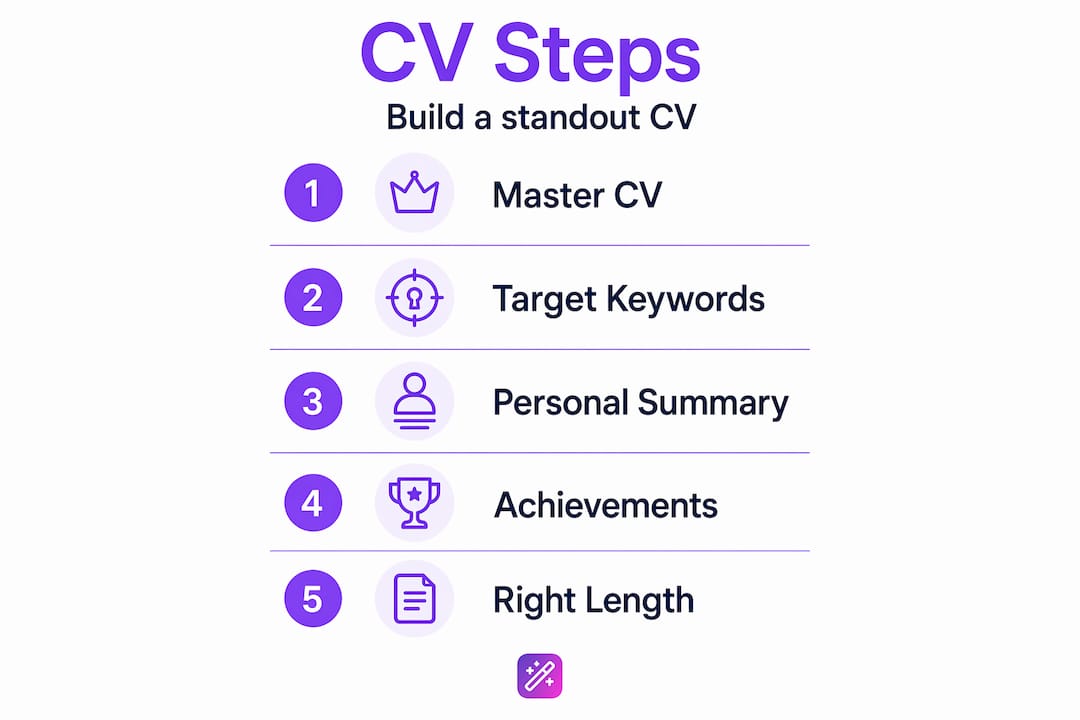
1. Set up your formatting correctly
ATS systems parse resumes into fields rather than rejecting them outright. Poor formatting causes your data to land in the wrong fields, which means a recruiter searching for your skill set simply will not find you. Use these formatting rules without exception:
- Single-column layout only
- Clean sans-serif font such as Calibri or Arial, sized 10 to 11 points
- Standard section headings: Work Experience, Education, Skills, Certifications
- No images, no graphics, no tables, no text boxes
- Save as PDF unless the job posting specifies otherwise
2. Write a targeted personal summary
Your summary sits at the top and determines whether a recruiter reads further. It should be three to four sentences that describe your professional identity, your most relevant experience, and what you bring to this specific role. Change it for every application. A summary that says “results-driven professional with excellent communication skills” tells a recruiter nothing. A summary that says “Digital marketing manager with six years in B2B SaaS, specializing in demand generation campaigns that reduced cost per lead by 34%” is worth reading.
3. Build achievement-led bullet points
This is where most CVs fail. Recruiters want results, not lists of duties. Use this formula for every bullet point:
Action verb + quantified or contextual result + brief context
Compare these two versions of the same job:
| Weak (duty-based) | Strong (achievement-based) |
|---|---|
| Responsible for managing social media accounts | Grew LinkedIn following by 4,200 in six months through a weekly thought leadership series |
| Handled customer complaints | Reduced average complaint resolution time from 4 days to 18 hours by redesigning the escalation workflow |
| Assisted with product launches | Coordinated launch of three product lines generating $1.2M in first-quarter revenue |
When exact numbers are unavailable, use qualitative outcomes. “Reduced client onboarding friction” is still better than “Helped with onboarding.” But always use numbers when you have them.
4. Optimize for keywords without stuffing
Mirror job advert wording in your summary and bullet points. If the posting says “cross-functional collaboration,” use that phrase. If it says “stakeholder management,” use that. Do not use synonyms here. ATS systems are not always smart enough to equate “team coordination” with “cross-functional collaboration.” That said, do not repeat keywords unnaturally. Place them where they genuinely belong.
5. Observe the right length
A one to two page CV is the right range for most applicants. One page works well for under ten years of experience. Two pages are acceptable when the content genuinely warrants it. Three pages and beyond is almost always a sign that you need to cut, not that you have more to say.
Pro Tip: Print your CV and physically scan it the way a recruiter would. Research shows recruiters follow an F-pattern when scanning, reading across the top, then scanning down the left side. Your strongest keywords and impact verbs should appear at the start of each bullet, never buried mid-sentence.
Common CV mistakes and how to fix them
Even well-prepared candidates make these errors. Some are obvious, others are subtle enough to cost you interviews without you ever knowing why.
- Listing responsibilities instead of achievements. If your bullet point starts with “Responsible for” or “Duties included,” rewrite it. Every bullet should show what changed or improved because you were there.
- Using graphics, icons, or multi-column layouts. These look polished in a PDF viewer but cause parsing errors inside ATS software. Your data ends up scrambled or lost entirely.
- Sending one CV to every job. A generic CV actively hurts you. Tailoring your CV per application is not optional if you want consistent results. The work of maintaining a master CV makes this faster than it sounds.
- Ignoring proofreading. A typo in your summary tells a recruiter you lack attention to detail. Grammar checking and a second reader before sending reduces errors that silently disqualify you.
- Keyword stuffing. Loading your CV with keywords that do not connect to real experience is easy to spot. Recruiters who see a skill listed but cannot verify it in your actual bullets will move on quickly.
- Using an unprofessional email address. Your contact section is the first thing a recruiter sees. An email like “partyguy92@gmail.com” will undermine even the best CV content. Use a version of your name.
Pro Tip: To test ATS compatibility, copy and paste your CV into a plain text file. If the formatting collapses completely and sections become unreadable, your ATS performance will be poor. Fix the layout before submitting.
Understanding how to improve your CV for job boards using AI tools is a practical way to catch these issues before they reach a recruiter’s desk.
What a well-crafted CV actually achieves
Getting your CV right does more than land interviews. It changes the entire dynamic of your job search.
A tailored CV filters your applications naturally. Instead of applying broadly and hoping, you apply to roles where your CV already speaks their language. The response rate climbs. The quality of conversations improves. You get calls from roles that are actually a fit rather than ones where you were just another applicant in the pile.
A standout CV is not about impressive design or clever writing tricks. It is about matching what the employer needs with specific evidence that you can deliver it. Every word should earn its place.
Your CV also serves a secondary function that most job seekers overlook. When someone refers you to a role, the first thing a hiring manager does is look at your CV. A CV that reads clearly and shows impact makes your referrer look good. It makes the hiring manager’s decision easier. Networking gets you in the door, but your CV determines whether you stay in the conversation.
Keep your CV updated every three to six months, even when you are not actively searching. Add achievements while they are fresh. Track metrics as you go. When you need your CV quickly, you will thank yourself for maintaining it. Pairing a polished CV with a strong cover letter and interview preparation gives you the full picture. One document alone rarely lands a job.
My honest take on CV advice
I have reviewed hundreds of CVs across industries, and the single most common issue I see is not bad formatting or missing keywords. It is that people write CVs as a record of what they did, not a case for why they should be hired.
The shift sounds small. It is not. Once I started advising candidates to approach every bullet point as if they were answering “so what?” after each line, the results changed. Callbacks increased. Conversations got further. The CVs started reading like arguments rather than timelines.
I also think the obsession with ATS optimization has gone too far. Yes, clean formatting matters and keyword alignment matters. But I have seen candidates so focused on gaming the algorithm that they produce documents no human would enjoy reading. The best CVs I have encountered pass ATS checks because they are clear and well-structured, not because someone reverse-engineered a system.
One more thing I rarely see discussed: your CV is only one part of a three-part job search. Networking, a personalized cover letter, and interview preparation do as much work as the CV itself. Treat all three seriously, and the whole effort compounds. Rely only on sending CVs into job boards and you will work twice as hard for half the results.
— Andras
Put your CV to work with Easy-cv
You now have the framework. The next step is executing it without spending hours reformatting every time you apply to a new role.
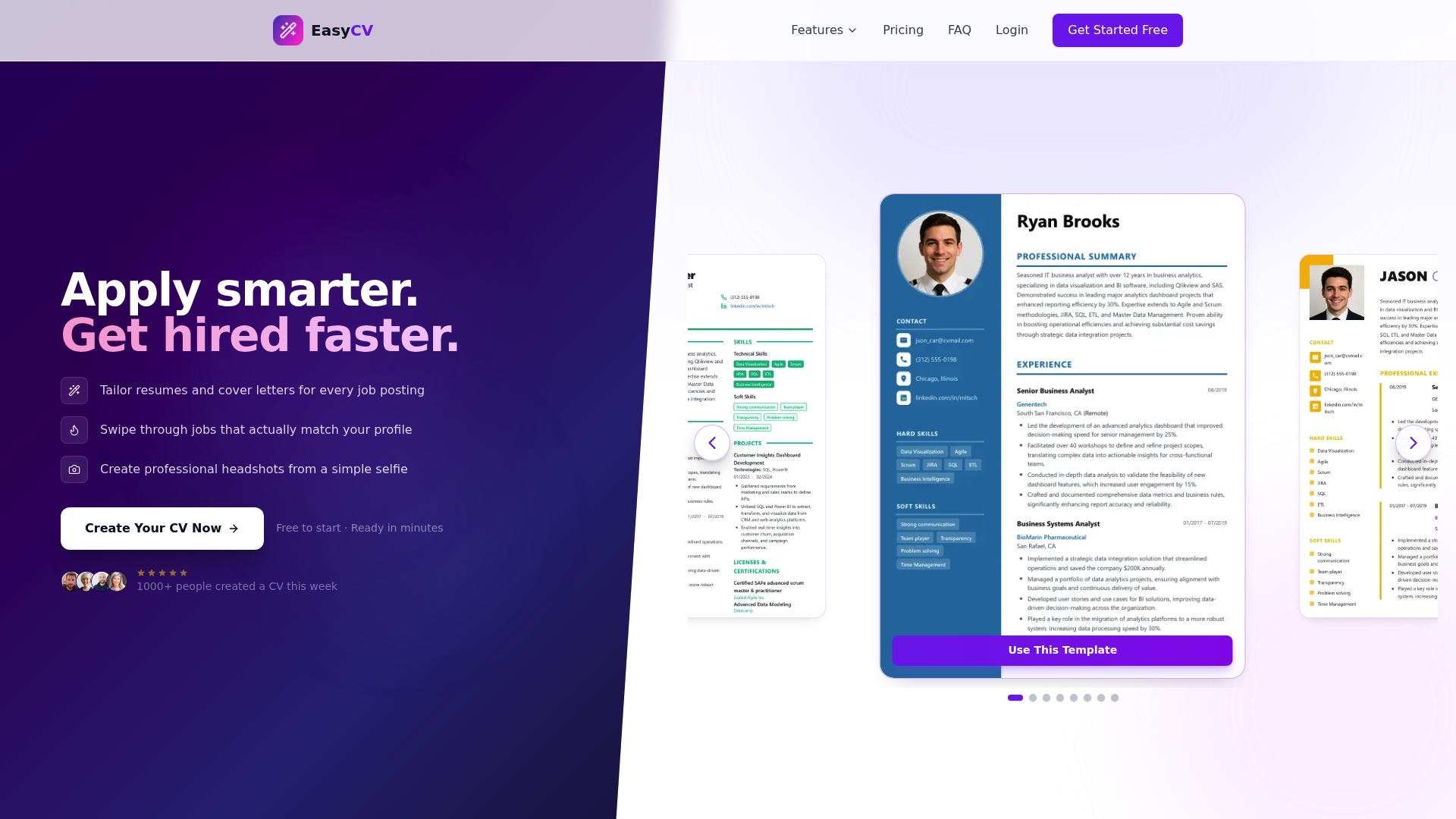
Easy-cv was built specifically for this problem. The AI-powered CV builder handles formatting, keyword optimization, and ATS-friendly layout automatically, so you spend your time on the content that actually differentiates you. You can create tailored versions of your CV for each application in minutes, not hours. The platform also generates matching cover letters, tracks your applications, and aggregates job listings from major boards so your entire search stays in one place. Whether you are building your first CV or updating after years in the field, Easy-cv gives you the tools to apply smarter. Explore the full feature set at Easy-cv features and see what a structured job search actually looks like.
FAQ
What makes a CV stand out to recruiters?
Recruiters respond to CVs that show measurable achievements, use relevant keywords from the job posting, and are easy to scan. Bullet points that follow the action verb plus quantified result structure consistently outperform duty-based lists.
How long should a standout CV be?
For most job seekers, one to two pages is the right length. One page suits candidates with under ten years of experience, while two pages are appropriate when the additional content is directly relevant to the role.
How do I make my CV pass ATS screening?
Use a single-column layout, standard section headings, and a clean sans-serif font. Avoid images, tables, and multi-column designs, which cause parsing errors. Mirror the exact keywords from the job description in your summary and bullet points.
Should I use the same CV for every job application?
No. A generic CV performs significantly worse than a tailored one. Use a master CV as your source document and adjust your summary and three to five bullets per role to match each specific job posting.
How do AI tools fit into CV writing?
AI tools can draft and refine CV content quickly, but they require your review and personalization to be accurate and effective. Use them to accelerate the process, not to replace your judgment about what experience actually matters for each role.