What is a modern CV? Essentials for today's job seekers

Submitting the wrong document, or a poorly formatted one, could end your application before a single recruiter ever sees your name. Many job seekers assume their CV is fine because it looks polished on screen, but “looking good” and “working correctly” are two very different things in 2026. Algorithms scan documents before humans do, and one wrong formatting choice can bury your profile in a digital pile that nobody revisits. This guide walks you through exactly what a modern CV is, how it differs from a resume, what sections it needs, and how to make it perform for both software and people.
Table of Contents
- Understanding the modern CV: Definition and essentials
- The anatomy of a modern CV: Key sections and structure
- Modern CVs vs resumes: What really sets them apart?
- Design and technology: Building CVs for humans and machines
- Real-world tips: How to craft a modern CV that stands out
- Why most candidates still get CV basics wrong (and how to avoid it)
- Take your modern CV further with Easy CV tools
- Frequently asked questions
Key Takeaways
| Point | Details |
|---|---|
| Modern CVs emphasize clarity | Well-structured CVs help both humans and screening software understand your qualifications quickly. |
| Format for technology | Simple, clean CV designs are more likely to pass ATS filtering than flashy, graphic-heavy ones. |
| Tailor each CV | Customizing your CV for each job improves your odds of landing an interview. |
| Highlight recent achievements | Focus on your most relevant, up-to-date experiences and skills for the target role. |
| Avoid common pitfalls | Steer clear of embedded images and overly complex layouts that block your CV from being read. |
Understanding the modern CV: Definition and essentials
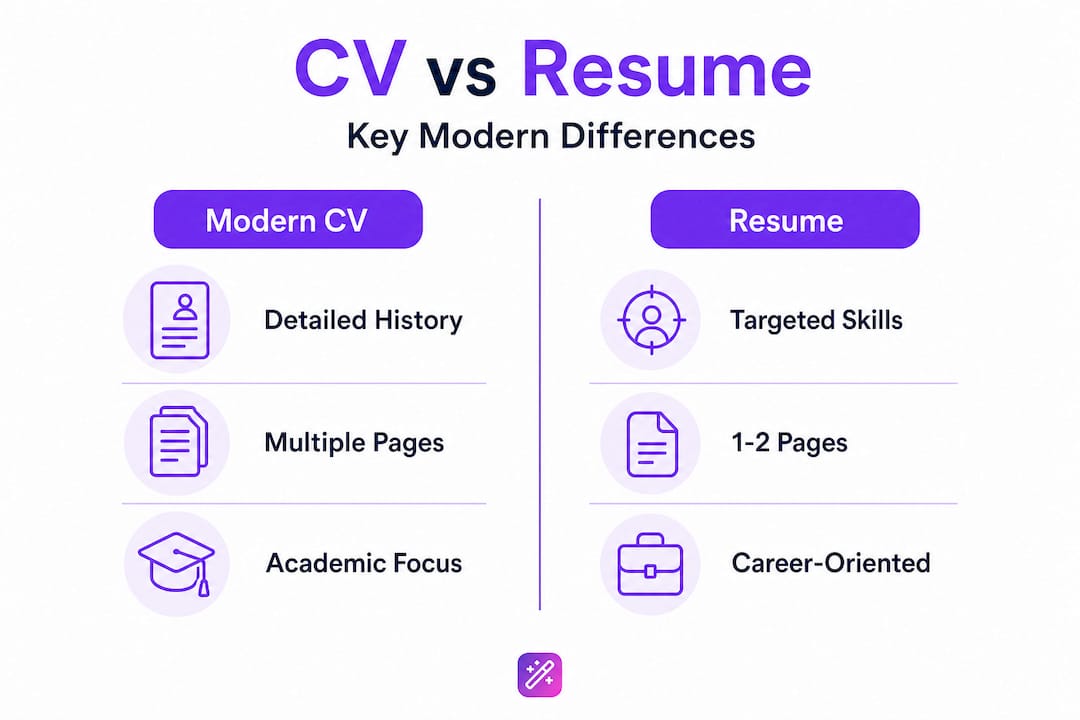
“CV” stands for curriculum vitae, a Latin phrase meaning “course of life.” Unlike a resume, which is a short, targeted snapshot of your experience, a CV is a detailed document commonly used in academic, scientific, medical, and research fields. It covers your full professional and academic history, including publications, presentations, grants, research projects, certifications, and affiliations. Length is not a concern the way it is with a resume. A strong CV can span three, five, or even ten pages depending on how much relevant history you have accumulated.
In the United States, CVs are primarily associated with academia and research. But globally, especially in Europe, Asia, and Australia, the word “CV” is used the way Americans use “resume.” This regional difference causes real confusion for job seekers applying internationally or working in fields that sit at the crossroads of industry and academia.
Here is a quick comparison to anchor your understanding:
| Feature | Modern CV | Traditional Resume |
|---|---|---|
| Length | Multiple pages | 1 to 2 pages |
| Detail level | Exhaustive | Selective |
| Primary use | Academic, research, medical | Business, industry, trade |
| Update frequency | Ongoing, additive | Tailored per application |
| Tone | Formal and comprehensive | Concise and targeted |
Understanding the resume vs CV differences before you apply is not just a technicality. Submitting a CV when a company expects a resume, or vice versa, sends the wrong signal about your awareness of the professional norms in that field.
“A CV tells the full story of your academic and professional life. A resume is the highlight reel selected for a specific audience.”
The modern CV has evolved from a purely static document into something that must also function within digital hiring ecosystems. That is a critical point we will return to throughout this guide.

The anatomy of a modern CV: Key sections and structure
With a clear understanding of the modern CV’s purpose, let’s dig into its essential structure and which sections matter most.
A well-built modern CV is organized so that the most important information appears early and flows logically. Recruiters and hiring committees scan before they read, so structure is not cosmetic. It is functional. Here are the core sections every modern CV should include:
- Contact information: Full name, professional email, phone number, LinkedIn profile or personal website, and location (city and country are usually enough).
- Professional summary or personal statement: A 3 to 5 sentence paragraph that summarizes your experience, specialization, and what you bring to the role or institution.
- Education: Listed in reverse chronological order, including degree names, institutions, graduation dates, and relevant honors or thesis titles.
- Work experience or research experience: Again, reverse chronological, with detailed bullet points describing responsibilities, methods, and measurable outcomes.
- Skills: Both technical and transferable skills, listed clearly without excessive jargon.
- Publications and presentations: For academic CVs, this section is often the longest and most scrutinized.
- Certifications and professional development: Any relevant licenses, training programs, or continuing education.
- Awards and achievements: Scholarships, fellowships, grants, honors, or industry recognitions.
- Affiliations and memberships: Professional organizations or academic societies you belong to.
- References: Optional in most cases. Many applicants simply write “Available upon request.”
Logical order matters because modern CVs should avoid design choices that prevent digital systems from extracting text correctly before a human ever reviews the file. When your sections are clearly labeled with standard headings, an applicant tracking system (ATS) can parse the data and populate employer databases accurately.
The best job application tips consistently point back to structure as a foundational advantage. It is also worth knowing how job boards and CV structure interact, because platforms often have their own parsing requirements that can differ slightly from one portal to another.
Pro Tip: Avoid multi-column layouts, text boxes, tables used for formatting, and headers embedded in graphics. What looks like clean design on your screen may render as scrambled characters inside an ATS database.
Modern CVs vs resumes: What really sets them apart?
Once you know what sections modern CVs share, it’s crucial to understand how they differ from the more common resume.
The comparison is not just about length. It is about purpose, audience, and expectation. CVs are appropriate for academia and scientific fields, while resumes are the standard for business, trades, and most non-academic jobs in the US. Sending the wrong document is a signal that you have not done your homework.
| Factor | CV | Resume |
|---|---|---|
| Page count | 3 or more | 1 to 2 |
| Content scope | Complete career and academic history | Relevant experience only |
| Typical reader | Academic committee, research body | Hiring manager, recruiter |
| Customization | Updated over time, additive | Rewritten per application |
| Common regions | Global, academia, medicine | US, Canada, business sector |
| Key emphasis | Publications, grants, research | Achievements, impact, skills |
So how do you choose between the two? Follow these steps:
- Read the job posting carefully. If it uses the word “CV” explicitly, submit one. If it says “resume,” use a resume. If it is ambiguous, research the organization type.
- Identify the field. Academic institutions, research labs, hospitals, and government scientific agencies almost always expect a CV.
- Check the region. Applying to a role in the UK or Europe? A CV is the norm there, even for non-academic positions.
- Match the format to the audience. If a hiring committee will review your application, they expect the full picture. If it goes to an HR screener at a tech firm, they want a concise resume.
- When in doubt, ask. Reaching out to the employer or checking types of resumes across different industries can give you a clearer sense of what to prepare.
Making the right call on this decision alone can significantly improve your chances of advancing to the next stage.
Design and technology: Building CVs for humans and machines
Now that you know which document suits your goal, let’s make sure your CV’s format actually gets read, not filtered.
The reality of modern hiring is that your CV passes through software before it reaches a person. Applicant tracking systems are used by the majority of mid-size and large employers to sort, rank, and filter applications automatically. Overly complex designs or image-based text can cause a CV to be rejected by ATS before any human reviews it. This is not a hypothetical risk. It is a daily reality for thousands of qualified candidates.
What does machine-friendly design look like in practice?
- Use standard fonts. Arial, Calibri, Times New Roman, and Georgia are safe choices. Unusual fonts may render incorrectly in different systems.
- Avoid tables for layout. Use tables for data only, not to arrange your name and contact details into a visually balanced header.
- No text in images. If your name, title, or job history is embedded in a graphic or image, ATS software reads it as a blank space.
- Keep columns to one. Multi-column CVs look sharp on paper but become a parsing nightmare in digital systems. Text from two columns often merges into one scrambled stream.
- Save in the right format. PDF is widely accepted and preserves formatting, but some ATS systems handle plain .docx files more accurately. Check each employer’s instructions.
- Use clear, standard headings. “Work experience,” “Education,” and “Skills” are understood universally. Creative headings like “My journey” or “What I know” may not be recognized.
Professional resume templates that are designed with ATS compatibility in mind give you a significant edge because they handle these technical details by default.
For those who want to go further, AI CV optimization tools can analyze your document against specific job descriptions and flag formatting or keyword issues before you submit. This is where technology becomes a genuine advantage rather than just a convenience.
Pro Tip: After building your CV, paste the plain text into a basic text editor. If it reads clearly and in logical order, your formatting is likely ATS-safe. If the text jumps around or mixes sections, your layout needs adjustment.
Real-world tips: How to craft a modern CV that stands out
Finally, applying all these best practices is what gives your modern CV the edge over outdated documents.
CVs should be detailed and accurate, especially in academic and scientific careers where reviewers are subject matter experts who will notice vague or inflated claims immediately. But “detailed” does not mean unfocused. Every entry should serve a purpose.
Here are actionable tips to make your modern CV work harder for you:
- Tailor for each application. Even though a CV is comprehensive, you can reorder sections, adjust your summary, and emphasize different achievements based on the specific role or institution.
- Lead with impact. Instead of “Responsible for data analysis,” write “Analyzed clinical trial data for three Phase II studies, improving reporting efficiency by 40%.” Numbers and outcomes communicate value far better than job duties.
- Be consistent with formatting. If you bold your job titles, bold all of them. If you use periods at the end of bullet points, use them everywhere. Inconsistency looks careless and undermines credibility.
- Keep language clear and direct. Avoid jargon that only insiders understand unless you are certain your audience shares the same vocabulary. When in doubt, use plain language.
- Update continuously. A modern CV is a living document. Add publications, presentations, awards, or new roles as they happen, not in a frantic pre-application scramble.
- Avoid keyword stuffing. Packing your CV with search terms to trick ATS actually backfires. Systems are now sophisticated enough to detect manipulation, and human reviewers find it unreadable.
- Do not include irrelevant personal information. Age, marital status, nationality, and photos are not appropriate in most American job applications and can inadvertently introduce bias into the screening process.
Use the resume checklist approach as a final quality pass before submitting. Cross-referencing against competitive edge templates can also reveal gaps or structural improvements you might have missed.
Why most candidates still get CV basics wrong (and how to avoid it)
Here is the uncomfortable truth: most applicants do not fail because of weak qualifications. They fail because their CV does not communicate those qualifications clearly, quickly, or accurately to the systems and people reviewing it.
The biggest trap is template dependency without critical thinking. Downloading a visually impressive template and filling in your information feels productive. But if that template uses columns, text boxes, or decorative headers, you have built a beautiful document that software cannot read. Style without substance is not modern. It is just colorful noise.
There is also a misunderstanding about what “modern” actually means. Many people assume a modern CV means sleek graphics, color-coded skills bars, and icons next to contact information. Those elements are cosmetic at best and damaging at worst. True modernity in a CV is about clarity of content, relevance of information, and compatibility with the systems employers actually use.
Another overlooked issue is audience awareness. Who reads your CV first? In most large organizations, no human reads your CV first. An algorithm does. Understanding this changes how you make decisions about formatting, language, and structure. The stand-out tips that actually work focus on substance, not decoration.
Finally, think about specificity. Generic CVs that could belong to any candidate in your field rarely make it through competitive screening. The ones that advance are specific about what the person accomplished, how they did it, and what it produced. In 2026, the applicants winning competitive roles are those who have invested time in writing CVs that speak directly to the reader’s needs, not in designing CVs that look impressive at a glance.
Take your modern CV further with Easy CV tools
Ready to put these principles into action? Here’s how Easy CV can give you a competitive advantage.
Building a modern CV from scratch or updating an outdated one can feel overwhelming, especially when you are also navigating job boards, interviews, and deadlines. That is exactly the problem our AI CV builder is designed to solve. EasyCV.ai generates tailored, ATS-compatible CVs using AI, so your document is structured correctly, keyword-optimized, and formatted to pass both algorithmic and human review.
You can explore the full range of Easy CV features including cover letter generation, AI-powered headshots, job matching across millions of listings, resume translation, and application tracking. Whether you are applying for your first academic position or pivoting to a new industry, Easy CV gives you the tools to move faster and apply smarter without sacrificing quality.
Frequently asked questions
How long should a modern CV be?
A modern CV can be several pages and is more detailed than a resume, but every section should contain only relevant, recent accomplishments rather than padding with outdated roles.
Does a modern CV need a photo?
Most modern CVs should not include a photo, particularly in the US, where photos can introduce unconscious bias and are generally not expected by employers.
What are the biggest mistakes people make with CVs?
The most common errors are using complex layouts that confuse ATS software, adding irrelevant personal information, and submitting image-based documents that parsing systems cannot extract correctly.
Do I need multiple CVs for different job applications?
Yes, tailoring your CV for each position by highlighting the most relevant achievements and skills is far more effective than sending a one-size-fits-all document.
Should I include references on a modern CV?
References are generally optional on a modern CV since most employers will request them separately during a later stage of the hiring process.