Updating Your Resume Workflow for Faster Job Wins
Updating your resume workflow is the process of systematically refreshing and tailoring your resume to match each job description, pass ATS filters, and reach recruiters faster. A disorganized process costs you time and response rates. AI tailoring tools can improve recruiter response rates by 5–10x compared to sending a generic document. The professionals who apply first with a well-matched resume consistently outperform those who apply later with a polished but untailored one. This guide covers the exact components, tools, and techniques that make the difference.
What are the essential components of an effective resume updating workflow?
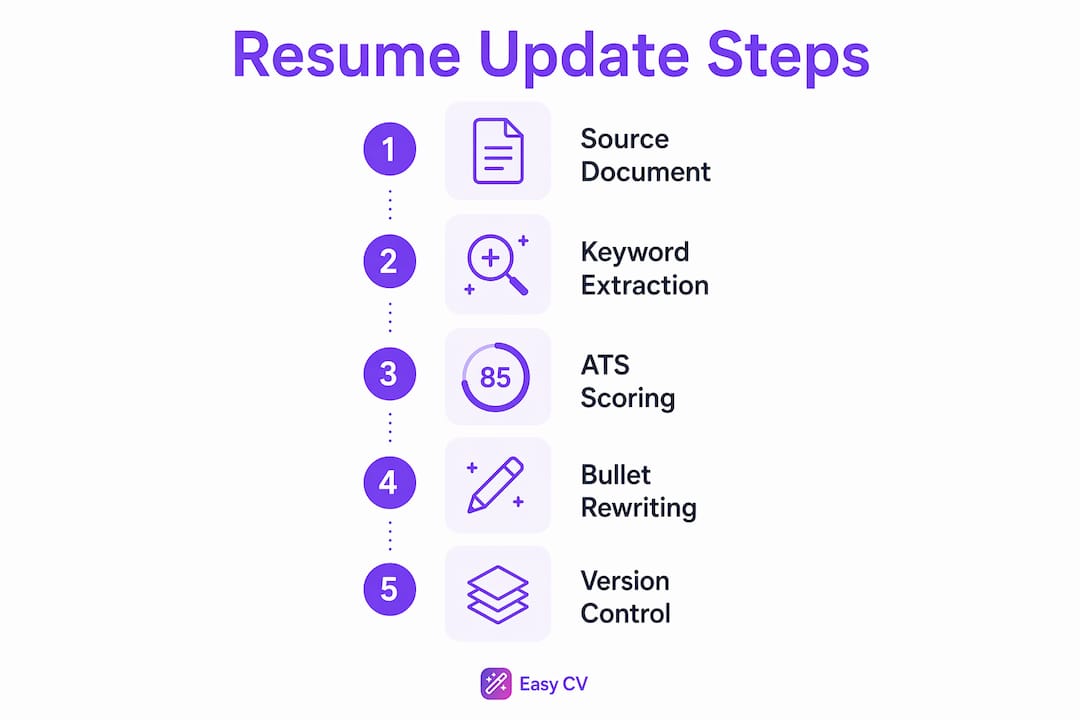
A resume updating workflow has four non-negotiable layers: a source of truth document, a keyword extraction step, an ATS scoring check, and a version log. Skip any one of these and the process breaks down. Most job seekers skip all four and wonder why their inbox stays quiet.
The source of truth document
The source of truth is a single master file that holds every role, metric, bullet point, and achievement you have ever documented. You never send this document to anyone. Its only job is to feed every tailored version you create. Maintaining this single document prevents version drift and keeps your facts consistent across dozens of applications.

Core tools for the process
Three categories of tools support a fast, repeatable resume revision process:
- AI rewriting tools: Generate and refine bullet points using keywords pulled from a job description. Easy-cv’s built-in AI writing assistant does this inside the same editor where you build your resume.
- Keyword extractors: Parse job descriptions and surface the exact terms an ATS will scan for. Tools like Jobscan or the keyword matching feature inside Easy-cv handle this step.
- ATS scoring tools: Score your resume against a job description before you submit. ATS match scores of 75% or higher significantly improve your chances of passing initial employer filters.
Pro Tip: Never rely on a single tool to cover all three categories. A keyword extractor tells you what to add. A scoring tool tells you whether you added it correctly. Both steps are required.
The most common pitfall is using an AI rewriting tool and skipping the scoring step entirely. You end up with polished prose that still misses the exact phrases an ATS is scanning for.
How to build a modular resume architecture for scalable tailoring
A modular resume treats your experience as a library of interchangeable parts rather than a fixed document. Modular bullet libraries let you swap content per industry or role without rewriting entire sections from scratch. That shift alone can cut editing time from 45 minutes down to roughly one minute per application.
The architecture works in four layers:
- Source of truth: Every bullet, metric, and role detail lives here. Update this file whenever you complete a project, earn a promotion, or hit a measurable result.
- Role baselines: Create one trimmed version per job category you target. A product manager baseline differs from a project manager baseline even if your experience overlaps. Each baseline pulls the most relevant 60–70% of your source of truth.
- Job-specific tailoring: Start from the relevant role baseline and swap in bullets that match the specific job description. This is where keyword extraction and AI rewriting do their heaviest lifting.
- Delivery versions: The final, formatted file you submit. Name it clearly (see the version tracking section below) and never edit it after submission.
Pro Tip: Tag each bullet in your source of truth with one or two category labels, such as “leadership,” “data analysis,” or “client management.” When you build a job-specific version, you can filter by tag instead of reading every bullet.
Version control matters more than most job seekers realize. Keeping a change log for each resume version tells you exactly what you changed, why you changed it, and which employer received that version. That log becomes critical when an interview question references something specific on your resume and you need to recall which version you sent.
How to tailor your resume with AI without losing accuracy
AI excels at surface rewriting and keyword insertion. It cannot verify whether your metrics are accurate or whether a claim is defensible in an interview. AI acts as a drafting partner, and human verification handles final accuracy. That division of labor is the safest and fastest approach.
Follow this sequence for each application:
- Extract keywords from the job description. Paste the full job posting into a keyword tool or AI prompt. Pull out the top 10–15 terms that appear repeatedly, especially in the requirements and responsibilities sections. Use Easy-cv’s AI resume builder to automate this step directly from the job listing.
- Rewrite your summary and top bullets. Feed your role baseline and the extracted keywords into an AI writing tool. Ask it to rewrite your professional summary and your three most relevant bullet points using those terms naturally.
- Score the result. Run the rewritten resume through an ATS scoring tool. Target a score above 75%. If you score below that threshold, identify which keywords are missing and add them manually or prompt the AI again with more specific instructions.
- Verify every metric and claim. Read the AI output line by line. Confirm that every number, percentage, and achievement reflects something you can defend in an interview. AI cannot verify complex metrics or nuanced accomplishments. That step belongs to you.
- Submit within 24 hours of the posting. Applications submitted in the first 24 hours with tailored resumes receive significantly more recruiter attention. Speed matters as much as quality.
A sequential AI pipeline that combines gap analysis, bullet rewriting, ATS scoring, and change logging produces the best results. Each step feeds the next, and no step fabricates experience because the human candidate controls the source data throughout.
Pro Tip: Keep a “metrics bank” inside your source of truth document. List every quantified result you have achieved, with the exact numbers. When AI rewrites a bullet, pull the verified metric from this bank and insert it manually. This prevents AI from inventing plausible-sounding but false numbers.
How to manage multiple resume versions without losing control
Version drift is the silent killer of a well-built resume process. It happens when you edit a delivery version instead of the role baseline, creating a fork that slowly diverges from your source of truth. Standalone tools that leave manual steps between editing and submission make this problem worse.
Use a consistent naming convention for every file you create. A reliable format is: Role_Company_Date, for example, “ProductManager_Acme_2026-03.” That name tells you the target role, the employer, and when you created it. You can retrieve the right version in seconds during a follow-up call.
Track your applications in a log or dashboard with these fields:
- Job title and company name
- Date applied
- Resume version file name
- Cover letter version file name
- Application status (applied, phone screen, interview, offer, rejected)
- Notes on any customizations you made
This log serves two purposes. First, it keeps your process organized when you are running 20 or 30 applications at once. Second, it prepares you for interviews. When a recruiter calls, you can pull up exactly what you sent them before the conversation starts.
Pro Tip: Review your source of truth document once a month. Add any new achievements, updated metrics, or completed projects. A monthly update takes 10 minutes and prevents a frantic scramble when a great opportunity appears.
Maintaining accurate records of your professional achievements also matters beyond the job search. Sound recordkeeping practices protect the integrity of complex metrics and ensure you can substantiate every claim on your resume.
Key Takeaways
An efficient resume updating process built on modular architecture, AI-assisted tailoring, and disciplined version control produces faster applications and higher recruiter response rates.
| Point | Details |
|---|---|
| Build a source of truth | Keep one master document with every role, metric, and bullet point to prevent version drift. |
| Use modular architecture | Organize resumes in four layers: source of truth, role baselines, job-specific versions, and delivery files. |
| Score before you submit | Target an ATS match score above 75% to pass initial employer filters consistently. |
| Verify all AI output | AI handles keyword extraction and rewriting; you confirm every metric and claim is accurate. |
| Track every version | Log the file name, date, and application status for each submission to stay organized and interview-ready. |
What I’ve learned from building resume workflows that actually work
The biggest mistake I see job seekers make is treating AI as a replacement for thinking rather than a tool for speed. I have watched people submit AI-generated resumes that listed metrics they could not explain in an interview. That is not a workflow problem. That is a trust problem, and it costs offers.
The modular approach changed how I think about the whole process. Once you separate your facts from your framing, updating a resume stops feeling like rewriting and starts feeling like assembly. You pull the right parts, fit them to the job, score the result, and submit. The AI resume writing workflow handles the tedious parts. Your judgment handles the parts that matter.
Speed is real. Getting a tailored application in front of a recruiter within 24 hours of a posting going live is a genuine competitive advantage. But speed without accuracy is worse than being slow. The professionals who win are the ones who built their source of truth carefully, tagged their bullets thoroughly, and then let the AI do the fast work.
My honest recommendation: spend one afternoon building your source of truth document properly. Tag every bullet. Build your role baselines. Set up a simple tracking log. That one afternoon will save you hours on every application you send for the next year.
— Andras
How Easy-cv makes your resume updating process faster
Easy-cv brings every part of the resume updating process into one place. You do not need a separate keyword tool, a separate ATS scorer, and a separate tracker running in different tabs.
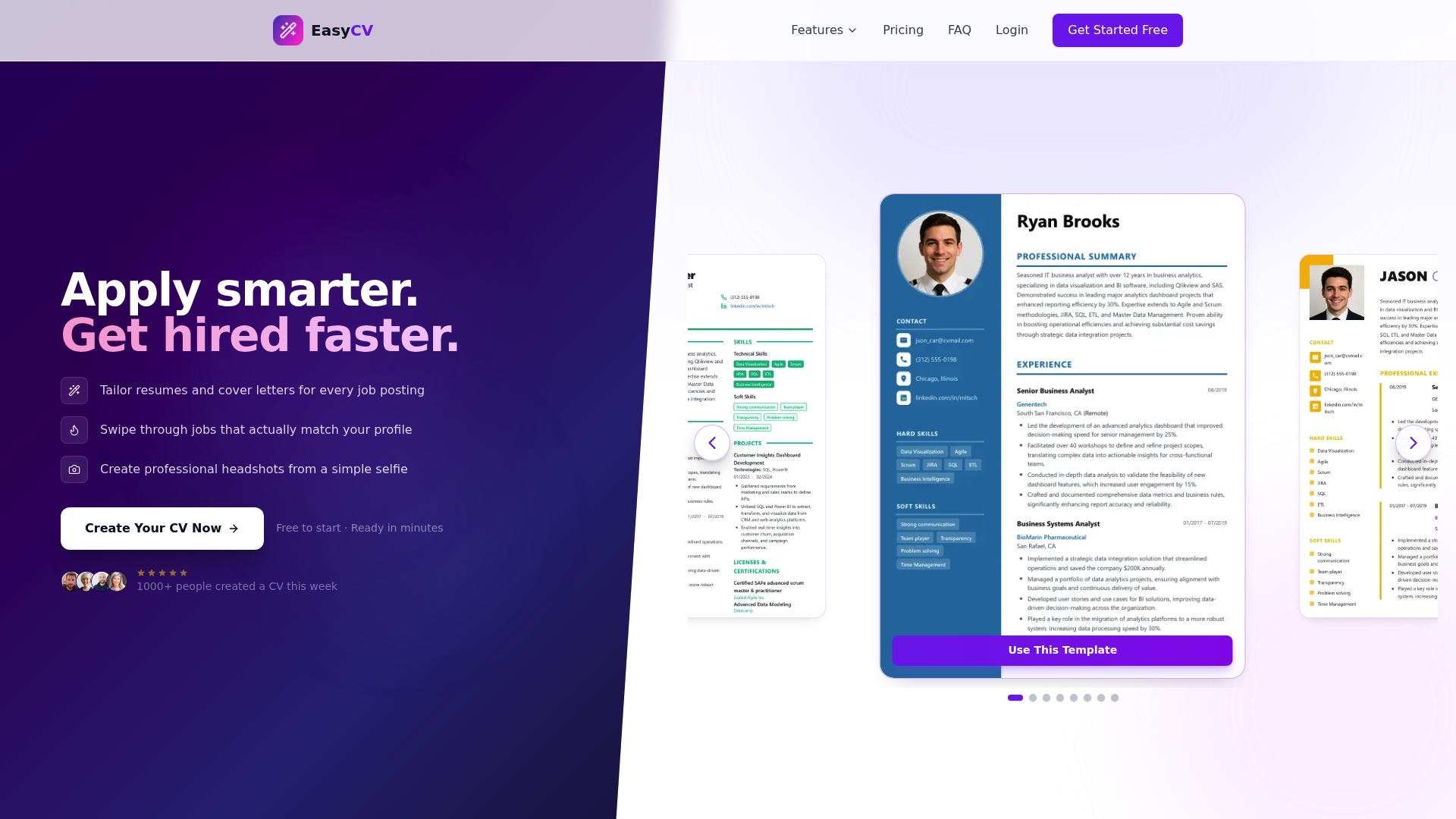
Easy-cv’s AI writing assistant tailors your resume and cover letter to each job description automatically. Its built-in job tracker keeps your application history organized without a separate spreadsheet. The platform aggregates over 10 million job opportunities per month from major job boards, so you can find a role, tailor your resume to it, and submit, all inside the same platform. For job seekers who want to apply faster without sacrificing quality, Easy-cv’s AI CV builder handles the heavy lifting from keyword matching to ATS-ready formatting.
FAQ
What is a resume updating workflow?
A resume updating workflow is a repeatable process for refreshing and tailoring your resume for each job application. It typically includes keyword extraction, AI-assisted rewriting, ATS scoring, and version tracking.
How often should I update my resume?
Update your source of truth document monthly to capture new achievements and metrics. Tailor a job-specific version for every individual application you submit.
What ATS score should I target before submitting?
Target an ATS match score of 75% or higher. Scores at that level significantly improve your chances of passing initial employer filtering systems.
How do I avoid version drift across multiple resume files?
Never edit a delivery version after submission. Make all changes to your role baseline or source of truth first, then create a new delivery version from that updated baseline.
Can AI write my entire resume accurately?
AI handles keyword extraction and bullet rewriting well, but it cannot verify your metrics or achievements. Always review AI output line by line and confirm every claim before submitting.