The Role of Data in Job Searching: 2026 Guide
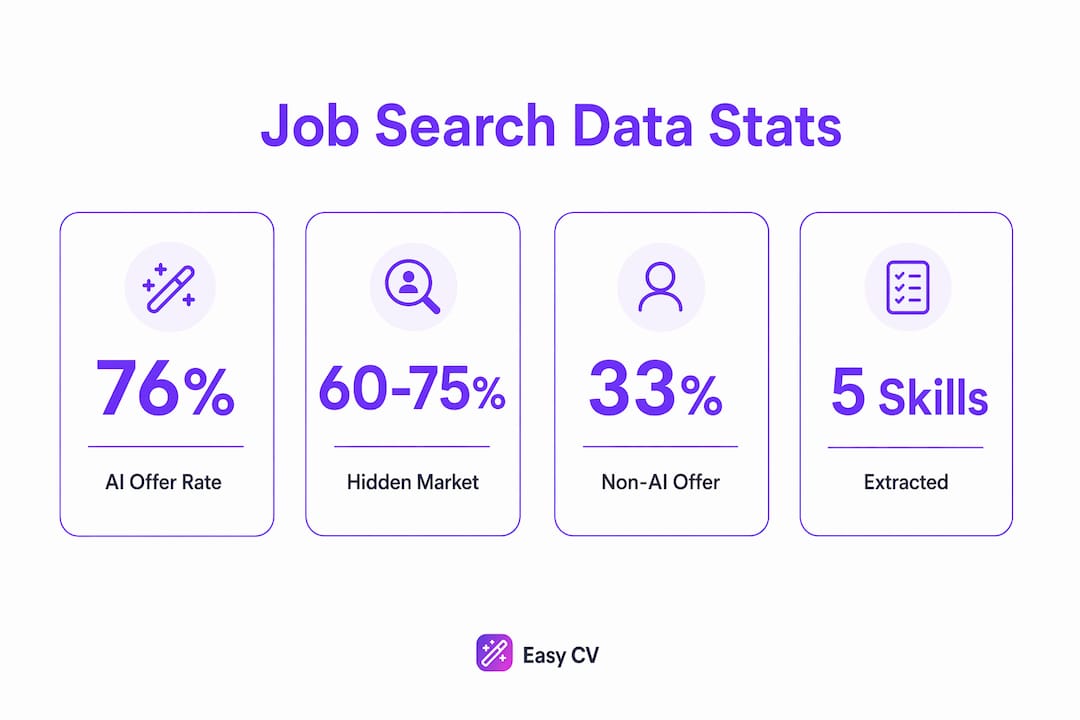
A data-driven job search is defined as using labor market analytics, AI tools, and structured tracking to make evidence-based decisions at every stage of the hiring process. The role of data in job searching has never been more decisive: job seekers who use AI frequently are more than twice as likely to secure offers, with 76% landing jobs compared to 33% of non-users. That gap is not a coincidence. It reflects a fundamental shift in how competitive job markets reward preparation, targeting, and measurable proof over volume and hope.
How does data-driven job searching improve targeting and decisions?
Data analytics in hiring gives job seekers a map where most people are navigating blind. The average job seeker applies broadly and waits. A data-driven job seeker filters first, applies second, and tracks everything.
The most important insight most job seekers miss: 60%–75% of hires above $80K happen through the hidden job market, meaning referrals, recruiter outreach, and internal mobility rather than public postings. Chasing job boards alone puts you in competition for a fraction of available roles. Data helps you identify where the real opportunities are and how to reach them.

Practical filtering is the first discipline to build. Multi-pass scoring filters help job seekers avoid ghost postings and low-probability roles, focusing effort on positions with genuine hiring intent. A ghost posting wastes your time and distorts your sense of the market.
Here is how to apply data thinking to your targeting:
- Map salary and role data by industry and geography using public labor market reports before you apply anywhere.
- Score each job listing on factors like posting date, specificity of requirements, and whether the company has recent hiring activity.
- Prioritize referral pathways by identifying second-degree connections at target companies through LinkedIn before cold-applying.
- Track your application pipeline in a spreadsheet or job tracker from day one, recording source, date, response time, and outcome.
Pro Tip: Use AI to analyze a job description and extract the top five required skills before writing a single word of your application. That analysis shapes everything that follows.
What role does data play in optimizing resumes and cover letters?
The most effective resume is not a narrative. It is a queryable data structure. Treating job documents as searchable data systems dramatically improves discoverability in applicant tracking systems and recruiter search tools. That means organizing your resume around skill-tool pairings, job titles, and measurable outcomes rather than freeform descriptions.
Skill-based hiring now covers 70% of employers for entry-level roles, according to National Association of Colleges and Employers data. That number signals a clear shift: proof beats claims. “Strong communicator” is a claim. “Reduced client onboarding time by three weeks by redesigning the intake process” is proof.
Here is a structured approach to data-driven resume writing:
- Extract keywords from the job description. List every required skill, tool, and qualification. Match each one explicitly in your resume where you have genuine experience.
- Pair skills with tools. Write “Python for data cleaning” not just “Python.” Specificity improves ATS ranking and recruiter confidence.
- Quantify every achievement you can. Use numbers, percentages, timeframes, and dollar amounts. If you cannot quantify it, describe the scope and impact.
- Remove generic claims. Phrases like “results-oriented professional” add no signal. Replace them with a specific accomplishment.
- Mirror the job title. If the posting says “Senior Product Manager,” use that exact phrase in your resume headline where accurate.
Recruiters increasingly discount resumes that read as generic AI outputs. Specificity and verifiable evidence are what separate callbacks from rejections. AI is best used to tighten language and surface stronger phrasing, not to generate your entire application from scratch.
Pro Tip: Run your resume through an ATS simulation tool before submitting. Many free options exist online. If your score is below 70%, revisit your keyword matching before applying.
For a deeper look at structuring your resume with verifiable evidence, the CV optimization guide at Easy-cv covers the specific formatting and content signals that improve recruiter attraction in 2026.
How can data analytics sharpen interview preparation?
Interview preparation becomes measurably better when you treat it as a data problem. The job description is your primary dataset. Every required skill, listed responsibility, and stated value signals the questions you will likely face.
Data-driven job search programs yield 2.67 times better odds of employment, with 30% more job offers compared to unstructured approaches. That improvement does not come from applying more. It comes from preparing more precisely and tracking what works.
Here is how to use data at the interview stage:
- Generate likely questions from the job description. Feed the full posting into an AI assistant and ask it to predict behavioral and technical questions based on the listed requirements.
- Track every interview. Record the questions asked, your answers, and the outcome. Patterns emerge quickly across three to five interviews.
- Identify sticking points. If you consistently fail to advance after first-round interviews, the problem is likely in your answers to a specific question type, not your qualifications.
- Prepare structured follow-ups. Send a follow-up email within 24 hours that references a specific point from the conversation. This signals attention to detail and genuine interest.
- Review offer and rejection data. When you receive feedback, treat it as a data point. When you do not receive feedback, note the role type and company size to identify patterns.
Tracking application data and learning from outcomes sustains motivation and improves search quality over time. Longitudinal research on job search persistence confirms that structured feedback loops outperform intuition-based adjustments.
What challenges come with using data in your job search?
Data use in job searching carries real risks that most guides skip. The biggest is over-reliance on AI-generated content. Hiring is a matching problem under uncertainty, and recruiters reduce that uncertainty by looking for specific, verifiable proof. A resume full of polished but generic AI language provides no proof. It raises suspicion instead.
Access to data tools is not equal. Job seekers with higher education levels and stronger digital literacy adopt AI tools at higher rates, which compounds existing advantages. If you are newer to these tools, free resources like LinkedIn Talent Insights, the Bureau of Labor Statistics Occupational Outlook Handbook, and public salary databases give you a strong foundation without any cost.
Trust is the second major challenge. 83% of candidates report encountering vague job descriptions, according to a Resume Genius and SHRM study. That vagueness makes it hard to know whether a role is real, whether the salary is competitive, or whether the company is worth your time. Data helps here too. Research the company’s hiring history, employee tenure on LinkedIn, and Glassdoor reviews before investing hours in an application.
“Job search success depends more on quality and self-regulation than volume. Structured execution systems outperform unplanned efforts every time. The job seeker who applies to 20 well-researched roles will consistently outperform the one who blasts out 200 generic applications.”
The solution is not to avoid data tools. It is to use them as an assistant, not a replacement for judgment. AI can surface insights and tighten language. You supply the authentic evidence, the real accomplishments, and the human judgment about fit. For practical guidance on applying AI responsibly to your resume, Easy-cv’s guide covers the specific pitfalls to avoid.
Key Takeaways
A data-driven job search consistently outperforms unstructured approaches because it replaces guesswork with evidence, filters out low-probability roles, and gives recruiters the specific proof they need to move you forward.
| Point | Details |
|---|---|
| AI doubles offer rates | Job seekers who use AI frequently land offers at 76% vs. 33% for non-users, per ZipRecruiter 2026. |
| Hidden market is the real market | 60%–75% of roles above $80K are filled through referrals and recruiter outreach, not public postings. |
| Resumes are data structures | Organizing your resume around skill-tool pairings and quantified outcomes improves ATS ranking and recruiter response. |
| Track everything | Recording application sources, response times, and interview outcomes reveals patterns that improve your next round. |
| Quality beats volume | Structured, data-backed approaches yield 2.67 times better employment odds than unplanned high-volume efforts. |
Why I think most job seekers are using data wrong
Most articles on the data-driven job search focus on tools. Download this app, use that AI, run your resume through this checker. That framing misses the point entirely.
Data is only useful if you have a system to act on it. I have seen job seekers with access to every premium tool still struggle because they were tracking the wrong things. They counted applications sent. They should have been tracking response rates by role type, application source, and resume version.
The job seekers who get results treat their search like a product manager runs a sprint. They set a weekly target, review what worked, cut what did not, and adjust. They use job search strategies grounded in market data, not gut feeling. They also know when to stop optimizing and start networking, because no amount of data replaces a warm introduction.
My honest recommendation: spend the first week of your search building your tracking system and your target company list before you write a single application. That week of preparation will save you six weeks of wasted effort. The data you collect in week one becomes your competitive advantage by week four.
— Andras
How Easy-cv puts data to work for your applications
Easy-cv brings the data-driven principles in this article into a single platform built for job seekers who want results, not busywork.
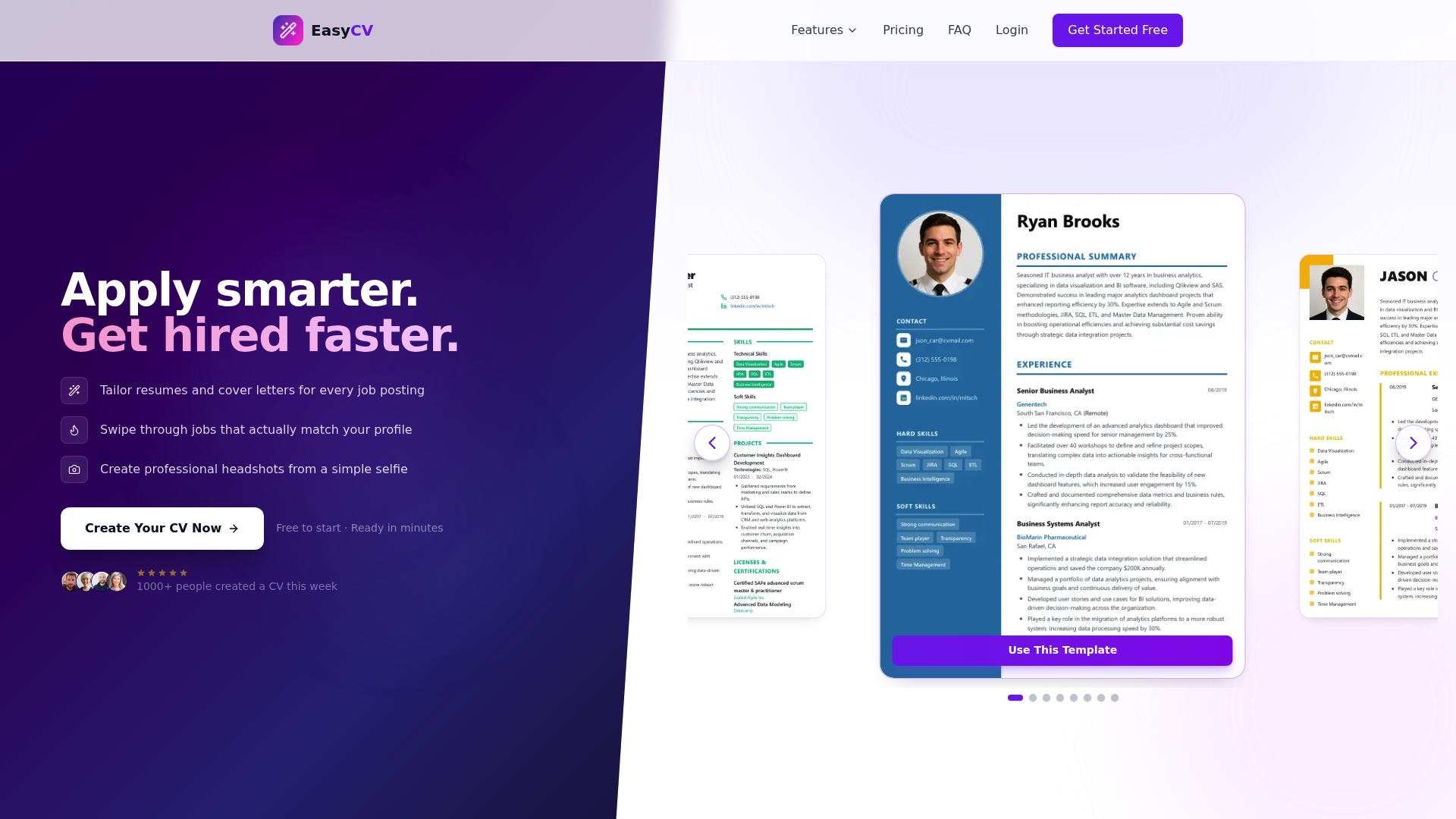
The AI-powered CV builder analyzes job descriptions and tailors your resume and cover letter to each role, matching keywords and surfacing your strongest evidence automatically. Easy-cv aggregates over 10 million job opportunities per month from major job boards, with new listings available within minutes. The built-in job tracker keeps your pipeline organized so your application data is always visible and useful. ATS-friendly templates, an AI writing assistant, and a swipe-based job matcher mean you spend less time on manual work and more time on the applications that actually fit. Explore the full feature set to see how each tool maps to the data-driven approach covered here.
FAQ
What is a data-driven job search?
A data-driven job search uses labor market analytics, AI tools, and structured tracking to make evidence-based decisions at every stage, from targeting roles to preparing for interviews. The goal is to replace guesswork with measurable inputs that improve offer rates.
How does data improve resume performance?
Treating your resume as a queryable data structure, with skill-tool pairings and quantified achievements, improves ATS ranking and recruiter response. Skill-based hiring now applies to 70% of employers for entry-level roles, making verifiable proof more important than general claims.
What is the hidden job market and how does data help access it?
The hidden job market refers to roles filled through referrals, recruiter outreach, and internal mobility rather than public postings. Data on your network connections and company hiring patterns helps you identify and pursue these opportunities before they are ever advertised.
Can AI hurt my job search if I use it too much?
Yes. Recruiters increasingly reject resumes that read as generic AI outputs because they lack specific, verifiable evidence. AI works best as a language and analysis assistant, not as a full replacement for your own authentic accomplishments and judgment.
How many applications should I send per week?
Research shows that quality and self-regulation matter more than volume. A structured approach targeting 10–15 well-researched roles per week consistently outperforms sending 50 or more generic applications.