Types of Job Search Platforms: Your 2026 Strategy Guide
Types of job search platforms fall into five distinct categories: broad aggregators, niche job boards, social networking platforms, public career centers, and curated listing sites. Each category serves a different purpose, and knowing which one fits your situation is the difference between a focused search and months of wasted applications. 68.6% of employers conduct nearly all recruiting through online job boards as of 2025. That number means your platform choices directly determine who sees your application.
1. What are the types of job search platforms?
Job search platforms are digital tools that connect job seekers with employers, but they differ sharply in scope, quality, and audience. The five main categories are broad aggregators, niche boards, professional networking sites, public career centers, and curated platforms. Each has a distinct role in a well-built search strategy. Understanding how job boards shape outcomes helps you stop treating every platform the same way.
Broad aggregators pull listings from hundreds of sources into one place. Niche boards focus on a single industry, work style, or region. Networking platforms let you connect directly with recruiters and hiring managers. Public career centers offer free, in-person support. Curated platforms screen listings before publishing them. Each type has a specific job in your search.

2. Broad job search aggregators: scale and speed
Broad aggregators are platforms that compile job listings from company websites, staffing agencies, and other boards into a single searchable database. The scale is their main advantage. You can filter by location, title, salary range, and date posted without visiting dozens of separate sites. For job seekers who are early in their search or open to multiple industries, this breadth is genuinely useful.
The drawbacks are real, though. Broad aggregators include ghost jobs, which are listings that are outdated or for roles that were never truly open. That means you can spend hours applying to positions that will never respond. The volume of listings also creates noise. A search for “marketing manager” on a major aggregator can return thousands of results with wildly different requirements, salary ranges, and legitimacy.
Key features to use on broad aggregators:
- Date filters: Sort by “posted in the last 7 days” to avoid stale listings.
- Salary filters: Eliminate roles that do not meet your minimum before reading descriptions.
- Company name search: Apply directly on the employer’s website when possible to bypass aggregator delays.
- Email alerts: Set up daily digests for your top search terms so you catch new listings fast.
Pro Tip: When you find a role on a broad aggregator, search the company name directly and apply on their careers page. Direct applications often reach hiring managers faster than aggregator submissions.
3. How niche job boards reduce noise and improve relevance
Niche job boards are specialized platforms that focus on a single industry, role type, or work arrangement. Niche boards reduce competition and listing noise compared to broad aggregators, which makes them especially strong for remote work, freelance, tech, and startup roles. The employers posting on niche boards are specifically looking for candidates with that focus, so the fit between listing and applicant is tighter from the start.
Common niche focus areas include:
- Remote and flexible work: Platforms dedicated to fully remote or hybrid roles attract employers who have already committed to distributed teams.
- Tech and engineering: Boards focused on software development, data science, and product roles attract employers who understand technical hiring.
- Startups and early-stage companies: Platforms serving the startup ecosystem list equity-based roles and fast-moving opportunities rarely found on general boards.
- Freelance and contract work: Boards built for independent professionals list project-based work with clear scope and pay structures.
- Creative industries: Design, writing, and media-focused boards attract employers who want to see portfolios alongside applications.
The limitation of niche boards is volume. A specialized board may list only a few dozen new roles per week in your field. That is why niche boards work best as a complement to broader platforms, not a replacement. Check them two or three times per week and set up alerts for new postings.
4. Social networking platforms and community groups
Professional networking platforms combine job listings with direct recruiter access and profile visibility. LinkedIn supports direct recruiter connections, portfolio building, and profile-based discovery, which makes it the dominant networking platform for senior and technical roles. The key difference from a job board is that recruiters can find you without you applying. A well-built profile generates inbound interest that no application form can replicate.
Response rates on networking platforms vary widely based on how actively you engage. Passive profiles with no recent activity get far less recruiter attention than profiles with regular posts, recommendations, and updated experience sections. LinkedIn response rates range from 3% to 13% depending on engagement level. That gap is large enough to treat profile activity as part of your job search, not a side task.
Beyond formal networking platforms, community groups on Discord and Slack have become serious job search venues, particularly in tech, design, and media. These groups share unlisted roles, give referrals, and connect members directly with hiring managers. They require more effort to find and join, but the quality of leads is often higher than anything on a public board.
- Optimize your headline: Use your target job title and two or three key skills, not your current title.
- Request recommendations: Three or more recommendations from former managers or colleagues significantly increase profile credibility.
- Engage with industry content: Commenting on posts in your field increases your visibility to recruiters who follow those conversations.
- Join relevant groups: Industry-specific groups on networking platforms surface job posts that never reach general boards.
Pro Tip: Message the hiring manager or a team member directly after applying through a networking platform. A brief, specific note about why you want the role increases your response rate more than any resume tweak.
5. Public career centers and curated platforms
Public career centers are government-funded resources that provide free job search support, including one-on-one counseling, resume workshops, and access to training programs. Nearly 2,300 American Job Centers operate across the United States, offering services that no automated platform can replicate. For career changers, workers without advanced degrees, or anyone re-entering the workforce, these centers provide structured support that online boards simply do not offer.
Curated platforms take a different approach. Instead of aggregating every available listing, they screen postings before publishing them. That screening removes scam listings, vague descriptions, and roles with misleading pay ranges.
Curated platforms offer vetted, high-quality listings that protect job seekers from wasting time on fraudulent or low-quality postings.
When to use public career centers and curated platforms:
- Career pivots: A counselor at an American Job Center can map your transferable skills to new industries and connect you with retraining programs.
- Credential gaps: Centers often partner with community colleges and certification programs to help job seekers qualify for higher-paying roles.
- Scam avoidance: Platforms requiring payment to apply are almost always scams. Curated platforms eliminate these before you ever see them.
- Local market knowledge: Career center counselors know the local hiring market in ways that national platforms cannot capture.
6. How to build a multi-platform job search strategy in 2026
A single platform is never enough. Job seekers using 3–5 platforms consistently achieve better results than those relying on one source. The logic is straightforward: different employers post on different platforms, and your visibility multiplies with each additional channel you activate.
The mistake most job seekers make is treating every platform identically. Tailored applications outperform mass applying across every platform type. A resume submitted to a niche tech board needs different emphasis than one sent through a broad aggregator. Customizing your materials for each platform’s audience and employer expectations is the single highest-return activity in a job search.
Managing applications across multiple platforms requires a tracking system. Without one, you will lose track of deadlines, follow-up dates, and which version of your resume you submitted where. A spreadsheet works, but purpose-built job trackers reduce the cognitive load significantly. You can also track multiple job openings with dedicated tools that centralize status, notes, and next steps.
Pro Tip: Audit your platform portfolio every two weeks. If a platform has produced zero responses in 14 days, replace it with a different category rather than doubling your effort on the same channel.
| Platform type | Best for | Key limitation |
|---|---|---|
| Broad aggregators | Volume, early-stage search | Ghost jobs, listing noise |
| Niche job boards | Specialized roles, remote work | Lower listing volume |
| Networking platforms | Senior roles, recruiter access | Requires active engagement |
| Public career centers | Career pivots, credential gaps | Limited to local availability |
| Curated platforms | Scam-free, quality listings | Smaller total listing count |
Key takeaways
A balanced portfolio of 3–5 platform types, with tailored applications for each, produces the highest response rates and the most efficient job search in 2026.
| Point | Details |
|---|---|
| Use multiple platform types | Combining 3–5 platform categories maximizes employer reach and application conversion. |
| Tailor every application | Customizing your CV and cover letter for each platform’s audience beats mass applying every time. |
| Avoid ghost jobs and scams | Filter by recent post dates on aggregators and avoid any platform that charges to apply. |
| Activate networking platforms | A complete, active profile on professional networking sites generates inbound recruiter interest. |
| Add human support | Public career centers provide counseling and training that no automated platform can replace. |
What I’ve learned from watching job seekers use the wrong platforms
Most job seekers I’ve observed spend 80% of their time on broad aggregators and wonder why their response rate is low. The aggregator is not the problem. The problem is using one tool for every situation. A senior engineer applying through the same general board as an entry-level candidate is competing in the wrong arena.
The job seekers who move fastest are the ones who treat their platform mix like a portfolio. They use a broad aggregator for volume and speed, a niche board for quality and fit, and a networking platform for direct recruiter relationships. They check each one with a different mindset and a different version of their materials. That discipline is rare, and it shows in their results.
The other pattern I’ve noticed is that people abandon platforms too quickly after one bad week. Platform effectiveness is partly cyclical. Hiring slows in late december and picks up sharply in january and september. A platform that feels dead in july may be your best source in september. Audit your mix regularly, but give each channel at least three to four weeks before drawing conclusions.
— Andras
Easy-cv brings your multi-platform search into one place
Running a search across five platform types means five different sets of listings, five different application formats, and five different versions of your materials. Easy-cv aggregates over 10 million job opportunities per month from all major boards, so you see new listings within minutes without switching tabs.
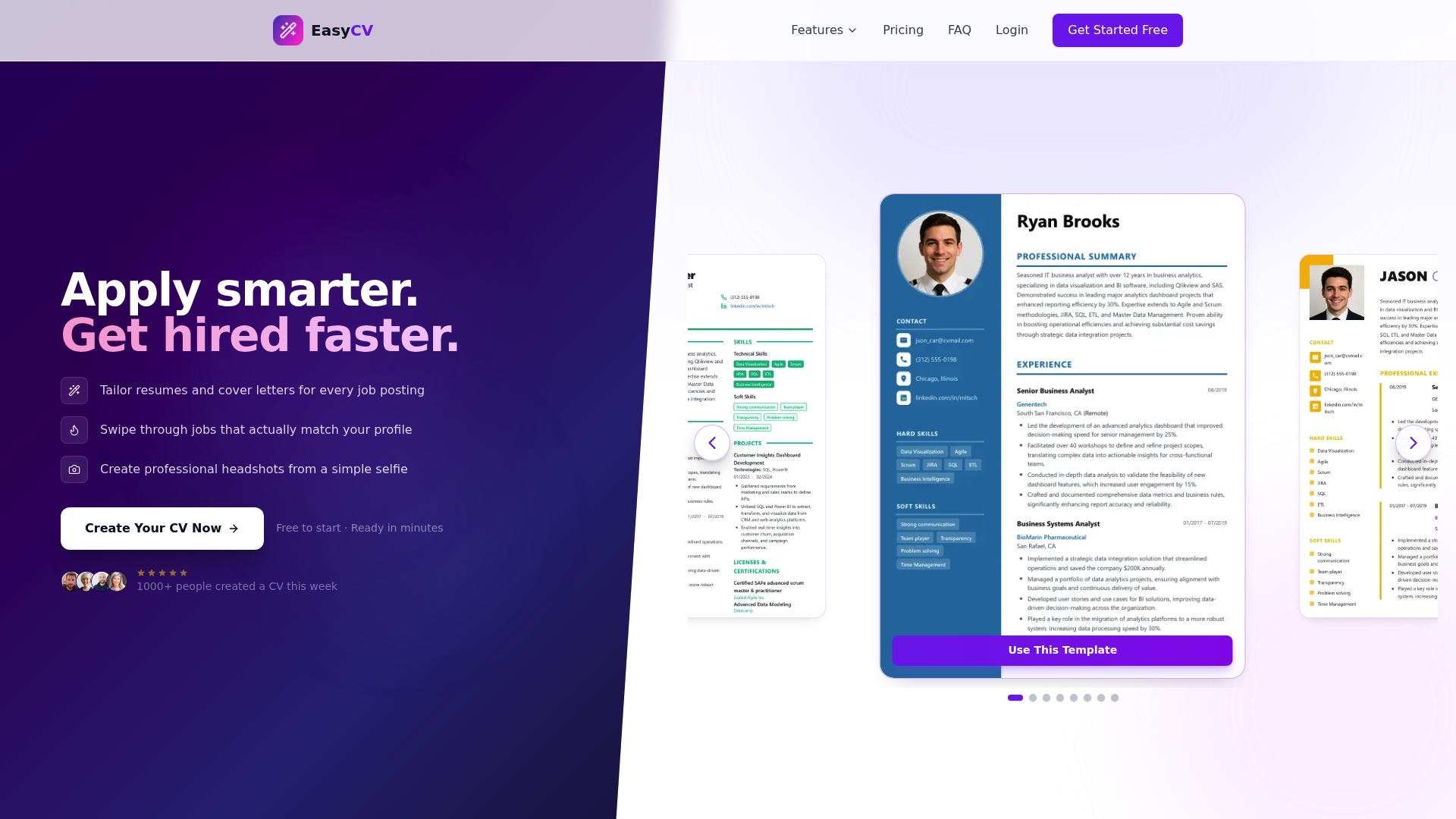
Every application you send through Easy-cv gets an AI-tailored CV and cover letter built for that specific role. The built-in job tracker keeps your applications organized across every platform you use. You can build and customize your CV with ATS-friendly templates, generate a professional headshot from a selfie, and create materials in 30+ languages. Whether you are searching casually or running a full-scale campaign, Easy-cv reduces the manual work so you can focus on the roles that matter. Explore the full Easy-cv feature set to see how each tool fits into your search.
FAQ
What are the main types of job search platforms?
The five main types are broad aggregators, niche job boards, professional networking platforms, public career centers, and curated listing sites. Each serves a different stage and goal within a job search.
How many job search platforms should I use at once?
Job seekers using 3–5 platforms consistently achieve better results than those relying on a single source. Using more than five tends to spread effort too thin without adding meaningful coverage.
Are niche job boards better than broad aggregators?
Niche boards outperform broad platforms for specialized roles by reducing noise and competition. Broad aggregators are better for volume and early-stage exploration.
What is a ghost job and how do I avoid it?
A ghost job is a listing that is outdated or for a role that was never truly open. Filter search results by “posted in the last 7 days” and apply directly on company career pages to reduce exposure to ghost listings.
How do I manage applications across multiple platforms?
Use a dedicated job tracker or spreadsheet to log each application, the platform used, the resume version submitted, and your follow-up dates. Tools built for managing multiple job openings centralize this process and reduce missed deadlines.