Student Resume Examples: Rewrite 3 Bullets Employers Notice
A strong student resume fits one page, leads with education when you lack full-time work history, and turns duties into quantified achievement bullets. That last change matters more than any template choice. Pick a clean, ATS-friendly layout, then rewrite your top three bullets using numbers before you touch anything else.
TL;DR:
- Most student resumes should prioritize education first, followed by experience and skills, with achievements framed as measurable results.
- Using action verbs and quantifiable outcomes in bullets improves credibility, even for campus jobs and volunteer roles.
- Keep formatting ATS-friendly by using standard fonts, avoiding images or columns, and embedding relevant keywords from the job posting.
- Including projects, research, and leadership roles as achievements with clear metrics can compensate for limited paid work experience.
- Achievements-based formatting and AI tools can help students quickly tailor strong, impact-oriented resumes for various applications.
Table of Contents
- Student Resume Examples: What to Include and in What Order
- Student Resume Examples by Level, With Sample Bullets
- How to Turn Job Duties Into Achievement Bullets
- Formatting Rules That Keep Your Resume ATS-Friendly
- Building Credibility Without Paid Work Experience
- Why We Build Student Templates Around Achievements, Not Duties
- Draft Your Student Resume Faster With EasyCV
- Where to Find More Sample Student Resumes
- Sources
Student Resume Examples: What to Include and in What Order
For most students, the resume runs education first, then experience, then skills. Recruiters scanning early-career resumes expect to see your degree program before your job history, since career centers advising undergraduates confirm this ordering is standard for anyone still in school or a year or two out.
Here’s what belongs in each section:
- Header: name, phone, email, city and state, plus LinkedIn and a portfolio or GitHub link if relevant.
- Summary: two lines naming your degree, one concrete achievement, and the role you’re targeting. Skip the generic objective statement. A tight summary that names something you’ve actually done beats a vague “seeking opportunities to grow” line every time.
- Education: school, degree, expected graduation date. Include GPA only if it’s 3.0 or higher, or if the employer specifically asks for it. List relevant coursework if you’re short on work experience.
- Skills: separate hard skills (software, languages, certifications) from soft skills, and place hard skills where an ATS scanner will find them fast, usually right under education.
- Extras: projects, volunteer work, leadership roles, and awards. These sections do real work when your job history is thin, so don’t bury them at the bottom if they’re your strongest material.
Student Resume Examples by Level, With Sample Bullets
1. High school or first-year student
Header: name, city, email, phone. No work history yet is fine. Try:
- “Volunteered 6+ hours weekly at local food bank, coordinating intake for 40+ visitors per shift.”
- “Maintained strong attendance while balancing varsity soccer and a part-time retail role.”
2. College student with an internship
Summary: “Marketing sophomore who grew a campus club’s Instagram following significantly in one semester.” Bullets:
- “Grew club Instagram following substantially in four months through weekly content calendars.”
- “Coordinated logistics for a well-attended campus event, significantly reducing setup time.”
- “Streamlined volunteer sign-up process, noticeably reducing no-shows.”
3. Graduate or research student
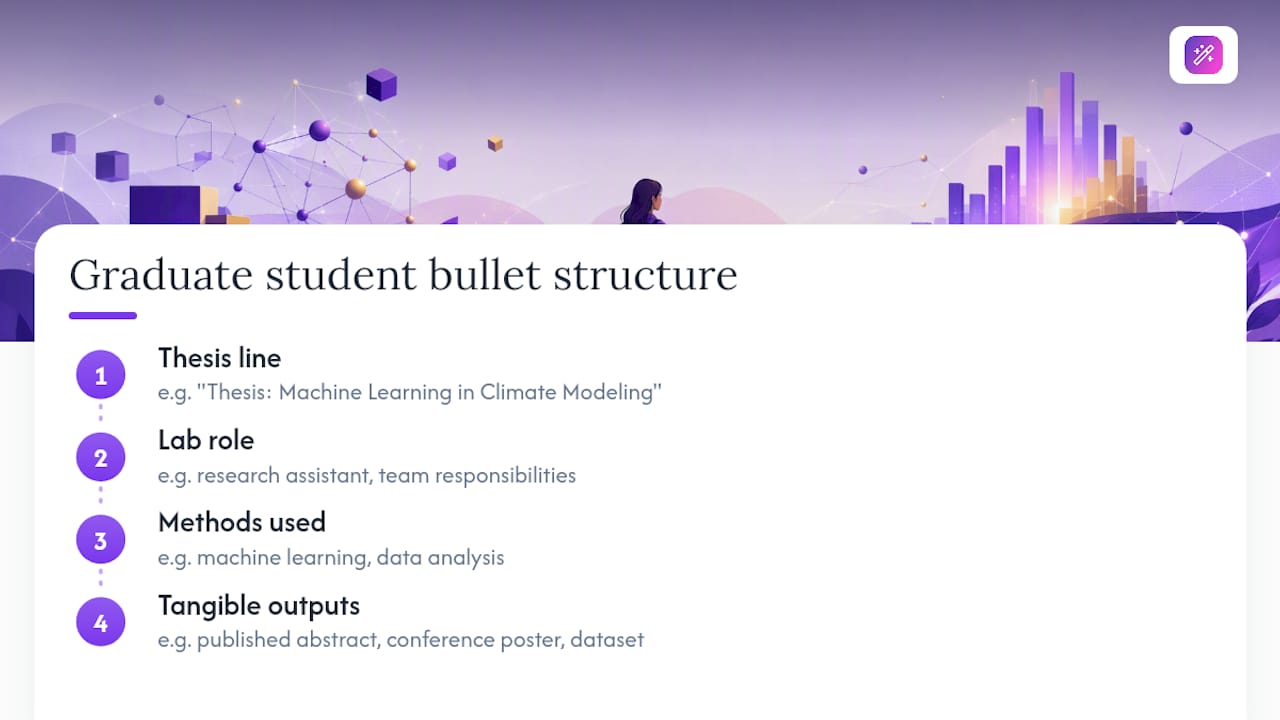
Lead with a thesis line: “Thesis: Machine Learning Applications in Climate Modeling, advised by Dr. [Name].” Follow with your lab role, methods used, and any output (published abstract, conference poster, dataset built).
4. Technical student
Projects section up top: “Built a Python inventory tracker (Flask, PostgreSQL) significantly reducing manual entry time. [Link to repo].” A dedicated technical skills or projects section near the top is standard advice for computer science and engineering applicants.
Quick tip: for finance or consulting applications specifically, some firms expect individual SAT section scores rather than a composite, but only when the posting requests it.
How to Turn Job Duties Into Achievement Bullets
Use this formula: action verb + task + result or scale. That’s the whole framework. Career advisors consistently push students toward action verbs and measurable outcomes, even for campus jobs that never felt like “real” work.
Six before-and-after examples:
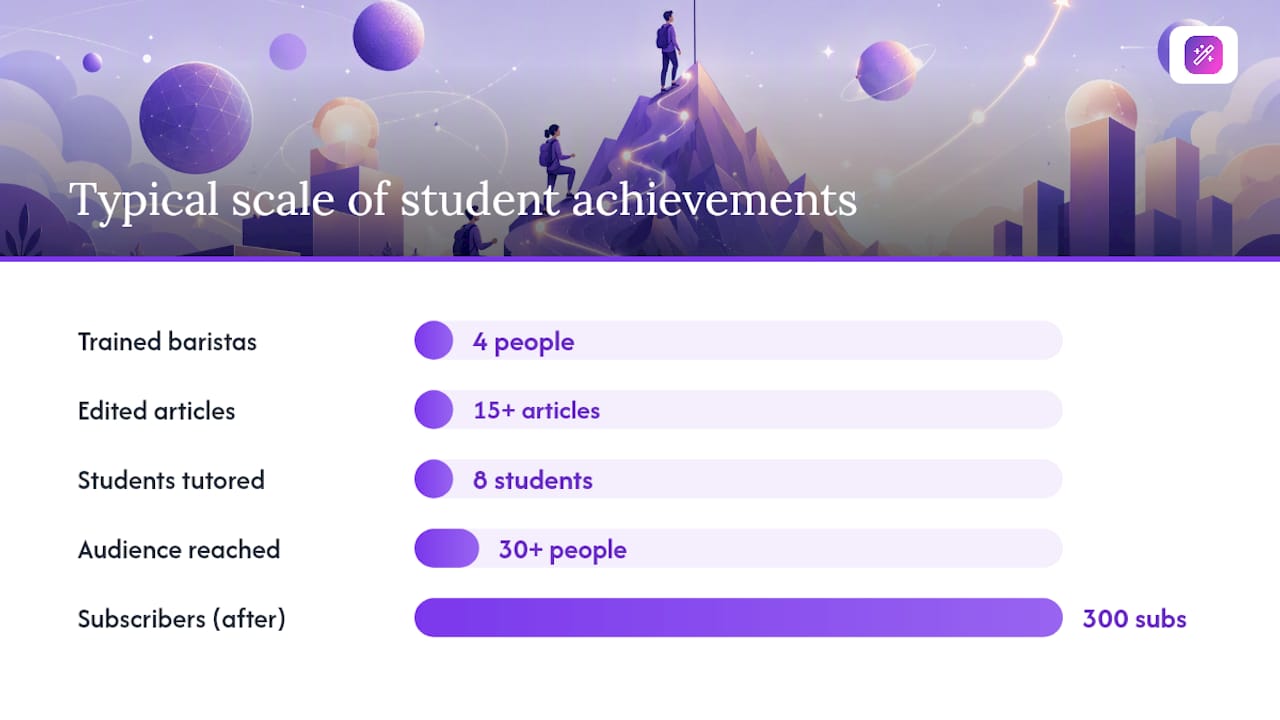
- Before: “Worked at coffee shop.” After: “Trained 4 new baristas on espresso standards, cutting onboarding time by half.”
- Before: “Helped with school newspaper.” After: “Edited 15+ articles per issue, increasing readership 20% over two semesters.”
- Before: “Was a tutor.” After: “Tutored 8 students weekly in algebra, raising average test scores by one letter grade.”
- Before: “Worked on group project.” After: “Led 4-person team building a market analysis, presented to 30+ classmates and professor.”
- Before: “Volunteered at shelter.” After: “Managed intake for approx. 15 volunteers weekly, organizing shift schedules for a 20-bed shelter.”
- Before: “Did social media for club.” After: “Grew club newsletter subscribers from 50 to 300 through weekly content.”
Run every bullet through a checklist: Is it specific? Does it have a number? Does it start with a strong verb? Does it show a result, not just a task? A categorized list of resume action verbs makes rewriting faster when you’re stuck on word choice, and our own breakdown of why action verbs make or break your application goes deeper on which verbs fit which roles.
Pro Tip: When you don’t have an exact number, use an honest range like “10 to 15 volunteers” rather than skipping the metric entirely. A range still signals scale, and it reads as more credible than a vague claim.
Formatting Rules That Keep Your Resume ATS-Friendly
One page covers almost every student resume. The exception: an undergraduate CV built for research or graduate school applications can run two pages, since it needs room for thesis details, methods, and research outputs that a standard resume skips.
- Use a standard font (Calibri, Arial, or Georgia) at 10 to 12 points, with half-inch to one-inch margins.
- Save and submit as a PDF unless the application explicitly requests a .docx file.
- Pull keywords directly from the job posting and place them in your skills section, coursework list, and bullets, not just once at the top.
- Avoid text boxes, images, headers and footers, and columns that confuse ATS parsing software.
Many large employers use applicant tracking systems to screen resumes before a human ever opens them, so a resume that looks great on screen but parses badly on the back end can get filtered out before anyone reads a word of it.
Building Credibility Without Paid Work Experience
Projects, research, and leadership roles carry real weight when you frame them like professional work. Guidance for college students with thin work history consistently points to coursework and campus roles as legitimate experience, provided you attach a measurable outcome to each one.
- Projects: title, tools or tech stack used, your specific role, the deliverable, and a metric or link.
- Research: methods used, your role on the team, key findings, and your supervisor’s name if the context calls for it.
- Leadership and volunteer work: treat these as projects with deliverables. “Organized” and “helped with” become “led,” “built,” or “increased.”
- Portfolios: host code on GitHub, writing samples or design work on a personal site, and link both directly from your header.
Why We Build Student Templates Around Achievements, Not Duties
Most student resumes fail for a boring reason: they list what the applicant was assigned to do, not what changed because they did it. Duty-based language treats every campus job as interchangeable, which is exactly how a hiring manager skimming 200 applications reads it. The fix isn’t a fancier template. It’s forcing every line to answer “so what happened because of this.”
Easy-cv’s own approach reflects that bias toward evidence. The ATS-friendly templates default to achievement-oriented formatting, the AI writing assistant is built to push vague duty lines toward metrics, and translation into 30+ languages plus the built-in job matcher exist because a resume is only useful once it’s actually reaching the right roles. For more on quantifying campus work specifically, our guide on quantifiable achievements on your CV walks through the math even for unpaid roles.
— Andras
Draft Your Student Resume Faster With EasyCV
Rewriting six bullets by hand is doable in an afternoon. Rewriting an entire resume for every application you send is not, which is where a lot of students lose momentum halfway through a job search.
Easy-cv’s student templates start achievement-first, so you’re not fighting the layout to fit metrics in. The AI writing assistant rewrites duty-based lines into quantified bullets in seconds, and the job matcher shows you which listings actually fit your resume before you spend an evening tailoring one that doesn’t. Try the free student template on Easy-cv and run the AI rewriter on your three weakest bullets first. That’s usually where the biggest jump in quality happens.
Where to Find More Sample Student Resumes
- UC Berkeley Career Engagement: sample resumes by student stage, including first year, leadership, and technical.
- UW Career & Internship Center: downloadable Word and Google Docs templates with annotated bullets.
- Columbia Career Education: guidance on when a two-page undergraduate CV replaces a one-page resume.
- Zety’s student resume guide: field-specific examples spanning nursing, engineering, and marketing roles.
Sources
- Undergraduate’s student resume samples – Career Services | University of Pennsylvania
- Sample Resumes – UC Berkeley Career Engagement
- Creating an Undergraduate CV | Columbia Career Education
- Student Resume Examples & Template