Why Action Verbs in Resumes Make or Break Your Application
Action verbs in resumes are the words that show what you actually did, not just what your job title was. Recruiters spend only 7.4 seconds on their first scan of a resume. That means your opening bullets carry almost all the weight. Understanding why action verbs in resumes matter so much comes down to one fact: verbs signal ownership and results, while passive phrases signal task completion. The difference between “was responsible for sales growth” and “grew sales by 40%” is the difference between a callback and a rejection.
Why action verbs in resumes improve ATS and recruiter results
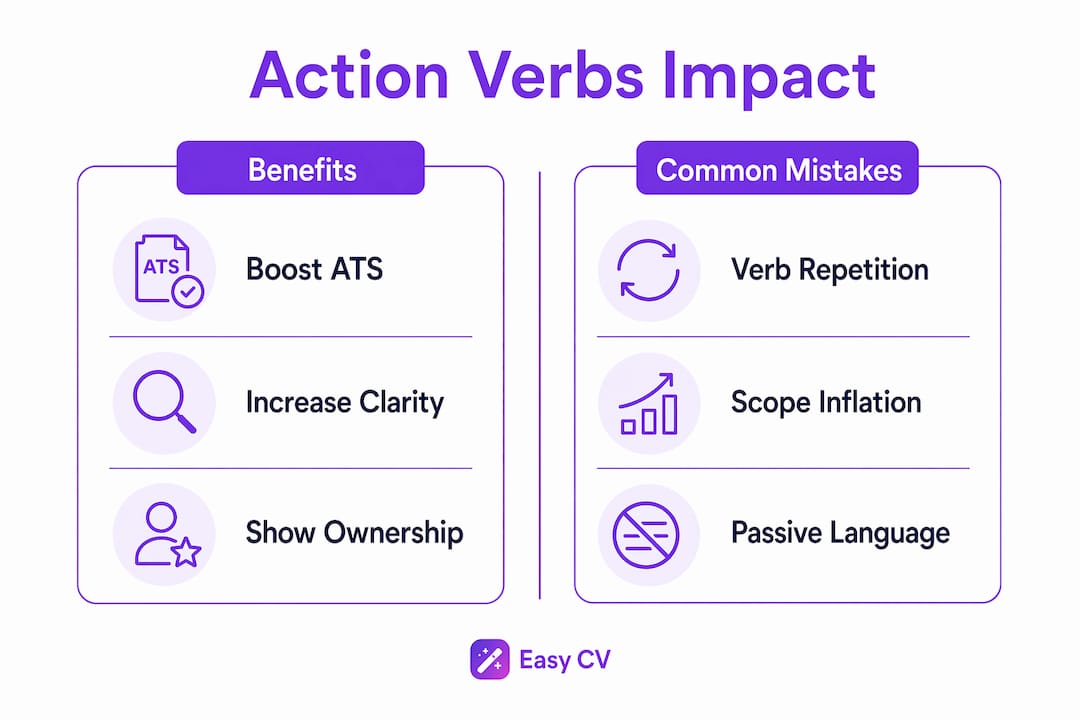
Action verbs do two jobs at once. They satisfy Applicant Tracking Systems (ATS), which are the software programs that filter resumes before a human ever reads them, and they make your bullets easier for recruiters to process quickly.
ATS algorithms scan for keywords, and verbs are among the most weighted. Matching verbs to job description language improves your ATS keyword score and signals alignment to the recruiter reading your file. A resume that mirrors the language of the job post ranks higher in ATS results and reads as more relevant to the hiring manager.

The readability benefit is just as significant. Weak and passive phrasing increases cognitive load and reduces clarity. When a recruiter has to parse “was responsible for the coordination of project timelines,” they burn mental energy on grammatical scaffolding instead of absorbing your achievement. A strong verb like “coordinated” or “directed” strips that scaffolding away instantly.
Research shows that strong verbs can make a resume read 30–50% more impressive without changing a single fact. That is not about exaggeration. It is about presenting the same truth in the language of results rather than the language of duties.
Modern ATS systems also evaluate verb strength density. Resumes below 70% strong verb density risk being downgraded automatically. That threshold matters because most job seekers do not realize their resume is being scored on verb quality, not just keyword presence.
Here is a quick comparison of weak versus strong verb choices across common resume contexts:
| Weak verb | Strong alternative | Why it works |
|---|---|---|
| Helped with marketing campaigns | Executed marketing campaigns | Shows direct ownership |
| Was responsible for training | Coached 12 new hires | Adds scope and specificity |
| Worked on data analysis | Analyzed sales data to cut costs | Connects action to outcome |
| Assisted in product launches | Launched three product lines | Removes hedging language |
| Participated in budget reviews | Audited a $2M annual budget | Quantifies the work |
Pro Tip: Front-load every bullet with a strong verb, then follow immediately with a number or scale. The structure “Reduced onboarding time by 30% by redesigning the training program” works because the verb and the metric appear before any explanation.
Common mistakes when using action verbs on a resume
Most job seekers know they should use strong verbs. Fewer know the specific ways they undermine their own efforts.
The most common error is verb repetition. Overusing the same verb repeatedly signals a limited vocabulary to recruiters. If every bullet on your resume starts with “managed,” you look like you only have one mode. Rotate through specific alternatives: “directed,” “supervised,” “oversaw,” “coordinated,” and “led” each carry slightly different weight and scope.
Scope inflation is the second major trap. Using “spearheaded” when you played a supporting role harms your credibility, and that harm compounds during reference checks. Hiring managers verify claims. If your verb implies you led a project but your reference describes you as a contributor, the mismatch ends your candidacy.
Passive and weak verbs are the third problem. Phrases like “helped,” “assisted,” and “was involved in” signal low ownership to hiring managers. They read as hedging. Recruiters interpret them as a sign that the candidate either did not own the outcome or lacks confidence in claiming it.
The fourth mistake is using strong verbs without measurable outcomes. A verb like “transformed” sounds powerful but means nothing without a number attached. “Transformed customer service protocols” is vague. “Transformed customer service protocols, cutting complaint resolution time from five days to one” is a result. Check out common resume language mistakes to see how these patterns show up across different industries.
Pro Tip: Copy the job description into a text document and highlight every verb the employer uses. Those are your target words. Mirror them in your resume bullets where they accurately reflect your experience.
How to choose the right action verbs for your role
The right verb depends on your function, your level of ownership, and the job you are targeting. Generic verbs like “did” or “worked on” fail because they apply to everyone. Specific verbs signal expertise.
Leadership roles call for verbs that convey authority and direction: “directed,” “established,” “championed,” “restructured,” “mentored.” Technical roles need verbs that show hands-on execution: “built,” “deployed,” “programmed,” “configured,” “automated.” Sales and business development roles benefit from verbs tied to growth and persuasion: “generated,” “negotiated,” “closed,” “expanded,” “converted.” Analytical roles need verbs that show rigor: “analyzed,” “forecasted,” “modeled,” “evaluated,” “benchmarked.”
The key principle is that strong action verbs help recruiters see candidates as value creators rather than cost centers. A verb like “generated $1.2M in new revenue” positions you as someone who produces results. A verb like “was part of the sales team” positions you as overhead.
Pairing verbs with quantified outcomes is what separates a good resume from a great one. The structure is simple: verb plus metric plus context. “Reduced customer churn by 18% by introducing a proactive outreach program” tells the recruiter what you did, how much it mattered, and how you did it. That three-part structure works across every function. You can also learn how resume achievements drive interview callbacks to see how this pairs with broader accomplishment framing.
Here is a role-based verb guide:
| Role type | Recommended verbs |
|---|---|
| Leadership | Directed, established, mentored, restructured, championed |
| Technical | Built, deployed, automated, configured, engineered |
| Sales | Generated, negotiated, converted, expanded, closed |
| Analytical | Analyzed, forecasted, modeled, evaluated, benchmarked |
| Operations | Coordinated, implemented, standardized, reduced, managed |
Pro Tip: Use achievement tracking tools throughout your career, not just when you are job searching. Logging your wins in real time gives you accurate verb-and-metric pairs to draw from when you update your resume.
Practical steps to rewrite your resume bullets
Rewriting weak bullets is a mechanical process once you know the pattern. Start by printing your current resume and circling every verb. Then ask one question for each: does this verb show what I owned, or does it describe a task I participated in?
Replace every passive or weak verb with one that reflects your actual level of involvement. Use this four-step process:
- Identify the weak verb. Look for “helped,” “assisted,” “was responsible for,” “participated in,” and “worked on.” These are your targets.
- Clarify your actual role. Did you lead, execute, support, or advise? Pick the verb that matches your real contribution.
- Add a metric. Every strong bullet needs a number: a percentage, a dollar amount, a headcount, a time reduction, or a volume figure.
- Cut the filler. Remove phrases like “in order to,” “as part of my role,” and “with the goal of.” The verb and the metric carry the sentence. Everything else is noise.
Front-loading the verb and following it with a quantified outcome maximizes impact for both ATS systems and human readers. The structure “Reduced bugs by 60% by refactoring the authentication module” works because the most important information appears first. Understanding how resume keywords affect ATS scoring helps you see why verb placement is not just a style choice. It is a ranking factor.
Variety matters too. Rotate your verbs across bullets so no single word appears more than twice on the page. A resume that uses “managed” eight times reads as repetitive. A resume that uses “directed,” “coordinated,” “supervised,” and “oversaw” reads as someone with range.
Key Takeaways
Action verbs are the single highest-leverage change you can make to a resume because they signal ownership, satisfy ATS filters, and communicate results in the fewest possible words.
| Point | Details |
|---|---|
| Verbs signal ownership | Strong verbs like “directed” or “generated” show you owned the outcome, not just the task. |
| ATS verb density matters | Resumes below 70% strong verb density risk automatic downgrading by modern ATS systems. |
| Match job description language | Mirror the verbs used in the job post to improve ATS alignment and recruiter relevance. |
| Pair verbs with metrics | Every strong bullet follows the pattern: verb plus metric plus context. |
| Avoid scope inflation | Use verbs that accurately reflect your role to protect credibility during reference checks. |
The thing most job seekers get wrong about action verbs
Most advice on this topic stops at “use strong verbs” and hands you a list. That misses the real problem. The issue is not that job seekers do not know words like “spearheaded” or “orchestrated.” The issue is that they reach for impressive-sounding verbs without asking whether those verbs are accurate.
I have reviewed hundreds of resumes over the years, and the pattern is consistent. Candidates inflate their verb choice to sound more senior, then stumble when an interviewer asks them to walk through exactly what they did. The verb “spearheaded” implies you initiated and drove something from start to finish. If you contributed to a project that someone else led, the right verb is “contributed,” “supported,” or “executed.” That is not a weaker resume. That is an honest one, and honest resumes survive reference checks.
The other thing I see constantly is job seekers treating their resume as a job description rather than a marketing document. A job description lists duties. A marketing document sells outcomes. Every bullet should answer the question a recruiter is actually asking: “What did this person produce, and how much did it matter?” The verb is the first word of that answer. Get it right, and the rest of the bullet almost writes itself.
The candidates who stand out are not the ones with the most impressive vocabulary. They are the ones whose verbs match their metrics, whose metrics match their stories, and whose stories match what the employer needs. That alignment is what gets you the interview. Viewing your resume through that lens changes how you write every single bullet.
— Andras
How Easy-cv helps you write stronger resume bullets
Writing strong resume bullets from scratch is harder than it looks. Easy-cv’s AI writing assistant generates and refines professional resume content, including verb suggestions tailored to your experience and the job you are targeting.
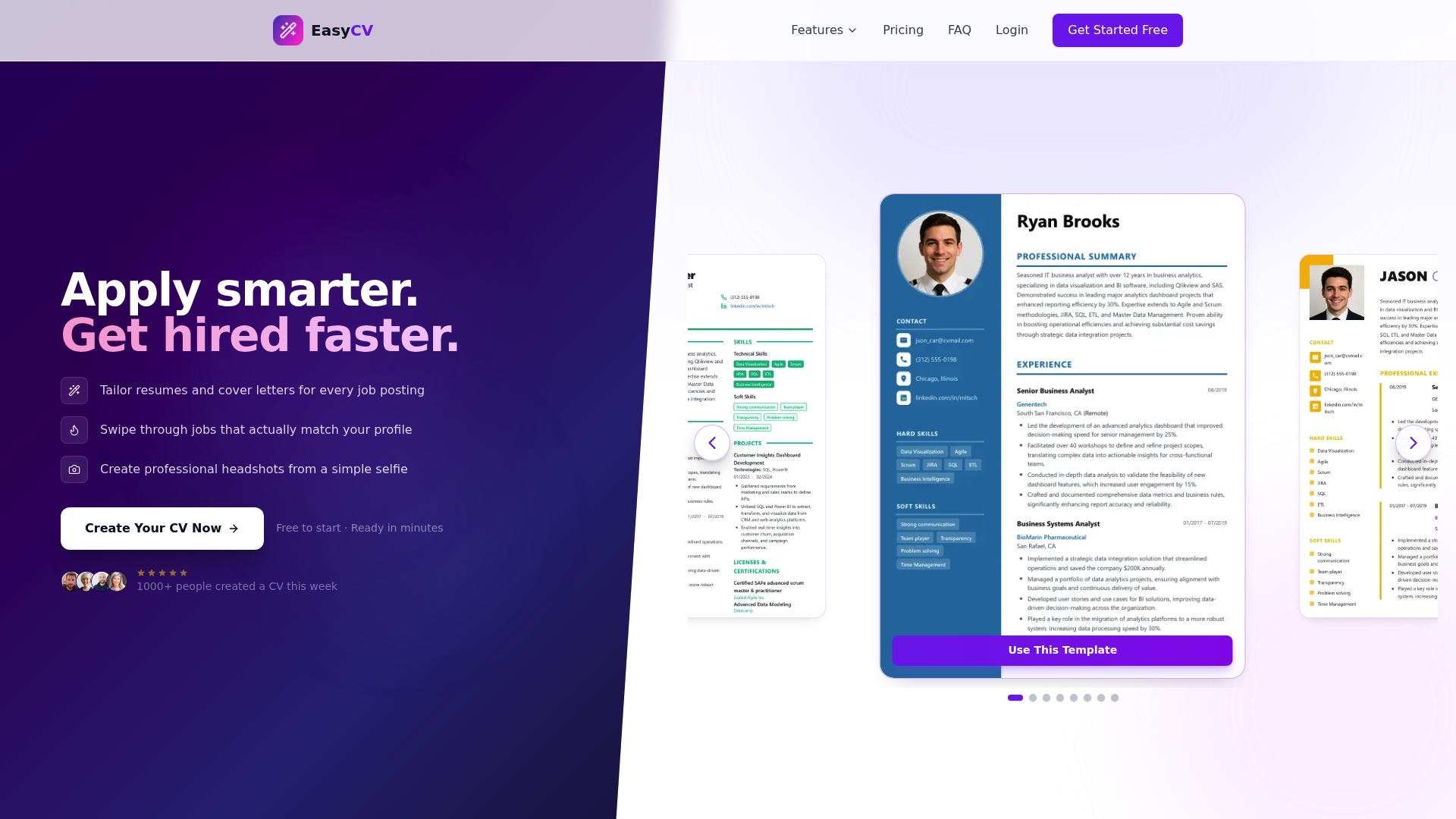
The Easy-cv resume builder matches your bullet points against job description language, flags weak or passive phrasing, and suggests specific alternatives that improve both ATS compatibility and recruiter readability. You also get access to ATS-friendly templates, a built-in job tracker, and cover letter generation, all in one place. Whether you are rewriting one bullet or rebuilding your entire resume, Easy-cv reduces the manual work and raises the quality of every application you send.
FAQ
What are action verbs in a resume?
Action verbs are words that describe what you did in a role, such as “directed,” “built,” or “generated.” They replace passive phrases and duty-based language to show ownership and results.
Why do action verbs matter for ATS systems?
ATS systems score resumes partly on verb strength and keyword alignment. Resumes below 70% strong verb density risk being ranked lower before a human recruiter ever reads them.
How do I choose the right action verbs for my resume?
Match your verbs to your actual level of involvement and to the language used in the job description. Leadership roles call for verbs like “directed” or “established,” while technical roles need verbs like “built” or “deployed.”
How many action verbs should I use per bullet point?
Each bullet point needs one strong verb at the start, followed by a metric and context. Using more than one verb per bullet dilutes the impact and makes the sentence harder to scan.
What is the difference between a weak verb and a strong verb on a resume?
Weak verbs like “helped” or “assisted” signal partial involvement and low ownership. Strong verbs like “led” or “generated” signal direct accountability and results, which is what hiring managers want to see.