The Role of Achievements in Resumes That Get Interviews
Achievements in resumes are proof of your real impact, not just a record of your daily tasks. A resume that lists duties tells a recruiter what your job was. A resume built on achievements tells them what you actually delivered. The role of achievements in resumes is to transform generic job descriptions into compelling evidence that you outperform your peers. Recruiters spend about 7 seconds scanning each resume, so every bullet must earn its place. Candidates who quantify their results are 58% more likely to receive interview invitations. That single statistic explains why achievement-focused resumes win.
Why achievements matter more than duties on resumes
Recruiters do not hire job descriptions. They hire people who solve problems and deliver results. A duty-based bullet like “Responsible for managing social media accounts” tells a recruiter nothing about your skill level or output. An achievement-based bullet like “Grew Instagram engagement by 43% in 90 days by redesigning the content calendar” tells them exactly what you can do.

Modern applicant tracking systems (ATS) have evolved beyond simple keyword matching. Achievement-based resumes rank higher in AI-enhanced ATS because they build richer keyword context around your skills. The system does not just confirm you know a skill. It assesses whether you applied it effectively. A bullet that says “proficient in Excel” passes a keyword check. A bullet that says “built Excel dashboards that reduced monthly reporting time by 6 hours” passes the keyword check and proves competence.
Here is a direct comparison that shows the difference:
-
Duty: “Managed a team of five sales representatives.”
-
Achievement: “Led a five-person sales team to exceed quarterly targets by 22%, the best result in the regional division.”
-
Duty: “Handled customer complaints and escalations.”
-
Achievement: “Resolved 95% of customer escalations within 24 hours, reducing churn by 18% over two quarters.”
The achievement version answers the recruiter’s unspoken question: so what? Every bullet on your resume should answer that question.
A resume is a marketing document. Its job is not to describe your past role. Its job is to prove your future value to the employer reading it.
A useful test comes from Resumefast: if your replacement could write the exact same bullet on their resume, it is a duty, not an achievement. Achievements must be unique to your actions and outcomes. Use strong action verbs like led, spearheaded, or drove to signal individual impact from the first word.
How to write achievement statements using CAR, STAR, and XYZ
Three proven formulas structure achievement bullets so they are clear, specific, and result-driven. CAR, STAR, and XYZ each serve a slightly different purpose, and knowing when to use each one gives you a real advantage.
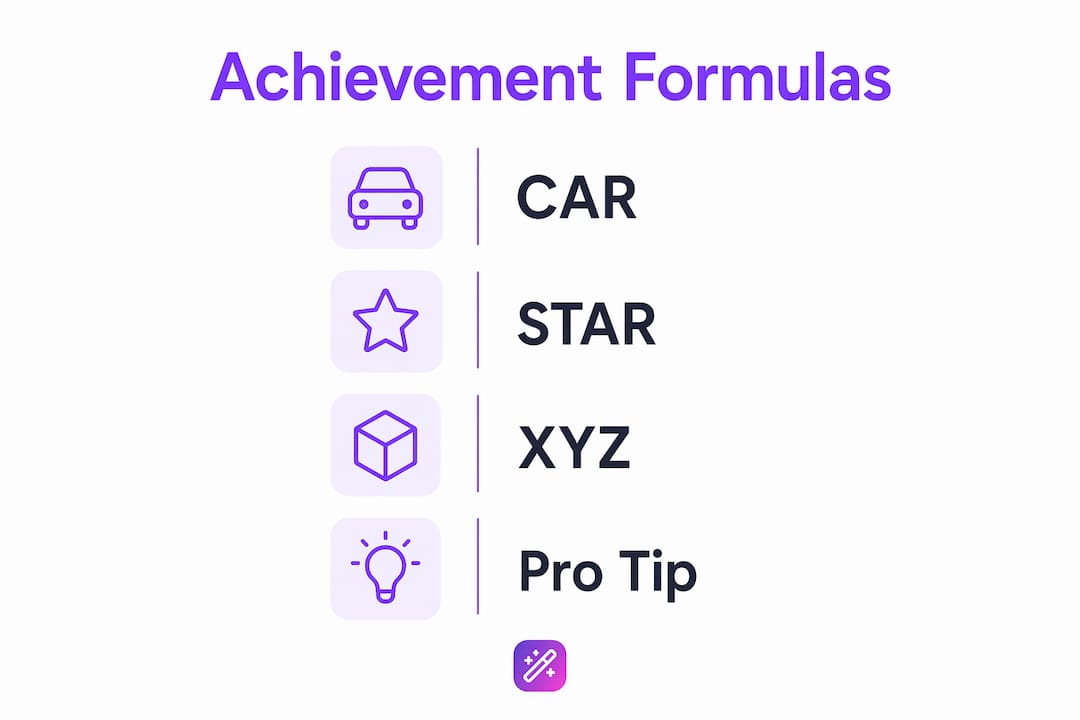
| Formula | Structure | Best used when |
|---|---|---|
| CAR | Challenge, Action, Result | You want a concise, versatile bullet for most roles |
| STAR | Situation, Task, Action, Result | The context is complex and needs more setup |
| XYZ | Accomplished X as measured by Y by doing Z | You have a strong metric to lead with |
CAR in practice: The challenge was high customer wait times. Your action was redesigning the ticketing workflow. The result was a 30% reduction in average resolution time. Combined into one bullet: “Redesigned the support ticketing workflow, cutting average resolution time by 30% and improving customer satisfaction scores.”
STAR in practice: STAR works best when a recruiter needs context to understand why the achievement matters. If you turned around a failing project, the Situation and Task explain the stakes before you describe your Action and Result. Use STAR for roles in consulting, project management, or any position where the complexity of the problem is part of the story.
XYZ in practice: Google’s Laszlo Bock popularized this formula for its directness. “Accomplished X as measured by Y by doing Z” forces you to lead with the outcome. Example: “Increased qualified leads by 35% (measured by CRM pipeline data) by launching a targeted LinkedIn outreach program.”
Pro Tip: Start every achievement bullet with a past-tense action verb. Words like “drove,” “built,” “reduced,” “launched,” and “negotiated” signal ownership and initiative before the recruiter reads a single number.
Before and after rewrites make the difference concrete. A weak bullet reads: “Assisted with the rollout of a new CRM system.” A strong CAR rewrite reads: “Supported CRM migration for a 200-person sales team, completing rollout two weeks ahead of schedule and reducing onboarding time by 40%.” The second version is specific, time-bound, and measurable.
How to find achievements when you lack obvious metrics
The most common reason job seekers skip achievements is that they believe they have none worth listing. That belief is almost always wrong. Qualitative achievements like completing a project under budget, leading a cross-functional team, or training new hires still signal strong performance to recruiters.
Start by mining these sources for hidden metrics:
- Past performance reviews: Annual reviews often contain specific praise, ratings, or improvement percentages that translate directly into resume bullets.
- Project management tools: Platforms like Jira, Asana, or Monday.com log completion rates, sprint velocity, and delivery timelines.
- Email records: Congratulatory emails from managers or clients often contain specific language about your impact that you can paraphrase.
- Team dashboards: Sales dashboards, support ticket systems, and marketing analytics platforms hold data you may have forgotten.
For students and career changers, the importance of achievements on resumes does not shrink. It shifts. Academic awards, volunteer initiatives, and extracurricular milestones demonstrate commitment and transferable skills that employers value in candidates without extensive work history. A student who organized a campus fundraiser that raised $12,000 has a measurable achievement. A career changer who led a volunteer team of 15 people has a leadership achievement.
Pro Tip: If you genuinely cannot find a number, use scope and scale instead. “Trained 12 new team members on compliance procedures” is more compelling than “Assisted with onboarding.” Specificity signals credibility even without a percentage.
The goal is to gather metrics from overlooked sources before you assume none exist. Spend 30 minutes reviewing your last two years of work records before writing a single bullet. Most people find at least five quantifiable results they had forgotten.
How to balance achievements and responsibilities on your resume
The 80/20 rule is the clearest framework for structuring resume content: 80% of your bullets should focus on achievements, and 20% should provide context through responsibilities. This balance matters because pure achievement lists without any context can confuse recruiters who need to understand the scope of your role.
Here is how to apply the balance in practice:
- Open each role with one or two context-setting bullets. These establish your scope: team size, budget managed, or geographic reach. They are the 20%.
- Follow with four to six achievement bullets. These prove your impact within that scope. They are the 80%.
- Lead every achievement bullet with a strong verb. Passive constructions like “was responsible for” belong in the duty category. Cut them.
- Answer “so what?” for every bullet. If a bullet does not tell the recruiter why the result mattered, revise it or cut it.
- Avoid vague language. Phrases like “improved team performance” or “contributed to growth” are placeholders, not achievements. Replace them with specific numbers or outcomes.
This structure improves recruiter perception and ATS ranking simultaneously. Responsibilities provide the role scope that ATS systems use to categorize your experience. Achievements provide the keyword context density that AI screening tools use to assess your effectiveness. Both layers work together. Removing either one weakens the resume.
The Monster career guide confirms that responsibilities provide role scope while achievements show measured results and value delivery. A resume that skips responsibilities entirely can read as vague. A resume that skips achievements reads as forgettable. The 80/20 split keeps you credible and compelling at the same time.
Key takeaways
Achievements are the single most effective tool for separating your resume from the competition, and the 80/20 rule, combined with CAR, STAR, or XYZ formulas, gives you a repeatable system to write them well.
| Point | Details |
|---|---|
| Achievements outperform duties | Quantified results make candidates 58% more likely to receive interview invitations. |
| Use proven formulas | CAR, STAR, and XYZ each structure achievement bullets for clarity and measurable impact. |
| Mine overlooked sources | Performance reviews, project tools, and dashboards hold metrics most job seekers forget. |
| Apply the 80/20 rule | 80% achievement bullets, 20% context duties creates a credible and compelling resume. |
| All experience levels qualify | Students and career changers can use awards, volunteer work, and project outcomes as achievements. |
What I have learned from watching achievement-driven resumes win
I have reviewed hundreds of resumes over the years, and the pattern is consistent. The candidates who get callbacks fastest are not always the most experienced. They are the ones who made their impact undeniable on paper.
The most common mistake I see is what I call the “responsible for” trap. Job seekers write “responsible for managing client relationships” and believe they have said something meaningful. They have not. They have described a job function that every person in that role shares. The recruiter has seen that exact phrase 40 times that week.
What stops most people from writing strong achievements is not a lack of accomplishments. It is a lack of confidence that their results are worth claiming. Career changers especially fall into this pattern. They discount volunteer leadership, freelance projects, and academic work because it does not feel “professional enough.” That is a costly mistake. Every achievement listed can become an interview question, which means your achievements also prepare you for the conversation that follows the resume.
My honest advice: write your achievements first, then verify the numbers. Go back to your performance reviews, your old emails, your project dashboards. The data is almost always there. And when you sit across from a hiring manager who asks “tell me about a time you improved a process,” you will have a specific, defensible answer ready because you already wrote it down.
The effect of achievements on job applications goes beyond the resume itself. They shape the entire interview narrative.
— Andras
Build your achievement-driven resume with Easy-cv
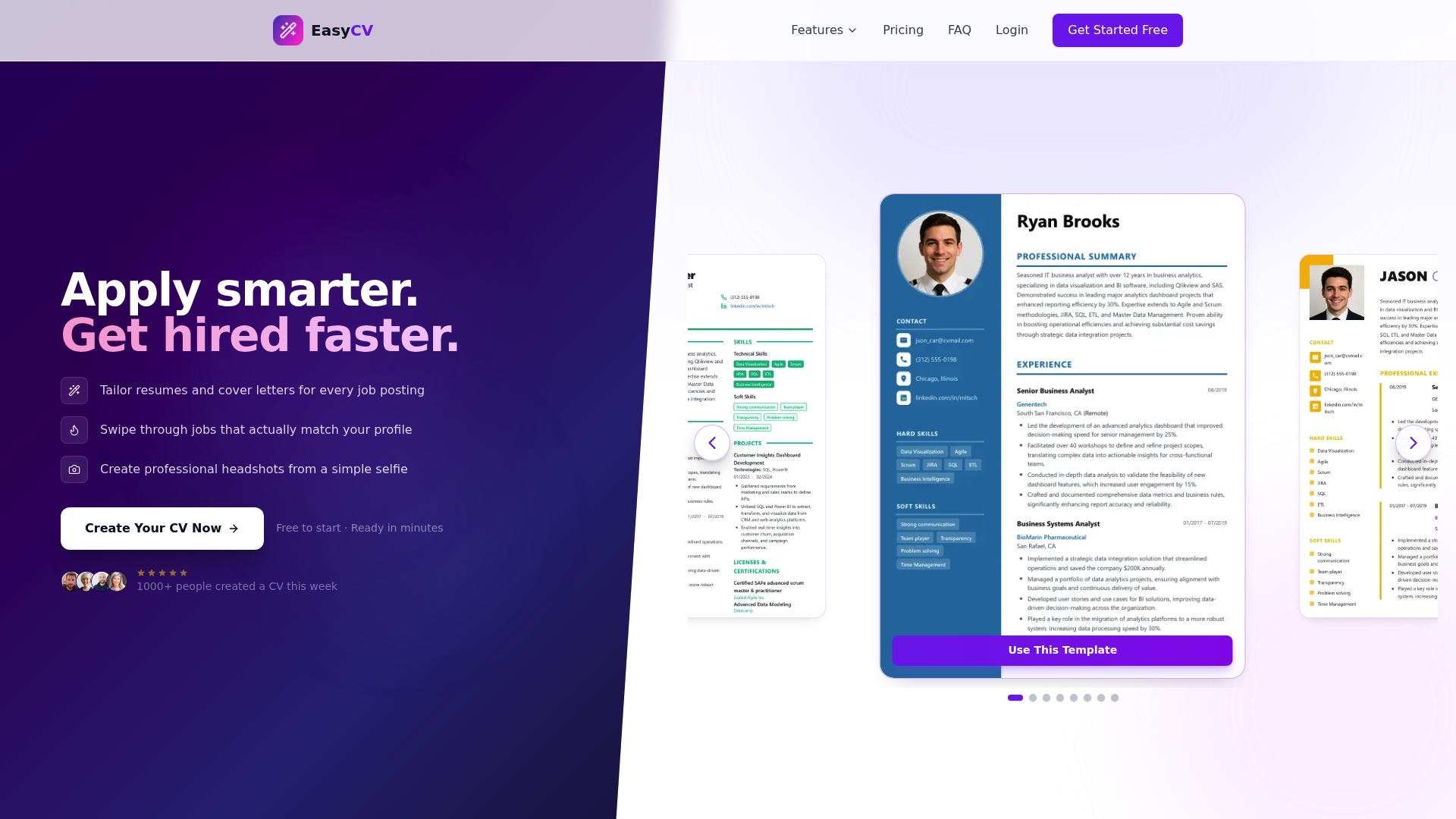
Writing strong achievement bullets is one thing. Formatting them into a resume that passes ATS screening and impresses recruiters is another challenge entirely. Easy-cv handles both. The AI resume builder analyzes each job description and helps you craft CAR and STAR-based achievement statements tailored to the role. You get ATS-friendly templates, an AI writing assistant that refines your bullets, and a built-in job tracker to keep every application organized. Whether you are a first-time job seeker or a career changer rebuilding your story, Easy-cv gives you the tools to present your best results clearly. Explore the full platform features and start your next application with achievements that actually land interviews.
FAQ
Why should I list achievements instead of just duties?
Achievements prove your specific impact, while duties only describe your job function. Candidates with quantified results are 58% more likely to receive interview invitations than those who list responsibilities alone.
What is the best formula for writing achievement bullets?
The CAR formula (Challenge, Action, Result) works for most roles and keeps bullets concise. Use STAR when context is complex, and XYZ when you have a strong metric to lead with.
How do I write achievements if I have no measurable numbers?
Review past performance reviews, project management tools, and team dashboards to uncover forgotten metrics. If no number exists, use scope and specificity: “Trained 12 new hires” is more compelling than “assisted with onboarding.”
How many achievement bullets should a resume have?
Follow the 80/20 rule: roughly 80% of your bullets should be achievement-focused, and 20% should set context through responsibilities. For a role with six bullets, that means four to five achievements and one to two duty statements.
Can students and career changers include achievements on their resume?
Yes. Academic awards, volunteer initiatives, and extracurricular milestones all qualify as achievements. They demonstrate transferable skills and commitment, which employers value even without formal work experience.