Job Hunting Tips for Students: 2026 Success Guide
Effective job hunting for students means sending 5–10 tailored applications weekly to targeted roles, not blasting out generic resumes to every open position. Career counselors recommend a structured 12-week sprint focused on 15–25 specific companies as the most reliable path from campus to offer letter. That approach works because it forces you to research each role, mirror its language, and connect your experience to what the employer actually needs. Students who apply broadly without customizing see roughly a 1% interview rate. Students who apply selectively with tailored materials push that rate to around 10%. The gap is not luck. It is method.
1. Job hunting tips for students: start with targeted research
The single biggest mistake students make is applying before they know what they want. Start researching companies and roles 6–8 months before your target start date. Many internship and entry-level programs post openings early and fill them on a rolling basis, meaning the best slots disappear weeks before the official deadline.

Use three sources in parallel: targeted job boards, your university career center, and company careers pages directly. Set up email alerts on job boards so new postings reach you within minutes. Act on any relevant listing within 24 hours. Positions older than 30 days are frequently already filled, even when they appear active online.
Prioritize roles where you meet at least 80% of the listed requirements. Applying to roles far outside your qualifications wastes time and dilutes your focus. A job board application guide can help you filter listings efficiently and avoid the trap of applying to everything that sounds interesting.
- Set Google Alerts for target company names plus “internship” or “entry-level.”
- Check your university’s alumni job board weekly. Alumni-posted roles often go to students first.
- Follow target companies on LinkedIn to catch postings before they hit major boards.
- Build a shortlist of 15–25 companies and track each one’s hiring cycle.
Pro Tip: Visit company careers pages directly every Monday morning. Many organizations post new roles at the start of the week and do not syndicate them to job boards for several days.
2. How to write a resume and cover letter with limited experience
Employers prioritize transferable skills and initiative over prior industry experience when hiring interns. That means your coursework, group projects, volunteer roles, and campus leadership all count. The key is framing them correctly.
Here is how to build a resume that gets past the first filter:
- Mirror the job description. Applicant Tracking Systems, known as ATS, reject resumes that do not match the exact keywords in the posting. Pull the three to five most repeated skills or phrases from the job description and work them into your bullet points naturally.
- Reframe coursework as outcomes. Instead of “Took Marketing 301,” write “Developed a go-to-market plan for a simulated product launch, presenting findings to a panel of 12 faculty and peers.” Outcomes beat descriptions every time.
- Add proof of initiative. Include any independent project, job simulation, Forage virtual experience, or portfolio piece. These signal that you do not wait to be told what to learn.
- Customize every cover letter. Name the company, reference a specific product, campaign, or value, and connect it to one concrete thing you have done. Generic cover letters get deleted in seconds.
- Follow every instruction exactly. Triple-check formatting, file names, email subject lines, and required attachments. Recruiters treat sloppy submissions as a preview of your work quality.
Pro Tip: Read your resume aloud before submitting. If a bullet sounds vague when spoken, it will read vague on the page. Rewrite it with a number, a name, or a specific result.
3. Which networking strategies actually open doors
Most internship and entry-level roles are never posted publicly. Networking with alumni, adjunct faculty, and peers through informational interviews gives you access to those hidden opportunities before anyone else knows they exist.
The most effective outreach is specific and curious, not transactional. Do not message someone and ask if they are hiring. Instead, ask one focused question about their career path or their team’s current work. That approach respects their time and starts a real conversation. Cold outreach with genuine curiosity consistently yields higher response rates than direct job requests.
For students in communications or marketing, communities built around remote work networking offer a practical way to connect with working professionals outside your immediate campus circle.
- Aim for 5–10 contacts per target company over a semester, not one cold message and silence.
- Ask your professors which alumni they stay in touch with. A warm introduction converts at a far higher rate than a cold LinkedIn message.
- Follow up every informational interview with a short thank-you note and one specific takeaway from the conversation.
- Treat networking as a long game. A contact who cannot help you now may refer you to someone who can in three months.
4. How to prepare for internship and entry-level interviews
Interview preparation for students with limited experience centers on one framework: the STAR method. STAR stands for Situation, Task, Action, and Result. It gives you a structure to turn any experience, even a class project or campus job, into a clear, compelling story.
Build 3–5 versatile STAR stories before your first interview. Mastering behavioral stories from academics and extracurriculars is the most reliable way to handle “Tell me about a time when…” questions without freezing. Each story should be adaptable to questions about teamwork, problem-solving, leadership, and failure.
- Research the company’s recent news, products, and stated values before every interview. Interviewers notice when candidates have done their homework.
- Prepare two or three thoughtful questions to ask at the end. “What does success look like in the first 90 days?” signals maturity and genuine interest.
- Practice out loud, not just in your head. Record yourself on your phone and watch it back once. You will catch filler words and pacing issues that reading a script never reveals.
- Emphasize your ability to learn fast. Hiring managers for entry-level roles know you lack experience. They are betting on your potential, so show them how quickly you absorb new information.
- Send a thank-you email to every interviewer within 24 hours. Keep it short: one sentence on what you appreciated, one sentence connecting your skills to the role, and a clear expression of continued interest.
Pro Tip: Prepare a “greatest hits” document before interviews: a one-page list of your five best stories with the key facts for each. Review it the morning of the interview so the details stay fresh without sounding rehearsed.
5. Common mistakes that kill student applications
Knowing what not to do is as valuable as knowing what to do. These are the five errors that most reliably sink student applications.
- Mass applying without customizing. Sending the same resume to 50 companies is not a strategy. It is noise. A focused, selective approach to 5–10 tailored applications per week produces far better results than volume alone.
- Ignoring application instructions. If the posting says to submit a PDF named “LastName_FirstName_Resume,” submit exactly that. Recruiters use instruction compliance as a filter for attention to detail.
- Skipping proofreading. One typo in a cover letter signals carelessness. Read every document three times, then ask a peer to read it once more. Check your LinkedIn profile for consistency with your resume.
- Applying late. Many roles fill before the posted deadline because hiring teams review applications on a rolling basis. Waiting until the last week of a posting window often means the role is already gone.
- Avoiding networking because it feels awkward. Discomfort with outreach is normal. Push through it. The students who land roles fastest are rarely the most qualified. They are the ones who made a connection before the job was posted.
Key Takeaways
The most effective student job search combines targeted applications of 5–10 tailored roles per week with proactive networking and STAR-method interview preparation, not high-volume generic efforts.
| Point | Details |
|---|---|
| Apply selectively and early | Target 15–25 companies and apply within 24 hours of a posting going live. |
| Tailor every resume | Mirror job description keywords so ATS systems pass your application to a human reader. |
| Network before roles are posted | Informational interviews with alumni and faculty reveal hidden opportunities. |
| Use STAR stories in interviews | Prepare 3–5 adaptable stories from coursework and activities to answer behavioral questions. |
| Follow instructions precisely | Correct file names, formatting, and required documents signal professionalism and attention to detail. |
What I have learned about the student job search that most guides skip
Most career advice tells students to “be confident” and “apply broadly.” Both pieces of advice are wrong, or at least incomplete. Confidence without preparation reads as arrogance in an interview. Applying broadly without a system produces rejection fatigue, not offers.
The shift that actually works is treating your job search as a repeatable process. Track every application in a spreadsheet. Note the date, the contact, the status, and what you customized. When you do that, you stop feeling like you are throwing things at a wall. You start seeing patterns: which companies respond, which job boards produce results, which types of roles fit your profile best.
I have also seen students underestimate how much a single genuine connection matters. One informational interview with an alumnus who likes you can move your resume from the pile to the top of the stack. That is not nepotism. That is how hiring works at every level. The students who resist networking because it feels transactional are the ones still applying six months later.
Start earlier than you think you need to. Tailor more than feels necessary. Follow up when it feels awkward. The students who do those three things consistently are the ones who land.
— Andras
How Easy-cv helps students apply smarter, not harder
Building a tailored resume for every application takes time students rarely have. Easy-cv brings the entire process into one place: you find relevant roles, customize your CV and cover letter for each one, and track every application without switching between tools.
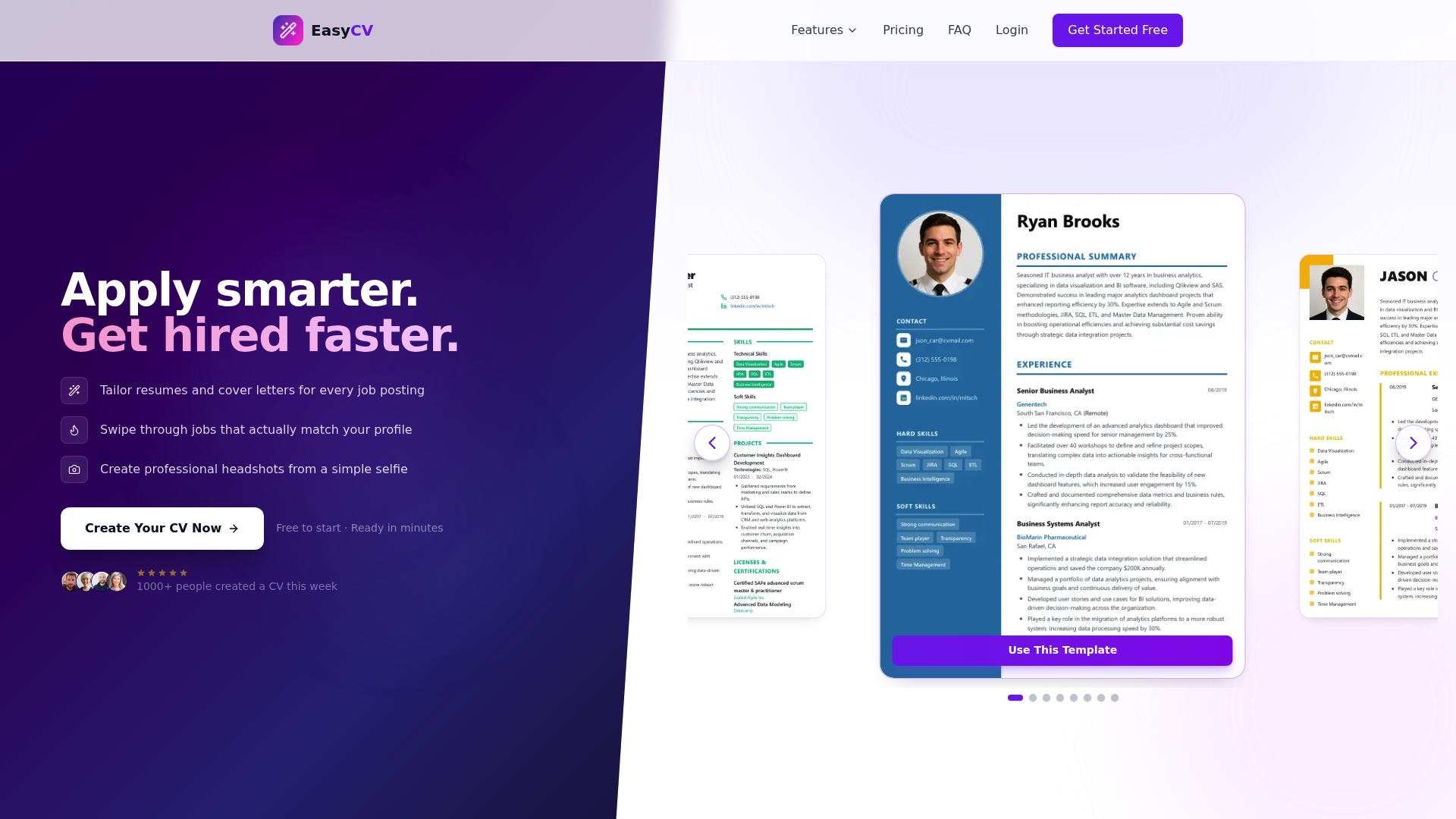
The AI-powered CV builder generates and refines professional content based on the specific role you are targeting, so your keywords match the job description without manual line-by-line editing. The job matcher scores openings against your profile so you spend time on roles where you actually have a strong fit. With 10 million-plus job opportunities added monthly and new listings available within minutes, you get to postings fast enough to act within that critical 24-hour window. Easy-cv also includes ATS-friendly templates and an AI headshot generator, giving your application a polished, professional look from the first click.
FAQ
How many jobs should a student apply to each week?
Career counselors recommend sending 5–10 highly tailored applications per week to a shortlist of 15–25 target companies. That focused approach produces significantly higher interview rates than mass applying.
When should students start looking for internships?
Start researching and applying 6–8 months before your target start date. Many programs post openings early and fill them on a rolling basis, so early action is a real advantage.
What is the STAR method for interviews?
STAR stands for Situation, Task, Action, and Result. It is a framework for answering behavioral interview questions with clear, structured stories drawn from your coursework, jobs, or activities.
Do employers care if students have no work experience?
Employers hiring interns prioritize transferable skills, communication, and demonstrated initiative over prior industry experience. Projects, volunteer work, and coursework all count when framed correctly.
How do students find unadvertised job openings?
Informational interviews with alumni, adjunct professors, and professional contacts reveal roles before they are posted publicly. Targeted cold outreach with specific questions, not direct job requests, produces the best response rates.