Quantifiable Achievements on Your CV: A Practical Guide

Quantifiable achievements are the single most effective way to turn CV duty lines into evidence of impact. A recruiter scanning your resume does not want to know what you were responsible for. They want to know what happened because of you, and a number answers that faster than any adjective.
Here is what that looks like in practice:
-
Before: Managed social media accounts for the company.
-
After: Grew Instagram following significantly over several months, increasing inbound leads noticeably.
-
Before: Responsible for customer support operations.
-
After: Led a team of agents handling hundreds of tickets daily, maintaining a high CSAT score over an extended period.
TL;DR: Add at least one specific number to your top bullet for every role. That single change does more for your CV than rewriting every sentence.
Table of Contents
- Why quantifiable achievements matter to recruiters and ATS
- What metric types count as a quantifiable achievement
- How to turn a duty line into a quantified achievement
- Before-and-after examples across common roles
- Where to place quantified achievements and how to format them for ATS
- Common mistakes that undermine your credibility
- Frameworks, templates, and a checklist for writing quantified bullets
- Key Takeaways
- Why most CVs still get this wrong
- Easy-cv makes quantifying your CV faster
- Recommended sources and further reading
Why quantifiable achievements matter to recruiters and ATS
Numbers do something qualitative language cannot: they compress a complex claim into a fast, defensible signal. Resume strategists describe metrics as the “so what” factor that makes a bullet convincing. Without a number, “improved team performance” is an opinion. With one, “improved team performance by 35% over two quarters” is evidence.

Recruiters typically spend seconds on an initial scan. A quantified bullet stops that scan because the eye catches digits before words. That is not a soft preference. It is how visual attention works on a dense page of text. The number earns the recruiter’s second look.
ATS systems add another layer. When your bullet reads “reduced customer churn by 18%,” the word “churn” sits next to a metric and an action verb. That proximity reinforces keyword relevance for roles where retention is a core competency. Keyword density alone does not win ATS ranking, but pairing metrics with action verbs produces the kind of contextually rich language these systems score well.
The hiring-risk angle is the one most job seekers miss. A hiring manager approving a $90,000 salary is making a bet. A CV that says “drove revenue growth” gives them nothing to anchor that bet on. A CV that says “closed $1.4M in new ARR in FY2024, exceeding quota by 31%” reduces the perceived risk of that bet considerably. Resumes with five or more quantified achievements received interview requests at multiple times the rate of qualitative-only resumes in practitioner studies.
What metric types count as a quantifiable achievement
Almost every job produces measurable outcomes. The challenge is knowing which unit to reach for. Here is a practical taxonomy:
Revenue and financial impact. Dollar amounts are the most universally legible metric. Closed $2.1M in new contracts. Managed a $4.5M annual budget. Reduced vendor spend by $180K without cutting output.
Percentage change. Percentage works when the absolute number is confidential or less meaningful than the rate of change. Increased conversion rate by 14%. Cut defect rate by 28%. Grew organic traffic 60% in six months.
Efficiency and time saved. Time is concrete and relatable. Reduced deployment cycle from 3 weeks to 4 days. Cut onboarding time by half. Automated a reporting process that previously took 6 hours per week.

Scale and scope. These signal operating level and ownership even when no change metric exists. Managed a team of 12 across three time zones. Oversaw a portfolio of 40 enterprise accounts. Administered infrastructure serving 200,000 daily active users.
Volume and frequency. Useful for support, operations, and logistics roles. Processed 300+ invoices per week. Resolved 40+ tickets daily. Coordinated 15 product launches per year.
Quality and customer metrics. CSAT, NPS, error rate, and retention all count. Maintained a 98% first-call resolution rate. Achieved a Net Promoter Score of 72. Reduced return rate from 9% to 3%.
Technical performance. Latency, uptime, and error rates are standard in engineering roles. Reduced API response time from 800ms to 210ms. Maintained 99.97% uptime across production systems.
When money or percentage is not available, scope numbers, time frames, and relative changes still make impact credible. “Managed a team of six serving 200,000 users” tells a recruiter exactly what level you operated at.
How to turn a duty line into a quantified achievement
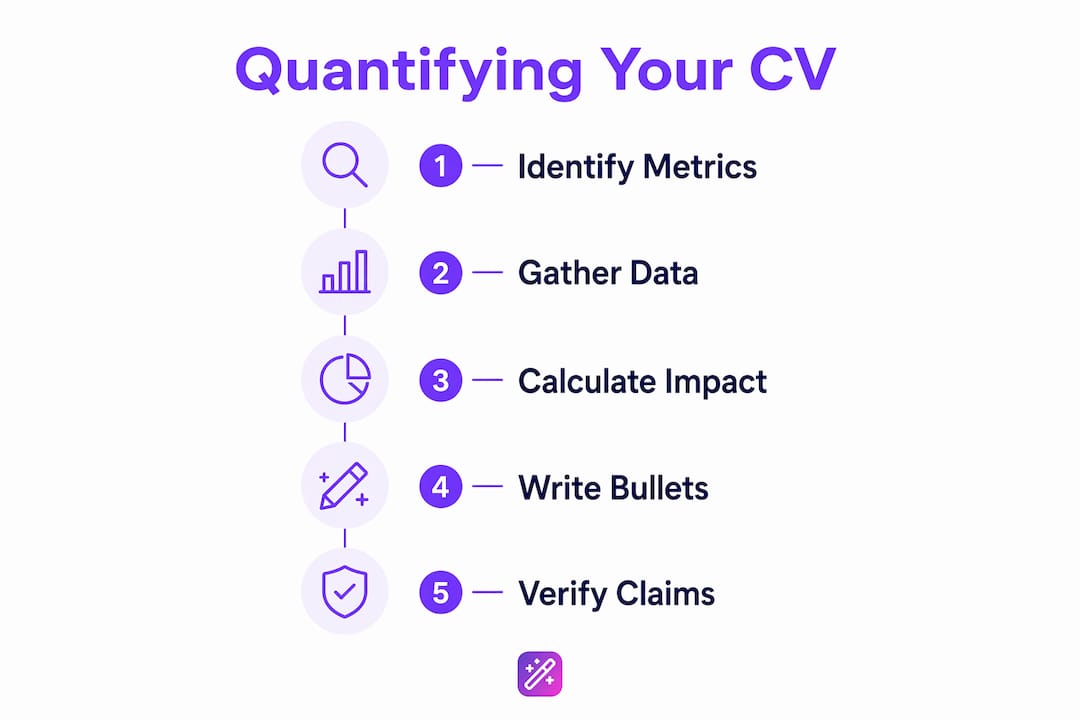
This is where most people get stuck. They know they should add numbers, but they do not know where the numbers come from. Here is a repeatable process:
-
Identify the outcome. Ask: what changed because I did this work? Revenue went up. Errors went down. A process got faster. A team grew. Start with the change, not the task.
-
Find your source data. Check dashboards (Google Analytics, Salesforce, Jira, Zendesk), performance reviews, project post-mortems, emails with results, or quarterly reports. Objective, trackable dashboard metrics are the gold standard. If you no longer have access, move to step 3.
-
Reconstruct from memory and context. Think in baselines. What was the number before you started? What was it when you left? If you cannot recall exact figures, use relative language: “roughly doubled,” “cut by about half,” “from approximately 20 to 45.” A defensible approximation beats a vague duty line every time.
-
Calculate the metric. Convert raw data into a CV-ready unit. If sales went from $800K to $1.1M, that is a 37.5% increase, or you can state the absolute gain: $300K. If a process took 4 hours and now takes 45 minutes, that is an 81% reduction. Pick whichever unit is more impressive and more verifiable.
-
Write the bullet using CAR or XYZ. CAR: Challenge, Action, Result. XYZ: Accomplished X, as measured by Y, by doing Z. Both force you to lead with the outcome and anchor it to a number.
Example calculation: You managed email marketing and want to quantify your impact. Your records show the welcome sequence had a 12% trial-to-paid conversion rate before your rewrite, and 19% after. That is a 58% relative improvement, or you can state it as “lifted trial-to-paid conversion from 12% to 19%.” Either version is defensible. The second is slightly more credible because it shows both data points.
Pro Tip: Write down the source for every number you use — the dashboard, the email, the review. You will be asked about these figures in interviews, and being able to say “that came from our Salesforce Q3 report” is the difference between a confident answer and a stumble.
Before-and-after examples across common roles
The table below shows one before and one after for seven common functions, along with the metric type each rewrite uses.
| Role | Before (duty) | After (quantified achievement) | Metric type |
|---|---|---|---|
| Sales | Managed a territory and met sales targets. | Closed substantial new ARR in the last fiscal year and consistently exceeding quota for multiple quarters. | Revenue + % change |
| Marketing | Ran email marketing campaigns. | Rebuilt the welcome sequence, significantly improving trial-to-paid conversion and increasing annual recurring revenue | % change + revenue |
| Engineering | Improved application performance. | Reduced API latency markedly, cut timeout errors, and improved user retention. | Technical perf + % |
| Customer support | Handled support tickets. | Resolved many tickets daily while maintaining a strong CSAT score for over a year | Volume + quality |
| Operations | Managed vendor relationships and procurement. | Renegotiated contracts with several vendors, significantly reducing annual spend without service disruption | Revenue (cost) |
| HR / People | Supported recruiting and onboarding. | Halved time-to-hire by building a structured interview process and reducing agency fees substantially annually | Time + revenue |
| Admin / Project management | Coordinated cross-functional projects. | Delivered multiple product launches on schedule in under a year, coordinated several teams, and managed a substantial budget | Volume + scope |
A few things to notice across these rewrites. Every after bullet opens with a strong action verb. Every one carries at least one number. None of them describe a task. They describe what happened. That is the structural shift that matters, and it applies regardless of role or industry.
For sales and marketing, revenue and percentage change are the natural units. For engineering, latency and error rates signal technical depth. For HR, time-to-hire and cost savings translate people work into business impact, which is exactly what a CFO or COO wants to see. Tailoring these metrics to the specific role you are applying for sharpens the signal further.
Where to place quantified achievements and how to format them for ATS
Placement matters as much as the numbers themselves. Here is where metrics do the most work:
- Professional summary. One concrete proof point in your 2–4 line summary anchors the whole document. “Sales manager with 7 years of experience, consistently exceeding quota by 20%+ and closing $1M+ in annual new business” tells a recruiter everything before they read a single bullet.
- Top bullet for each role. Lead every position with your strongest quantified achievement. Recruiters skim top bullets first. If the first line is a duty, the rest of the role gets less attention.
- Projects section. Scope, budget, and outcome numbers belong here. “Led migration of 3 legacy systems to AWS, reducing infrastructure costs by 34% and cutting deployment time from 2 weeks to 3 days.”
- Leadership highlights. Team size, budget owned, and headcount managed signal seniority faster than any title.
On format, two well-crafted quantified bullets outperform a list of vague duty statements. Aim for 8–15 strong quantified statements across the full CV, with at least one measurable result per role. For recent positions, three to six bullets is the right range. Older roles can carry fewer.
For ATS compatibility, keep bullets in plain text with no tables, text boxes, or graphics inside the bullet block. Use standard section headers (“Experience,” “Skills,” “Education”). Place your metric close to the action verb and the relevant keyword. “Reduced customer churn by 18% through a loyalty program redesign” keeps “churn,” the metric, and the action in the same sentence, which is exactly what an ATS parser needs to score the line correctly. More detail on ATS-friendly formatting is worth reviewing before you finalize your layout.
Common mistakes that undermine your credibility
Adding numbers to a CV is not automatically good. The wrong numbers, or numbers used the wrong way, can hurt more than help.
Fake precision. “Increased revenue by 23.7%” reads as manufactured. Rounded numbers and ranges are more credible than suspiciously exact decimals. “Increased revenue by roughly 24%” or “between 20% and 25%” signals honest estimation. A hiring manager who asks about that figure in an interview will trust a range you can explain over a decimal you cannot.
Unverifiable claims. If you cannot reconstruct how you arrived at a number, do not use it. “Saved the company $4.2M” with no supporting context invites a follow-up question you cannot answer. Scope it: “Identified $4M+ in cost-saving opportunities across 3 vendor contracts, of which $1.8M was implemented in FY2024.”
Irrelevant metrics. A metric is only useful if it connects to the role you are applying for. A customer support manager listing server uptime percentages on a people-management role is adding noise, not signal. Ask: does this number tell the hiring manager something they care about for this specific job?
Claiming full credit for shared outcomes. If you were one of five people on a project that hit $2M in revenue, you cannot write “generated $2M in revenue.” You can write “contributed to a cross-functional initiative that generated $2M in revenue” or “owned the outbound channel that accounted for $400K of a $2M campaign result.” Attribution matters, and interviewers will probe it.
Pro Tip: For any confidential figure, use a relative or percentage-based version instead of the absolute number. “Reduced costs by 31%” is just as strong as “$310K saved” and does not expose proprietary data.
Avoiding common resume mistakes around exaggeration and vague language is as important as adding the numbers in the first place.
Frameworks, templates, and a checklist for writing quantified bullets
Three formulas cover nearly every situation. CAR is the default for concise bullets; STAR suits complex stories that need context before the action makes sense.
| Framework | Structure | Best for | Example |
|---|---|---|---|
| CAR | Challenge → Action → Result | Most bullets; keeps it tight | Faced rising churn; redesigned onboarding flow; reduced churn significantly. |
| XYZ | Accomplished X, as measured by Y, by doing Z | When the result leads naturally | Grew organic traffic 60% (Y) by rebuilding the content strategy around long-tail keywords (Z). |
| STAR | Situation → Task → Action → Result | Complex achievements needing context | After a merger left two support teams misaligned, I consolidated workflows and cut average handle time from 9 to 5 minutes. |
Fill-in-the-blank templates you can copy:
-
[Action verb] + [metric or outcome] + by [doing what] + in [time frame]. Example: “Reduced onboarding time by 40% by building a self-serve knowledge base, cutting support load by 15 tickets per week.”
-
[Action verb] + [scope/scale] + achieving [result]. Example: “Managed a portfolio of 35 enterprise accounts, achieving 118% of annual renewal target.”
-
[Action verb] + [problem] + resulting in [measurable outcome]. Example: “Automated weekly reporting that previously required 6 manual hours, freeing the team for higher-priority analysis.”
One-page checklist for sourcing and writing defensible metrics:
- Pull dashboards, performance reviews, project post-mortems, and email threads with results before you start writing.
- For each role, ask: what changed in revenue, cost, time, quality, or scale because of my work?
- If exact data is unavailable, reconstruct a relative baseline (“doubled,” “cut by half,” “from X to Y”) and use a range or qualifier (“approximately,” “roughly”).
- Convert raw data to a CV-ready unit: percentage change, absolute dollar figure, time saved, or volume per period.
- Write the bullet using CAR or XYZ. Lead with an action verb. Put the metric where a skimming eye will catch it.
- Check: is this number defensible in a 30-second interview answer? If not, scope it down or use a range.
- Verify every figure before sending. One wrong number that gets challenged in an interview undermines everything else on the page.
When exact figures are missing, relative changes and scope numbers still carry weight. “Cut deploy time by half” or “managed a team of six serving 200,000 users” communicates operating level without requiring a dashboard export. In high-volume hiring environments, where AI tools are increasingly used to screen candidates, metrics-rich bullets help your application clear automated filters before a human ever reads it.
Key Takeaways
Numbers on a CV are not decoration. They are the fastest signal of impact a recruiter has, and a CV with multiple quantified achievements consistently outperforms one built on duty lines alone.
| Point | Details |
|---|---|
| Lead every role with a metric | Your top bullet for each position should carry at least one specific number. |
| Use CAR as your default formula | Challenge, Action, Result keeps bullets tight and recruiter-ready for most situations. |
| Ranges beat fake precision | Honest approximations (“roughly 24%”) are more credible than suspiciously exact decimals. |
| Document your sources | Record where each number came from so you can defend it confidently in an interview. |
| Easy-cv speeds the process | Easy-cv’s AI writing assistant and ATS-friendly templates help you draft and place quantified bullets faster across every application. |
Why most CVs still get this wrong
The conventional advice is “add numbers to your resume.” That is correct but incomplete, and the gap between the advice and the execution is where most CVs fall apart.
The real problem is not that job seekers do not know numbers matter. It is that they do not know how to find the numbers they actually have. They assume that because they did not track metrics obsessively during the job, they have nothing to quantify. That assumption is almost always wrong.
Every role leaves a trail. Performance reviews mention targets and whether you hit them. Project emails contain before-and-after comparisons. Managers reference headcount and budget in passing. A Salesforce export from three years ago is probably still accessible if you ask the right person. The work of quantifying a CV is mostly detective work, not math.
The second mistake is treating every metric as equally valuable. A number that does not connect to the role you are applying for is clutter. A customer success manager applying for a VP of Sales role should lead with revenue retained and expansion ARR, not CSAT scores, even if the CSAT number is impressive. Metrics earn their place by answering the specific question a hiring manager has about your candidacy.
One thing worth saying plainly: conservative, verifiable numbers are always stronger than inflated ones. A candidate who says “I contributed to a project that generated roughly $800K in new revenue, and I can walk you through my piece of it” is more credible than one who claims sole credit for $2M with no supporting detail. Defensibility is the standard, not impressiveness.
Easy-cv makes quantifying your CV faster
Knowing what to write is half the work. Getting it onto a clean, ATS-ready CV quickly is the other half, and that is where Easy-cv closes the gap.
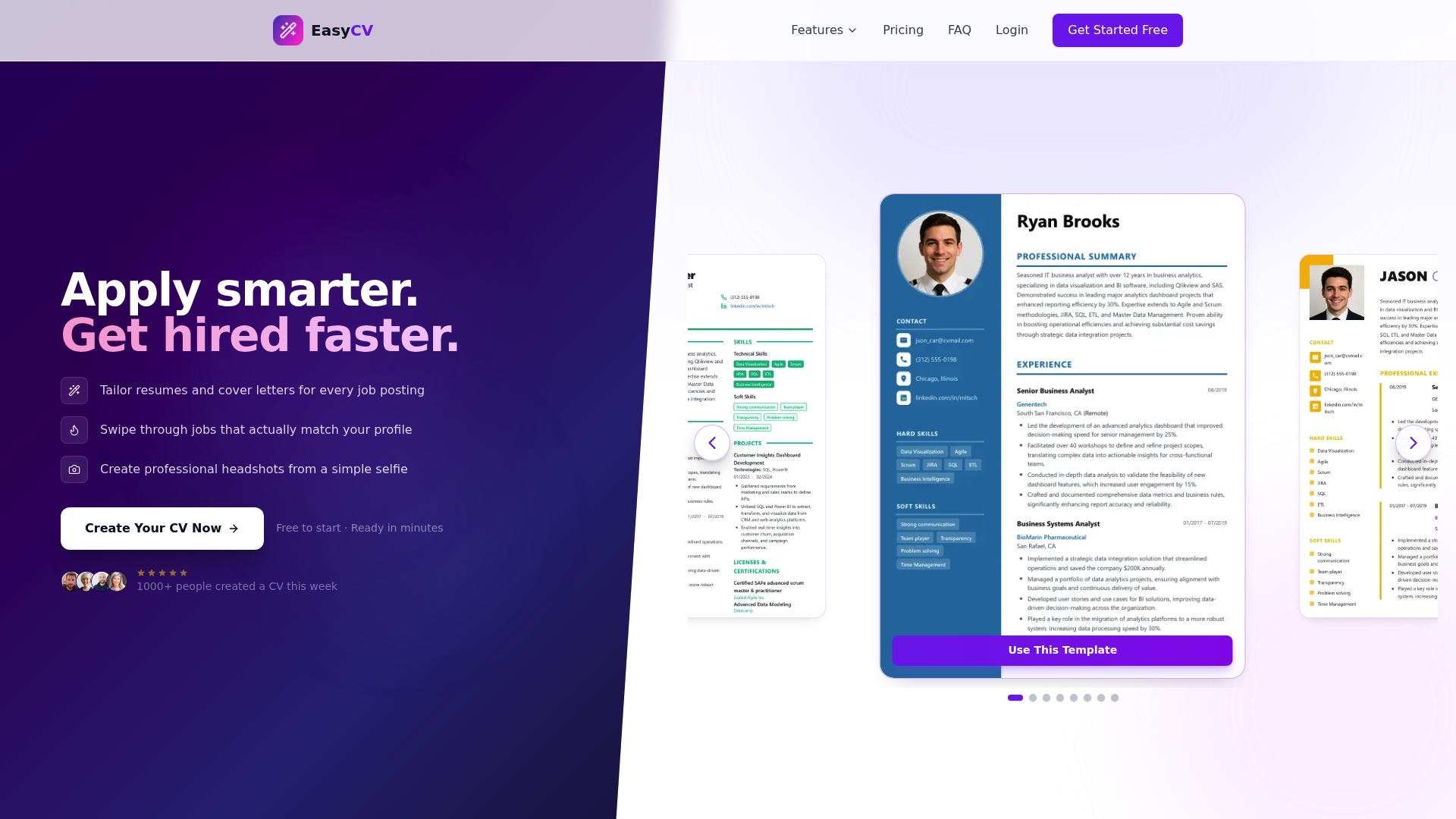
Easy-cv’s AI writing assistant drafts and refines achievement bullets directly in the editor, matching your content to the language of the job posting you are targeting. Instead of staring at a blank bullet and trying to remember your Q3 numbers, you get a working draft you can sharpen with your real figures. The job matcher pre-scores roles against your CV so you know which positions your current metrics align with before you apply, saving you from tailoring the wrong applications. For international applicants, the CV translator carries your quantified achievements across 30+ languages without breaking the formatting or the numbers.
Every template in the builder is ATS-friendly and designed to put your strongest bullets where recruiters look first. Try the Easy-cv builder free and see how fast a metrics-driven CV comes together when the structure is already there.
Recommended sources and further reading
These are the most useful resources for going deeper on quantified achievements, whether you want more examples, better templates, or a stronger understanding of what recruiters actually look for.
-
Indeed: How to Quantify Resume Accomplishments — Practical guidance from one of the largest job platforms in the US, with examples across industries and a clear breakdown of the four key metric types (money, people, time, rankings). Good starting point for anyone new to quantification.
-
Resume Writing Guide 2026 | Roleframe — A modern, opinionated guide that covers the shift from responsibilities to quantified achievements, with strong before/after examples and the 5 P’s and 3 C’s frameworks for self-checking your CV.
-
Easy-cv Blog: The Role of Achievements in Resumes — Deeper examples of converting duties into CAR/STAR bullets, with context on why achievements catch recruiter attention at the scan stage.
-
Easy-cv Blog: CV Optimization Tips — Covers formatting, ATS considerations, and placement strategy for quantified bullets, useful once you have your numbers ready and need to structure the page.
-
Your own dashboards and performance reviews. Before consulting any external resource, pull your Salesforce reports, Jira velocity data, Google Analytics exports, or past annual reviews. The numbers you already have, even approximate ones, are more valuable than any template.