The Real Role of Career Coaching for AI-Powered Job Seekers

Career coaching gives you something no algorithm can: a clear, honest read on how you come across and why that matters to hiring managers. Career advocate Amanda Miller describes the core benefit as delivering clarity, helping clients reframe years of experience into a coherent narrative and reduce anxiety during transitions. The Interagency Working Group on Career Guidance (2025) goes further, framing career guidance as a lifelong skill-builder, not a one-time fix. If you’re already using a platform like Easy-cv to tailor applications and track outreach, coaching fills the gap AI can’t close: the psychological shift and story alignment that turn a polished CV into a compelling case.
The verdict: coaching adds measurable value when you’re stuck, pivoting, or preparing for high-stakes interviews. If you’re in an active, well-targeted search with strong messaging, AI self-serve tools often cover the ground.
Table of Contents
- What the role of career coaching actually looks like day to day
- How coaching and AI job-search tools actually fit together
- When should you actually hire a coach?
- What to expect: formats, timelines, and what it costs
- How to pick a coach who’s actually worth it
- Coach-style exercises you can run yourself right now
- Applying coaching recommendations inside Easy-cv: a practical workflow
- Key Takeaways
- Why combining coaching with AI is the smarter play for most mid-career job seekers
- Easy-cv puts coaching-quality outputs within reach for every job seeker
- Sources and further reading
What the role of career coaching actually looks like day to day
A coach’s core job is to help you get clear on what you want, then build the case for why an employer should want you back. That sounds simple. In practice it involves several distinct functions.
- Clarity and alignment: Identifying what you actually want vs. what you’ve defaulted into, and mapping transferable skills to realistic targets.
- Narrative building: Turning a scattered work history into a coherent story a hiring manager can follow in 30 seconds.
- Targeted outreach strategy: Prioritizing roles, companies, and contacts rather than mass-applying.
- Interview and story coaching: Practicing STAR-format answers, tightening your 60-second pitch, and handling curveball questions.
- Accountability and emotional regulation: Keeping you moving when rejection stacks up, and managing the anxiety that tanks interview performance.
Concrete deliverables from a good engagement include a prioritized job list, rewritten value statements, a one-paragraph pitch, and a decision framework for evaluating offers. The Interagency Working Group stresses that these skills compound over time, building long-term career management capacity well beyond the current search.
Pro Tip: The coaches who move the needle fastest focus on psychological shift and narrative alignment first, tactical edits second. If a coach leads with “let me fix your bullet points,” that’s a red flag.

How coaching and AI job-search tools actually fit together
They solve different problems. AI handles volume, speed, and formatting. A coach handles judgment, story, and emotional readiness. The table below maps where each earns its keep.
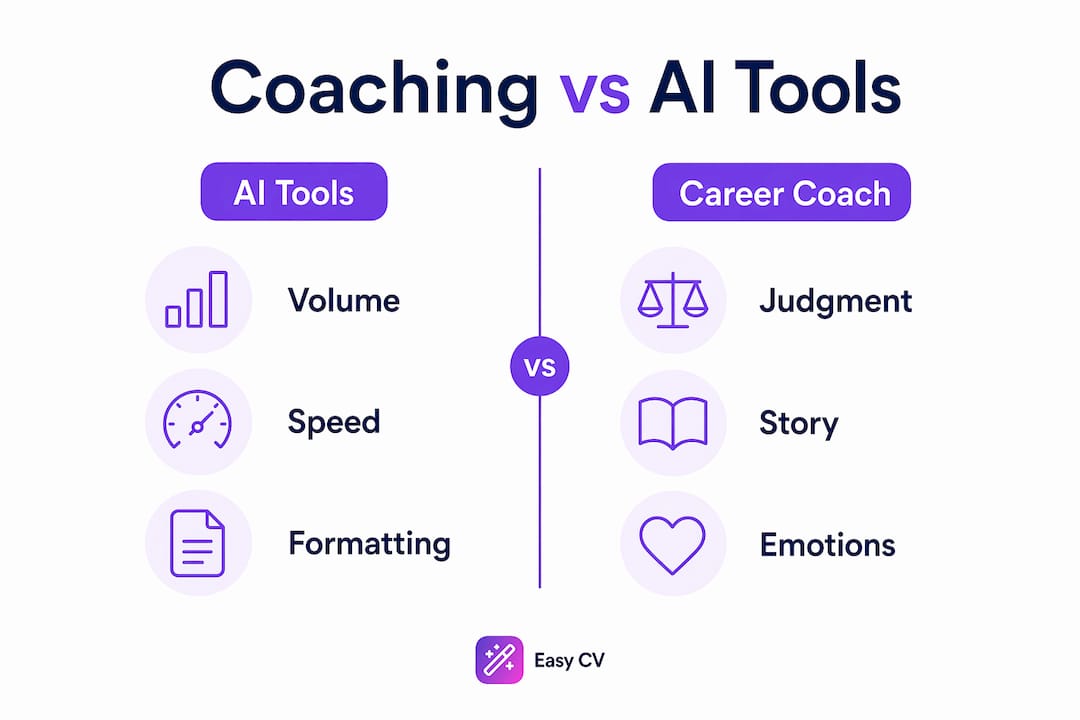
| Task | AI tools (e.g., Easy-cv) | Human career coach |
|---|---|---|
| CV tailoring per job description | Automated, fast, consistent | Slower; better for repositioning |
| Cover letter drafting | Strong first draft in seconds | Adds nuanced tone and story arc |
| Job discovery and matching | Aggregates millions of listings | Curates a short, strategic target list |
| Value proposition articulation | Rephrases; can’t invent the insight | Articulates unique fit hiring managers notice |
| Interview preparation | Practice prompts, script suggestions | Live feedback, emotional coaching |
| Negotiation strategy | General scripts | Personalized, real-time guidance |
| Long-term career management | Tracks applications | Builds career management skills |
The gap AI can’t close is judgment. Knowing which three companies to target, how to frame a career gap, or when to walk away from an offer requires the kind of contextual reasoning a coach brings. For a deeper look at how AI resume platforms fit into this picture, the distinction is worth understanding before you decide where to invest.
When should you actually hire a coach?
Not everyone needs one. Run through this checklist and see where you land.
- You’re making a significant industry or function pivot. AI tools optimize for what you’ve done; a coach helps you argue for what you want to do next.
- Your search has stalled for more than three months. Stalling usually signals a messaging problem, not a volume problem. More applications won’t fix it.
- You’re getting interviews but not offers. The CV is working. Something in the room isn’t. That’s a coaching problem.
- You’re negotiating a senior or executive offer. A single negotiation session often pays for itself many times over.
- You’re post-layoff and your confidence is low. Burnout and stress directly hurt interview performance. Coaching addresses both.
- You’re transitioning to leadership for the first time. The narrative shift from “contributor” to “leader” is harder than it looks on paper.
If none of those apply and you have clear messaging and a targeted list, AI self-serve tools like Easy-cv are likely sufficient. Treating the search as purely administrative, mass-applying without a plan, consistently produces worse outcomes than a targeted approach.
What to expect: formats, timelines, and what it costs
Coaching comes in several formats. A one-off strategy session works for a specific problem (negotiation prep, pitch refinement). A short package of four to six sessions suits a focused pivot. Long-term engagements run three to six months and cover the full arc from clarity to offer. Group coaching and asynchronous feedback (written reviews, recorded mock interviews) cost less and work well for people who are self-directed.
On timelines: messaging improvements show up within weeks. Role-targeting clarity and network expansion take one to three months. Measurable interview performance gains typically follow four to eight sessions of deliberate practice.
Pricing ranges widely. Sessions typically run $75–$500 depending on the coach’s seniority and specialization. Executive coaches and niche-industry specialists sit at the top of that range. A short package of five sessions might run $500–$2,000. The ROI question is real: one successful negotiation or a faster offer in a higher-paying role usually covers the cost. Coaching builds resilience and interview readiness, but it doesn’t guarantee an offer. Go in with that expectation.
How to pick a coach who’s actually worth it
The credential landscape is messy. ICF (International Coaching Federation) certification is the most recognized standard, but it doesn’t guarantee industry-specific expertise. Look for both.
What to look for:
- ICF credential plus direct experience in your target industry or function
- Specific client outcome examples (not vague “helped clients land roles”)
- A clear process they can walk you through in 10 minutes
- References or testimonials from people in comparable situations
Questions to ask in a discovery call:
- What does your typical engagement look like, start to finish?
- What outcomes have clients in my situation achieved?
- What won’t coaching fix for me?
- How do you handle it when a client isn’t making progress?
Red flags to walk away from:
- Guarantees of job offers or specific timelines
- No clear process, just “we’ll figure it out together”
- Inability to name a relevant client success story
- Pressure to sign a long package before a free discovery call
Learning to assess your own job skills before the discovery call helps you ask sharper questions and evaluate whether the coach’s experience actually maps to your gaps.
Coach-style exercises you can run yourself right now
You don’t need to hire anyone to get started. These three exercises produce real outputs you can feed directly into Easy-cv.
Exercise 1: Value proposition rewrite. Pull a job description for a role you want. List the three skills it emphasizes most. Write one sentence for each: “I [did X] at [company], which resulted in [measurable outcome].” That’s your raw material for a tailored CV summary.
Exercise 2: 60-second pitch using STAR. Situation, Task, Action, Result. Pick your strongest career win. Write it out in four sentences, one per element. Time yourself saying it aloud. Under 60 seconds? You have your elevator pitch.
Exercise 3: Interview run-through. Record yourself answering “Tell me about yourself” and one behavioral question. Watch it back. The filler words, the eye contact, the pace: you’ll catch things a mirror won’t show you.
Once you have these outputs, paste your value proposition into Easy-cv’s AI writing assistant to sharpen the language, then run the pitch through the cover letter generator as your opening hook.
Pro Tip: Before a high-stakes interview, spend two minutes on a slow breathing exercise (four counts in, six counts out). Emotional regulation directly improves recall and reduces the verbal stumbling that makes candidates seem less confident than they are.
Applying coaching recommendations inside Easy-cv: a practical workflow
Here’s how a coaching insight becomes a stronger application in practice.
- Step 1: Coach identifies your revised value proposition (“operations leader who cuts costs without cutting headcount”).
- Step 2: Open Easy-cv’s CV builder, paste the new positioning into your summary field, and use the AI rewriting tool to refine the language for the specific role.
- Step 3: Run the job matcher to surface roles that align with your repositioned profile. Swipe through pre-scored matches rather than browsing cold.
- Step 4: Generate a tailored cover letter using your STAR pitch as the opening paragraph.
- Step 5: Log every application in the built-in job tracker so you can spot patterns (which roles get callbacks, which don’t) and adjust your targeting.
- Step 6: If you’re applying to global roles, use Easy-cv’s CV translator to produce versions in the required language without reformatting from scratch.
The CV automation workflow handles the repetitive execution. The coaching insight is what makes each application worth sending.
Key Takeaways
Career coaching delivers the most value when it’s paired with a targeted, AI-supported application strategy rather than used as a standalone fix.
| Point | Details |
|---|---|
| Core coaching value | Coaches clarify your narrative and value proposition in ways AI tools cannot generate on their own. |
| When to hire | Pivot, stalled search over three months, interview rejections, or high-stakes negotiation are the clearest triggers. |
| Expected cost | Sessions typically run $75–$500; a short package runs $500–$2,000 depending on coach seniority. |
| Self-help starting point | Run the value proposition rewrite and STAR pitch exercises before spending on coaching. |
| Easy-cv pairing | Feed coaching outputs into Easy-cv’s AI rewriter, job matcher, and cover letter generator for faster, more targeted applications. |
Why combining coaching with AI is the smarter play for most mid-career job seekers
The conventional wisdom says you either hire a coach or you use AI tools. That framing misses the point. The job seekers who move fastest are the ones who use AI to handle volume and execution, then bring in a coach for the two or three decisions that actually change outcomes: how to position a pivot, how to walk into a negotiation, how to tell a story that makes a hiring manager lean forward.
What I’d push back on is the idea that coaching is a luxury for executives. A single well-coached negotiation can add tens of thousands of dollars to a starting salary. A repositioned narrative can cut a stalled search from six months to six weeks. The math usually works, even at $200 a session.
That said, coaching is not a magic fix. It improves resilience and readiness, not guarantees. The job seekers who get the most from it come in with clear goals, do the work between sessions, and use tools like Easy-cv to execute the strategy their coach helped them build. The combination is what produces better-fit outcomes faster, not either one alone.
Easy-cv puts coaching-quality outputs within reach for every job seeker
Most job seekers don’t need a coach for every step. They need one for the hard decisions, and a fast, capable platform for everything else. Easy-cv covers the execution side completely: AI-tailored CVs and cover letters for every application, a swipe-based job matcher that pre-scores roles against your profile, a built-in job tracker, and CV translation across 30+ languages for global searches.
If you’ve just worked through the STAR pitch exercise or rewritten your value proposition with a coach, Easy-cv is where that work gets applied at scale. Paste your new summary, generate a tailored cover letter, and start matching against 10 million+ monthly listings in minutes. Start your search at Easy-cv and put your coaching insights to work immediately.
Sources and further reading
- Amanda Miller, The Benefits of Working with a Career Coach — Your Career Advocate: Used for clarity, narrative alignment, and anxiety-reduction claims in the opening and core functions sections.
- Interagency Working Group on Career Guidance (2025) — ETF Joint Statement: Source for long-term career management skills framing and the lifelong guidance perspective.
- UVM PACE, 10 Benefits of Career Coaching (2026): Used for value proposition articulation, targeted vs. mass-apply outcomes, and program format examples.
- BetterUp, What Is Career Coaching?: Source for resilience, emotional regulation, and realistic ROI expectations.
- Coursera, What Is a Career Coach?: Source for the $75–$500 per-session pricing range cited in the cost section.