How to Write a Quality Assurance Engineer Resume That Gets Interviews
A strong resume of quality assurance engineer must prove three things in the first ten seconds: what product you tested, which automation stack you actually ran, and what measurably improved because of you. Skip the duties list. Recruiters scan for scope, tools, and impact, in that order.
Here’s a copyable summary you can adapt right now:
“QA Engineer with 4 years testing B2C SaaS platforms. Skilled in API testing, CI/CD integration, and cross-functional bug triage.”
Swap the years, product type, and numbers for your own, then drop it into an ATS-friendly template to format it correctly.
Every quality assurance resume needs these elements, regardless of seniority:
- A headline naming your specialty (manual, automation, or hybrid QA)
- Product scope (mobile, SaaS, embedded, e-commerce)
- One named automation framework, such as Selenium, Cypress, or Playwright
- A CI/CD tool reference (Jenkins, GitHub Actions, GitLab CI)
- Two to three bullets with real numbers attached
- A skills block and a certifications line (ISTQB matters here)
Key Takeaways
A quality assurance resume earns interviews when it proves product scope, names a specific automation stack, and attaches real numbers to at least two or three achievements.
| Point | Details |
|---|---|
| Lead with scope and impact | Name your product type and automation framework in the first two lines, not just your job title. |
| Rewrite duties as achievements | Convert “responsible for testing” into a metric like reduced regression time or lowered defect escape rate. |
| Separate certifications visibly | List ISTQB or CAST in their own labeled section so recruiters spot them during a fast scan. |
| Keep layout single-column | Avoid tables, sidebars, and images that cause ATS parsers to scramble or drop content. |
| Use Easy-cv to tailor fast | Easy-cv’s ATS-friendly templates and AI tailoring match your resume’s language to each job description in minutes. |
Table of Contents
- Quality Assurance Resume Examples for Every Career Stage
- How Do You Write Each Section of a QA Resume?
- Turning QA Responsibilities Into Achievement Bullets
- Which QA Skills and Certifications Matter Most?
- How Do You Get a QA Resume Past ATS Filters?
- What Resume Layout Works Best for QA Engineers?
- Final QA Resume Checklist Before You Apply
- What Do Hiring Managers Actually Look For in QA Resumes?
- Build Your QA Resume Faster With Easy-cv
- Frequently Asked Questions
- Sources
Quality Assurance Resume Examples for Every Career Stage
The gap between a junior and senior QA engineer resume isn’t length. It’s what the resume claims ownership over. A junior candidate lists tools they used. A senior candidate describes a test strategy they designed. Here’s how that plays out across three copyable examples.

Entry-level QA resume (one page). Lead with a projects section instead of a thin work history. If you tested a personal app, contributed to an open-source repo, or wrote automated tests in a bootcamp capstone, that goes near the top.
“Computer Science graduate with hands-on testing experience through academic projects and a QA internship. Wrote 40+ automated test cases in Selenium WebDriver for a course-project web app; identified and logged 15 defects using JIRA during a 3-month internship at a local startup.”
Mid-level QA resume (one page). This is where ownership language enters. You’re not just running tests anymore; you own a suite, a release process, or a testing standard.
“QA Engineer with 3 years owning end-to-end release testing for a fintech mobile app. Partnered with 4 engineering teams to establish a shared bug-severity taxonomy in JIRA, cutting triage meeting time in half.”
Senior QA resume (one to two pages). TechieCV’s guidance is right that senior resumes need to show test strategy, not just test execution. A second page is acceptable here if it’s carrying real leadership and metric weight, not padding.
“Senior QA Engineer leading test strategy across multiple microservices for a B2B SaaS platform with a large user base. Designed the organization’s shift-left testing framework, significantly reducing production defect escapes year over year. Mentored junior QA engineers and led automation tooling migration from Selenium to Playwright.”
Export any of these to Word or PDF, but check formatting after export. Simple resume templates and clean single-column layouts avoid the parsing errors that come from tables and text boxes. Easy-cv’s template library gives you ATS-safe layouts by default, and the Job Matcher can surface QA roles pre-scored against your existing resume, so you know which version to send where.
Pro Tip: Keep one “master” resume with every project and metric you’ve ever logged, then trim it down for each application. It’s faster than rebuilding from scratch every time.
How Do You Write Each Section of a QA Resume?
Each section of a QA engineer CV format does a specific job. Get the order and content right, and the resume reads itself to a recruiter in under 20 seconds.
-
Header. Full name, city and state (or “Remote, US” if applicable), phone number, a professional email, and a link to GitHub or a portfolio if you have automation scripts worth showing. Skip your full street address and a photo, neither helps and some ATS platforms choke on images.
-
Summary or objective. Junior candidates should write an objective naming the role they want and one strength: “Aspiring QA Engineer seeking to apply automation testing skills from academic projects to a SaaS testing team.” Career changers should name the transferable skill directly: “Former customer support lead transitioning into QA, bringing 5 years of hands-on product knowledge and a completed ISTQB Foundation certification.” Senior candidates should lead with scope and one metric, as shown in the examples above.
-
Professional experience. Structure every role the same way: one line of context (company, product, team size), then 3 to 5 achievement bullets. Start each bullet with a strong verb, Indeed’s resume guidance recommends verbs like “designed,” “automated,” “reduced,” and “implemented” over passive phrasing like “was responsible for.”
-
Projects and test suites. If you built a personal automation framework or contributed tests to an open-source project, treat it like a work entry. Name the tool, the scope, and what it demonstrated, not just that it exists.
-
Skills and technical stack. List tools that match the job description’s exact wording. If the posting says “test automation frameworks,” don’t just write “automation,” write the specific frameworks you know.
-
Certifications and education. Put certifications in their own labeled section, not buried in skills. ISTQB, CAST, or a Scrum credential each signal something different to a hiring manager scanning fast.
Pro Tip: If you’re short on quantifiable experience, quantify effort instead of outcome: “Executed 200+ manual test cases across 3 release cycles” still shows scale even without a business metric attached.
Turning QA Responsibilities Into Achievement Bullets
Hiring guides consistently push the same point: quantify the outcome, not the task. Here’s what that rewrite actually looks like in practice.
Before: “Responsible for testing new features before release.” After: “Tested and validated 12+ features per sprint across a 2-week release cycle, catching an average of 8 critical bugs before production.”
Before: “Wrote automated tests using Selenium.”
Before: “Worked with developers to fix bugs.” After: “Led weekly bug triage with a team of 6 engineers, reducing average bug resolution time from 5 days to 2.”
Use these metric categories as templates for your own bullets:
- Regression time reduced (hours or days saved per cycle)
- Defect escape rate lowered (percentage drop in production bugs)
- Test coverage increased (percentage of codebase or features covered)
- Release velocity improved (cycles shipped per quarter, or time-to-release shortened)
For specialized testing, adapt the same pattern: API testing bullets should name the tool (Postman, REST Assured) and endpoint count tested; performance testing bullets should cite load thresholds; accessibility testing bullets should reference WCAG compliance level achieved.
Pro Tip: No hard number available? Pull it from sprint reports, JIRA dashboards, or release notes; most teams already track this data, you just haven’t looked for it yet.
Which QA Skills and Certifications Matter Most?
The tool list on a QA resume matters less than most candidates think. What matters is showing you used the tool inside a real workflow, not that you can spell it correctly.
High-priority technical skills to feature: UI automation frameworks, API testing, CI/CD pipeline integration, and at least one programming or scripting language (Python, Java, or JavaScript, depending on your stack).
Here’s how to present the tools recruiters expect to see:
- Selenium or Playwright — name the language binding you used (Java, Python) and the scale of the suite you built or maintained.
- JIRA — mention it alongside a workflow action, like “managed defect lifecycle in JIRA across 3 sprints,” not just a bare listing.
- Postman — reference the number of endpoints or services tested, if you have that figure.
- Jenkins or GitHub Actions — note whether you configured the pipeline or just consumed test results from it; that distinction matters to senior roles.
- TestRail or Cypress — mention test case volume or the type of application (web, mobile) tested.
On certifications, ISTQB Foundation Level is the most broadly recognized entry point and worth listing even if it’s your only one. CAST carries weight in the US market specifically. A Scrum certification (CSM or PSM) helps if the role emphasizes agile collaboration over pure technical testing.
Soft skills deserve real bullets too, not a buzzword line. Try: “Facilitated weekly cross-functional standups between QA, dev, and product to align on release readiness” or “Mentored 2 junior testers on writing maintainable test scripts.” That shows collaboration without wasting a whole section on adjectives.
How Do You Get a QA Resume Past ATS Filters?
Applicant tracking systems reject qualified candidates constantly, usually over formatting, not content. Fixing this is mechanical, not creative.
-
Mirror the job description’s exact phrasing. If the posting says “quality assurance engineer,” use that exact title, not “QA specialist,” even if they mean the same thing to a human. Repeat your top 3 to 5 required skills verbatim somewhere in your experience or skills section.
-
Choose the right file format. PDF works with most modern ATS platforms and preserves formatting, but some older systems parse DOCX more reliably. When a posting doesn’t specify, PDF is the safer default in 2026.
-
Avoid formatting that breaks parsers. Skip tables, text boxes, headers and footers holding critical information, and multi-column layouts. ATS software often reads these out of order or drops them entirely, turning your carefully written bullets into scrambled text.
-
Use standard section headers. “Professional Experience” and “Education” parse correctly. Creative alternatives like “My Journey” or “Where I’ve Been” often don’t.
A quick dos and don’ts pass before submitting: no embedded images, no special characters in bullet points, no fonts an ATS might not recognize. Easy-cv’s export tool checks for these issues automatically and can tailor your resume’s keyword match to a specific job description in a few minutes.
Pro Tip: Paste your finished resume into a plain-text editor. If sentences run together or sections disappear, an ATS will likely have the same problem.
What Resume Layout Works Best for QA Engineers?
Layout choice depends heavily on where you are in your career, and getting it wrong signals inexperience faster than a typo does.
For early-career candidates: lead with education and projects, then experience, then skills. You don’t have enough work history yet to lead with it, and that’s fine.
For candidates with 3 or more years of experience: lead with a summary, then professional experience, then skills and certifications, with education at the bottom.
A single-column layout consistently outperforms two-column or sidebar designs for ATS compatibility, since many parsers read left to right and can scramble sidebar content into the wrong order. Save icons and colored sidebars for portfolio sites, not the resume itself.
Stick to one or two standard fonts (Calibri, Arial, or Georgia), 10 to 12 point body text, and 0.5 to 1 inch margins. One page suffices for anyone under 7 years of experience; two pages are acceptable for senior or staff-level QA engineers with genuine leadership scope to show.
When exporting, name your file clearly: “FirstName_LastName_QA_Resume.pdf” beats “resume_final_v3.pdf” for both ATS parsing and human recruiters skimming a downloads folder.
- Early-career order: header, summary, education/projects, experience, skills, certifications
- Experienced order: header, summary, experience, skills, certifications, education
Pro Tip: If you’re deciding between one page and two, cut ruthlessly before you expand. A tight one-page resume usually beats a padded two-page one at the recruiter-screen stage.
Final QA Resume Checklist Before You Apply
Run this checklist immediately before submitting, most rejections at this stage come from fixable mistakes, not weak experience.
- Verify tense consistency: past roles in past tense, your current role in present tense.
- Double-check spelling of every framework and tool name (Selenium, not “Selinium”; Cypress, not “Cypres”).
- Confirm every metric in your bullets is one you could actually explain in an interview.
- Replace passive phrases (“was involved in”) with active verbs (“built,” “led,” “reduced”).
- Test every link, GitHub, portfolio, LinkedIn, to confirm they open correctly.
- Recheck your contact information for typos, especially your email address.
The most common QA-specific mistake is a long tool list with zero context attached. Ten tools with no scope tells a recruiter nothing; three tools tied to real outcomes tell them everything.
Pro Tip: Read your resume out loud, then export it to PDF and open it on a phone. Awkward phrasing and formatting breaks both show up faster this way than staring at it on your laptop screen.
What Do Hiring Managers Actually Look For in QA Resumes?
The Bureau of Labor Statistics tracks quality-control and inspection occupations as a distinct category with its own wage and task data, underscoring that QA is treated as a specialized discipline with its own hiring criteria, not a generic engineering catch-all. That specialization shows up directly in what recruiters scan for first.
Recruiters typically look for three things in this order: your current or most recent product scope, the automation framework you named, and the CI/CD systems you worked inside. Everything else on the page supports those three signals.
Certification recognition through bodies like ISTQB helps during recruiter screens, particularly in regulated industries like finance and healthcare, where formal testing training carries real weight. Listing certifications in their own clearly labeled section, rather than folding them into a skills list, makes them easier for a recruiter to spot in a fast scan.
That single formatting choice, a dedicated certifications section, shows up repeatedly in Indeed’s structural guidance for QA resumes, and it costs nothing to implement.
A note from Andras
I’ve spent years watching QA candidates undersell themselves by listing tools instead of outcomes, and it’s the single most fixable mistake on this list… Easy-cv’s ATS-friendly templates, AI tailoring, and job matcher exist specifically to remove the formatting guesswork so you can focus on the content that actually gets interviews…
Build Your QA Resume Faster With Easy-cv
Easy-cv turns the advice in this guide into a working document in minutes instead of hours. You get an ATS-friendly template library built specifically to survive the parsing issues that trip up hand-formatted Word documents, plus an AI writing assistant that helps convert your responsibilities into the metric-driven bullets recruiters actually scan for.
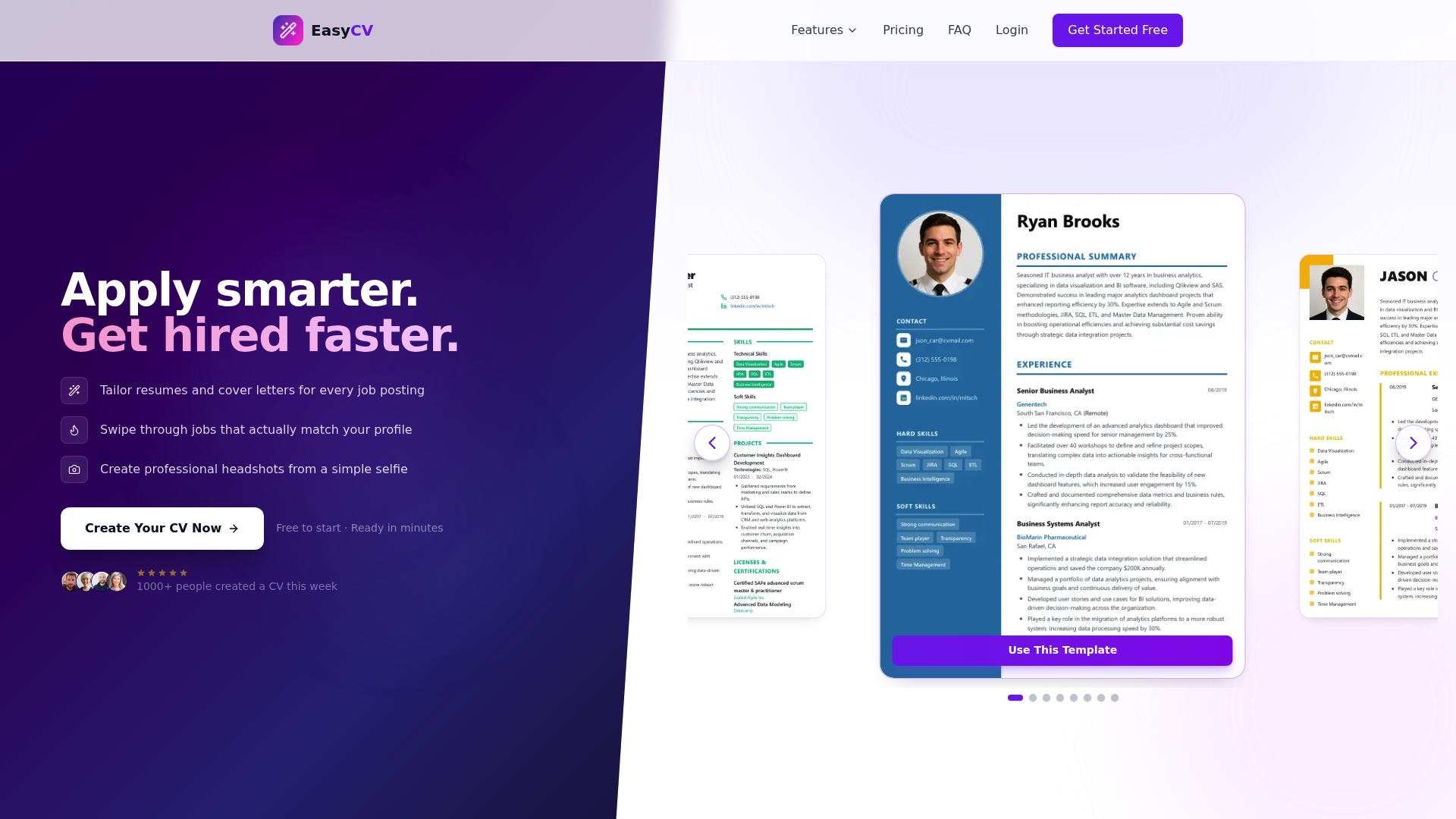
Paste a job posting into the AI tailoring flow and it maps the posting’s language, “test automation frameworks,” “CI/CD,” “regression testing”, directly against your existing resume content, so you’re not manually rewriting bullets for every application. The Job Matcher then surfaces QA roles pre-scored against that same resume, so you spend less time hunting listings and more time applying to the ones worth your effort.
The free plan covers the core builder and templates; premium unlocks unlimited AI tailoring and exports if you’re applying broadly. Start by building your resume with one of the QA-focused templates and tailoring it to your next application today.
Frequently Asked Questions
What should a quality assurance engineer resume include at minimum? A strong QA engineer CV format needs a headline, product scope, one named automation framework, a CI/CD reference, 2 to 3 quantified achievement bullets, a skills section, and any relevant certifications like ISTQB.
How long should a QA resume be? One page works for anyone with under 7 years of experience. Senior QA engineers managing test strategy across multiple teams or products can justify two pages, but only if every line carries real weight.
Do I need certifications to get a QA engineering job? No, but ISTQB or CAST certifications help during recruiter screens, especially in regulated industries like finance or healthcare, and they cost little to earn relative to the credibility they add.
How do I write a resume for an entry-level quality assurance role with no professional experience? Lead with academic or personal projects, internships, and any open-source testing contributions. Name specific tools used (Selenium, JIRA) and describe the scope, like test case count or defects found, rather than just listing coursework.
Should I include a cover letter with my QA resume? Yes, when the application allows it. A short cover letter tailored to the specific job description gives you room to explain a career transition or address an employment gap that a resume format doesn’t easily accommodate.
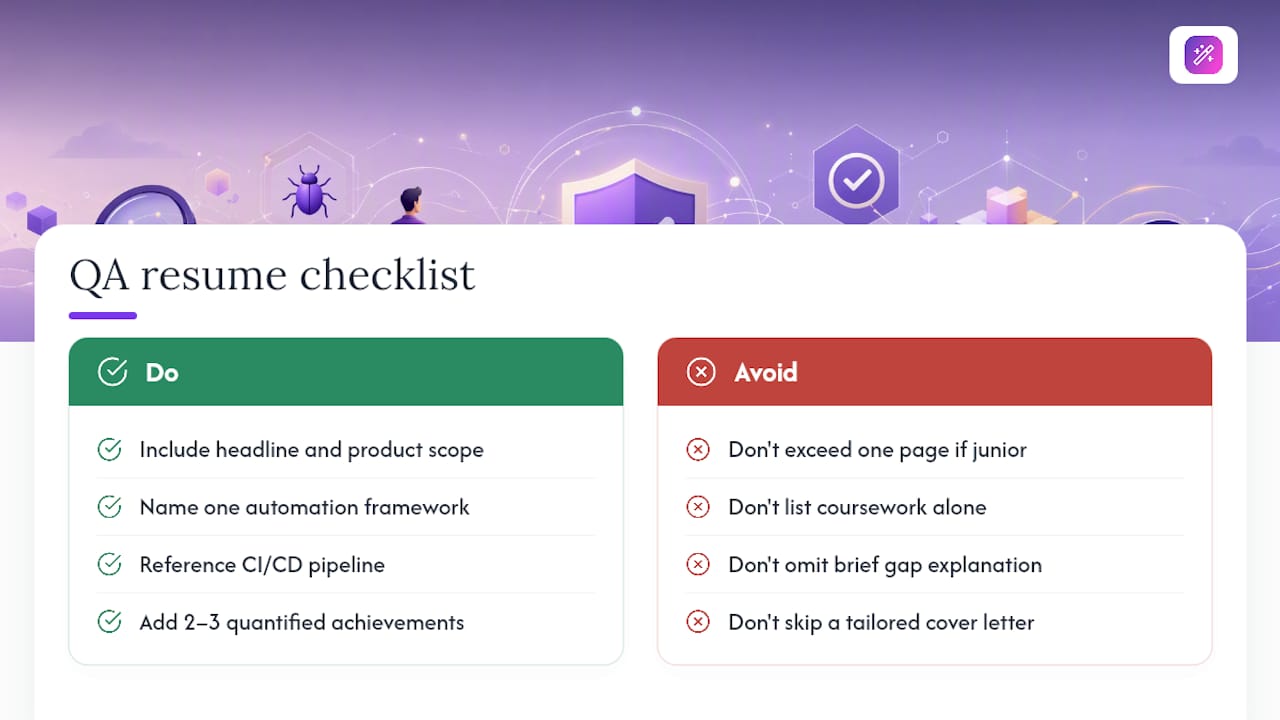
How do I handle an employment gap or a career change into QA on my resume? Address it briefly and directly in your summary. Name the transferable skill you’re bringing and any QA-specific learning (a certification, a bootcamp, a personal automation project) that shows you’ve already started building relevant experience.
Sources
- Bls
- Istqb
- Indeed
- QA Engineer Resume: Complete 2026 Guide | TechieCV
- 16 Quality Assurance Resume Examples for 2026 | Resume Worded
Easy-cv’s blog also covers ATS optimization and template selection in more depth.