Internal Transfer Resume: Rewrite Top Bullets, Update Workday First
Yes, you need a separate resume for an internal transfer, not your old external one recycled. Open with the destination role’s title, update your HR profile fields in Workday or SuccessFactors before you apply, and lead with one or two cross-functional achievements that map directly to what the new team needs. Everything else is refinement.
TL;DR:
- An internal resume must be tailored to prove your suitability for the new role within your company, emphasizing measurable impact and cross-team collaboration.
- It should start with a target role headline, a focused summary referencing your tenure and key achievement, and bullets structured around action, tool, result, and relevance.
- Rewriting bullets to match the new team’s language and internal terminology significantly increases the chances of passing ATS filters and catching the hiring manager’s eye.
- Before applying, update your HR profile fields, especially your current title, skills, and certifications, to ensure consistency and visibility in automated systems.
- Notify your manager according to your company’s policies, ideally before applying, and prepare a concise cover letter emphasizing your fit and motivation for the internal move.
Table of Contents
- What Makes an Internal Resume Different From an External One?
- Structuring the Resume: Headline, Summary, and Bullets That Work
- How Do You Rewrite Bullets to Fit the New Team’s Language?
- What Should You Update in Your Workday or SuccessFactors Profile First?
- When Should You Tell Your Manager You’re Applying?
- Copy-Ready Summaries and Bullets You Can Adapt
- Do You Need a Cover Letter for an Internal Application?
- Final Checklist Before You Hit Submit
- How EasyCV Speeds Up an Internal Resume Rewrite
- Try EasyCV’s Tools to Tailor Your Internal Application Faster
- Sources
- FAQ
What Makes an Internal Resume Different From an External One?
An internal resume is a document that lists your experience, skills, and objectives specific to your current employer, built to argue for a move rather than introduce you from scratch. That distinction changes almost everything about how you write it, according to Indeed’s guidance on internal resumes.
An external resume has to prove you’re legitimate. An internal one has to prove you’re the obvious pick. The hiring manager already knows you exist, maybe even knows your reputation secondhand. What they don’t know is whether you can operate at the level the new role demands, or whether you’ll actually collaborate outside your current silo. That’s what your bullets need to answer.
Hiring managers reviewing internal candidates look for two things above almost everything else:
- Measurable impact in your current seat. Vague responsibility lists don’t move the needle here; numbers and outcomes do.
- Evidence of cross-team fit. Projects where you worked with another department, in the language and priorities of the team you’re trying to join.
Not every internal move needs a ground-up rewrite. If you’re applying for a role one level up on the same team, a targeted edit to your summary and top three bullets might be enough. But if you’re switching functions, say from customer support to product, or from finance to operations, you need a new document built around the destination role’s vocabulary and priorities. Reusing your old resume in that scenario reads as lazy at best and clueless at worst.
Structuring the Resume: Headline, Summary, and Bullets That Work
Structure matters more for internal moves than people expect, because the reader is scanning for one specific thing: proof you already think like someone in the new role.
Start with a headline that states the role you’re targeting, not your current title. If you’re a senior analyst applying for a manager position, don’t lead with “Senior Analyst.” Lead with something like “Analytics Leader Transitioning to Team Management” or simply the target job title itself. Recruiters skimming internal postings often see dozens of applications from people whose headlines don’t match the role, and it costs them time to figure out what you actually want.
Your summary should open with the destination role, reference your tenure at the company, and name one flagship achievement. A weak version: “Experienced professional looking for new challenges.” A stronger version: “Marketing coordinator with four years at the company, seeking to move into brand strategy after leading the rebrand project that increased campaign engagement across three product lines.”
For work experience bullets, use a simple internal formula: action, tool, result, and why it mattered to the business. This structure gives hiring managers what career sites consistently recommend for internal-position resumes: concrete, checkable proof instead of adjectives.
Here’s the ordering logic:
- Lead with your most relevant achievement, even if it happened two roles ago, not necessarily your most recent one.
- Follow with cross-functional projects that show you’ve already worked adjacent to the target team.
- Include process or systems improvements you drove, since these signal initiative beyond your job description.
- Close each role with a metric-backed result, even an estimate, rather than ending on a task description.
For the skills section, prioritize tools and systems the new team actually uses, especially internal platforms with brand names your company recognizes internally. A well-built skills section does double duty here: it satisfies internal ATS keyword matching and gives the hiring manager a fast confidence check that you won’t need months of ramp-up.
Optional sections worth adding for internal candidates specifically: a short “Cross-Functional Projects” block if you’ve got two or more, internal training or certifications completed, and any committee or working-group participation. External candidates rarely have these; internal candidates who use them stand out immediately.
Pro Tip: Keep one master version of your internal resume with every achievement you’ve logged, then trim it down for each specific posting. Internal roles open faster than external ones, and you won’t have time to reconstruct your work history from memory when a good one appears.
How Do You Rewrite Bullets to Fit the New Team’s Language?
Every internal posting has its own dialect, and matching it does more work than people realize. Mirror the exact phrasing in the job description wherever it’s accurate. If the posting says “stakeholder management” and your bullet says “worked with other departments,” change the wording. Hiring managers and internal ATS keyword scans both respond to this kind of alignment, a tactic covered in more detail in Alloquy’s guide to evidence-led resume tailoring.
A few rewrite rules that consistently matter:
- Translate internal codenames and tool names into plain English. If you built something using an internal platform only your current team recognizes, describe what it does, not just what it’s called.
- Round confidential numbers. If you can’t share the exact revenue figure a project touched, use a public range or describe scale (“a project supporting a multi-million-dollar product line”) instead of the internal number.
- Open your summary with the destination role, not your current one, every single time.
- Check for ATS field mismatches, since some internal systems filter by exact title match before a human ever sees your resume.
Company tenure plays into this too. Longer-tenured employees tend to have more institutional knowledge to draw on, and Bureau of Labor Statistics tenure data shows many workers stay with employers for multi-year stretches, which is exactly the kind of internal-mobility pipeline most large companies actively build around. Use that tenure as leverage in your summary rather than treating it as background noise.
What Should You Update in Your Workday or SuccessFactors Profile First?
Before you touch your resume file, fix your HR profile. Many internal application systems auto-populate fields from your employee record, and if that record is stale, your application can look worse than your actual resume.

Washington University’s HR team advises internal applicants to update Workday fields including education, certifications, job history, and skills before applying, precisely because internal applications often pull from those fields automatically.
Fields worth checking before you submit anything:
- Current job title, especially if you’ve had an informal promotion or title change that never made it into the system.
- Skills list, which some internal ATS platforms use for keyword matching independent of your resume.
- Employee ID and contact email, particularly if your company recently migrated HR systems.
- Certifications and completed training, which recruiters sometimes filter by directly.
Some employers, Stanford among them, run a separate internal candidate profile in the applicant system that reuses parts of your employee record, and may require merging an external profile if you ever applied before joining the company. Stanford’s guidance recommends applying through your internal SUNetID and checking for merge issues rather than creating a duplicate account.
On formatting: export a clean PDF unless the internal system specifically requests a Word document, since some internal ATS platforms re-parse resumes and mangle complex formatting or graphics on upload.
When Should You Tell Your Manager You’re Applying?
Timing here is mostly a policy question, not a strategy question. Check your employee handbook first. Some companies require manager notification before you submit an internal application; others only require it once you’re selected for an interview.
Recruiters sometimes expect that notice has already happened by the time your application lands, so silence at that stage can create friction later even if your handbook doesn’t technically require early disclosure.
- Eligibility rules vary by company, but time-in-role minimums (often 6 to 12 months) and a recent satisfactory performance rating are common gates.
- Exceptions exist for reorganizations, role eliminations, or moves flagged by leadership as strategic.
- Typical transition windows run 4 to 6 weeks, though sales and SDR roles sometimes need up to 45 days for a clean handover, according to GitLab’s internal hiring handbook.
- Handover expectations usually include documentation and a transition plan for your current manager.
Copy-Ready Summaries and Bullets You Can Adapt
Here are three summary templates you can adjust to your situation, plus a batch of bullet formats built on the action, tool, result, and relevance structure.
Promotion summary: “Senior [current title] with [X] years at [company], seeking promotion to [target title] after leading [flagship project] that delivered [measurable result].”
Lateral move summary: “[Current title] transitioning from [current department] to [target department], bringing [specific skill or system experience] and a track record of [cross-functional result].”
Function change summary: “[Years] at [company] in [current function], moving into [target function] after [relevant project, certification, or self-directed initiative] demonstrating readiness for [target role].”
Sample bullets, adaptable across departments:
- Led a cross-functional pricing review using internal analytics tools, cutting quote turnaround time and earning recognition from the sales leadership team.
- Partnered with legal and finance to close a vendor contract renegotiation, saving the department a meaningful percentage of its annual spend.
- Built a reporting dashboard adopted by two additional teams after demonstrating it at a quarterly business review.
- Trained four new hires on internal onboarding systems, reducing ramp-up time by a measurable margin.
- Managed a customer escalation process redesign that lowered repeat complaint volume within two quarters.
Keep each bullet to one line where possible. A one-page resume still works best for most internal moves, but two pages are acceptable if you’re applying for a senior or leadership-track role where depth of experience matters more than brevity.
Do You Need a Cover Letter for an Internal Application?
Attach one even when it’s marked optional. A short cover letter for an internal move should focus on fit and forward motivation, not a recap of your resume, and definitely not a list of grievances about your current role.
HR sometimes asks for a recent performance review as part of an internal application, particularly for promotions. If that’s requested, prepare a clean copy in advance rather than scrambling once the recruiter asks, and check with your manager or HR partner about which version is appropriate to share, according to resume.co’s internal-position guidance.
- Keep the cover letter to three short paragraphs, focused on why the new role, why now, and one proof point.
- Name your file clearly, something like “LastName_InternalResume_TargetRole.pdf” so HR can track it easily.
- Stick to PDF or Word, whichever the internal portal specifies, and avoid embedded images or unusual fonts that some systems fail to parse.
A cover letter built around forward-looking motivation rather than a rehash of your resume tends to land better with internal reviewers who already know your background.
Final Checklist Before You Hit Submit
Run through this sequence once before you apply:
- Update HR profile fields first, reconciling your title, skills, and certifications with what your resume actually says.
- Rewrite your top three bullets and summary to open with the destination role and mirror the posting’s language.
- Export a clean, single-column PDF and do a quick format check to make sure nothing breaks on upload.
- Confirm manager-notification timing against your handbook before or immediately after you submit.
Skipping any one of these creates the exact kind of mismatch that makes internal applications look sloppier than they are.
How EasyCV Speeds Up an Internal Resume Rewrite
Rewriting a resume for a specific internal posting is exactly the kind of repetitive, detail-heavy task where AI assistance earns its keep. An AI writing assistant can generate role-focused summary and bullet drafts in the tone the destination posting uses, which cuts down the back-and-forth of manually rephrasing every line to match a new team’s vocabulary.
A built-in job tracker also helps here in a way people underestimate: internal postings often move fast and get pulled once filled, so having a system flag new listings and track where you’ve applied beats checking an internal portal manually every few days.
One caution worth repeating: keep any numbers you use aligned with what’s already public inside your company. AI tools speed up phrasing, not judgment about confidentiality.
Try EasyCV’s Tools to Tailor Your Internal Application Faster
Rewriting a resume for a lateral move or promotion by hand means juggling the destination job posting, your own achievement list, and your company’s internal formatting quirks all at once. This process is streamlined to one workflow: describe the target role, and an AI writing assistant drafts a summary and bullet set already aligned to that posting’s language, which you then edit for accuracy and any confidential details.
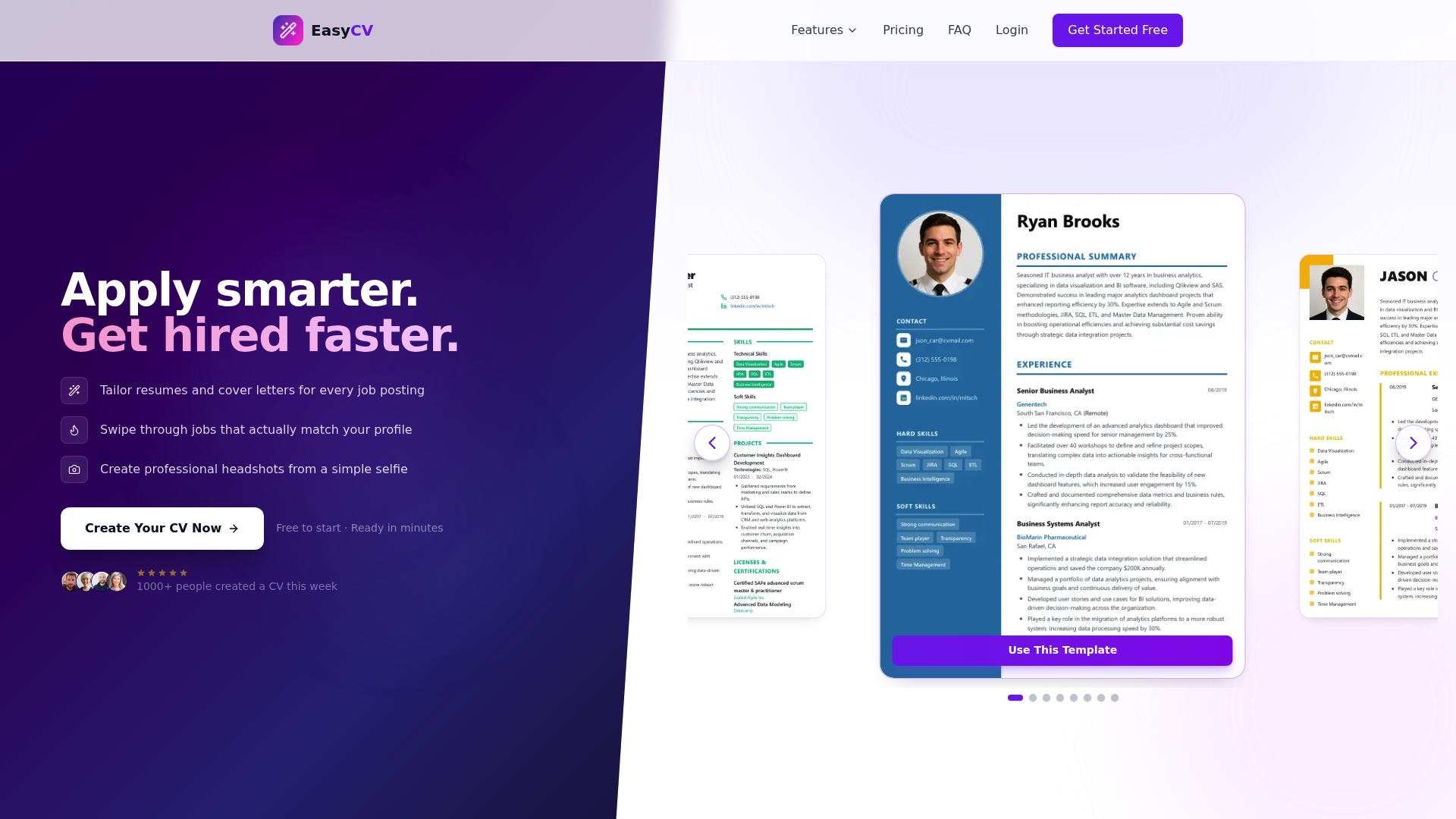
The platform’s job matcher also works for internal moves if your company posts openings on a board it can track, letting you swipe through roles that fit your profile instead of refreshing an internal portal out of habit. Pair that with the ATS-friendly templates in Easy-cv’s full feature set and you get a resume that’s less likely to get mangled by an internal system’s parser. CV translation tools can handle internal postings written in a different language without losing your original phrasing.
Start by building a master version of your resume, then generate a tailored copy the next time an internal posting catches your eye.
Sources
- Internal Applicant FAQ | Human Resources | Washington University in St. Louis
- How to apply for jobs as an internal candidate | Cardinal at Work
- Internal hiring process | GitLab handbook
- What Is an Internal Resume? Definition, Tips and Examples
- Resume for an Internal Position: Samples and Guide
FAQ
What Should an Internal Resume Look Like?
It should open with the destination job title, lead the summary with your tenure and one flagship achievement, and use bullets built around action, tool, result, and business relevance, mirroring the language of the job posting itself.
How Do I Let My Manager Know About an Internal Transfer?
Check your employee handbook for required timing, since some companies expect notice before you apply while others only require it once you’re selected for an interview; when unsure, a brief heads-up before applying tends to avoid friction.
How Do I Present My Skills as Transferable?
Frame each skill around the outcome it produced rather than the task itself, and connect it explicitly to a need stated in the target job posting, using the same terminology the posting uses wherever it’s accurate.
How Do I Write a Resume for an Internal Promotion?
Lead with the promotion target title in your headline, open your summary with your current tenure and a measurable win, and prioritize bullets that show you’ve already been operating above your current title before you ask for the new one.