3 Steps to Rewrite Your Career Change Resume and Get Interviews
For a successful career change, lead your resume with a concise professional summary and a skills-first section that proves your fit before a recruiter ever reaches your job titles. This combination format puts your most relevant evidence where a screener sees it in the first few seconds, instead of burying it under a decade of job history that doesn’t obviously connect to the role you want.
TL;DR:
- Use a combination resume format that highlights skills and proof points upfront, followed by a clear work history, to quickly demonstrate relevance for a career change.
- Tailor your bullets by extracting key requirements from the job posting, mapping your responsibilities to them, and rewriting with action, context, and concrete results.
- Emphasize education, certifications, and projects that directly demonstrate skills and commitment in the new field, especially if work experience is limited or unrelated.
- Keep the resume to one page for most applicants under ten years of experience, using simple, ATS-friendly layout, keywords, and consistent formatting for easy parsing by recruiters and software.
- Always tailor your resume for each application by analyzing requirements, updating bullet points, and verifying that the strongest points appear early in your experience section.
Table of Contents
- What Is the Best Format for a Career Change Resume?
- How Do You Write a Summary and Skills Section That Prove You’re Qualified?
- How Do You Rewrite Old Job Bullets for a New Career?
- How Do You Present Education and Projects as Career-Pivot Evidence?
- What ATS and Formatting Rules Should a Career Change Resume Follow?
- What Does a Career Change Resume Example Look Like?
- How Should a Cover Letter Address a Career Change?
- What’s the Fastest Way to Tailor and Track Each Application?
- Why Trust This Career-Change Resume Framework?
- The One Habit That Actually Moves the Needle
- Let Easy-cv Handle the Tailoring While You Focus on the Pivot
- Sources
What Is the Best Format for a Career Change Resume?
The combination (or hybrid) format is the right structure for almost every career changer, and it’s the format Monster recommends specifically because it solves the one problem a straight chronological resume can’t: it lets you lead with skills while still preserving the work history that hiring managers expect to see.
Here’s the logic. A purely chronological resume assumes your most recent job title tells the reader everything they need to know. That works fine if you’re staying in your lane. It works against you if your last title was “Operations Coordinator” and you’re applying for “Product Manager” roles, because the title alone gives the reader zero reason to keep reading. A combination resume front loads a skills summary that closes that gap immediately, then backs it up with a real employment timeline underneath.
Wharton’s guidance on career-change resumes goes a step further and recommends listing your skills summary above your work experience entirely, not just near the top. That ordering matters because hiring managers scanning a stack of applications are pattern matching for relevance, and a title that doesn’t match the job posting is the fastest way to get skipped.
Structure your resume top to bottom in this order:
- Header with name, contact info, and a link to a portfolio or LinkedIn if relevant.
- Professional summary (three to four lines that name the pivot and the proof).
- Skills summary organized into two or three clusters, each with a proof bullet.
- Professional experience in reverse chronological order, bullets rewritten to emphasize transferable work.
- Education, certifications, and projects as pivot evidence.
Keep hard technical skills (software, tools, languages) in a short separate list near the skills summary or at the bottom of the page. Keep transferable skill clusters (the ones doing the heavy lifting for your pivot) higher up, with narrative proof attached. Mixing the two into one undifferentiated bullet list wastes the format’s biggest advantage: clarity.
How Do You Write a Summary and Skills Section That Prove You’re Qualified?
Use a summary when you have relevant experience to compress into three or four lines. Use an objective only when you’re entering the workforce fresh or making such a sharp turn that you need a sentence to state your intent before you can prove anything. Most career changers should use a summary. It reads as confident rather than uncertain, and it lets you open with evidence instead of an aspiration.
Compare these two openers:
Objective (weak): “Seeking a marketing coordinator role where I can apply my communication skills and learn new systems.”
Summary (strong): “Operations manager with six years of cross-functional project leadership, now applying data-driven campaign planning and stakeholder communication skills to marketing coordination roles.”
The second version does the work the first one avoids: it names the pivot, states years of experience, and points directly at the skills the target job needs.
Your skills summary should do the same thing on a bigger scale. Rather than listing generic traits like “team player” or “detail-oriented,” group your abilities into two or three clusters tied to what the job posting actually asks for, then add a one-line proof point under each. Wharton recommends exactly this: connect your work experience back to whatever you list in the skills summary, rather than letting the two sections float independently.
Here’s how that looks in practice:
- Cluster 1: Data Analysis & Reporting. Built weekly performance dashboards tracking 12 KPIs across three regional teams, cutting manual reporting time by half.
- Cluster 2: Cross-Functional Communication. Coordinated between engineering, sales, and finance to launch two product updates on schedule.
- Cluster 3: Client-Facing Problem Solving. Managed a portfolio of 40+ accounts, resolving escalations directly with department heads.
The goal is to treat your skills section as a mini case for your pivot. Every claim you make needs a proof bullet directly under it, so a reader never has to guess whether you’re describing a real capability or just borrowing language from the job posting. Our guide to building a skills section that passes ATS screening walks through more cluster examples by industry.
Pro Tip: If you can’t attach a specific, concrete example to a listed skill within ten seconds, cut the skill. Unsupported claims read as filler to both human reviewers and applicant tracking systems, and they weaken the clusters around them.
How Do You Rewrite Old Job Bullets for a New Career?
The single most effective technique in career-change resume writing is a three-step mapping process. Most people skip straight to rewriting, which produces vague, softened bullets that don’t actually connect to anything. Mapping first fixes that.
Step one: extract requirements. Pull five or six specific requirements or keywords directly from the target job posting. Not the fluffy ones. The concrete ones: “manage vendor relationships,” “build quarterly forecasts,” “lead a team of five.”
Step two: map your bullets. Go through your existing work history and flag which past responsibilities connect to which requirement, even loosely. Wharton’s guidance specifically recommends tailoring which responsibilities you highlight based on relevance to the target job, rather than listing your full job description.
Step three: rewrite with action, context, and result. Once you know which bullet maps to which requirement, rewrite it using the language of the new field while keeping the real numbers.
Before and after, side by side:
-
Before: “Responsible for scheduling and coordinating team meetings.”
-
After: “Coordinated cross-departmental meetings for a 15-person team, aligning project timelines across three business units.”
-
Before: “Handled customer complaints and questions.”
-
After: “Resolved an average of 30 client escalations weekly, maintaining a 95% satisfaction rating while identifying recurring service gaps.”
HBS Online’s research on resume screening found that recruiters can make an initial decision on a resume in as little as six seconds, which means the bullets you choose to keep matter more than the ones you cut. Omit anything that doesn’t map to a target requirement, condense repetitive duties across similar past roles into one strong bullet, and never keep a bullet just because it was true. True and relevant are different bars.
How Do You Present Education and Projects as Career-Pivot Evidence?
When your work history doesn’t fully support your pivot, your education, certifications, and side projects have to carry more weight, and they need their own visible section rather than a buried line at the bottom.
Indeed’s guidance on updating resumes for a career change recommends listing relevant certifications, coursework, or projects prominently to compensate for limited direct experience in the field. If you’ve completed even one certificate or course tied to the new industry, give it a dedicated “Certifications” section rather than folding it into education. It’s easier to scan and signals intent.
For projects, use a simple formula: role, problem, action, outcome.
A few rules to keep this section credible:
- List in-progress coursework or certifications with expected completion dates, not as if already finished.
- Include unpaid or personal projects only when they demonstrate a skill directly relevant to the target role.
- Keep project descriptions to two or three lines each. This section supports your case; it doesn’t replace your experience section.
- Avoid vague labels like “various projects” that a reader can’t evaluate. Name what you built.
Momentum matters here. A reader who sees you’re actively working toward a credential, even unfinished, reads that as commitment rather than gap filling.
What ATS and Formatting Rules Should a Career Change Resume Follow?
One page is the right length for most career changers, particularly anyone under ten years of total work experience, a guideline that lines up with HBS Online’s recommendation to keep resumes concise and screening-friendly. Two pages is defensible only if you have extensive, genuinely relevant experience across multiple roles, and even then, cut ruthlessly before you add a second page just to fit everything in.
For layout, keep formatting simple enough that both a human and an applicant tracking system can parse it correctly:
- Use standard section headers (“Experience,” “Skills,” “Education”) rather than creative labels the ATS might not recognize.
- Stick to one or two fonts, avoid text boxes and columns that scrape incorrectly, and skip graphics or icons inside the body text.
- Left-align content and use consistent bullet formatting throughout, not a mix of styles.
- Save and submit as a PDF unless the job posting specifically requests a Word document.
For keywords, mirror the exact phrasing from the job posting wherever it’s true of your background. If the posting says “stakeholder management” and your bullet says “client relations,” change the wording to match, but only when the underlying experience genuinely supports it. Never inflate a claim just to trigger a keyword match. Our CV optimization guide covers formatting choices that hold up across different ATS platforms.
Pro Tip: Run your resume through a plain-text copy-paste test. Paste it into a basic text editor. If sections, bullets, and spacing turn into a jumbled mess, an ATS is likely reading it the same way.
What Does a Career Change Resume Example Look Like?
A finished example makes the abstract advice concrete. Here’s a compressed version of what the top third of a career-change resume looks like when a project coordinator pivots into marketing:
Summary: “Project coordinator with five years of cross-functional planning experience, now applying campaign scheduling, stakeholder communication, and performance tracking skills to marketing coordination roles.”
Skills Summary:
- Campaign Planning & Timelines — Managed rollout schedules for 8+ product launches, coordinating across four departments.
- Data-Driven Reporting — Built recurring performance dashboards used by leadership to track quarterly goals.
- Stakeholder Communication — Served as primary liaison between vendors, internal teams, and executive sponsors.
Experience (rewritten entry): “Project Coordinator, Acme Logistics — Coordinated launch timelines for 8 cross-functional product initiatives, tracking KPIs across marketing, sales, and operations teams; built weekly stakeholder reports adopted company-wide.”
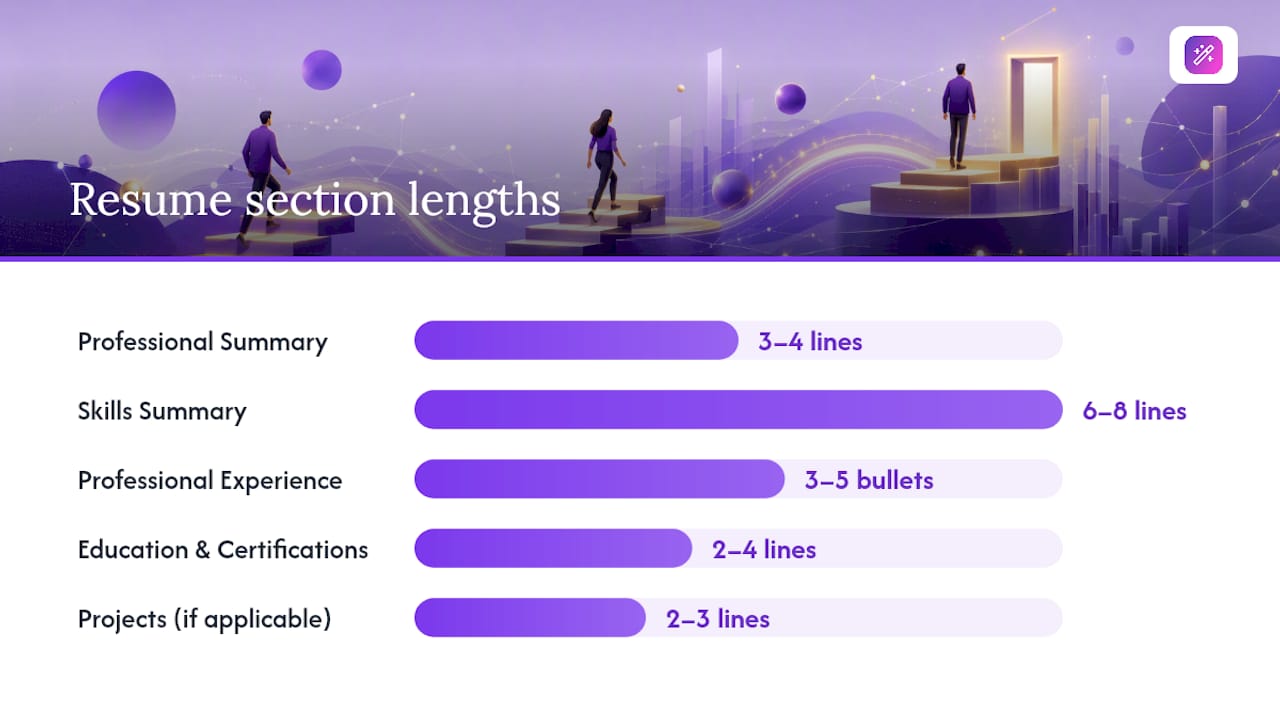
Use this table as a quick reference for what belongs in each section when you’re building your own version:
| Resume Section | What Goes Here | Length |
|---|---|---|
| Professional Summary | Pivot statement + years of experience + top transferable skills | 3 to 4 lines |
| Skills Summary | 2 to 3 skill clusters, each with one proof bullet | 6 to 8 lines total |
| Professional Experience | Rewritten bullets mapped to target job requirements | 3 to 5 bullets per role |
| Education & Certifications | Degrees, in-progress coursework, relevant certificates | 2 to 4 lines |
| Projects (if applicable) | Role, problem, action, outcome format | 2 to 3 lines per project |
Before you send anything out, run through a short tailoring checklist: pull the job posting’s top requirements, confirm your summary names at least two of them, check that every skill cluster has a proof bullet, and confirm your strongest bullet appears in the first half of your experience section, not buried at the bottom. Our career transition workflow guide breaks this tailoring process into a repeatable routine for each application.
How Should a Cover Letter Address a Career Change?
Your cover letter is where you explain the pivot in your own words. Your resume is where you prove it. Keep those roles separate and you’ll avoid the most common cover letter mistake: repeating your entire resume in paragraph form.
HBS Online recommends using the cover letter to be transparent about the transition, then letting the resume carry the weight of proof through targeted examples. A two-sentence opener does the job: “After five years managing operations at a logistics firm, I’m transitioning into marketing coordination, drawn to the discipline’s blend of data analysis and cross-functional communication I’ve built throughout my career. My experience coordinating multi-team launches directly translates to campaign planning and execution.”
That’s it. State the pivot, state the credibility bridge, move on to specifics.
On the resume itself, keep your summary line short and factual rather than trying to fully justify the transition there too. A few guidelines:
- Use the cover letter for the “why,” and the resume summary for the “what” and “how.”
- If your pivot is subtle (adjacent industry, similar function), you may not need a separate pivot sentence at all. Let the skills summary speak for itself.
- If your pivot is dramatic (unrelated field entirely), a one-line acknowledgment in your summary helps frame the skills that follow.
- Never apologize for the change or use hedging language like “despite my background in…” Frame it as an asset, not a liability.
Check out our library of professional summary examples for more pivot-statement templates you can adapt.
What’s the Fastest Way to Tailor and Track Each Application?
A career change resume only works if you actually customize it for each posting, and that’s easiest to manage with a repeatable seven-step workflow rather than starting from scratch every time.
- Analyze the job posting and pull five to six specific requirements (10 minutes).
- Draft or update your master resume with the combination format and skill clusters (30 to 45 minutes, once).
- Rewrite two or three bullets to map directly to that posting’s requirements (10 minutes per application).
- Run an ATS formatting check for keyword matches and layout issues (5 minutes).
- Write a two-sentence cover letter opener naming the pivot (10 minutes).
- Proofread out loud to catch awkward phrasing before submitting (5 minutes).
- Submit and log the application with the date, role, and which summary version you used (2 minutes).
Keep one detailed master resume with every skill cluster and bullet you might ever need, then trim it down for each specific application rather than rebuilding from zero. If you’re sending out multiple applications a week, try A/B testing two different summary openers across similar roles and track which one generates more replies. Given iHire’s finding that 66% of workers have considered changing careers, you’re competing against a large pool of people making the same pivot, which makes small wording tests worth the extra ten minutes.
Why Trust This Career-Change Resume Framework?
The advice in this guide isn’t guesswork. It’s built on established research into how hiring managers actually screen resumes, including Wharton’s recommendation to feature skills above work history and HBS Online’s finding that recruiters make snap judgments within seconds of opening a resume. This piece was written by Andras, whose work at Easy-cv focuses on practical, template-driven job search content for professionals navigating exactly this kind of transition.
The product decisions of some AI-driven resume tools reflect the same principles covered here:
- Job aggregation pulls listings from major job boards to help users find postings whose requirements can be mapped against their experience.
- AI writing assistants can help rewrite work-experience bullets using target-job language without inflating actual experience.
- ATS-friendly templates handle formatting and layout rules automatically, improving scannability.
The workflow works because it’s grounded in how screening actually happens, not in what feels thorough to the applicant writing it.
The One Habit That Actually Moves the Needle
Most career changers fail their resume for one of two reasons: they overexplain the pivot instead of proving it, or they list broad, unverifiable skills like “strategic thinker” with nothing underneath to back it up. Both mistakes come from the same instinct, which is trying to convince the reader with adjectives instead of evidence.
The single habit that fixes both problems is mapping. Before you write a single bullet, sit down with the target job posting and match your history to its actual requirements, line by line. Do this every single time, for every application, even when it feels repetitive. It’s the difference between a resume that reads as a hopeful guess and one that reads as an obvious fit. Readers who’ve made this switch consistently report that the resumes generating replies were the ones where every line clearly answered a specific requirement in the posting, not the ones that sounded impressive in isolation.
— Andras
Let Easy-cv Handle the Tailoring While You Focus on the Pivot
Rewriting bullets, matching keywords, and reformatting a resume for every application eats hours you’d rather spend actually job hunting. Some AI resume platforms build the mapping process described in this guide into their tools: AI writing assistants generate and refine skill-cluster bullets, ATS-friendly templates handle formatting rules automatically, and built-in job trackers help keep tailored versions organized instead of scattered across multiple files.
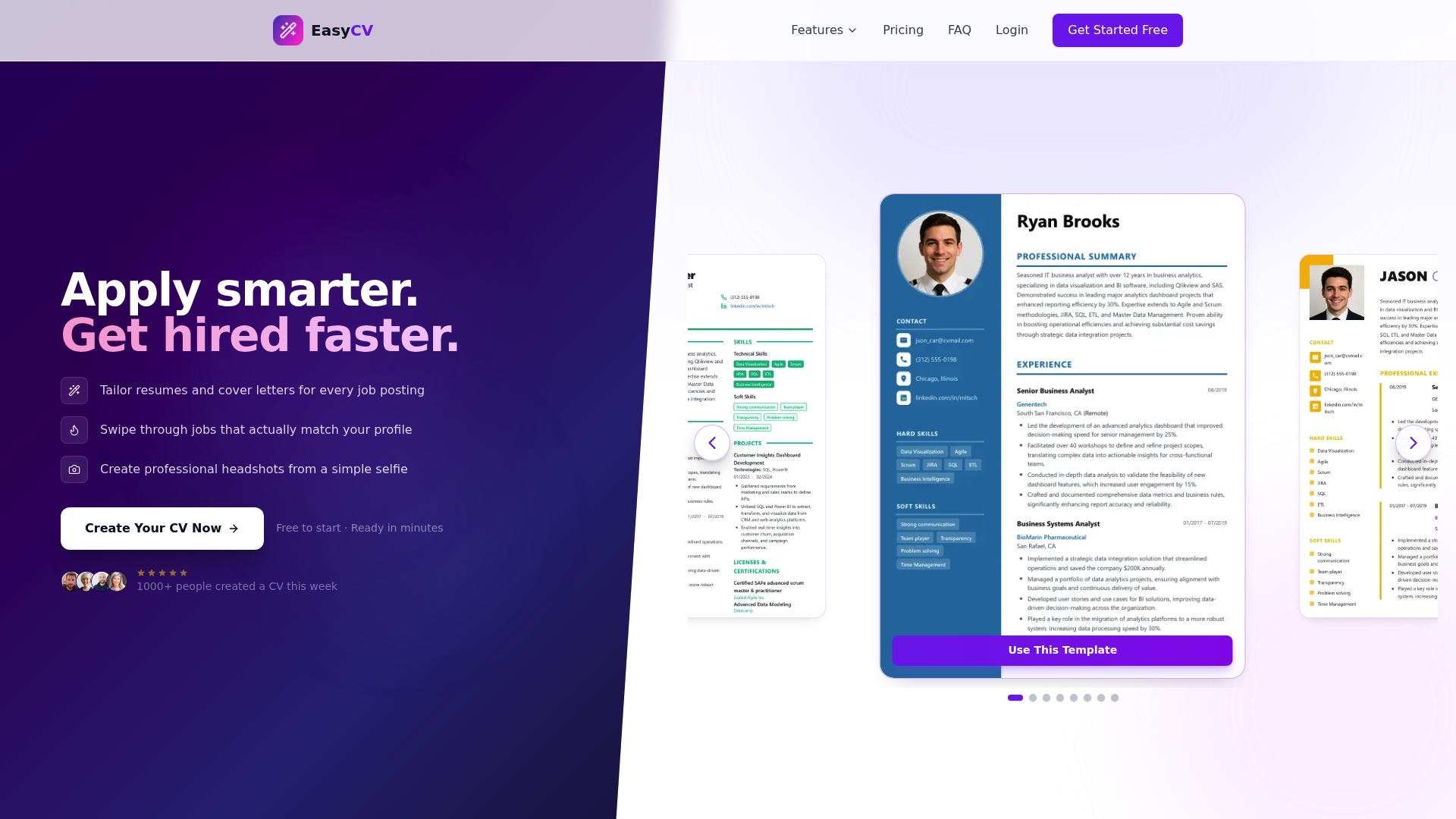
If you’re not sure which roles are even worth tailoring toward, the Job Matcher scores job listings against your existing resume with a swipe-based interface, so you spend your editing time on postings that actually fit your pivot instead of guessing from a job title alone. Create a free account and run your current resume through the matcher to see which listings are worth a rewrite first.
Sources
- How to Write a Career-Change Resume With Template - Wharton Online Insights
- How to make your resume stand out - HBS Online
- How to Write a Career Change Resume That Gets Interviews (& Examples) - Monster
- Updating your resume for a career change - Indeed