Rewrite Your Resume With AI in 15 Minutes
Yes, AI can rewrite your resume quickly and well. The fastest reliable route is a dedicated AI resume builder that lets you paste in a job description, tailors your bullets to it, and keeps your actual facts intact rather than inventing new ones. Run your current resume through a tool that supports job-tailoring and ATS-friendly export, then verify every number and date before you send it anywhere.
TL;DR:
- AI resume rewrite tools effectively improve sound and relevance, but they require careful verification of all numbers, dates, and claims before submission.
- The most reliable results come from uploading specific job descriptions, then manually checking and adjusting AI-generated content for accuracy and authenticity.
- ATS-friendly resumes should use simple, single-column layouts with standard headers, avoiding tables, embedded images, and multi-column formats that can corrupt parsing.
- Uploading resumes to AI tools should be done cautiously, with attention to data privacy policies and redacting sensitive information like social security numbers or exact salaries.
- Combining AI-powered rewriting with a structured workflow that includes tracking, verification, and tailored submissions increases the chances of standing out in an active job search.
Table of Contents
- How AI Resume Rewriting Works: What The Model Changes And What It Doesn’t
- Step-By-Step Workflow To Rewrite Your Resume With AI
- One-Click Tailoring Or Manual Prompts: Which Fits Your Job Search?
- What Makes A Resume Template ATS-Friendly?
- Is It Safe To Upload Your Resume To An AI Tool?
- What Does A Real AI Resume Rewrite Look Like?
- How Do These Tools Fit Into A Full Job Search Workflow?
- When AI Actually Helps And Where It Falls Short
- Try The AI Resume Rewrite Workflow Without Starting From Scratch
- Sources
How AI Resume Rewriting Works: What The Model Changes And What It Doesn’t
An AI resume rewrite tool does two jobs at once: it improves how you sound, and it improves how well you match a specific opening. Those are different tasks, and understanding the split helps you know what to double-check.
On the “how you sound” side, the model rewrites weak, passive lines into action-driven statements. “Was responsible for managing a team” becomes “Led a five-person team.” It tightens a rambling summary into a two-line headline pitch, cuts filler words, and swaps vague verbs for specific ones. This is the part AI does genuinely well, because it’s a language pattern problem, and language pattern problems are exactly what large language models are built for.
On the “match this job” side, the tool reads a job description, pulls out the recurring skills and phrases, and works them into your bullets and summary. If the posting says “cross-functional stakeholder management” three times, a good rewrite tool notices and nudges your resume toward that phrasing where it’s honestly applicable.
The risk sits in a specific gap: the model doesn’t know what actually happened at your job. It can guess at a metric, round a date, or attribute a project outcome to you that you only supported. Microsoft’s own documentation on AI resume tools in Word walks through how Copilot generates outlines and rewrites content from templates, but the output still needs a human pass before it’s true.
Most builders accept your resume in one of three ways:
- File upload — drop in a PDF or DOCX and the tool parses the structure automatically.
- Paste — copy and paste raw text when your file has unusual formatting.
- LinkedIn import — pull your experience directly from your profile to save re-typing.
Pro Tip: Never accept a rewritten bullet with a number in it until you’ve traced that number back to something you can defend in an interview. AI is great at making a claim sound confident. It’s not great at knowing if the claim is true.
Step-By-Step Workflow To Rewrite Your Resume With AI
This is the sequence that actually produces a resume you’d send out, not just a resume that looks impressive for thirty seconds.
- Prepare. Pick the exact resume version you’re editing and find the specific job posting you’re targeting. Don’t rewrite in the abstract. AI tailoring only works when there’s something concrete to tailor toward.
- Input. Upload or paste your resume into the tool, then paste the full job description into whatever field it offers for tailoring. Skipping the job description step is the single most common way people waste this tool. A generic rewrite is barely better than what you started with.
- Run the rewrite. Ask the AI to rewrite your summary and bullet points, and specifically request stronger action verbs and quantified outcomes where you have real numbers to support them. Be direct in your prompt: “rewrite this bullet with a strong action verb and a measurable result” gets better output than “make this better.”
- Verify. This is the step people skip, and it’s the one that matters most. Go line by line and cross-check every date, every title, every responsibility, and any metric the AI added or changed. If a number looks invented, because it wasn’t in your original draft, cut it or replace it with something you can back up. Confirm you actually owned the accomplishment the bullet describes, not just adjacent to it.
- Format and export. Choose a clean, ATS-friendly template and export in the format the job posting asks for. Most builders offer both PDF and DOCX. If the posting doesn’t specify, PDF is usually the safer default for preserving your formatting.
- Track. Save a copy of this specific tailored version with a clear filename, and log the application in a job tracker so you know exactly which resume version went where. This matters more than people expect once you’re applying to more than five roles a week.
The verification step deserves more than one sentence, because it’s where AI resume rewriting goes wrong most often. A model doesn’t have a concept of lying. It has a concept of “what usually follows this kind of sentence,” and sometimes that means it fills a gap with a plausible-sounding number instead of leaving a blank.
Pro Tip: Keep your original, unedited resume open in a second tab while you review the AI version. Reading them side by side makes fabricated details jump out far faster than reading the new version alone.
Once you’ve verified content, do a second, faster pass focused purely on voice. Read the whole resume out loud. If a sentence doesn’t sound like something you’d say describing your own work in an interview, revise it. AI tends to default to a slightly generic “professional” register that can flatten your actual strengths if you don’t push back on it.
For a deeper breakdown of this exact sequence with more granular tooling advice, Easy-cv’s guide on how to use AI for resume writing covers additional prompt patterns worth testing.
One-Click Tailoring Or Manual Prompts: Which Fits Your Job Search?
Not every application deserves the same level of hands-on effort, and knowing when to automate versus when to slow down saves real time.
Automated one-click tailoring works by feeding a job description into a resume builder and letting it adjust keywords, reorder bullets by relevance, and tighten the summary automatically. It’s fast, and speed matters when you’re applying to fifteen or twenty roles in a similar category. The tradeoff is nuance: the tool optimizes for keyword match more than for the specific story you want to tell about your career.
Manual prompt-based tailoring, using a general assistant like ChatGPT or Microsoft Copilot directly, gives you more control over tone and emphasis. This suits senior roles, niche technical positions, or any application where the standard template feels too generic for what you’re pitching. You’re writing the prompts, which means you’re also doing more of the thinking.
A few prompt examples worth trying when you go manual:
- “Rewrite this bullet to emphasize budget ownership, since the job description mentions P&L responsibility twice.”
- “Compare this resume against the job description and list the three biggest keyword gaps.”
- “Rewrite my summary in three sentences, positioning me as a candidate transitioning from operations into product management.”
Once you have a tailored draft, validate the match before you submit. Some builders show a match score against the job description, which gives you a quick numeric gut check. But don’t stop there. Read the final version once, straight through, as if you were the hiring manager. Match scores catch keyword overlap. They don’t catch whether the resume actually reads as a coherent story.
For senior IT and technical roles specifically, role-specific tailoring guidance for IT professionals covers keyword patterns that generic tools frequently miss.
What Makes A Resume Template ATS-Friendly?
Simple structure beats clever design. Applicant tracking systems parse resumes by scanning for standard section headers and reading text in a predictable order, and anything that breaks that pattern risks getting misread or dropped entirely.
Stick to single-column layouts with standard headings like “Experience,” “Education,” and “Skills.” Avoid tables for layout, since many parsers read table cells out of order or skip them completely. Use a readable font like Calibri, Arial, or Georgia rather than a decorative one, and keep font sizes above 10 points for body text.
On PDF versus DOCX: check the job posting first. Some systems specify one or the other, and when they don’t, PDF is generally the safer choice because it locks in your formatting exactly as designed. DOCX is worth using when a posting explicitly requests it, since some older ATS platforms parse Word files more reliably than PDFs.
Common formatting traps that come from AI-generated resumes and template exports include:
- Text boxes for the header or contact section, which many parsers skip entirely.
- Embedded images used as section dividers or icons, invisible to the ATS.
- Unusual bullet symbols (like arrows or checkmarks) that some systems render as garbled characters.
- Multi-column layouts that scramble reading order, mixing your job titles with your skills list.
Many of the top-ranking AI resume tools now advertise ATS-friendly PDF export as a standard feature, which reflects how central this issue has become to the category as a whole.
Before you submit anywhere, run a quick checklist: paste your exported resume into a plain text editor and see if it still reads in a logical order top to bottom. Confirm your target keywords from the job description actually appear in the final text. And name your file something a recruiter can identify at a glance, like “FirstName_LastName_JobTitle.pdf,” rather than “Resume_Final_v3.pdf.”
Easy-cv’s resume checklist for AI-optimized resumes covers the export side in more depth if you want a printable reference.
Is It Safe To Upload Your Resume To An AI Tool?
Your resume contains your full name, address history, employer names, and sometimes salary figures, so it’s worth a minute of caution before you upload it anywhere.
Before uploading, look for answers to three questions: does the vendor use uploaded content to train its models, how long does it retain your file, and does it share data with third parties. Google’s privacy policy is a useful model for what a clear answer to these questions should look like, since it spells out data use in plain, specific terms rather than vague marketing language. Most legitimate resume tools publish similar policies, and if you can’t find one in under two minutes of searching, treat that as a warning sign.
Before you upload, redact anything you don’t need the tool to see. That includes:
- Your Social Security number or any government ID number, which should never appear on a resume anyway.
- Exact current salary, unless the specific application explicitly requires it.
- Personal identifiers like a home address down to the street number, when a city and state will do.
Vendor terms of service pages, similar in structure to Google’s terms of service, typically spell out what happens to your data after upload and whether you retain ownership of the content. Read the retention section specifically, since that’s where the difference between “we process this and delete it” and “we may retain this indefinitely” actually shows up.
If you’re still unsure about a tool’s data practices, keep a local backup of your original resume before uploading anywhere, and delete the uploaded copy from the platform once you’ve exported your final version, if the tool gives you that option.
What Does A Real AI Resume Rewrite Look Like?
Seeing the actual transformation matters more than reading about it in the abstract. Here’s a typical before-and-after:
Before: “Responsible for helping customers with their accounts and resolving issues.”
After: “Resolved numerous customer account issues weekly, maintaining a high first-contact resolution rate.”
The second version only works if the numbers are real. That’s the whole point of the verification step covered earlier. The rewrite pattern, though, from vague responsibility to specific, action-first outcome, is the shift you’re aiming for across every bullet.
Easy-cv builds toward this workflow directly: an AI writing assistant that generates and refines resume content, ATS-friendly templates, a built-in AI CV builder for tailoring output to a specific job description, and export options built for applicant tracking systems rather than generic document formatting.
The gap between a resume that gets opened and one that gets skipped usually isn’t talent or experience. It’s whether the first six seconds of reading give a recruiter a reason to keep going.
On author background: this piece is written under the byline of Andras, whose focus is the practical mechanics of AI-assisted job search tools rather than resume design theory. That distinction matters here specifically because the workflow described above is about output you can defend in an interview, not just output that looks polished on a screen.
Set your expectations at a reasonable level. AI resume tools save time on drafting and tailoring, often cutting a full rewrite down from an hour to about fifteen minutes of editing plus verification. They don’t guarantee interviews. What they reliably do is remove the blank-page problem and the repetitive manual work of tailoring the same resume twenty different ways for twenty different postings.
How Do These Tools Fit Into A Full Job Search Workflow?
Rewriting one resume is a task. Running an active job search is a system, and the tools work best when they’re chained together rather than used in isolation.
A workflow that holds up under real application volume looks like this: import your base profile from LinkedIn to save retyping, run the AI rewrite pass for tone and clarity, apply job-specific tailoring for each posting, run an ATS parse check before exporting, and log every version in a job tracker so you’re not guessing which resume went where three weeks later.
For deeper reading on specific pieces of that chain, Easy-cv’s guide to building an AI resume from a job description covers the tailoring stage in detail, and the step-by-step AI resume workflow guide walks through the full sequence end to end. If you want an outside opinion on how your draft reads before you submit it, ResumeRoast’s AI feedback tool offers a blunt second read that catches issues a builder’s internal check might miss.
A few practical habits keep multiple tailored versions from turning into chaos:
- Name files by company and role, not by version number, so you can find the right one fast.
- Keep one “master” resume untouched, and tailor copies from that master rather than editing it directly.
- Delete or archive tailored versions for roles you’ve already heard back from, so your active folder stays manageable.
When AI Actually Helps And Where It Falls Short
AI earns its place in a job search when it’s handling repetition: rewriting the same core experience twenty different ways for twenty different postings, catching weak verbs, and surfacing keywords you’d otherwise miss from a dense job listing. It falls short the moment you stop checking its work. The biggest pitfall isn’t bad output. It’s trusting a confident-sounding bullet without tracing it back to something true.
Pick one job posting right now and rewrite just your summary section using the workflow above. Verify it. That’s the whole exercise, and it takes fifteen minutes.
— Andras
Try The AI Resume Rewrite Workflow Without Starting From Scratch
Easy-cv is built around the exact sequence covered in this guide, rewrite, tailor, format, track, so you’re not stitching together five separate tools to get one finished resume. The AI writing assistant rewrites your summary and bullets, one-click tailoring matches your content to a specific job posting, and the export options are built with ATS parsing in mind rather than generic document design.
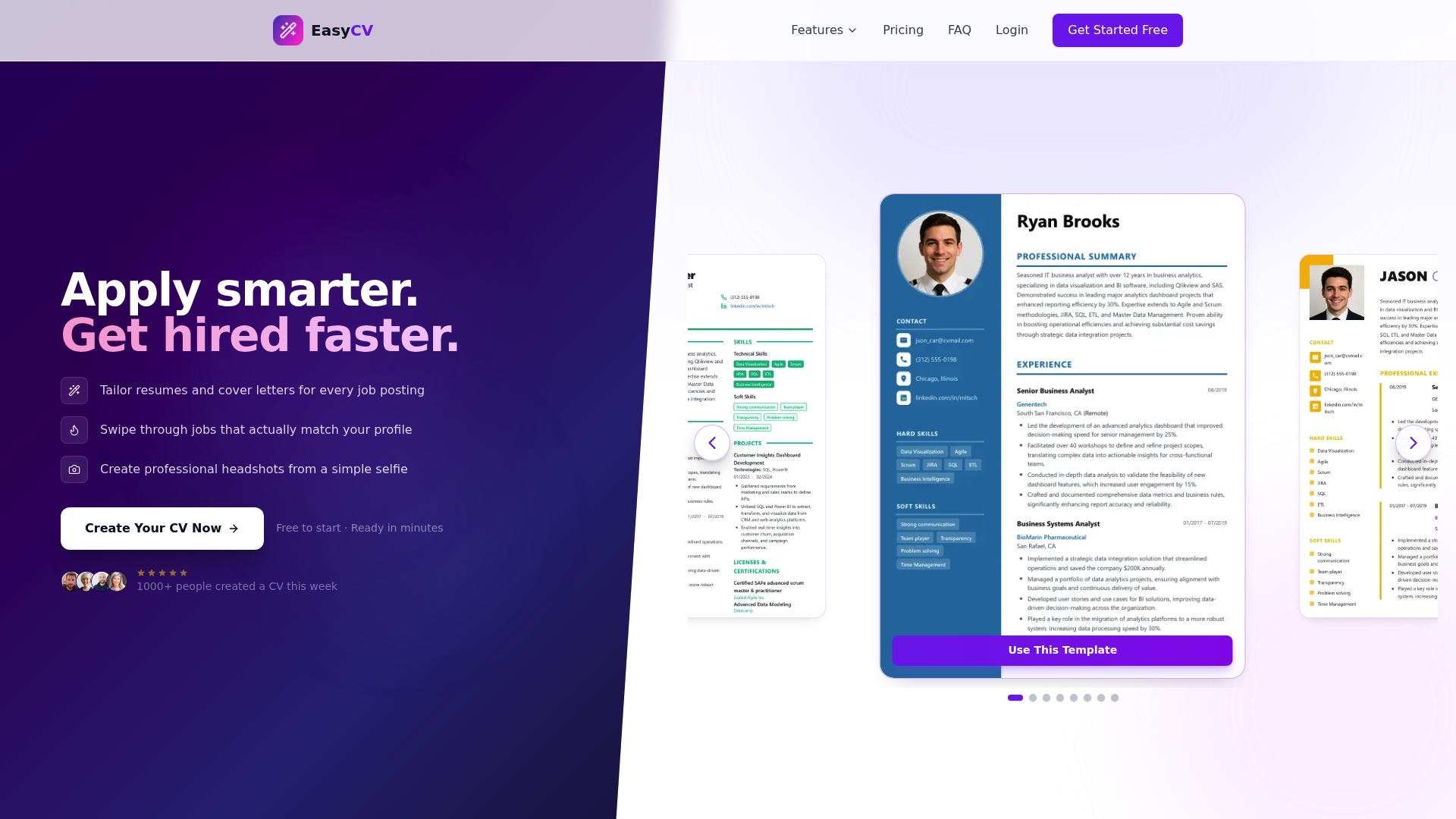
Beyond the rewrite itself, Easy-cv folds in the parts of a job search that usually live in separate apps: a swipe-based job matcher that surfaces relevant openings from major job boards, a built-in job tracker so you always know which tailored version went where, and support for translating your resume into other languages if you’re applying across borders, covered in more depth on the CV translator page.
If you want to see the full feature set mapped against the workflow in this guide, the Easy-cv features page breaks down what’s included at each plan level. Otherwise, the fastest way to know if it fits your search is to upload one resume and run it against one real job posting on Easy-cv today.