CV Editing Tips That Actually Get You Hired in 2026
Your CV has roughly six seconds to make an impression before a recruiter moves on. These cv editing tips will help you make every one of those seconds count:
- Use a single-column layout with ATS-friendly fonts like Calibri or Arial (10–11pt body, 18–22pt name)
- Include only name, city/state, phone, professional email, and LinkedIn URL — no photos, no date of birth
- Quantify every achievement you can: percentages, dollar amounts, team sizes, timeframes
- Tailor your summary and key bullet points to each role rather than rewriting the entire document
- Use keywords from the job description within achievement-focused bullets rather than as a standalone list
- Keep formatting consistent: uniform date formats, aligned margins, and matching bullet styles throughout
Table of Contents
- What goes into each core CV section — and how to edit it
- Formatting your CV so both humans and ATS can read it
- How to tailor your CV to each job without burning out
- Common CV editing do’s and don’ts
- How Easy-cv’s AI tools sharpen your CV and job search
- CV vs. resume: what’s the actual difference?
- How to cut irrelevant information from your CV
- Incorporating ATS keywords the right way
- Easy-cv makes CV editing faster and more effective
- Key Takeaways
What goes into each core CV section — and how to edit it
A well-structured CV covers six essential areas. Getting each one right matters more than perfecting any single line.
- Contact information: Per US resume format standards, exclude personal details like age, marital status, or full street address. Stick to name, city/state, phone, professional email, and a LinkedIn URL.
- Professional summary: Two to three lines, customized per role. Name the job title you’re targeting, your strongest relevant skill, and one measurable win. Generic summaries get skipped.
- Work experience: Reverse chronological order, always. Aim for several bullets per role, each focused on outcomes rather than duties. Strong CVs maintain a 7:1 ratio of achievement bullets to context bullets, maximizing ATS scoring and recruiter interest.
- Education: List your degree, institution, and graduation year. Include GPA only if you’re entry-level and it’s above 3.5. Certifications go here or in their own section if they’re central to the role.
- Skills: Pull directly from the job description. Hard skills and certifications belong here; soft skills like “team player” do not unless the posting specifically calls for them.
- Additional sections: Volunteer work, publications, languages, and side projects earn a spot only when they’re genuinely relevant to the role you’re applying for.
The UW–Madison Writing Center notes that CV sections should be clearly labeled and logically ordered so readers can locate information without hunting for it.
Formatting your CV so both humans and ATS can read it
Formatting is where a lot of otherwise strong CVs fall apart. ATS software parses your document before any human sees it, and a misplaced table or decorative font can wipe out entire sections.
- Use standard section headers: “Work Experience,” “Education,” “Skills.” Clever alternatives like “Where I’ve Been” confuse parsers.
- Stick to Calibri, Arial, or Helvetica. Decorative or script fonts often render as symbols in ATS outputs.
- Keep dates consistent throughout — “Jan 2022–Mar 2024” everywhere, not a mix of formats.
- ATS systems ignore content placed in headers, footers, text boxes, or tables. Every critical detail belongs in the main body.
- Set margins between 0.5 and 1 inch. Anything tighter looks cramped; anything wider wastes space.
- Format your document on US Letter size (8.5 x 11 inches). An A4 document can trigger display errors and signal an international applicant to automated filters.
- Export as a selectable-text PDF unless the employer specifically requests a Word file.
- Avoid photos, colored backgrounds, and decorative dividers. They add nothing and frequently break parsing.
Pro Tip: Before submitting, copy and paste your CV text into a plain-text editor like Notepad. If the structure collapses or symbols appear, your formatting will likely cause ATS parsing errors.
For a deeper look at CV formatting best practices, the Easy-cv blog covers ATS compatibility in detail.

How to tailor your CV to each job without burning out
Tailoring does not mean rewriting your CV from scratch for every application. That approach leads to fatigue and, ironically, worse results because rushed rewrites introduce inconsistencies.
- Focus your edits on three areas: the professional summary, the top 3–5 bullets of your most recent role, and the skills section. The rest of your CV can stay largely consistent.
- Extract exact phrases from the job description and work them into your bullets naturally. Contextual keyword integration within achievement-based bullets scores better with ATS than a keyword list at the bottom of your document.
- Add quantified context wherever you can. “Managed social media” becomes “Managed four brand social accounts, growing combined following by 34% in six months.”
- Only include skills you actually have. ATS systems are increasingly cross-referenced against interview performance, and misrepresentation surfaces quickly.
- Use AI writing tools to draft tailored bullets quickly, then edit them to sound like you. The goal is speed without losing your authentic voice.
- If you’re eligible to work in the US without sponsorship, add a line stating “Authorized to work in the US without sponsorship.” This one addition can bypass automated filters that screen out international applicants.
- Submit early. Applying before 9 AM EST on Monday puts your application among the first reviewed, which research links to significantly higher interview rates.
Pro Tip: Keep a “master CV” with every role, bullet, and achievement you’ve ever written. When tailoring, copy from that document rather than starting from memory. It’s faster and more accurate.
Managing multiple CV versions becomes much easier when you have a system for it from the start.

Common CV editing do’s and don’ts
Most CV mistakes fall into predictable patterns. Here’s what to do and what to cut.
Do:
- Open every bullet with a strong action verb: “Led,” “Built,” “Reduced,” “Generated,” “Negotiated.” Passive phrasing like “Responsible for managing” buries the impact.
- Keep length proportional to experience. One page for under 10 years; two pages maximum for more. A third page is almost never justified in a US job search context.
- Use consistent tense: past tense for previous roles, present tense for your current one.
- Run a final proofread focused specifically on the top half of your CV. That’s where recruiters spend most of their attention.
Don’t:
- Include a photo, date of birth, or full home address. Beyond being unnecessary, these details can introduce bias and are not standard in US applications.
- Stuff your skills section with buzzwords like “results-driven,” “synergistic,” or “thought leader.” They signal nothing and take up space.
- Place important information in headers, footers, or image-based text. ATS systems routinely miss content stored outside the main body.
- List every job you’ve ever held. Roles older than 10–15 years rarely add value unless they’re directly relevant to the position.
For a full breakdown of resume mistakes to avoid, the Easy-cv blog covers the most common pitfalls in detail.
How Easy-cv’s AI tools sharpen your CV and job search
Easy-cv is built around the idea that editing and applying shouldn’t be two separate, manual processes.
- The AI writing assistant generates achievement-focused, ATS-friendly bullets based on your role and the job description — then lets you refine them to match your voice.
- You can create multiple tailored CV versions quickly, each optimized for a different role or industry, without rebuilding from scratch each time.
- Easy-cv’s job description analysis identifies keywords automatically and suggests where to integrate them within your existing bullets.
- The platform supports CV creation and translation in 30+ languages, which matters if you’re applying across markets or to multinational employers.
- With over 10 million job listings added monthly, the built-in job aggregator surfaces relevant roles as soon as they’re posted, making it easy to hire day laborers in minutes.
- An AI headshot generator converts a standard selfie into a professional-quality photo, useful for LinkedIn profiles and international applications where photos are expected.
- Real-time feedback flags formatting issues, weak phrasing, and missing keywords before you submit.
Pro Tip: Use Easy-cv’s AI to draft your tailored summary first. A strong summary sets the tone for the whole document and takes the most time to write from scratch.
CV vs. resume: what’s the actual difference?
In the US, these two terms get used interchangeably, but they’re not the same document.
A resume is a one-to-two page summary of your work experience, skills, and education, tailored to a specific job. It’s the standard document for most US private-sector roles.
A CV (curriculum vitae) is longer and more comprehensive. It includes publications, research, presentations, awards, and academic history. CVs are standard in academia, medicine, and research, and they’re the norm in most countries outside the US. When a US employer in a non-academic field asks for a “CV,” they almost always mean a resume.
The National Careers Service notes that a CV should present your skills and experience clearly and concisely — a principle that applies regardless of which format you’re using.
How to cut irrelevant information from your CV
Every line on your CV is either earning its place or costing you attention. The editing question isn’t “Is this true?” — it’s “Does this help me get this specific job?”
Start with a relevance filter: read the job description, then read each bullet on your CV. If a bullet doesn’t connect to a required or preferred qualification in the posting, cut it or replace it with something that does. This is especially important for career changers, where older roles can dominate a CV that should be pointing forward.
Remove job duties that are obvious from the job title. A sales manager doesn’t need a bullet that says “managed sales team.” Use that space for a result instead. The same logic applies to skills: if you’re applying for a software engineering role, listing “Microsoft Word” as a skill wastes a line.
Outdated roles and expired certifications should go. Experience from more than 15 years ago rarely influences a hiring decision unless it’s directly foundational to the role. When in doubt, ask whether a recruiter who’s never met you would find that line useful. If the answer is no, delete it.
Incorporating ATS keywords the right way
ATS software doesn’t read your CV the way a human does. It scans for specific terms, then scores your document against the job description. Getting past that scan requires deliberate keyword placement.
Pull the exact language from the job posting. If the description says “cross-functional collaboration,” use that phrase rather than “working across teams.” The match needs to be close to literal for many systems. Focus keyword placement on your summary, your most recent role’s bullets, and your skills section — those are the sections ATS parsers weight most heavily.
The key distinction: embedding keywords inside achievement-based bullets outperforms listing them in isolation. “Ran A/B tests on email subject lines, improving open rates by 22%” signals competency in a way that “A/B testing” alone does not. ATS systems in 2026 are increasingly built to recognize contextual relevance, not just keyword presence.
Avoid keyword stuffing. Repeating a term five times doesn’t improve your score and makes the document unreadable for the human reviewer who comes after the ATS. Two or three well-placed instances of a key term are enough.
For more on passing ATS screening, the Easy-cv blog covers the mechanics in depth.
Easy-cv makes CV editing faster and more effective
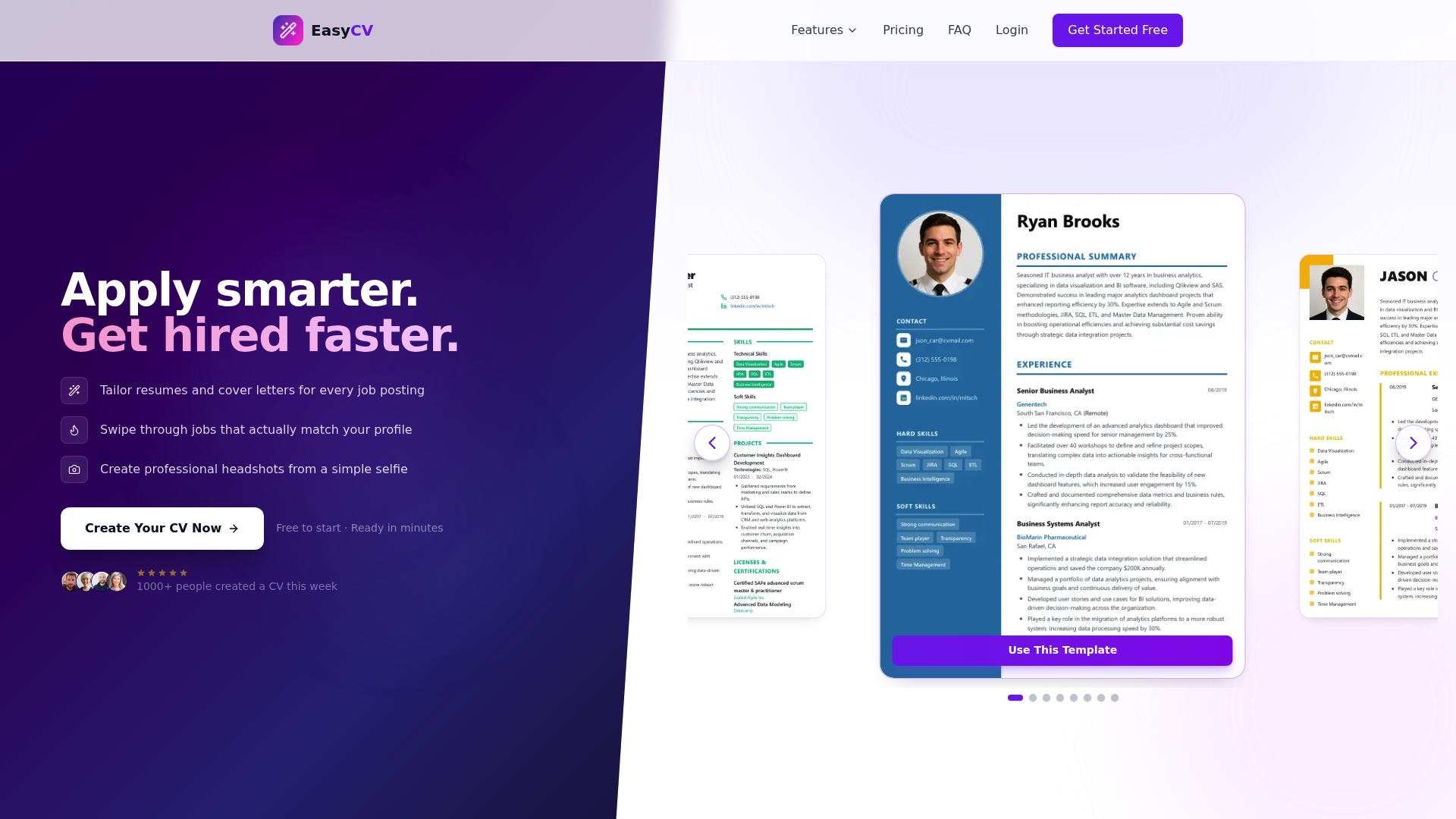
Most job seekers spend hours editing a CV that still doesn’t pass ATS screening. Easy-cv cuts that cycle short. The platform’s AI writing assistant drafts tailored, keyword-rich bullets in seconds, its ATS-friendly templates handle formatting automatically, and the built-in job matcher surfaces roles that fit your profile before you even start editing.
The real advantage is the workflow. Instead of toggling between a job board, a word processor, and a keyword checker, everything lives in one place. You find a role, the AI analyzes the description, and your CV updates to match. Free and premium plans are both available, so you can start without a financial commitment and upgrade when the search gets serious.
If you’re ready to stop guessing whether your CV will make it past the first filter, try Easy-cv and see how much faster the process gets.
Key Takeaways
A strong CV combines precise formatting, quantified achievements, and targeted keyword placement — not just good writing.
| Point | Details |
|---|---|
| ATS formatting rules | Keep all content in the main body; avoid headers, footers, tables, and text boxes to prevent parsing failures. |
| Achievement-to-context ratio | Strong CVs maintain a 7:1 ratio of achievement bullets to context bullets across each role. |
| Targeted tailoring | Focus edits on your summary and top 3–5 bullets of your most recent role — not the entire document. |
| Keyword integration | Embed job description keywords inside quantified bullets; contextual placement outperforms standalone keyword lists. |
| Easy-cv | Easy-cv’s AI writing assistant drafts tailored, ATS-friendly bullets and flags formatting issues before you submit. |