Why Sector-Specific Resumes Matter for Your Job Search

Tailoring your resume to a specific industry is one of the highest-return moves you can make in a job search. Recruiters spend just 6–10 seconds scanning a resume before deciding whether to read further. A document written for a generic audience forces them to hunt for relevance. Most won’t.
Here’s what a sector-specific resume does differently from a generic one:
- Summary: Rewritten to name the exact role title and the core skill the employer is prioritizing
- Top bullet points: Reordered or swapped to front-load the responsibilities the job description emphasizes
- Skills section: Updated with exact tool names, platforms, or certifications the posting lists
ATS systems rank candidates by how closely their resume text matches the job posting. Most large companies use applicant tracking systems, and the vast majority of recruiters use filters inside those systems. A resume missing one key skill or job title variant can be eliminated before a human ever reads it.
1. Key benefits of tailoring your resume to industry requirements
A sector-focused resume does more than clear an ATS filter. It signals to a recruiter that you understand their world.
- Better ATS ranking: Exact keyword matches carry real weight. When your resume mirrors the posting’s language, your match score improves before a human sees it.
- Faster recruiter engagement: A resume that reflects the employer’s language signals relevance in seconds. A generic one forces them to search for fit.
- Higher interview rates: Tailored resumes tend to convert to interviews at roughly twice the rate of generic ones (more on the numbers in section 4).
- Proof of industry knowledge: Aligning your language to sector priorities, whether that’s HIPAA compliance for healthcare or ROAS for marketing, shows you already speak the industry’s language.
- Fewer wasted applications: Targeted applications with strong match rates consistently outperform high-volume generic sending.
The advantages of industry-specific CVs compound over time. Each tailored application teaches you more about what a sector values, which makes the next one faster to write.
2. How to customize your resume effectively for different sectors

Effective tailoring is surgical. You update three sections and leave the rest alone.
Focus on these three areas:
- Resume summary (2–4 sentences): Use the exact role title from the posting. Name the core skill the employer is prioritizing and pair it with one concrete result.
- Top 3–5 bullet points in your most relevant role: Swap out or reorder bullets to surface the skills the job description emphasizes. You’re not inventing experience. You’re choosing which real experience to show first.
- Skills section: Add exact tool names and methodologies the posting lists that you genuinely have. Remove skills irrelevant to this role. ATS filters frequently scan this section first.
Different sectors trust different forms of proof. A tech hiring team wants stack, scale, and shipping velocity. A finance team wants forecast accuracy, GAAP compliance, and margin impact. Healthcare employers look for patient outcomes, HIPAA, and care coordination scope. Aligning your evidence to what each sector actually measures is what separates a strong tailored resume from a generic one with a few keywords swapped in.
Using keywords honestly 1–3 times per resume is the right approach. Don’t fabricate qualifications to hit a keyword count. ATS systems read for relevance; interviewers read for truth.
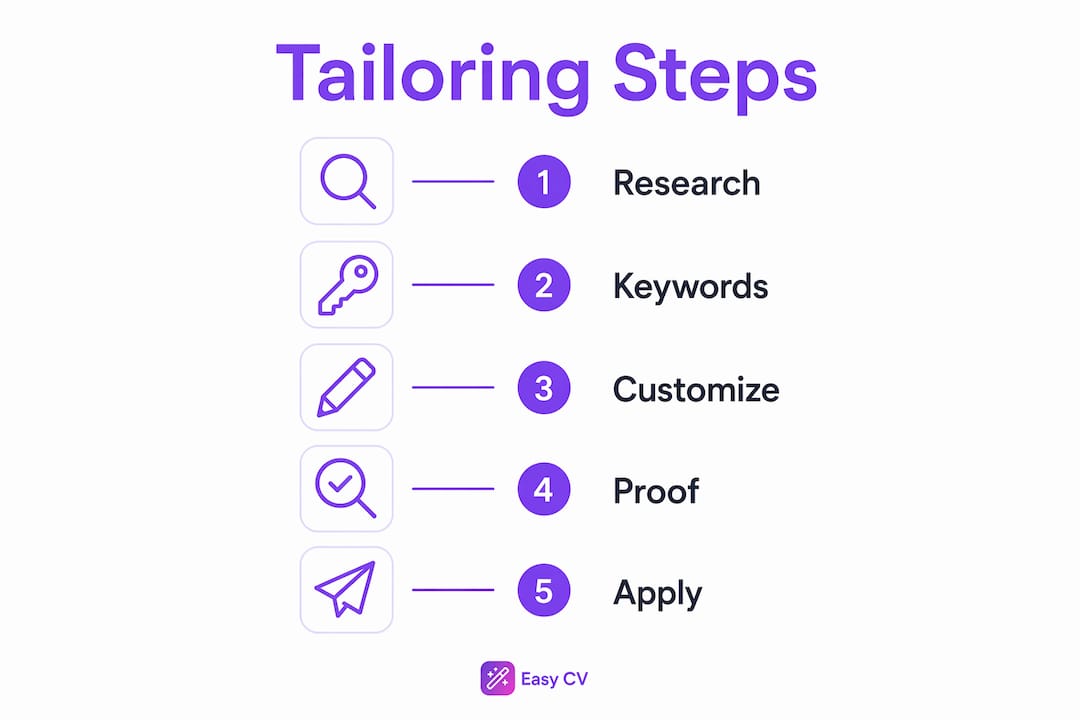
Pro Tip: Review three to five job descriptions for the same role type before writing a single word. The terms that appear across all of them are your sector’s core vocabulary. Those are the words your resume needs.
AI tools can cut tailoring time to under 10 minutes by matching keywords from the job description automatically, which makes it realistic to tailor every application without burning out.
3. Data-driven proof that tailored resumes double interview rates
The numbers here are hard to argue with.
Two-thirds of successful job searches in that same report ended within 50 targeted applications. High-volume generic sending rarely beats a focused, tailored approach. Fewer applications with stronger match rates is the strategy the data supports.
The same-title trap catches a lot of job seekers. A Software Engineer role at a fintech startup prioritizes Python, microservices, and AWS. The same title at an enterprise bank emphasizes Java, compliance, and system reliability. A resume optimized for one will score poorly against the other, even though the candidate may be equally qualified for both. Each posting tells you what that company actually values.
4. Common mistakes to avoid when tailoring resumes for sectors
Most tailoring errors come from doing too little or the wrong things.
Tailoring only the job title in the summary. Swapping one word at the top while leaving the rest of the resume generic doesn’t move your ATS score. The skills section and bullet points carry equal or greater weight.
Copying job description language verbatim. Mirroring the employer’s language is smart. Pasting their exact sentences into your bullet points reads as lazy and can flag as suspicious. Rewrite the idea in your own words using their terminology.
Fabricating metrics or qualifications. If you don’t have a particular experience, leave that keyword off your resume. Inflated numbers get exposed in interviews. Claimed tools you haven’t used create problems on day one.
Applying the same version to identical job titles at different companies. As the fintech versus enterprise bank example shows, identical titles can require entirely different resumes. Read each posting as its own brief.
Ignoring the skills section. Many job seekers spend all their time on bullet points and forget that ATS systems often scan the skills section as a first pass. Keep it updated and specific to each application.
5. How to research industry-specific keywords and jargon
The best keyword research doesn’t come from a single job posting. It comes from patterns across many.
Pull five to ten job descriptions for your target role and read them side by side. Look for:
- Repeated terminology: Words that appear in most postings are the sector’s baseline vocabulary.
- Recurring tools and platforms: Specific software names (Salesforce, AutoCAD, Epic EHR) signal what the industry runs on.
- Shared success metrics: How does this sector measure good work? Quota attainment in sales, uptime in tech, patient volume in healthcare.
- Credentials near the top of listings: Certifications or licenses that appear consistently are often ATS filters, not just preferences.
LinkedIn job postings and industry association websites are reliable sources for current terminology. Professional communities on Reddit, Slack, or industry forums often surface the informal language that practitioners actually use, which can be just as valuable as the formal terms.
Sector-specific resume optimization also means checking how your target industry formats resumes. Finance and law favor conservative layouts with credentials easy to find. Tech roles often benefit from a GitHub link or portfolio. Healthcare resumes typically put licenses near the top. Format is part of the signal.
Pro Tip: Use a free word-frequency tool to paste in several job descriptions at once. The most repeated non-generic words are your keyword targets.
Easy-cv turns resume tailoring from a chore into a competitive edge
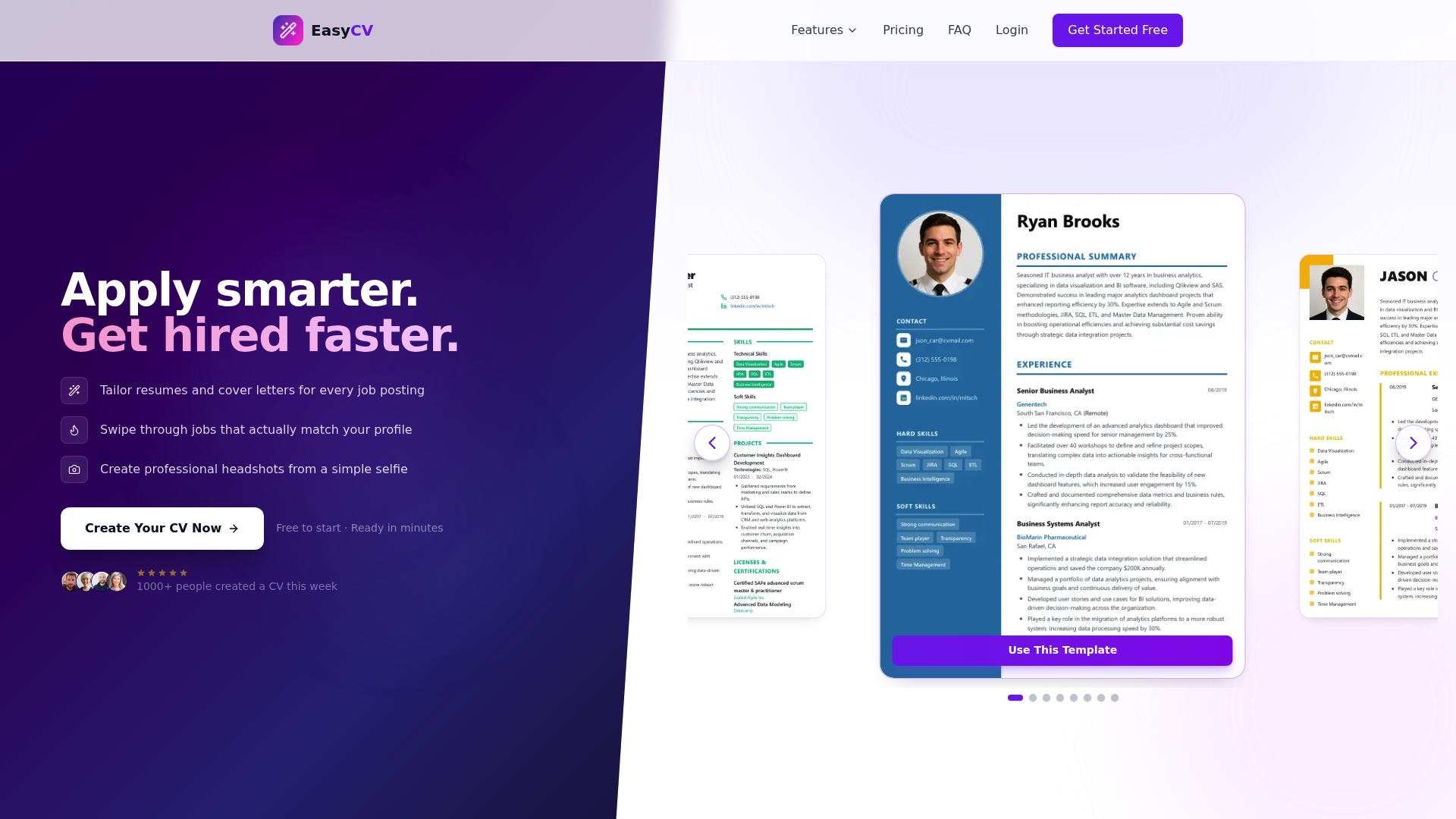
Most job seekers know they should tailor their resume. The part that stops them is time. Easy-cv solves that directly. Its AI writing assistant matches keywords from any job description to your existing resume automatically, cutting the tailoring process to under 10 minutes per application. You get ATS-ready output without rewriting from scratch every time.
The platform’s job matcher pre-scores live listings against your CV using a swipe-based interface, so you’re only spending tailoring time on roles that already fit. ATS-friendly templates handle the formatting side, and the built-in job tracker keeps your applications organized across every sector you’re targeting. For job seekers applying across borders, Easy-cv supports CV creation and translation in 30+ languages. Start tailoring smarter with Easy-cv.
Key Takeaways
Tailored resumes convert to interviews at more than twice the rate of generic ones, making sector-specific customization the single highest-impact change most job seekers can make.
| Point | Details |
|---|---|
| ATS filters are decisive | 98% of Fortune 500 companies use ATS; 99.7% of recruiters use ATS filters, and resumes missing key skills or an exact job title keyword can be eliminated before a human reads them. |
| Three sections drive results | Update your summary, top 3–5 bullet points, and skills section. Leave the rest alone. |
| The data is clear | Tailored resumes tend to convert to interviews at roughly twice the rate of generic ones. |
| Same title, different resume | Identical job titles at different companies often require entirely different keyword sets and evidence. |
| Easy-cv cuts tailoring time | Easy-cv’s AI keyword matching reduces per-application tailoring to under 10 minutes. |