Skills Extraction Explained: Methods, Tools, and Use Cases
Skills extraction is the process of converting unstructured resume or job-posting text into a structured, machine-readable list of competencies, each tagged with its source context and an optional confidence score. That output is what powers ATS matching, job discovery, and personalized resume advice across the U.S. hiring market. Datasets like SKILLSPAN have pushed the research forward, and platforms like Easy-cv now apply these techniques directly to job seekers’ workflows.
Where it matters most:
- ATS and job matching: Recruiters’ systems rank candidates by comparing extracted skill profiles against job-requirement lists. A resume that doesn’t surface the right skills in a parseable format simply scores lower, regardless of the candidate’s actual experience.
- Resume optimization: Knowing which skills an extractor will and won’t catch lets you write a resume that reads well to both humans and machines.
Pro Tip: Add an explicit “Skills” section to your resume and spell every technical term consistently, “JavaScript” not “Javascript” or “JS” in different places. Extractors match on exact or near-exact strings before they reason about context, so inconsistent casing and abbreviations are the fastest way to lose credit for a skill you actually have.
Key Takeaways
Skills extraction converts unstructured resume and job-posting text into structured, taxonomy-mapped competency profiles that directly determine ATS ranking and job match scores.
| Point | Details |
|---|---|
| Core definition | Skills extraction produces a structured list of competencies with context, taxonomy IDs, and confidence scores from raw text. |
| Pipeline stages | Ingestion and OCR quality determine downstream accuracy more than the NER model itself. |
| Method choice | Gazetteer-plus-classifier pipelines (around 73% F1) suit most product contexts; fine-tuned LLMs deliver higher accuracy at significantly greater cost. |
| Benchmark to trust | SKILLSPAN (~14.5K sentences, ~12.5K spans) is the standard reference for evaluating span-level extraction models. |
| Easy-cv application | Easy-cv’s job matcher scores your CV against 10 million-plus monthly job listings and uses AI to help you close skill gaps before you apply. |
Table of Contents
- What is skills extraction, and how does the pipeline work?
- How do the core technical approaches compare?
- What datasets and benchmarks should you trust?
- What tools and APIs can you try today?
- How to extract skills from a resume or job posting, step by step
- What can go wrong, and what are the ethical risks?
- How jobseekers and ATS platforms use skills extraction in practice
- What to actually do first, and where to be careful
- Easy-cv turns extracted skills into a stronger application
- Sources
What is skills extraction, and how does the pipeline work?
Skills extraction, sometimes called skill identification, is not a single operation. It is a multi-stage pipeline that converts raw text into a normalized competency profile. Understanding each stage tells you where errors enter and where to focus when results look wrong.
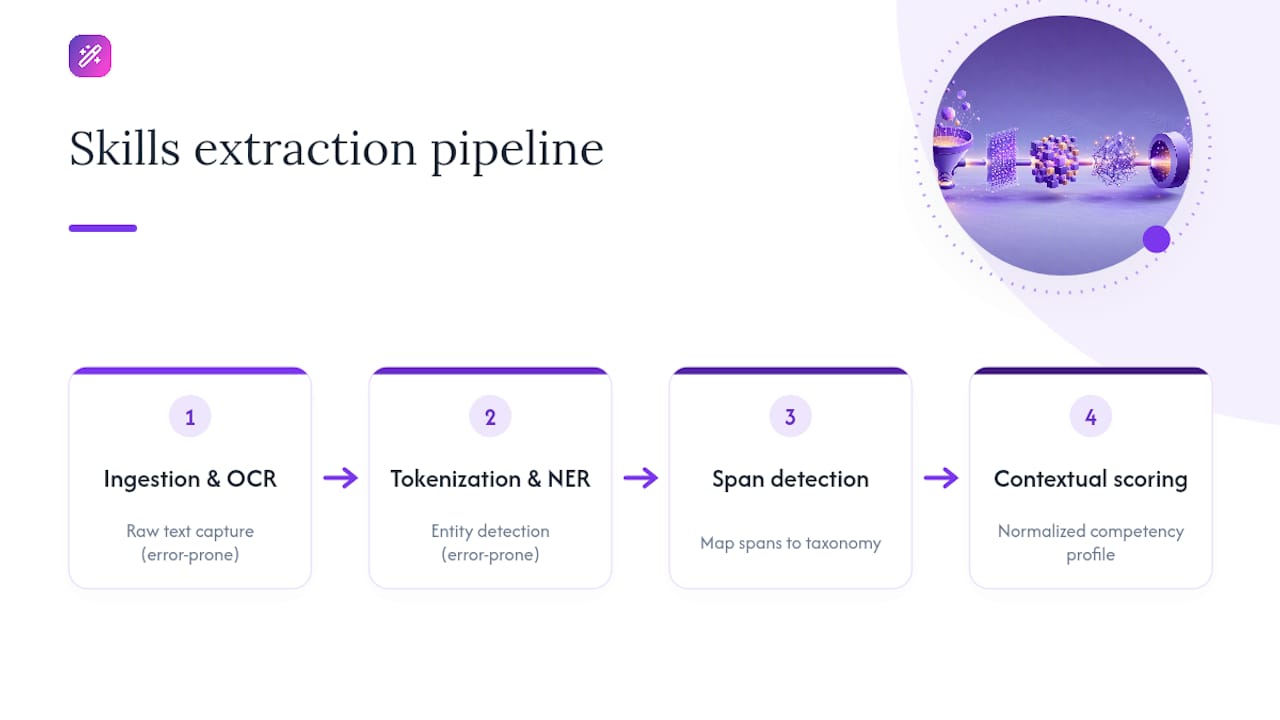
Stage 1: Ingestion and OCR
The pipeline starts with whatever document format the user submits: PDF, Word, LinkedIn export, or even a screenshot. PDFs and images require optical character recognition (OCR) to convert visual layout into plain text. Resume parsers run OCR and layout reconstruction before any NER model sees the text, and failures at this stage, garbled characters, merged columns, or dropped bullet points, cascade into missed or corrupted skill spans downstream. A scanned PDF from a two-column template is one of the most common sources of extraction failures in practice.
Stage 2: Tokenization and named entity recognition
Once the text is clean, the pipeline tokenizes it into words or subwords and runs a named entity recognition (NER) model to locate skill-related spans. This is where the system decides which phrases are skills and which are not. NER models are probabilistic: the same phrase might score differently depending on surrounding context.
Stage 3: Span detection and taxonomy mapping
After the NER pass, the system has a list of candidate spans. The next step is normalization: mapping “team supervision” and “supervision of a team” to the same canonical entry in a taxonomy. The Skills Extractor Library uses spaCy NER for extraction and then semantic similarity to map spans to taxonomies like ESCO or Lightcast Open Skills. Without this step, synonym variants fragment candidate profiles and make cross-resume comparison unreliable.
Taxonomy mapping is not optional. A well-maintained taxonomy provides canonical identifiers and synonym lists; production systems combine these with semantic-similarity matching to handle novel mentions not yet in the taxonomy.
Stage 4: Contextual scoring and output
The final stage attaches metadata to each extracted skill: where it appeared (Skills section vs. work experience), a short context snippet, and a confidence score. Skill extraction systems tag each item with this metadata because downstream match scoring depends on it. A skill mentioned only in a buried bullet carries less weight than one that appears in both the Skills section and a job description bullet.
Standard output is JSON. A canonical structure looks like this:
{
  "skill": "Python",
  "taxonomy_id": "ESCO/S4.1.2",
  "context": "Built ETL pipelines using Python and Apache Airflow",
  "source_section": "experience",
  "confidence": 0.91
}
The deterministic parts of the pipeline (gazetteer lookups, exact-match taxonomy entries) are fast and predictable. The probabilistic parts (NER inference, semantic similarity scoring) are where accuracy varies and where method choice matters most.
How do the core technical approaches compare?
Three families of methods dominate skills extraction today, and the right one depends on your budget, accuracy requirements, and how much labeled data you have.
Keyword and rule-based matching
The simplest approach: maintain a list of known skill strings (a gazetteer) and scan text for matches. When the vocabulary is controlled and stable, this is fast, cheap, and highly precise. The problem is recall. A gazetteer built on a large list of known skills still misses novel phrasings, multi-word expressions, and context-dependent terms. It also requires ongoing maintenance as the labor market evolves.

This approach still makes sense for narrow domains where the skill vocabulary is small and well-defined, or as a first-pass filter before a more expensive model runs.
Token classification and NER
BERT-style token classifiers treat skill extraction as a sequence labeling problem: each token gets a label (B-SKILL, I-SKILL, O) and the model learns from annotated examples. Fine-tuned on a labeled corpus like SKILLSPAN, these models generalize better than gazetteers and handle multi-word spans naturally.
The trade-off is annotation cost. You need thousands of labeled examples to fine-tune reliably, and the model’s accuracy degrades on domains far from its training distribution. spaCy-based pipelines are the most common deployment pattern for teams with moderate compute budgets.
LLM-based extraction
Large language models approach the problem differently. Instead of labeling tokens, they read the full text and reason about which phrases represent skills in context. Zero-shot prompting works surprisingly well for common skills; few-shot examples improve consistency. Fine-tuned LLMs, like those described in the Skill-LLM research, can outperform prior state-of-the-art methods on span-level benchmarks when trained with structured output formats.

The catch: LLM approaches require careful prompt design or fine-tuning and often produce generative outputs that need additional parsing to become machine-readable JSON. Compute costs are also meaningfully higher than running a small NER model.
Practical trade-offs at a glance:
- Keyword/gazetteer: High precision, low recall, zero annotation cost, brittle on novel phrasing
- NER/token classification: Balanced precision and recall, moderate annotation cost, good for production at scale
- LLM zero/few-shot: Strong contextual reasoning, no annotation needed, higher cost, output parsing required
- Fine-tuned LLM: Best accuracy on benchmarks, highest compute and engineering cost, needs labeled data
| Approach | Accuracy | Labeling effort | Compute cost | Integration ease |
|---|---|---|---|---|
| Keyword/gazetteer | Moderate | None | Very low | Easy |
| NER/token classification | Good | High | Low–moderate | Moderate |
| LLM zero/few-shot | Good–very good | None | High | Harder |
| Fine-tuned LLM | Best on benchmarks | High | Very high | Hardest |
Open-source pipelines often combine a gazetteer with a small contextual classifier as a practical middle ground. One project pairs a 32K-skill gazetteer with MiniLM embeddings and an MLP classifier, reporting around 73% F1 on a held-out job-posting set. That level of accuracy is usable in many product contexts without the overhead of a full transformer stack.
What datasets and benchmarks should you trust?
Evaluating an extraction system requires labeled data and agreed-on metrics. The research community has converged on a small set of public resources.
SKILLSPAN
SKILLSPAN is the most widely cited public benchmark for skill extraction. It contains roughly 14,500 sentences and 12,500 annotated spans drawn from English job postings, covering both hard skills (technical competencies) and soft skills (interpersonal and behavioral traits). The dataset ships with span-level annotation guidelines, which teams can reuse to build consistent internal labels.
Benchmark note: SKILLSPAN’s ~14.5K sentences and ~12.5K annotated spans make it the standard reference for comparing span-level extraction models. Any system claiming state-of-the-art results should report F1 on this or an equivalent held-out set.
Evaluation metrics
Three metrics matter for skill extraction:
- Precision: Of all spans the model labeled as skills, what fraction were correct? High precision means fewer false positives.
- Recall: Of all actual skill spans in the text, what fraction did the model find? High recall means fewer missed skills.
- F1: The harmonic mean of precision and recall. It is the standard single-number summary for span-level extraction tasks.
Span-level scoring is stricter than label-level scoring. A span must match the gold annotation’s exact boundaries to count as correct, not just overlap with it. This distinction matters when comparing systems: a model that reports high label-level accuracy may still miss partial spans that a recruiter would consider meaningful.
Recommended evaluation practices:
- Always use a held-out test set that was not seen during training or hyperparameter tuning
- Report span-level F1, not just token-level accuracy
- Run separate error analysis on hard skills vs. soft skills, since models typically underperform on soft skills
- Check inter-annotator agreement on your internal labels before training; SKILLSPAN’s published guidelines are a reasonable starting point
What tools and APIs can you try today?
You don’t need to build from scratch. Several production-ready and research-grade options exist across the spectrum from hosted APIs to local Python packages.
Hosted APIs and demos:
- Lightcast Skills Extractor: Lightcast’s Skills API accepts raw text and returns a list of skills mapped to the Lightcast Open Skills taxonomy, complete with taxonomy IDs and confidence scores. It is one of the most widely used commercial APIs for this task in the U.S. market, and Lightcast offers a demo interface for testing without writing code.
- Reqcore and similar hosted extractors: Several B2B platforms offer REST APIs that accept resume text and return structured JSON profiles, useful for teams that want to skip model hosting entirely.
Open-source libraries:
- The Skills Extractor Library (Nesta/ESCoE) is a Python package that runs spaCy NER to find skill phrases and then maps them to ESCO or Lightcast taxonomies via semantic similarity. It has been used in large-scale analyses of job postings and is well-documented for researchers and product teams alike.
- The skill-extractor package on PyPI combines a large gazetteer with MiniLM embeddings and an MLP classifier. It supports quantized models and ONNX runtime to keep resource use low, making it practical for teams running inference locally without GPU access.
- The dreamjobs-tech/skill-extractor GitHub repo is a cloneable implementation of the gazetteer-plus-classifier pipeline with configuration options and accuracy metrics you can benchmark against your own data.
Research implementations:
- Skill-LLM (available on arXiv and GitHub) is a fine-tuned LLM approach that demonstrates how to adapt a general-purpose language model for structured skill extraction. It is the right starting point if you want to experiment with LLM-based methods and have access to labeled training data.
- SKILLSPAN is both a dataset and a benchmark suite. Cloning the associated repository gives you annotation guidelines, train/dev/test splits, and baseline model results to compare against.
Technical prerequisites: The Python-based libraries require Python 3.8+ and pip. The spaCy-based Skills Extractor Library needs a spaCy model download on first run. Lightcast’s API requires an account and API key. Skill-LLM experiments require a GPU for fine-tuning, though inference on smaller models can run on CPU.
Pro Tip: If you want a quick sanity check on your own resume, paste the text into the Lightcast Skills Extractor demo before investing in any pipeline setup. The output tells you immediately which skills a production-grade system surfaces and which ones it misses, giving you a concrete baseline to improve against.
How to extract skills from a resume or job posting, step by step
This workflow applies whether you are a jobseeker checking your own resume or a practitioner building a pipeline for a product.
-
Prepare your input. Export your resume as plain text or a clean PDF. If you are working from a scanned document or screenshot, run it through an OCR tool (Tesseract is free and widely used) and visually inspect the output for garbled characters, merged words, or dropped lines before proceeding. Fix obvious errors manually.
-
Run the extractor. Feed the cleaned text to your chosen tool: the Skills Extractor Library, the PyPI skill-extractor package, or the Lightcast API. For job postings, paste the full description including requirements and preferred qualifications, since skills often appear in both sections.
-
Map to a taxonomy. If your extractor does not handle taxonomy mapping internally, run a semantic similarity step to normalize extracted spans to ESCO or Lightcast Open Skills IDs. This converts “team supervision” and “supervising teams” into the same canonical entry.
-
Review low-confidence spans. Sort output by confidence score and manually review anything below roughly 0.70. Low-confidence spans are often partial matches, OCR artifacts, or domain-specific acronyms the model has not seen before. Correct or discard them.
-
Export the structured profile. Write the validated output to JSON. A canonical record for each skill should include the span text, taxonomy ID, source section, context snippet, and confidence score (see the JSON example in the pipeline section above).
Quick debugging checks when results look wrong:
- OCR errors: look for transposed characters (“Pytho n”, “JavaScrlpt”) in the raw text before the extractor runs
- Abbreviations: “ML,” “NLP,” and “CI/CD” may not match gazetteer entries that store the full form
- Hyphenation: “cross-functional” vs. “cross functional” vs. “crossfunctional” are three different strings to a gazetteer
- Inconsistent casing: “agile” vs. “Agile” vs. “AGILE” can split matches across taxonomy entries
Pro Tip: After running an extractor on your resume, check that each skill you consider core to your candidacy appears in at least two places: the Skills section and a work experience bullet. Extractors weight skills that appear in multiple sections more heavily, and ATS ranking systems often do the same.
What can go wrong, and what are the ethical risks?
Skills extraction fails in predictable ways, and some of those failures carry real consequences in a hiring context.
Common technical failure modes:
- Fragmented phrasing: “Experience with leading cross-functional teams in fast-paced environments” may yield no clean skill span because the relevant competency is distributed across the clause rather than named directly.
- Multi-skill spans: “Python, R, and SQL” is three skills in one span. Extractors that don’t handle comma-separated lists correctly will either miss all three or return the full string as one entity.
- Domain-specific acronyms: “FMEA,” “GD&T,” or “HIPAA compliance” are meaningful skills in their industries but may not appear in a general-purpose gazetteer or training corpus.
- Synonym mismatch: “Stakeholder management” and “stakeholder engagement” are functionally identical but may map to different taxonomy nodes or fail to match at all.
Bias and fairness concerns:
Soft skills are where bias risk concentrates. Labels like “leadership,” “communication,” and “teamwork” are applied inconsistently across annotated datasets, and models trained on those datasets inherit the inconsistency. More concerning: contextual cues in a resume (school names, geographic references, extracurricular activities) can correlate with demographic characteristics. A model that infers skills from context rather than explicit mentions may inadvertently encode those correlations into its output. The growing importance of soft skills in hiring makes this a live problem, not a theoretical one.
U.S. privacy considerations:
Resumes contain PII: names, addresses, phone numbers, and sometimes Social Security numbers or immigration status. Parsed profiles derived from resumes inherit that sensitivity. Under U.S. frameworks, organizations processing resume data should apply minimal retention policies, store parsed profiles separately from raw documents, and restrict access to the structured output. Sending resume text to a third-party API without reviewing that provider’s data processing terms is a compliance risk.
Pro Tip: If you are building an extraction pipeline for a hiring product, implement audit logs that record which skills were extracted, which were flagged for human review, and which were corrected. A human-in-the-loop review step for borderline confidence scores (roughly 0.60–0.75) is the single most practical mitigation against both technical errors and bias amplification.
How jobseekers and ATS platforms use skills extraction in practice
The structured output from a skills extraction pipeline feeds several downstream workflows that directly affect a jobseeker’s chances.
Candidate-job matching: ATS platforms compare a candidate’s extracted skill profile against the skill requirements parsed from a job description. The match score determines ranking in recruiter search results. A candidate whose resume surfaces 8 of 10 required skills in structured form will rank above an equally qualified candidate whose resume surfaces only 5, even if the underlying experience is identical.
Profile enrichment for job discovery: Platforms that aggregate job listings use extracted skill profiles to surface relevant roles the user did not explicitly search for. The richer and more accurate the profile, the better the recommendations. This is where taxonomy normalization pays off directly: a profile that maps “Python scripting” to the same taxonomy node as “Python programming” matches a broader set of job postings.
Personalized resume suggestions: Some platforms use the gap between a candidate’s extracted profile and a target job’s requirements to generate specific resume edits. If the job requires “stakeholder management” and the candidate’s resume mentions “working with stakeholders” without a clean extraction, the system can flag that gap and suggest a rewrite.
Easy-cv applies this logic across its full workflow. The platform’s job matcher scores each of the 10 million-plus job opportunities added monthly against a user’s CV, surfacing the roles where the skill overlap is strongest. The AI writing assistant then helps users close the gap: if a job description emphasizes skills that are present in a user’s experience but not clearly stated in their CV, the assistant can surface and articulate them. That feedback loop, from extraction to match score to targeted CV edit, is what makes the difference between a generic application and one that actually ranks.
Skills extraction is most valuable when it closes the loop: the same signal that scores a candidate against a job posting can tell that candidate exactly what to add or rewrite to improve their score on the next application.
For jobseekers, the practical implication is straightforward. Understanding how AI tools shape job hunting means understanding that your resume is being read by a machine before a human sees it. Writing for extractability is not gaming the system; it is communicating clearly in the format the system is designed to read.
What to actually do first, and where to be careful
The gap between a working demo and a reliable production system is wider in skills extraction than most people expect. The NER model is rarely the bottleneck. Taxonomy mapping and human review are where most teams underinvest, and where most accuracy problems actually live.
If you are prototyping, start with taxonomy mapping before you optimize the extraction model. A well-maintained taxonomy (ESCO or Lightcast Open Skills) gives you a controlled vocabulary to evaluate against, makes errors visible, and forces you to confront synonym coverage early. Teams that skip this step and optimize NER first often discover months later that their “high-accuracy” extractor is producing fragmented profiles that don’t match anything in their job database.
The caution I would add for hiring teams specifically: extracted skills are a signal, not a verdict. A system that auto-rejects candidates based on skill-profile gaps, without human review of borderline cases, will systematically disadvantage candidates who write differently, use different terminology, or come from non-traditional backgrounds. The evolution of talent acquisition is moving toward skills-based hiring, but that only works if the extraction layer is honest about its own error rate. Build the audit log. Keep a human in the loop. The technology is good enough to be useful; it is not good enough to be trusted without oversight.
Easy-cv turns extracted skills into a stronger application
Knowing which skills an extractor surfaces from your resume is useful. Knowing how to act on that information is where most jobseekers get stuck.
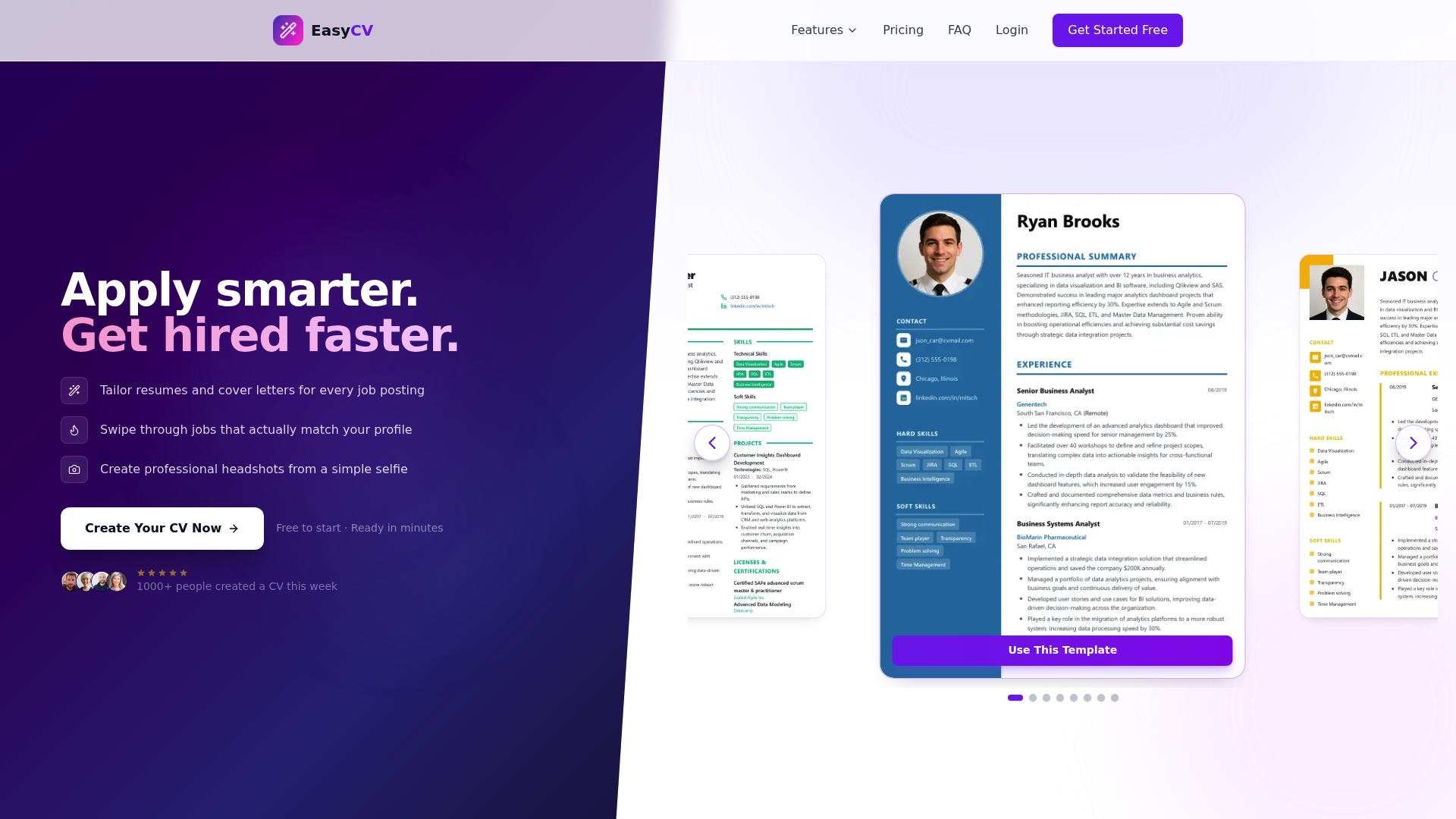
Easy-cv closes that gap directly. The platform’s job matcher scores your CV against more than 10 million job opportunities added monthly, showing you exactly where your skill profile aligns and where it falls short for each role. The AI writing assistant then helps you rewrite the relevant sections, not with generic suggestions, but with edits tied to the specific skills the target job requires. You get a tailored CV and cover letter for each application, ATS-friendly exports, and a built-in job tracker to keep the whole search organized. Other engineering options exist for teams building extraction pipelines from scratch, and the tools listed in this guide are worth exploring. For jobseekers who want to apply these insights to their actual job search today, Easy-cv’s platform is the fastest path from extracted skills to a submitted application.
Sources
Research papers:
- skill-extractor v0.1.0
- The Skills Extractor Library - ESCoE : ESCoE
- Hard and Soft Skill Extraction from English Job Postings
Datasets:
Open-source code:
Hosted demos and APIs: