Job Matching Guide: Land the Right Role Faster
Job matching is the process of aligning your skills, experience, and goals with job opportunities that genuinely fit your profile. Done right, it is the single biggest lever you can pull to increase your interview rate. Tailored resumes yield 200–300% more interviews than generic ones. That number alone explains why a structured approach to matching beats mass-applying every time. This job matching guide covers the tools, algorithms, and step-by-step workflows active job seekers and career changers need in 2026 to stop guessing and start getting callbacks.
What tools do you need to start job matching effectively?
Effective job matching starts with three inputs: an updated resume, a clear skills inventory, and detailed job descriptions from roles you are targeting. Without all three, any matching process, manual or AI-powered, produces weak results. Think of it as triangulation. You need to know where you are, where you want to go, and what the gap looks like.
Your skills inventory should go beyond job titles. List specific tools, methodologies, certifications, and measurable outcomes. A project manager who lists “Agile, Jira, cross-functional team leadership, 30% on-time delivery improvement” matches far more precisely than one who lists “project management.” Specificity is what separates a strong match from a near-miss.

On the software side, several platforms now offer AI-assisted matching with varying levels of transparency. Easy-cv aggregates over 10 million job opportunities per month and uses AI to evaluate each listing against your profile, so you see the best fits first. Other tools like LinkedIn’s job recommendations and Indeed’s Smart Apply use keyword-based filtering, which is faster but less nuanced than true semantic matching.
| Platform | Matching method | Explainability | Resume tailoring |
|---|---|---|---|
| Easy-cv | AI semantic + swipe | Yes | AI-assisted, per application |
| Keyword + network signals | Partial | Manual | |
| Indeed | Keyword filtering | No | Manual |
| Handshake | Skills-based (early career) | Partial | Manual |
Pro Tip: Before uploading your resume to any platform, run a plain-text version through it. ATS systems and AI matchers read plain text first. Formatting errors in PDFs can cause your strongest qualifications to disappear entirely.
How does AI-driven job matching work?
AI job matching converts your resume and a job description into numerical representations called vector embeddings. The system then measures the mathematical distance between the two vectors. A smaller distance means a stronger match. This is fundamentally different from keyword filtering, which only checks whether a word appears, not whether the meaning aligns.
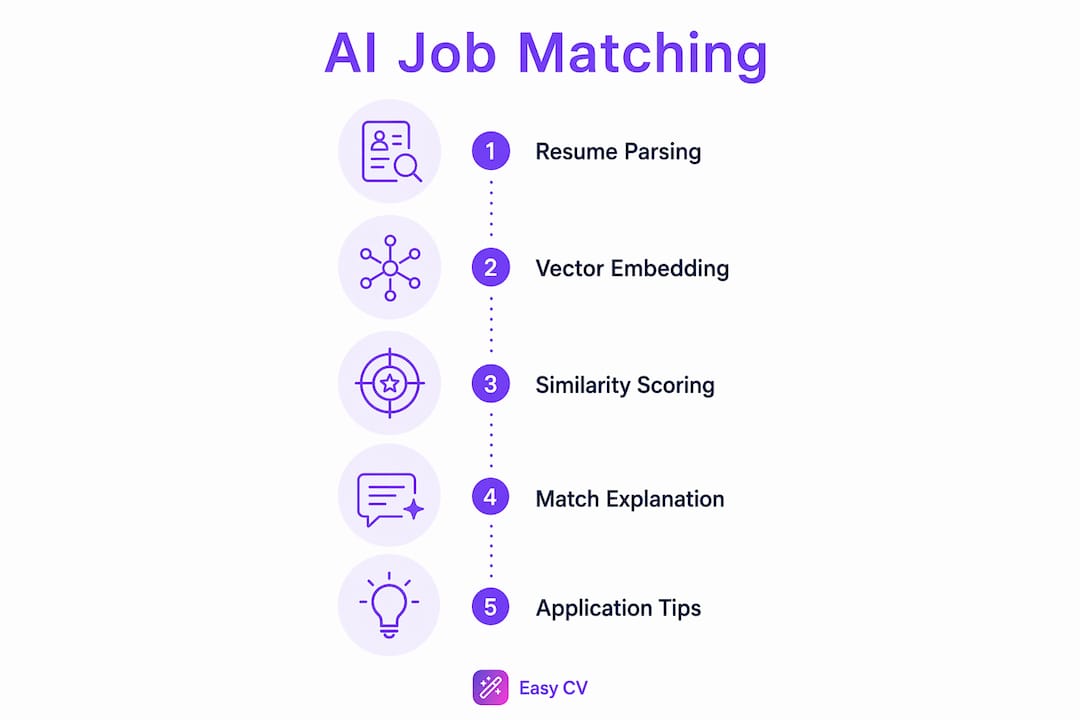
Modern AI recruiting achieves an F1 matching accuracy score of 0.91 using transformer and graph neural network models. That level of precision means the system can recognize that “led cross-functional teams” and “managed stakeholder groups” describe the same competency, even though the words differ. Traditional keyword filters would treat those phrases as unrelated.
The technology keeps improving through feedback loops. AI matching algorithms use reinforcement learning from human feedback to refine their predictions over time. Every time a recruiter advances or rejects a candidate, the model updates its understanding of what a strong fit actually looks like in practice.
Three capabilities define the best AI matching platforms in 2026:
- Semantic understanding: Recognizes equivalent skills described with different words
- Explainable scores: Shows you exactly why a role matched or did not match your profile
- Continuous learning: Improves predictions based on real hiring outcomes
AI job matching platforms now provide explainable match scores that describe why a role fits your profile. This matters because a score without explanation is useless. If you know a role scored 72% because you lack Python experience, you can decide whether to apply anyway or spend two weeks closing that gap first.
43% of organizations use AI in HR and recruitment as of early 2026, nearly doubling the rate from the previous year. Job seekers who understand how these systems work hold a clear advantage over those who treat them as a black box.
How to optimize your resume for better job matches
Resume optimization for AI matching follows a repeatable five-step process. A manual workflow takes about 15 minutes per application; an AI-assisted version takes about 5 minutes. The time savings compound quickly when you are applying to 10 or 20 roles.
-
Copy the full job description into a separate document. Do not skim it. The full text contains the exact language the ATS and AI matcher will compare against your resume.
-
Extract the top 10–15 keywords and phrases. Focus on skills, tools, and outcomes mentioned more than once. Repetition in a job description signals priority to both human readers and AI systems.
-
Run a gap analysis. Compare those keywords against your current resume. Highlight every term that is missing or underrepresented. This list becomes your editing checklist.
-
Rewrite, do not paste. Integrate missing skills into your existing bullet points naturally. Keyword stuffing lowers AI matching scores, so the goal is natural language that reflects real experience, not a keyword list bolted onto the bottom of your resume.
-
Verify with an AI tool. Upload the tailored resume and the job description to an AI resume builder. Check the new match score. If it did not improve, revisit step three and look for skills you described with different terminology than the job posting uses.
For career changers, step three is where the real work happens. You may have the underlying competency but not the industry-specific label for it. A teacher who managed 30-person classrooms has “team leadership” and “performance coaching” experience. The gap analysis reveals where to reframe, not fabricate.
Pro Tip: Use the AI resume tailoring workflow from Easy-cv to run your gap analysis automatically. It flags missing keywords and suggests rewrites that preserve your natural voice instead of making your resume sound like a copy-paste of the job description.
Resume tailoring combined with AI-assisted matching can reduce time-to-hire by 2–3x while improving the quality of hires. For job seekers, that translates directly into fewer weeks between applications and offers.
How to evaluate job matches and manage your applications
A match score is a starting point, not a final verdict. Strong platforms show you scores above 80% as high-priority targets, scores between 60–79% as worth a closer look, and anything below 60% as a stretch role. Use those thresholds as a triage system, not a hard cutoff.
67% of hiring professionals say AI has sped up recruitment processes. That speed works against job seekers who move slowly. When a role posts and matches your profile strongly, applying within the first 48 hours puts you in the pool before it fills up.
Application management is where most job seekers lose control of their search. Common mistakes include:
- Applying to too many roles without tailoring, which produces low match scores and low response rates
- Failing to track which version of your resume you sent to which employer
- Ignoring follow-up timing, which is typically one week after applying for roles without a stated timeline
- Not logging recruiter feedback, which is the most direct signal for refining your profile
Easy-cv includes a built-in job tracker that keeps every application organized by status, date, and the specific resume version used. That structure prevents the confusion of managing 20 open applications across a spreadsheet and three email threads.
Pro Tip: Review your match scores weekly, not just when you apply. As you update your resume with new skills or certifications, your score on previously saved roles will shift. A role that was a 65% match last month may be an 82% match today.
Quality beats quantity in job matching. Ten tailored applications to well-matched roles consistently outperform 50 generic applications. The math is simple: a higher match score means a higher chance of passing the ATS screen, which means more human eyes on your resume.
Key takeaways
Effective job matching combines a precise skills inventory, AI-powered tools, and tailored resumes to turn more applications into interviews.
| Point | Details |
|---|---|
| Tailoring drives results | Tailored resumes produce 200–300% more interviews than generic submissions. |
| AI reads meaning, not just words | Semantic matching recognizes equivalent skills across different phrasing. |
| Explainability matters | Use platforms that show why a role matched so you can act on the gap. |
| Quality over quantity | Ten tailored applications outperform 50 generic ones in response rate. |
| Track every application | Log resume versions, dates, and recruiter feedback to refine your approach. |
What I have learned from watching AI reshape the job search
The biggest mistake I see job seekers make is treating AI matching as a shortcut rather than a feedback system. They upload a generic resume, get a 55% match score, and apply anyway. Then they wonder why they hear nothing back.
The match score is a diagnostic. A score of 55% tells you exactly how much work is left before that application is worth sending. The job seekers who use AI tools well are the ones who read the explanation behind the score, close the specific gaps it identifies, and then apply. That is a fundamentally different behavior from just clicking “Easy Apply” on 40 listings.
I also think the fear around AI “black box” decisions is fading fast, and rightly so. High-quality AI platforms provide transparent, explainable match scores that give job seekers real information to act on. That transparency shifts the power dynamic. You are no longer guessing why you did not get a callback. You can see the gap and close it.
The job seekers who will win in 2026 are not the ones who apply the most. They are the ones who treat their profile as a living document, update it after every rejection, and use AI feedback to get sharper with every application cycle. That is not a technology story. That is a discipline story.
— Andras
Easy-cv puts your entire job search in one place
Finding the right role is hard enough without juggling five browser tabs, three spreadsheets, and a folder of resume versions. Easy-cv brings job discovery, resume tailoring, and application tracking into a single workflow.
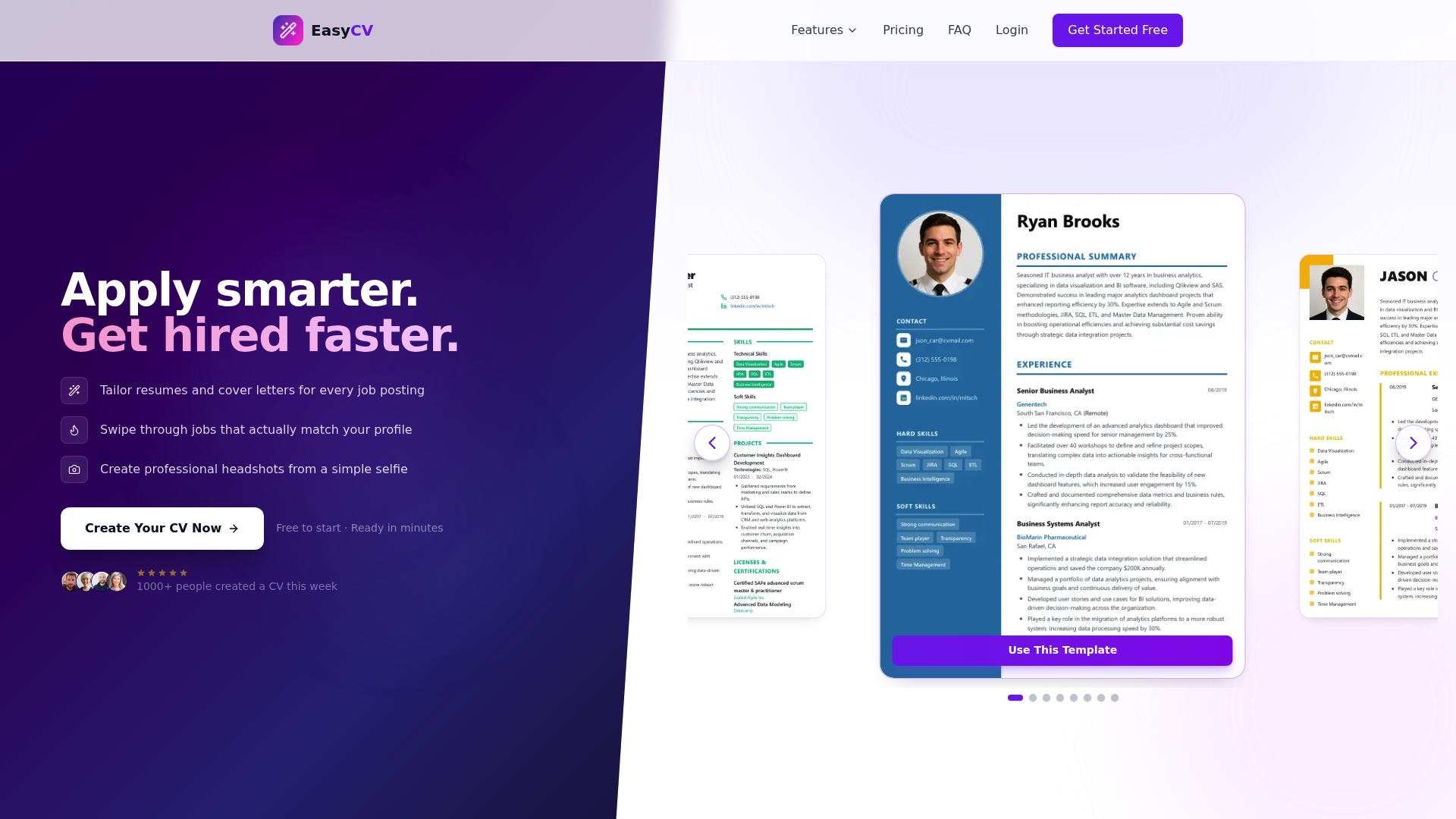
The platform aggregates over 10 million job opportunities per month from major job boards, with new listings available within minutes of posting. Its AI evaluates each role against your profile so you can swipe through the best matches instead of scrolling endlessly. Every application gets its own AI-tailored resume and cover letter, built from your profile and the specific job description. The AI CV builder handles keyword gap analysis automatically, and the built-in tracker keeps your pipeline organized from first application to final offer. Free and premium plans are available, with no commitment required to get started.
FAQ
What is job matching in a job search?
Job matching is the process of comparing your skills, experience, and goals against job requirements to identify roles where you are most likely to succeed. AI-powered platforms do this mathematically using vector embeddings and semantic analysis.
How do job matching algorithms work?
AI matching converts resumes and job descriptions into vector embeddings and measures the similarity between them mathematically. This allows the system to recognize equivalent skills even when the wording differs between your resume and the job posting.
How much does resume tailoring actually improve your chances?
Tailored resumes produce 200–300% more interviews than generic ones. The improvement comes from higher ATS pass rates and stronger alignment with what hiring managers are specifically looking for.
What is a good job match score?
A match score above 80% is a strong signal to apply immediately. Scores between 60–79% are worth reviewing for quick wins through targeted resume edits. Scores below 60% typically require significant profile gaps to be closed before applying.
How do I avoid keyword stuffing when tailoring my resume?
Integrate target keywords into existing bullet points using natural language that reflects real experience. Keyword stuffing lowers AI matching scores, so the goal is contextual use, not repetition. An AI writing assistant can flag unnatural phrasing before you submit.