What Is Passive Job Search? Your 2026 Career Guide
Passive job search is defined as the practice of positioning yourself to attract job opportunities without actively submitting applications. Unlike sending out resumes on job boards, passive job hunting relies on professional visibility, networking, and digital presence to bring recruiters to you. Passive candidates represent around 70–80% of the global workforce. That figure means most of the working population is open to a better opportunity but not actively chasing one. Understanding this approach gives you a real edge in how you manage your career long term.
What is passive job search and how does it work?
Passive job search is the strategy of making yourself discoverable to recruiters and hiring managers without formally entering the job market. The industry term for people using this approach is “passive candidate.” A passive candidate is currently employed, not urgently seeking a new role, but open to the right opportunity if it presents itself.
The mechanics are straightforward. You build a strong professional profile, maintain an active network, and signal your expertise publicly through content, contributions, or community involvement. Recruiters then find you through LinkedIn searches, referrals, or professional associations rather than through a job application. Recruiters avoid traditional job board applications due to overwhelming volume and prefer warm introductions and curated profiles instead. That shift in recruiter behavior is exactly why passive positioning has become a serious career strategy.

The result is a fundamentally different experience. You evaluate opportunities from a position of strength rather than urgency. You negotiate from a place of security rather than desperation. That psychological advantage alone makes passive job hunting worth understanding.
How does passive job search differ from active job search?
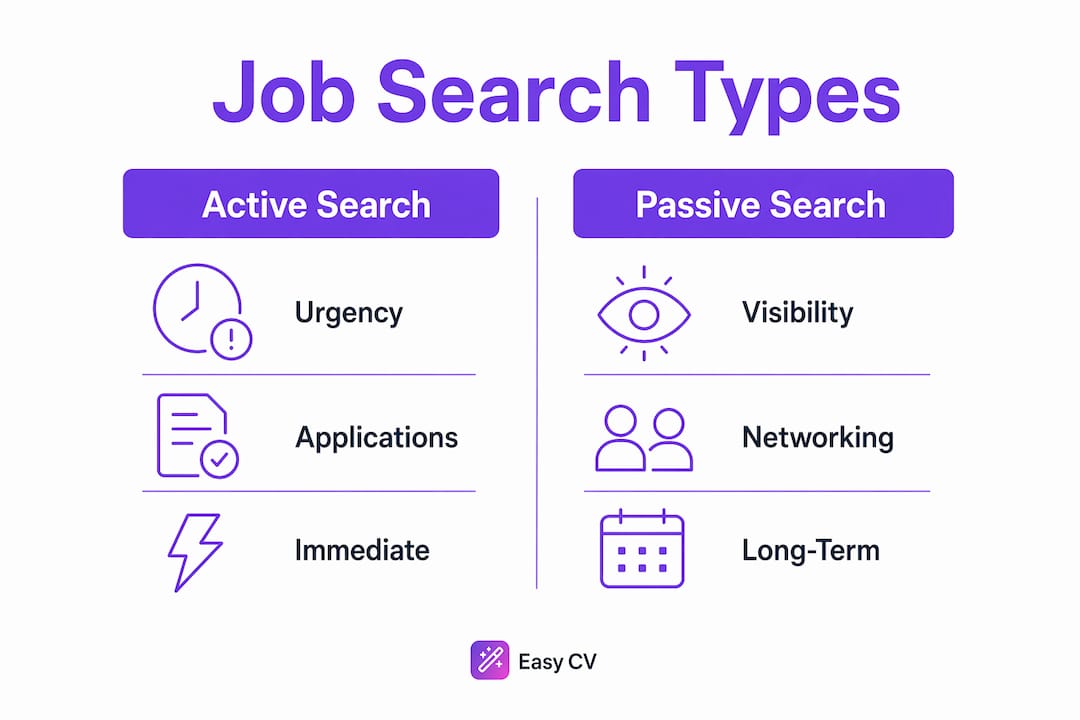
Active job searching is immediate and application-driven. You post your resume, scan job boards daily, and submit applications in volume. The timeline is short and the pressure is high. Passive job searching is the opposite. It is long-term, relationship-driven, and built around visibility rather than volume.
The table below captures the core differences between the two approaches.
| Attribute | Active job search | Passive job search |
|---|---|---|
| Urgency | High. Immediate need to find a role | Low. Open to the right opportunity |
| Primary channel | Job boards, applications, recruiters | LinkedIn, networking, referrals |
| Timeline | Weeks to months | Months to a year or more |
| Leverage | Limited. Candidate needs the job | Strong. Candidate has current employment |
| Effort type | High volume outreach | Consistent brand building |
| Stress level | Typically high | Typically lower |
Active search suits professionals who are unemployed, facing a layoff, or need a change quickly. Passive search suits professionals who are employed, performing well, and want to upgrade their situation without disruption. Neither approach is universally better. The right choice depends on your timeline and current circumstances.
One underappreciated point: passive and active search are not mutually exclusive. Many professionals run a quiet passive strategy for months, then shift to active mode once the right opportunity surfaces. Knowing effective job search strategies for both modes gives you maximum flexibility.
What are the key strategies for an effective passive job search?
The foundation of passive job searching is curated visibility. A discoverable digital footprint is essential for passive search success. You are not hiding. You are presenting yourself clearly so the right people find you at the right time.
Build a recruiter-ready LinkedIn profile
Your LinkedIn headline should communicate your specialty and the value you deliver, not just your job title. “Senior Product Manager” is forgettable. “Product Manager | B2B SaaS | 0 to 1 Product Launches” is specific and searchable. Your summary should read like a professional narrative, not a list of duties. Recruiters spend seconds scanning profiles, so a strong online presence that communicates clear value helps them decide quickly.
Pro Tip: Use LinkedIn’s private “Open to New Opportunities” setting rather than the public “Open to Work” banner. The private setting makes you visible to recruiters without alerting your current employer.
Create public professional artifacts
Recruiters respond to evidence of expertise. A well-maintained GitHub repository, a published article on LinkedIn or a niche industry blog, or a portfolio site all generate inbound interest without a single application. Most senior tech roles in hubs like NYC and SF are filled through warm introductions and direct sourcing, not job boards. Public artifacts accelerate that process by giving recruiters something concrete to reference when they reach out.
Activate your network deliberately
Passive job hunting does not mean waiting passively. It means investing in relationships before you need them. Attend industry events, engage with peers on LinkedIn, and reconnect with former colleagues quarterly. Alumni networks from universities and past employers are particularly underused. A brief message checking in on someone’s work costs nothing and keeps you top of mind when they hear of an opening.
Key passive job search strategies to implement now:
- Update your LinkedIn headline, summary, and skills section with searchable keywords
- Enable the private “Open to New Opportunities” recruiter signal on LinkedIn
- Publish at least one piece of professional content per month on LinkedIn or a niche platform
- Reconnect with three to five former colleagues or mentors each month
- Join two or three active professional associations or online communities in your field
- Build or update a portfolio, GitHub profile, or personal website that showcases your work
What benefits and challenges come with passive job hunting?
The benefits of passive job searching are real and well-documented. You approach every conversation from a position of employment security. You attract higher-quality opportunities because recruiters who find you through referrals or curated profiles are already pre-sold on your profile. You avoid the emotional grind of mass applications and rejection cycles.
The challenges are equally real. Passive job searching is a long-term process, often requiring six months or more of networking and profile work before you are ready to move. That timeline demands patience. Professionals who expect results in weeks will be disappointed.
Pro Tip: Stay fully engaged in your current role throughout your passive search. Disengagement often signals intent prematurely and can damage the professional reputation you are working to protect.
Common pitfalls to avoid:
- Using the public “Open to Work” banner, which can alert your current employer
- Neglecting your current role while focusing on future opportunities
- Treating networking as transactional rather than relationship-based
- Expecting passive search to deliver results on an active search timeline
- Failing to update your profile consistently, which signals inactivity to recruiters
The most overlooked challenge is informal reputation. Recruiters conduct off-the-record checks through mutual connections before making formal outreach. What your colleagues say about you in casual conversation matters as much as what your LinkedIn profile says. Protecting that reputation requires consistent professionalism in your current role, not just a polished online presence.
How do you optimize your digital presence for passive job searching?
Your LinkedIn profile is your most important passive search asset, but it is not your only one. Think of your digital presence as a system of signals that collectively tell a coherent professional story.
LinkedIn profile optimization
Every section of your LinkedIn profile contributes to recruiter search rankings. Fill in all sections completely, including skills, certifications, and volunteer work. Request endorsements from colleagues for your top three to five skills. Recommendations from managers or clients carry particular weight because they function as informal references that recruiters can read before reaching out.
Your profile photo matters more than most professionals realize. A clear, professional headshot increases profile views significantly compared to a casual photo or no photo at all. Tools like the AI headshot generator in Easy-cv can turn a standard selfie into a studio-quality photo, which removes one common barrier to a polished profile.
Beyond LinkedIn
A personal website or portfolio gives you a space you fully control. Unlike LinkedIn, it is not subject to algorithm changes or platform limitations. A blog that demonstrates your thinking on industry topics, a case study page showing project outcomes, or a simple one-page site with your professional bio all serve the same purpose: they give recruiters a reason to reach out.
Tailored resumes and cover letters also matter when a passive opportunity becomes active. When a recruiter does reach out and ask for your CV, a generic document undercuts the strong impression your profile created. Your resume should match the narrative your digital presence has already established.
Passive candidates require highly personalized outreach tailored to their career narrative. That means your profile needs to communicate a clear, specific story. A recruiter who cannot quickly understand what you do and what you are good at will move on to the next candidate.
Key Takeaways
Passive job search works because it positions you as a sought-after professional rather than a job applicant, giving you leverage, better opportunities, and a lower-stress path to career growth.
| Point | Details |
|---|---|
| Define your approach | Passive search means building visibility so recruiters find you, not the other way around. |
| Use LinkedIn’s private settings | Enable “Open to New Opportunities” for recruiters only to stay discoverable without alerting your employer. |
| Invest in relationships early | Networking takes months to pay off, so start before you need it. |
| Protect your current reputation | Stay engaged at work. Informal references from colleagues shape recruiter decisions. |
| Keep your CV ready | When a passive opportunity turns active, a tailored, polished resume closes the deal. |
The part of passive search most professionals get wrong
Most professionals treat passive job search as a waiting game. They update their LinkedIn profile once, enable the “Open to New Opportunities” setting, and then sit back expecting recruiters to flood their inbox. That is not how it works.
The professionals who succeed with passive search treat it as a slow, consistent investment. They publish content. They show up at industry events. They respond thoughtfully to messages from people they do not know yet. They maintain strong relationships with colleagues who might become informal references. None of this feels like job searching. All of it is.
The other thing most people miss is the informal reputation layer. I have seen candidates with outstanding LinkedIn profiles get passed over because a recruiter’s mutual connection mentioned they were difficult to work with. That off-the-record check happens before any formal outreach. Your reputation inside your current organization is part of your passive search strategy whether you treat it that way or not.
The mindset shift that makes passive search work is this: you are not looking for a job. You are building a career. The opportunities come to professionals who are clearly excellent at what they do and easy to find. Focus on those two things and the right roles will surface.
— Andras
Your passive search profile, built with Easy-cv
A passive job search only works when your CV matches the professional story your online presence tells. Easy-cv gives you the tools to build that story without spending hours on formatting or writing from scratch.
The AI CV builder generates and refines professional CV content, tailors your resume to specific roles, and produces a polished document in minutes. The AI headshot generator turns a simple selfie into a studio-quality photo for your profile. With ATS-friendly templates and support for 30+ languages, Easy-cv works for professionals in any market. When a passive opportunity turns into a real conversation, you will be ready. Explore Easy-cv’s features and build the profile that brings opportunities to you.
FAQ
What is a passive candidate?
A passive candidate is a professional who is currently employed and not actively applying for jobs but is open to the right opportunity. Passive candidates make up around 70–80% of the global workforce.
Is passive job search effective?
Passive job search is effective for professionals who can invest time in networking and profile building over six months or more. It consistently surfaces higher-quality opportunities than mass application methods.
How do I start a passive job search without my employer finding out?
Use LinkedIn’s private “Open to New Opportunities” setting rather than the public “Open to Work” banner. The private setting is visible only to recruiters, not to your current employer’s HR team.
How long does passive job searching take?
Passive job searching typically requires six months or more of consistent networking and profile optimization before a strong opportunity materializes. Patience is the defining requirement.
What is the difference between passive and active job search?
Active job search involves submitting applications and targeting open roles immediately. Passive job search focuses on long-term visibility and relationship building so recruiters approach you rather than the other way around.