Types of Job Application Methods That Land Interviews

Job application methods are the specific strategies candidates use to submit their interest in a role, and the method you choose determines how often recruiters actually respond. The best approaches in 2026 combine personalized content, early submission timing, and direct referrals. Knowing the different job application strategies available puts you in control of your results rather than leaving them to chance. This guide covers every major method, explains when each works best, and gives you concrete tactics to apply today.
1. Referral-based applications
Referral-based applications are the single highest-converting method available to job seekers. Referrals convert to interviews at rates 35% higher than standard online applications. That gap exists because a hiring manager who receives a referral already has a reason to trust you before reading a single line of your resume.

The key is identifying the right contacts. Search LinkedIn for first and second-degree connections at your target companies. Prioritize people in the same department as the open role, not just anyone you know at the company.
When you reach out, keep it short and specific. Name the exact role, explain why you are a strong fit in two sentences, and ask if they would be comfortable passing your name along. Warm introductions work best when the referrer does not feel pressured.
- Identify connections at target companies using LinkedIn’s “People” filter
- Message contacts you have a genuine relationship with first
- Offer to send a short bio or tailored resume they can forward easily
- Apply to the role formally before or immediately after reaching out
Pro Tip: Apply to the role through the official portal first, then contact your referral. This way, your name is already in the system when the hiring manager checks.
2. Applying early: The timing advantage
Timing is a job application technique that most job seekers underestimate. Applications submitted within the first 24–48 hours of a posting going live have the highest probability of recruiter review. After day three, that probability drops sharply as inboxes fill.
Set up job alerts on LinkedIn, Indeed, and company career pages for your target roles. Configure alerts to deliver in real time, not as daily digests. The goal is to be among the first ten applicants, not the first hundred.
Timing compounds with personalization. An early application with a generic resume still loses to a slightly later application that references a specific company initiative or recent news. Speed matters, but not at the cost of relevance.
- Use LinkedIn job alerts set to “as it happens” frequency
- Follow target companies directly to see new postings in your feed
- Prepare a base resume and cover letter template you can customize in under 30 minutes
- Avoid bulk-applying to dozens of roles in one session; focus beats volume
Stat to know: Applications submitted after the first 72 hours of a posting face significantly lower review rates as recruiters often shortlist candidates before the deadline closes.
3. Online job application methods: Company portals vs. job boards
Online job application methods fall into three main categories: company career pages, third-party job boards, and direct email submissions. Each carries different risks and advantages.
Applying directly through a company’s own career portal is the most reliable approach. Systems like Greenhouse, Lever, and Workday preserve your resume formatting and feed directly into the recruiter’s workflow. Applying through a third-party aggregator sometimes strips formatting or creates duplicate entries that confuse ATS software.
65% of job applicants now use AI tools to write application materials. Recruiters have noticed. Generic AI-generated cover letters get filtered out quickly because they lack company-specific detail. The fix is simple: use AI to draft, then rewrite key paragraphs with specifics you researched about the company.
- Find the role on a job board for discovery
- Navigate directly to the company’s careers page to apply
- Customize your resume headline and summary for each role
- Write a cover letter that references a specific company project, product, or value
- Save a PDF copy of every application you submit for your records
Pro Tip: Keep a running document of company-specific details you research. Reusing those notes for follow-ups saves time and keeps your messages consistent.
Understanding how job boards shape your application visibility helps you decide where to invest your time across different platforms.
4. Speculative applications and work samples
Speculative applications bypass the formal job posting entirely. You identify a company you want to work for, research a specific problem they face, and send a tailored pitch directly to the hiring manager or department head. This method works best in creative, marketing, product, and consulting fields.
A work sample application takes this further. Instead of just expressing interest, you send a short deliverable. A content marketer might send a draft blog post. A UX designer might send a quick audit of the company’s onboarding flow. The goal is to demonstrate value before the conversation starts.
“Sending an unsolicited, tailored work sample to a hiring manager is one of the few application methods that makes the recruiter feel like they discovered you, rather than the other way around.”
This approach requires research and effort, which is exactly why it works. Most candidates never do it. When you do, you stand out by default.
5. Video applications
Video applications are growing in use, particularly for remote roles and companies that prioritize communication skills. A personalized video application runs 60–90 seconds and covers who you are, why you want this specific role, and one concrete example of relevant work.
One-way video interview algorithms score candidates on structure, clarity, and direct eye contact with the camera lens. The same principles apply to self-recorded application videos. Look at the camera, not the screen. Use the STAR method (Situation, Task, Action, Result) to structure your example.
Video applications work best when the job posting explicitly welcomes them or when you are applying speculatively. Sending an unrequested video to a traditional corporate recruiter can backfire. Read the company culture before choosing this format.
6. Reverse job marketplaces
Reverse job marketplaces flip the traditional dynamic. Instead of candidates applying to companies, companies browse candidate profiles and reach out directly. Platforms in this category let you post a profile describing your skills, experience, and the type of role you want.
This method suits senior professionals and specialists with in-demand skills. It requires a strong, detailed profile that reads like a pitch rather than a resume. Recruiters browsing these platforms are actively looking to fill roles, so response rates tend to be high for well-matched profiles.
The tradeoff is control. You cannot target specific companies, and you may receive outreach for roles that do not fit your goals. Treat reverse marketplace inquiries as leads to qualify, not offers to accept.
7. Micro-consulting as a warm introduction
Micro-consulting engagements create warm introductions that bypass traditional application bottlenecks. Offering a short, paid consulting contract of 5–10 hours lets you demonstrate your skills directly to a potential employer. The engagement often leads to a full-time conversation without a formal application ever being submitted.
This method works well for freelancers transitioning to full-time roles, or for professionals targeting companies that are not actively hiring. Reach out with a specific, scoped proposal rather than a vague offer to help. A concrete deliverable makes it easy for the company to say yes.
The risk is time investment. Micro-consulting requires real work, and not every engagement converts to a job offer. Limit this approach to your top two or three target companies to keep the effort manageable.
8. Networking events and in-person outreach
In-person networking remains one of the most underused job application techniques among digital-first job seekers. Industry conferences, meetups, and professional association events put you in the same room as hiring managers who are not actively recruiting but would hire the right person if they met them.
The goal at these events is not to hand out resumes. The goal is to have a genuine conversation, establish a connection, and follow up with a brief email within 24 hours. That email becomes the warm entry point for a future application.
Warm application entry points work best when you apply first and then follow up with your contact to flag your candidacy. The same logic applies after networking events. Apply to any relevant open roles, then reference the conversation in your follow-up.
9. Follow-up as a method, not an afterthought
Most job seekers treat follow-up as optional. It is not. A well-timed follow-up email is a distinct application technique that keeps your name visible after the initial submission.
Effective follow-ups reference specific role details, restate your fit in one sentence, and stay under three sentences total. Send the first follow-up five to seven business days after applying if you have not heard back. A second follow-up two weeks later is acceptable for roles you strongly want.
The follow-up also gives you a chance to add information you left out of the original application. A recent project completion, a relevant certification, or a specific connection to the company’s recent news all make strong additions.
10. Building a modular application asset library
A modular asset library is a preparation method that makes every other application technique faster and more effective. A library of 40–60 quantified achievement bullets lets you customize any resume in under 20 minutes by selecting the most relevant accomplishments for each role.
The library includes your strongest resume bullets organized by skill category, three to five cover letter opening paragraphs for different role types, and a list of company-specific research notes for your top targets. This structure removes the blank-page problem that slows most job seekers down.
Targeted applications to a researched, short list of companies consistently outperform high-volume generic submissions. A library makes deep customization fast enough to be practical, even when you are applying to multiple roles per week.
Comparison of job application types
| Method | Response rate | Time investment | Best for |
|---|---|---|---|
| Referral-based | Highest | Medium | Any industry with professional networks |
| Early online application | High | Low to medium | Roles posted on major job boards |
| Company career portal | Medium to high | Medium | Corporate and mid-size employers |
| Speculative work sample | Variable | High | Creative, product, and consulting roles |
| Reverse marketplace | Medium | Low | Senior specialists with in-demand skills |
| Micro-consulting | High when matched | High | Freelancers targeting specific companies |
| Video application | Variable | Medium | Remote roles and communication-heavy positions |
Combining two or three methods for your top target companies produces better results than relying on any single approach. A referral plus an early portal application plus a strong follow-up is a complete strategy, not three separate tactics.
Key takeaways
The most effective job application strategy in 2026 combines referral outreach, early submission timing, and company-specific personalization rather than high-volume generic applications.
| Point | Details |
|---|---|
| Referrals outperform cold applications | Referral applications convert to interviews at 35% higher rates than standard online submissions. |
| Timing determines visibility | Submitting within the first 24–48 hours of a posting gives you the highest chance of recruiter review. |
| Apply directly on company portals | Company career pages preserve formatting and feed directly into ATS systems like Greenhouse and Workday. |
| Personalization beats volume | Targeted applications with company-specific content consistently outperform high-volume generic submissions. |
| Follow-up is a tactic, not a courtesy | A concise follow-up email five to seven days after applying keeps your candidacy visible and adds new information. |
What I have learned about applying for jobs in the AI era
The most common mistake I see job seekers make is treating application methods as interchangeable. They pick one approach, usually the online job board, and repeat it hundreds of times expecting different results. The method matters as much as the resume itself.
AI tools have made it easier to produce polished application materials quickly. Career experts recommend using AI as an augmentation tool to brainstorm and refine, not as a replacement for genuine thought. The job seekers who get callbacks are the ones who use AI to draft and then rewrite the parts that require real knowledge of the company. Recruiters can spot the difference immediately.
The advice I give consistently is this: pick ten companies you genuinely want to work for, research each one deeply, and apply using at least two methods per target. A referral plus an early portal application plus a tailored follow-up is not overkill. It is a complete strategy. The job search strategies that work in 2026 are not about doing more. They are about doing less, better, and with more intention behind each submission.
Authenticity is not a soft concept. It is a competitive advantage. A cover letter that references a specific product launch or a recent company blog post signals that you did the work. That signal is rare enough to be noticed.
— Andras
How Easy-cv supports every application method
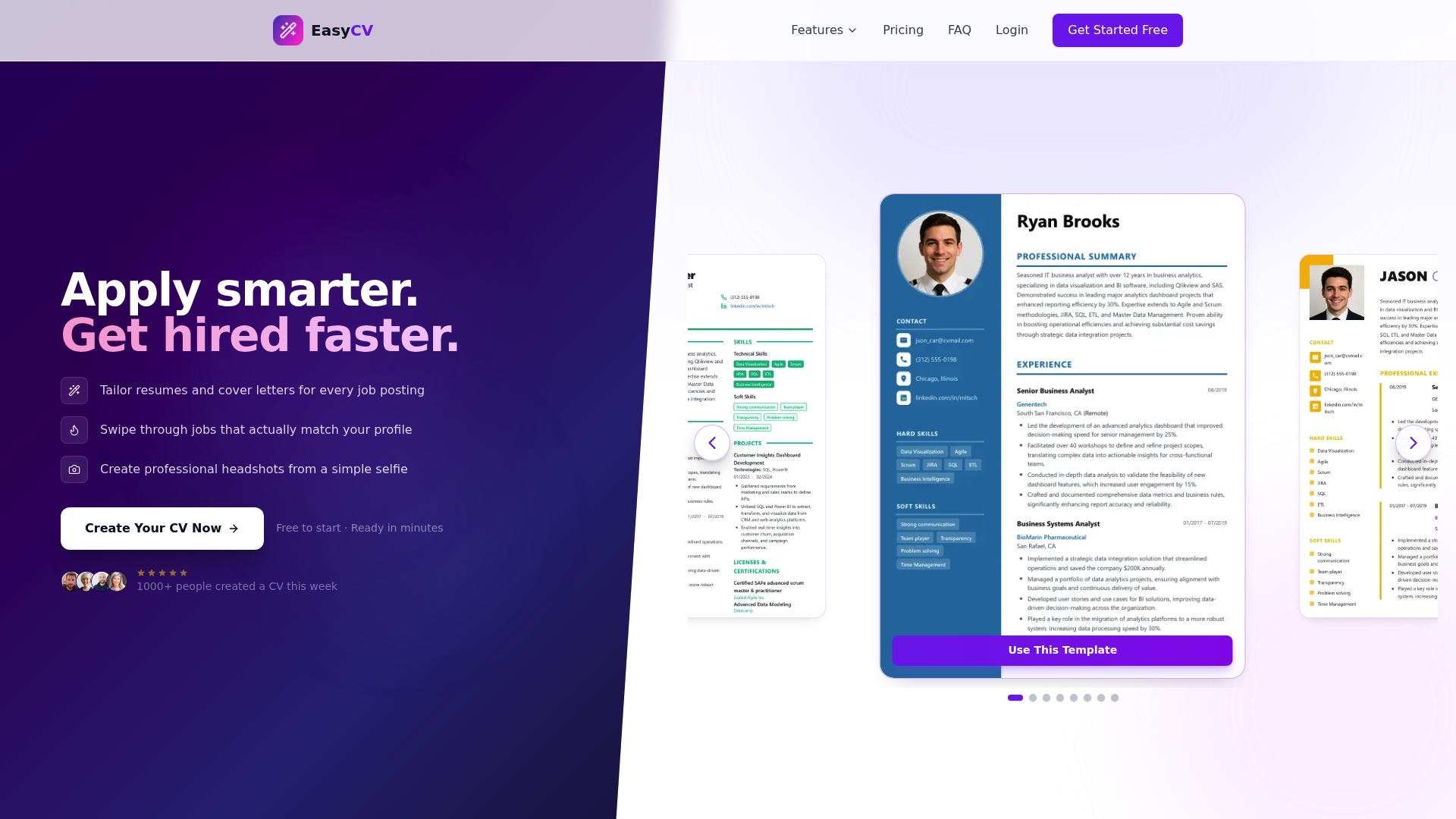
Every method in this article requires one thing: application materials that are tailored, formatted correctly, and ready to go fast. Easy-cv brings your entire job search workflow into one place, from discovering roles across 10 million+ monthly listings to building AI-optimized resumes and cover letters for each application. The AI resume builder generates strong, professional content and lets you customize it for every role in minutes. ATS-friendly templates preserve your formatting whether you apply through Greenhouse, Lever, or Workday. For job seekers who want to apply smarter across multiple methods without starting from scratch each time, Easy-cv removes the friction that slows most applications down.
FAQ
What are the most effective types of job application methods?
Referral-based applications, early online submissions, and speculative work samples are the three highest-converting methods. Referrals alone convert to interviews at rates 35% higher than cold online applications.
How do I apply for jobs through company career portals?
Go directly to the company’s careers page and submit through their native system, such as Greenhouse, Lever, or Workday. This preserves your resume formatting and avoids the ATS compatibility issues common with third-party job board submissions.
How soon should I apply after a job is posted?
Apply within the first 24–48 hours of a posting going live. Applications submitted after the first 72 hours face significantly lower review rates as recruiters often begin shortlisting early.
What is a speculative job application?
A speculative application is an unsolicited pitch sent directly to a hiring manager at a company that has not posted a relevant role. It works best when paired with a tailored work sample that demonstrates your skills before any formal interview process begins.
How many job applications should I send per week?
Quality outperforms quantity. Targeting a small, researched list of companies with customized applications produces better results than sending dozens of generic submissions. Five to ten deeply tailored applications per week is more effective than fifty generic ones.