Market Research Analyst: Career Guide for 2026
A market research analyst converts customer and market data into clear recommendations that reduce business risk. The fastest typical path in the U.S. is a bachelor’s degree in marketing, statistics, psychology, economics, or a related field, followed by one to three years of entry-level experience or internships. According to the Bureau of Labor Statistics, the median annual wage was approximately the median wage reported by the Bureau of Labor Statistics as of May 2024, and employment is expected to grow at a faster than average rate from 2024 to 2034.
Who hires these analysts? The short list covers most of the economy:
- Consumer packaged goods and retail brands
- Technology and software companies
- Healthcare and pharmaceutical organizations
- Financial services and insurance firms
- Market research agencies and management consultancies
- Government agencies and nonprofits
Key Takeaways
A market research analyst career rewards people who combine statistical rigor with clear communication — and the fastest path in is a targeted degree, a short portfolio, and ATS-optimized applications.
| Point | Details |
|---|---|
| Median U.S. wage | The BLS reports $76,950 annually as of May 2024, with the top 10% earning over $133,560. |
| Job growth | Employment is expected to grow at a faster-than-average rate from 2024 to 2034. |
| Fastest entry path | A bachelor’s degree plus one to three years of experience or internships gets most candidates hired. |
| Portfolio matters | One quantitative and one qualitative case study is enough to differentiate you from degree-only candidates. |
| Easy-cv advantage | Easy-cv’s AI CV builder and job matcher help you tailor applications and surface analyst roles pre-scored to your background. |
Table of Contents
- What does a market research analyst actually do?
- Where do analysts work, and what does the environment look like?
- How do you become a market research analyst?
- What skills and tools do hiring managers look for?
- What is the salary range, and how strong is job demand?
- What does career advancement look like in this field?
- How do you land the job? Resume, portfolio, and interview tactics
- What separates good analysts from great ones?
- What the day-to-day actually feels like
- Easy-cv helps you apply faster and smarter
- What it’s like to work in this field every day
- Sources
What does a market research analyst actually do?
The core job is collecting, analyzing, and translating market and customer data into decisions that executives can act on. That sounds clean on paper. In practice, the work splits across four distinct task types, and most days involve at least two of them.
Primary research means designing and running the studies yourself: writing surveys, moderating focus groups, conducting one-on-one interviews, and occasionally doing field observation. HubSpot’s overview of marketing research methods frames it well: primary and secondary research serve different objectives, and choosing the right method depends on your timeline and budget as much as your research question.

Secondary research is faster but shallower. You pull industry reports, mine public databases, track competitor activity, and monitor social listening feeds. The signal is often weaker, but the speed is hard to beat when a product team needs a directional answer by Friday.
Analysis is where the real differentiation happens. Cleaning messy survey data, running significance tests, building segments, forecasting demand, and turning a spreadsheet into a chart that tells a story — these tasks separate analysts who add value from those who just report numbers.

Reporting is the last mile. Slide decks, dashboards, executive summaries, and a clear recommendation. Coursera’s guide to the role notes that analysts combine qualitative and quantitative methods to produce insights that support product and marketing decisions — but the insight is only useful if the person reading it knows what to do next.
Pro Tip: Before fielding any survey, pilot it with five to ten people outside your team. You will catch ambiguous wording, double-barreled questions, and leading phrasing that would otherwise corrupt your data.
Where do analysts work, and what does the environment look like?
Most analysts are employed in one of three settings: in-house insights teams at brands, market research agencies, or management consultancies. Startups and government agencies round out the picture, each with a different pace and scope.
In-house roles at consumer goods, tech, or healthcare companies typically mean working alongside product, marketing, and strategy teams. You own fewer projects end-to-end but have deeper context about the business. The tradeoff is that your research agenda is set by internal stakeholders, which can limit methodological variety.
Agency and consultancy roles expose you to more industries and methods faster. You run studies for multiple clients simultaneously, which builds breadth quickly. The pace is project-driven, with predictable crunch periods around deliverable deadlines.
Remote and hybrid work is common across both settings. Most analytical work — data cleaning, coding, visualization, report writing — translates well to remote environments. Client-facing work like focus group moderation or stakeholder presentations still tends to happen in person or via video conference.
Industries that hire most frequently:
- Consumer packaged goods and retail
- Technology and software
- Healthcare and life sciences
- Financial services
- Dedicated market research and polling firms
- Government and public policy organizations
How do you become a market research analyst?
The standard entry point is a bachelor’s degree plus zero to three years of experience. Senior and technical roles, particularly those involving advanced modeling or managing research programs, often expect a master’s degree.
Here is a practical timeline for someone starting from scratch:
- Earn a bachelor’s degree in marketing, business, statistics, psychology, economics, or communications. Prioritize coursework in research methods, statistics, and consumer behavior. These three subjects show up in nearly every job description.
- Complete at least one internship in a research, marketing, or data role. Even a marketing assistant position builds transferable skills. Appalachian State’s career overview confirms that internships and entry-level adjacent roles are the most common on-ramps.
- Build a short portfolio before you graduate. Two projects — one quantitative, one qualitative — are enough to differentiate you from candidates who have only coursework to show.
- Target entry-level titles like research analyst, marketing analyst, or data analyst. These roles build the technical and client-facing skills you need to move up.
- Add certifications or platform training once you are employed. Qualtrics, Google Analytics, and SQL courses are widely available and signal tool fluency to hiring managers.
- Consider a master’s degree if you want to move into research management, work in healthcare or financial services, or specialize in advanced methods like conjoint analysis. It is not required to enter the field, but it does accelerate advancement.
University of Phoenix’s overview confirms that employers typically expect coursework in statistics, research methods, and marketing — so if your degree is in an adjacent field, supplementing with online coursework in those three areas closes most gaps.
Pro Tip: Your portfolio does not need client work. A well-documented class project or a self-initiated study — say, a survey of 50 people on a topic you find interesting — works fine. Show the research question, the method you chose and why, the analysis, and the recommendation. That structure is what hiring managers want to see.
What skills and tools do hiring managers look for?
The skill set breaks into two buckets: technical (statistics, programming, visualization) and workplace (storytelling, stakeholder management, critical thinking). Strong candidates have both. Most early-career applicants have one.
Technical skills worth listing on your resume
- Sampling and significance testing: understanding when a sample size is sufficient and whether a difference between groups is real
- Regression basics and segmentation: grouping customers by behavior or attitude, and modeling relationships between variables
- Survey design: question construction, scale selection, and bias reduction
- Conjoint analysis basics: useful for pricing and feature research; not required at entry level but a differentiator at mid-level
Tools and programming
Entry-level roles most commonly require Excel, one survey platform (Qualtrics or SurveyMonkey), and basic data literacy. SQL and R come up frequently in job postings for mid-level roles. Python and SAS appear more in technical or healthcare-adjacent positions. Tableau or Power BI for visualization rounds out the toolkit at the senior level.
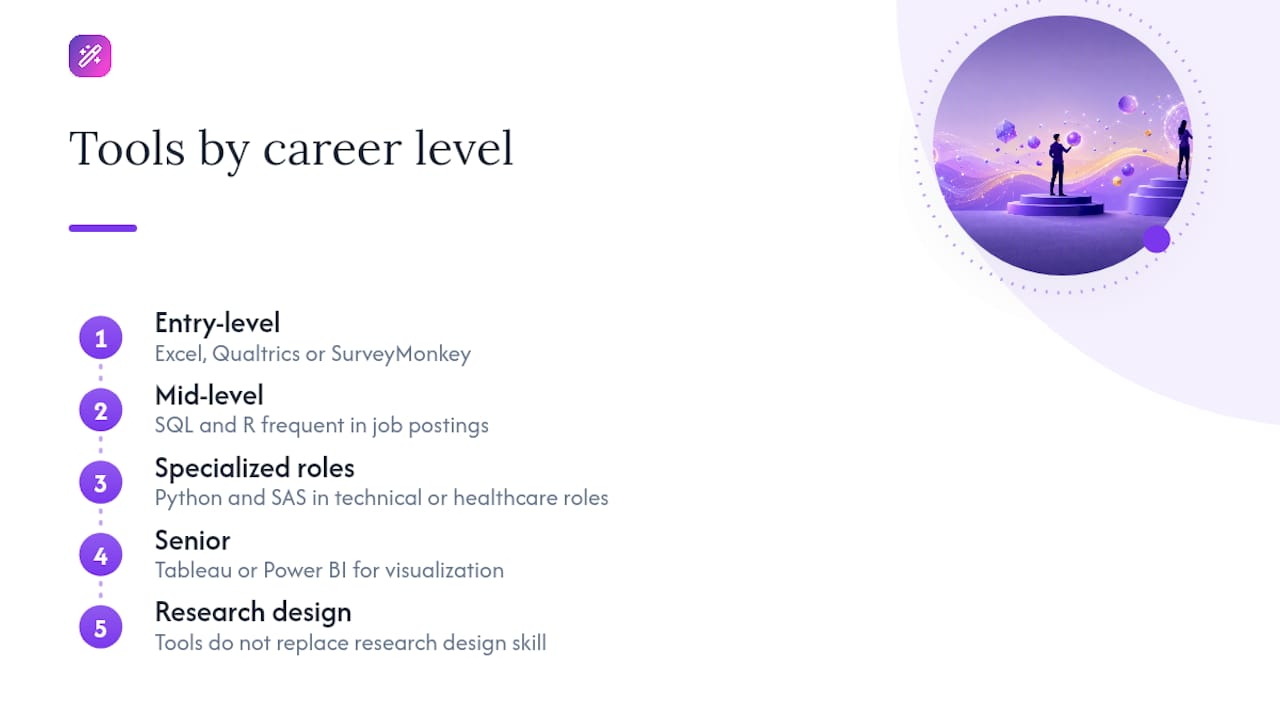
University of Phoenix’s breakdown notes that platforms like Qualtrics, SurveyMonkey, and Tableau are standard, but tools alone do not replace research design skill. A poorly framed survey question produces misleading data no matter how polished the dashboard looks.
Soft skills that actually get you hired
Interpretation, communication, and the ability to moderate a focus group or interview without leading the respondent are harder to teach than SQL. Hiring managers notice them immediately in interviews.
Pro Tip: Start with Excel plus one survey platform plus basic SQL or R. Add Tableau once you have a job. That sequence gets you interview-ready without wasting time on tools you will rarely use at the entry level.
What is the salary range, and how strong is job demand?
The BLS Occupational Outlook Handbook reports a median annual wage around the figure cited for May 2024, with employment expected to increase moderately between 2024 and 2034.
Pay varies significantly by industry, experience level, and geography. Analysts in financial services and technology tend to earn above the median. Those in nonprofits and government tend to earn below it. Location matters too: metro areas like San Francisco, New York, and Boston consistently pay more than the national median, while smaller markets pay less.
Factors that most affect where you land in that range:
- Specialization: healthcare, financial services, and UX research command premiums
- Industry: tech and finance pay more than retail and nonprofits
- Location: major metro areas versus smaller markets
- In-house versus agency: in-house roles at large brands often pay more than agency positions at the same experience level
- Advanced degree: a master’s or MBA typically accelerates movement into the upper half of the range
For live updates, check the BLS Occupational Outlook Handbook directly, along with your state’s labor market information site and O*NET’s occupation summary for task-level detail.
What does career advancement look like in this field?
The typical progression runs from analyst to senior analyst to research manager, then to director or VP of insights. Lateral moves into product marketing, product management, or data analytics are common and often well-compensated.
Common intermediate roles and what separates them:
- Senior analyst: owns studies end-to-end, mentors junior staff, presents directly to senior stakeholders
- Research manager: manages a team or a portfolio of projects, sets methodology standards, owns vendor relationships
- Project manager (research-focused): coordinates timelines, budgets, and fieldwork logistics across multiple studies
Related occupations with significant skill overlap include data analyst, product analyst, market intelligence manager, and UX researcher. Each draws on a different subset of the same core competencies: research design, statistical analysis, and stakeholder communication.
Specialization accelerates advancement and pay. Analysts who develop deep expertise in conjoint analysis, ethnographic research, or a specific industry — healthcare, financial services, or technology — become harder to replace than generalists running standard surveys. Industry benchmarking resources like Bizminer can help you understand the competitive dynamics of the sectors you are targeting, which is useful both for career planning and for demonstrating industry knowledge in interviews.
How do you land the job? Resume, portfolio, and interview tactics
Recruiters want to see three things on a market research analyst resume: measurable impact, the specific research methods you used, and the tools you know. Generic descriptions of duties do not move the needle.
Resume tactics:
- Lead each bullet with an action verb tied to a method: “Designed and fielded a 500-respondent survey to assess brand awareness, identifying a 12-point gap among 25–34-year-olds.”
- Include a skills section that lists tools (Qualtrics, Tableau, SQL, Excel) and methods (conjoint, segmentation, regression).
- Add a portfolio link in your contact header. Even a Google Drive folder with two case studies works.
- Use O*NET’s task list for SOC 13-1161.00 to match your resume language to the keywords employers actually search for.
Understanding why sector-specific resumes matter is worth a few minutes of your time before you apply to roles in healthcare or financial services — the vocabulary shifts enough that a generic resume reads as generic.
Cover letter tactics:
Keep it to three short paragraphs: the research question you faced, the method you chose and why, and the business outcome. That structure shows you think like a researcher, not just a task-completer.
Portfolio advice:
Each case study should show the problem, the method, the analysis, and the recommendation. Academic projects are fine. Self-initiated studies are fine. Never include client data without explicit permission — describe the methodology and outcome without exposing proprietary information.
Interview tactics:
- Prepare two to three STAR-format examples (Situation, Task, Action, Result) where your research directly influenced a business decision.
- Be ready to walk through a study you designed: how you wrote the questions, how you handled a sampling challenge, and what you would do differently.
- Expect a technical screen at mid-level roles: a short data cleaning exercise or a case study where you recommend a research approach.
- Ask about how research findings are used — it signals that you care about impact, not just execution.
Pro Tip: Use Easy-cv’s AI CV builder to generate an ATS-optimized resume tailored to each job description. The platform’s templates are built for readability by both applicant tracking systems and human recruiters, and you can add a portfolio link directly in the header.
What separates good analysts from great ones?
The highest-impact analysts combine rigorous research design with stakeholder-centered storytelling. That combination is rarer than it sounds, and it is the clearest differentiator between analysts who get promoted and those who stay in execution roles.
Rigorous research design means asking the right question before choosing a method. It means writing survey items that measure what you intend to measure, selecting a sample that actually represents the population you care about, and building in controls for common biases — social desirability, acquiescence, recency effects. Qualtrics’ industry guidance frames it directly: the highest-impact analysts tailor research design to the specific decision at hand, not to the method they happen to know best.
Stakeholder-centered storytelling means translating findings into a recommendation the executive team can act on in the next 90 days. Not a 40-slide deck of charts. A clear problem statement, two or three key findings, and a recommendation with a rationale. The visualization supports the narrative; it does not replace it.
The trade-off between fast-and-shallow and slow-and-deep is real. A 200-person online survey can be fielded in a week and gives you statistical patterns. A series of 12 in-depth interviews takes a month but explains why those patterns exist. Practitioners commonly cross-validate by pairing quantitative surveys to identify patterns with qualitative interviews to explain them — relying on a single method routinely leaves gaps.
Pro Tip: On your resume or in an interview, describe a study using this one-paragraph structure: the business question, the method you chose and why, one key finding, and the decision it informed. That structure signals research maturity more clearly than any tool or certification.
What the day-to-day actually feels like
Most days split between data work and stakeholder time, roughly in that order. The morning often involves cleaning a dataset, reviewing survey responses, or building a cross-tab. The afternoon shifts to a check-in with a product manager, a presentation prep session, or a debrief with a client.
A typical week might look like:
- Monday/Tuesday: data collection or analysis sprint — pulling responses, running tests, building charts
- Wednesday: internal alignment meeting with the product or marketing team
- Thursday: drafting the report or presentation
- Friday: presenting findings, fielding questions, and scoping the next study
The emotional demands are real and underappreciated. Stakeholders often come to research with a hypothesis they want confirmed. Delivering findings that contradict that hypothesis — diplomatically, with enough evidence that the team trusts the result — is a skill that takes years to develop. Managing ambiguous requests (“just tell us what customers think”) and translating them into a researchable question is often the hardest part of the job, and it rarely shows up in a job description.
Easy-cv helps you apply faster and smarter
Getting the interview is half the battle. The other half is showing up with a resume that passes ATS filters, a cover letter that tells a research story, and a portfolio link that works.
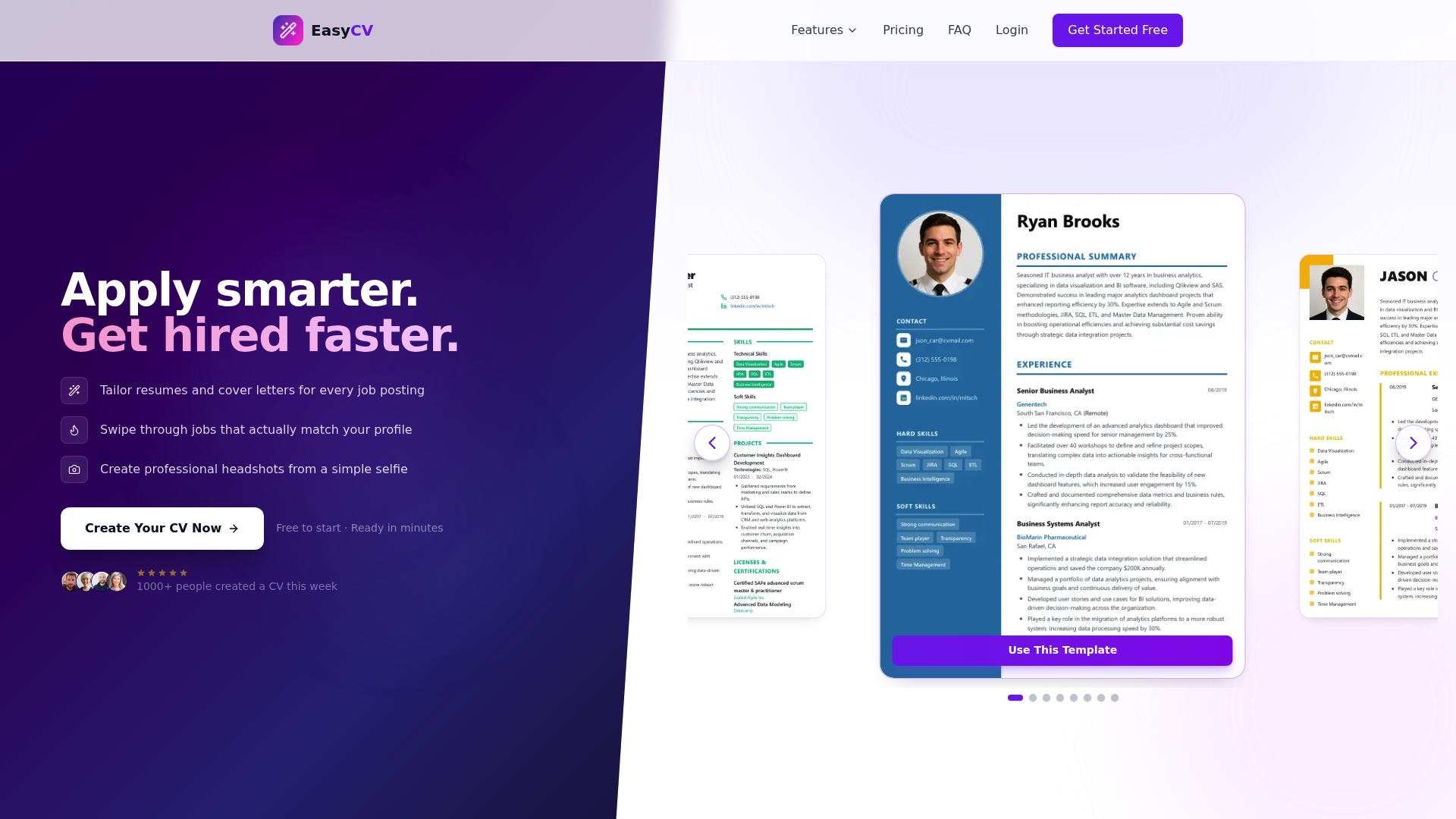
Easy-cv puts the entire application workflow in one place. The AI CV builder generates and refines content tailored to each job description, and the ATS-friendly templates are built to pass automated screening without sacrificing readability. The job matcher pre-scores open roles against your CV so you spend time on applications that actually fit, not on listings that are long shots. With access to over 10 million job opportunities per month across all major boards, you are not missing roles that never surface on a single platform.
Specific features that map directly to what this article covers:
- AI-tailored CV and cover letter for every application, with language matched to the job description
- ATS-friendly templates that keep your research methods and tools visible to both systems and humans
- Job matcher that surfaces analyst roles pre-scored to your background
- Portfolio link in the CV header so recruiters can access your case studies in one click
Start building your market research analyst resume on Easy-cv and get your first application out faster than you would formatting a template from scratch.
Pro Tip: Use Easy-cv’s AI writing assistant to draft a one-paragraph case study summary for your cover letter. Paste in the research question, method, and outcome, and let the AI sharpen the language for a recruiter audience.
What it’s like to work in this field every day
The honest version: this job is satisfying when your research changes a decision, and frustrating when it doesn’t. The data work is engaging, the stakeholder dynamics are complicated, and the best days are the ones where a product team pivots based on something you found.
The role suits people who are comfortable sitting with ambiguity, asking “why” more than “what,” and translating messy human behavior into something a spreadsheet can hold. If that description fits, the career path is solid, the pay is competitive, and the demand is growing.
Sources
- Market Research Analysts : Occupational Outlook Handbook
- What Is a Market Research Analyst? 2026 Guide | Coursera
- 9 Best Marketing Research Methods to Know Your Buyer Better + Examples
- 13-1161.00 - Market Research Analysts and Marketing Specialists
- What Does a Market Research Analyst Do? - App State Online
- What Is a Market Research Analyst? | University of Phoenix