Job Board Integration Explained for Recruitment Teams
Job board integration is a two-way automated data exchange between an Applicant Tracking System (ATS) and external job boards such as LinkedIn, Indeed, and Glassdoor. It pushes job postings outbound to multiple platforms simultaneously and pulls candidate applications, resumes, and status updates back into a single ATS. The result is centralized candidate tracking, eliminated manual data entry, and measurable hiring pipelines. For HR professionals and organizational leaders, understanding job board integration is the difference between a fragmented hiring process and a system that actually scales.
How does job board integration work technically?
Job board integration operates as a closed-loop hiring ecosystem connecting your ATS to external boards through APIs, webhooks, and automated data pipelines. The ATS acts as the control center. It sends structured job data outbound and receives candidate records inbound without human intervention at each step.
The technical architecture typically includes these components:
- RESTful APIs: The ATS calls job board APIs to post, update, or remove listings. Indeed’s Job Sync API, for example, uses standard HTTP methods and requires OAuth2 authentication for secure connections.
- Webhooks and event-driven updates: When a candidate applies on LinkedIn or Indeed, a webhook fires and delivers that application record directly into the ATS in near real time.
- Resume parsing: Inbound candidate data passes through a parsing engine that extracts structured fields (name, skills, work history) from unstructured resume files.
- Data normalization: Raw data from different boards arrives in different formats. Normalization maps all fields to a unified schema so your ATS can read and compare records consistently.
- Deduplication logic: Duplicate records are flagged using hashing algorithms that compare job title, company name, and location. Matching hashes trigger conflict resolution rules rather than creating a second record.
The data pipeline stages follow a consistent sequence: extraction, normalization, deduplication, enrichment, and delivery. Each stage filters and structures data so the final output supports analytics, dashboards, and AI-driven candidate scoring.
Pro Tip: Test your API connections with a staging environment before going live. A failed OAuth2 token or a misconfigured webhook will silently drop candidate applications, and you will not know until you audit the pipeline.

What are the benefits of using job board integration?
The primary business case for integrating multiple job boards is reach combined with control. Single job board reliance limits candidate reach and forces recruiters to manage separate logins, spreadsheets, and manual status updates across platforms. Integration eliminates that fragmentation.
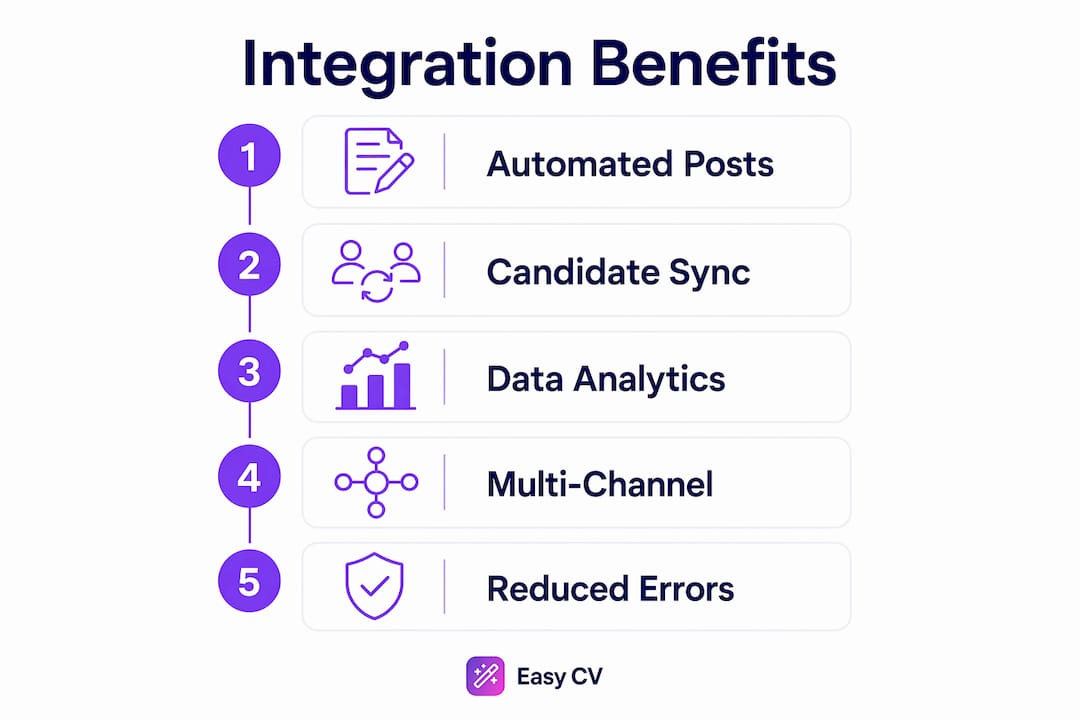
The concrete benefits break down into five areas:
- Unified job distribution: One posting in your ATS broadcasts to LinkedIn, Indeed, Glassdoor, and niche boards simultaneously. Recruiters save hours per open role.
- Centralized candidate tracking: Every application, regardless of source, lands in one ATS pipeline. Source attribution is automatic, so you know which board delivered the best candidates.
- Reduced data entry errors: Automated inbound syncing removes manual copy-paste steps. Fewer errors mean cleaner candidate records and more reliable reporting.
- Improved analytics: With all data centralized, you can calculate cost-per-hire by source, track funnel conversion rates, and identify which boards produce hires versus just applicants.
- Permanent candidate database: Your organization owns the candidate data. Even if a job board changes its pricing or access terms, your talent pipeline stays intact and searchable.
Job aggregators add another layer to this strategy. Aggregators index postings automatically across thousands of sources, including company career pages, without requiring manual reposting. That means your integrated listings can surface on aggregator platforms like Google for Jobs without additional configuration.
The analytics benefit deserves emphasis. When candidate source data flows automatically into your ATS, you can compare cost-per-hire across boards with precision. That data directly informs budget decisions for the next hiring cycle.
What challenges should organizations avoid when integrating job boards?
Integration creates efficiency, but it also creates new failure points. The most common problems are data quality issues that compound quietly over time until your candidate database becomes unreliable.
The key challenges to anticipate:
- Duplicate job postings: If a role is posted manually on a board and then pushed again through integration, candidates see the same job twice. This inflates application volume and distorts source analytics.
- Ghost jobs: Closed or filled roles that remain active on job boards due to failed API updates mislead candidates and damage employer brand. Continuous API monitoring is the only reliable fix. Status codes like 401 Unauthorized or 404 Not Found must be caught and resolved immediately, not left to accumulate.
- Stale data corruption: Without deduplication, the same candidate can appear multiple times under slightly different name spellings or email addresses. Normalization into unified schemas prevents this, but it requires deliberate configuration.
- Coverage gaps for senior roles: Generic job boards underrepresent executive and senior-level positions. Senior-level openings often appear first on company ATS-hosted career pages and never reach aggregators. Supplement your integration with direct scraping of target company career sites.
- Posting sequence errors: Broadcasting a role before it is live on your internal career portal creates duplicate and ghost listings downstream.
Posting first to your internal career portal before activating integration is the single most effective way to prevent duplicate and ghost job problems. Proper deduplication requires hashing the job title, company name, and location together. Any two records with matching hashes are flagged as duplicates before they enter your database.
Pro Tip: Set up automated alerts for API error codes rather than relying on manual checks. A 401 error on your Indeed integration means your token has expired and no new applications are flowing in. You want to know within minutes, not days.
How to choose and optimize your job board integration strategy
The right integration strategy depends on your hiring markets, role types, and the technical capabilities of your ATS. A one-size approach rarely works for organizations hiring across multiple regions or specializations.
| Factor | What to evaluate |
|---|---|
| Board coverage | Does the integration support niche boards relevant to your industry, not just LinkedIn and Indeed? |
| Data flow direction | Does it handle both outbound posting and inbound candidate syncing, or only one direction? |
| API costs | What are the per-result fees or subscription tiers for data aggregation services? |
| Deduplication support | Does the platform include built-in deduplication, or do you need to configure it separately? |
| Analytics depth | Can you track source attribution, cost-per-hire, and funnel conversion rates natively? |
| Global reach | Does the integration support job boards in the specific countries where you hire? |
Professional data aggregation services vary in cost from roughly $0.01 per result to higher subscription fees depending on scale and complexity. Managed scraping services typically include deduplication as part of the package, which justifies the cost for high-volume hiring teams.
Multi-channel distribution is the most effective approach for organizations with diverse hiring needs. Combine direct ATS-to-board API integrations for your primary platforms with aggregator coverage for broader reach. Add direct scraping of company career pages to capture senior roles that generic boards miss. This three-layer approach gives you the widest candidate pool with the cleanest data.
Pro Tip: Audit your candidate source data quarterly. If one board consistently delivers applicants who do not progress past the first interview, reallocate that budget to boards with better conversion rates. Integration makes this analysis possible. Manual processes do not.
For job seekers navigating this landscape, understanding how job boards shape hiring helps you position your application for ATS-driven pipelines more effectively.
Key takeaways
Job board integration is the foundational infrastructure that turns disconnected recruitment tools into a single, measurable hiring system built on clean data and automated workflows.
| Point | Details |
|---|---|
| Two-way data exchange | Integration pushes jobs outbound and pulls candidate data inbound automatically. |
| API monitoring is non-negotiable | Unmonitored API connections drop applications silently; check error codes continuously. |
| Post internally first | Always publish to your internal career portal before activating board distribution. |
| Senior roles need direct scraping | Generic boards miss executive positions; supplement with company career page scraping. |
| Clean data drives decisions | Deduplication and normalization are prerequisites for reliable cost-per-hire analytics. |
What I have learned from watching organizations get integration wrong
Most organizations treat job board integration as a one-time IT project. They configure the API connections, flip the switch, and assume the system will run itself. That assumption is where things break down.
The teams I have seen get the most value from integration share one habit: they treat their candidate database as a living asset that requires maintenance. They run deduplication audits, monitor API health dashboards, and review source attribution reports on a regular schedule. The teams that struggle treat the database as a byproduct of the hiring process rather than the point of it.
The other mistake I see consistently is over-relying on the largest boards and ignoring niche platforms. LinkedIn and Indeed are essential, but they are also where every competitor is posting. For specialized roles in engineering, healthcare, or finance, niche boards often deliver better-qualified candidates at lower cost-per-hire. Integration makes it operationally feasible to post to ten boards instead of two, so there is no reason not to use that capability.
The deeper insight is that integration creates infrastructure, not just efficiency. A well-maintained candidate database gives you a talent pipeline that exists independently of any single job board’s pricing changes or algorithm updates. That independence is worth more than the time savings alone.
For organizations serious about recruitment technology, the question is not whether to integrate. The question is how well you maintain what you build.
— Andras
How Easy-cv fits into a modern recruitment workflow
Job board integration handles the distribution and tracking side of recruitment. The candidate experience side requires equally sharp tools. Easy-cv gives job seekers access to over 10 million job opportunities per month, aggregated from all major boards, with new listings available within minutes of posting.
Every application on Easy-cv is supported by an AI writing assistant that tailors your CV and cover letter to the specific role, and an ATS-friendly template library that ensures your resume passes automated screening. The built-in job tracker keeps your search organized across every board and application stage. For professionals who want to compete effectively in ATS-driven pipelines, the Easy-cv AI CV builder is the practical complement to any integrated hiring system.
FAQ
What is job board integration?
Job board integration is an automated two-way connection between an ATS and external job boards. It distributes job postings outbound and imports candidate applications inbound into a centralized system.
What is the difference between job board integration and job board aggregation?
Integration connects your ATS directly to specific job boards via APIs for posting and candidate tracking. Aggregation indexes job listings from thousands of sources automatically, surfacing them on a single platform without requiring individual board connections.
How does job board API integration work?
A job board API integration uses RESTful calls and OAuth2 authentication to push job data from your ATS to a board and receive candidate data back. Webhooks trigger real-time updates when candidates apply.
What are the biggest risks of job board integration?
The main risks are duplicate job postings, ghost listings from failed API updates, and stale or corrupted candidate data. Continuous API monitoring and deduplication logic address all three.
Do I need separate integrations for each job board?
Most enterprise ATS platforms offer pre-built connectors for major boards like LinkedIn, Indeed, and Glassdoor. Niche boards may require custom API configuration or a third-party aggregation service to connect.