What Is a Human Performance Specialist? Careers and Pay
A human performance specialist is a practitioner who uses science and data to help individuals or teams perform closer to their potential, working in either the mental performance track (psychology, coaching, cognitive science) or the physical performance track (strength training, biomechanics, recovery). The field pulls together biology, psychology, and kinesiology into a single toolkit, which is exactly why job titles under this umbrella look so different from one posting to the next.
If you’re weighing this as a career, don’t start by hunting for a perfect job title. Start here:
- Audit your background against the two main tracks (mental vs. physical performance) and note which one you’re already closer to qualifying for.
- Pick one sub-area to lead with on your resume, even if you plan to stay broad long term.
- Shortlist two job titles you’ll actually search for this week, based on your current credentials.
- Look at one respected career arc for orientation, such as researcher-turned-practitioner Andy Galpin, who runs a Human Performance Center that blends lab work with public education, or Jim Loehr, whose energy-management framework shaped how corporations approach performance training.
Key Takeaways
A human performance specialist blends mental or physical performance science with coaching and data translation, and the fastest path to hire is documented outcomes plus a resume tailored to each specific posting.
| Point | Details |
|---|---|
| Definition first | The role splits into mental and physical performance tracks, each with distinct titles and duties. |
| Titles vary by employer | Cognitive specialist, sports performance specialist, and strength coach describe different responsibilities under one umbrella term. |
| Translation skills win | Converting data into clear client action matters more than any single credential. |
| Certifications plus projects | Pair an affordable certificate with a documented outcome to stand out fast. |
| Tailor every application | Use Easy-cv’s AI tailoring and job matcher to mirror posting language and find pre-scored roles quickly. |
Table of Contents
- What Does a Human Performance Specialist Actually Do?
- What Does a Typical Week Look Like in This Role?
- Where Do Human Performance Specialists Find Jobs?
- What Education and Certifications Do You Need?
- What Skills Matter Most for This Job?
- How Much Do Human Performance Specialists Earn?
- How Do You Become a Human Performance Specialist?
- How Do You Tailor a Resume to a Real Job Posting?
- What Other Careers Can You Pivot Into?
- Who Are the People Shaping This Field?
- My Take on Breaking Into This Field Fast
- How Easy CV Speeds Up Your Job Search in This Field
- Frequently Asked Questions
- Sources
What Does a Human Performance Specialist Actually Do?
Job titles in this field vary more than almost any other health or coaching profession, and that’s a problem if you’re trying to search job boards efficiently. The confusion is structural, not accidental. Because “human performance specialist” is more of a category label than a licensed title, employers invent their own variations, and each one signals a different mix of research, coaching, and hands-on technical work.
A cognitive performance specialist typically works on decision-making, attention, and mental resilience, often for military units, esports organizations, or high-stakes corporate teams. A sports performance specialist focuses on physical output: speed, power, recovery timelines, and injury prevention for athletes. A strength and conditioning coach is the most recognizable title, common in collegiate and professional sports, and leans heavily toward hands-on program delivery rather than research. A performance psychologist usually holds a doctoral-level credential and works on mindset, anxiety, and focus, sometimes under clinical licensure. A human performance technologist sits closer to engineering, designing systems and workflows (often in aviation, defense, or manufacturing) that reduce human error under fatigue or stress.

Title modifiers matter more than people realize. “Senior” usually means program ownership and budget input, not just more years of experience. “Cognitive” or “mental” narrows the role toward psychology and decision science. “Military” or “tactical” signals security clearance requirements and physically demanding testing protocols. Reading these modifiers correctly saves you from applying to a dozen roles that don’t fit.
| Title | Primary focus | Typical employer |
|---|---|---|
| Cognitive performance specialist | Attention, decision-making, mental resilience | Military, esports, high-stakes corporate teams |
| Sports performance specialist | Speed, power, recovery, injury prevention | Collegiate and pro sports programs |
| Strength & conditioning coach | Program delivery, hands-on training | College athletics, private training facilities |
| Performance psychologist | Mindset, anxiety, focus, clinical support | Sports organizations, private practice, hospitals |
| Human performance technologist | Systems design, error reduction under fatigue | Aviation, defense, manufacturing |
What Does a Typical Week Look Like in This Role?
Assessment work anchors almost every version of this job. That means running fitness or cognitive tests, reviewing wearable data, and translating raw numbers into a plan a client can actually follow. From there, duties split into four recurring buckets: designing programs, coaching delivery, data collection and analysis, and coordinating with other specialists (physicians, nutritionists, athletic trainers) who touch the same client.
Three project types show up constantly across job postings and practitioner interviews:
- A pre-season athlete optimization program, where a specialist builds a 12-week block combining strength training, sleep tracking, and load management to reduce injury risk before competition starts.
- A corporate executive resilience program, often modeled on the energy-management approach popularized by the Johnson & Johnson Human Performance Institute, which has trained a very large number of leaders in principles connecting physical energy to sustained cognitive output.
- A cognitive workload redesign for high-risk teams, such as air traffic controllers or surgical staff, where the specialist studies fatigue patterns and rebuilds shift structures or checklists to cut error rates.
Seniority changes the shape of the job more than the setting does. Entry-level roles are testing-heavy and execution-focused. Mid-career roles add program design and client-facing coaching. Senior roles shift toward outcome reporting, budget ownership, and managing junior staff, which is why job postings for senior positions often list “stakeholder communication” ahead of any technical skill.
Where Do Human Performance Specialists Find Jobs?
Six settings account for most of the openings in this field, and each one rewards a different profile.
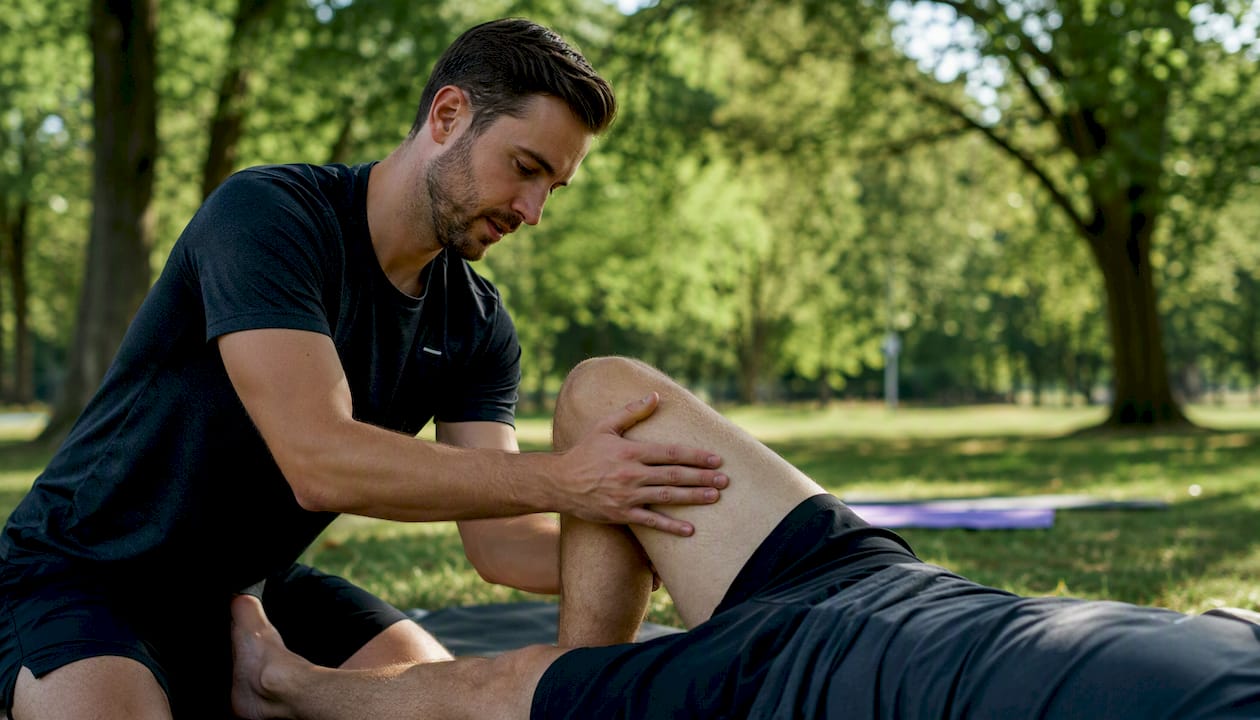
Military and defense roles prioritize measurable readiness outcomes and often require security clearance or a willingness to obtain one. Collegiate and professional sports programs weight coaching certifications heavily and expect comfort with unpredictable schedules, including travel and early mornings. Corporate performance and wellness teams, increasingly common inside large employers, care most about program scalability, since a single specialist might design interventions for hundreds of employees at once. Clinical centers and rehabilitation facilities require licensure or supervised clinical hours far more often than other settings, because the work overlaps with patient care. Research labs and universities favor advanced degrees and publication history, and pay less in exchange for intellectual autonomy. Private practice and consulting rewards people who can market themselves and build referral networks, since there’s no institutional pipeline of clients.
| Setting | What employers prioritize | Best fit if you… |
|---|---|---|
| Military & defense | Security clearance, measurable readiness metrics | Want structure and mission-driven work |
| Collegiate/pro sports | Coaching certifications, travel flexibility | Thrive on competition schedules and team culture |
| Corporate wellness | Scalable program design, ROI reporting | Prefer business environments over athletic facilities |
| Clinical/rehab | Licensure, supervised clinical hours | Have or want a clinical credential |
| Research/academia | Advanced degrees, publication record | Value autonomy over higher pay |
| Private practice/consulting | Self-marketing, referral networks | Want independence and are comfortable with income variability |
Performance science built inside elite sport doesn’t stay there. Practitioners with Olympic-system backgrounds have carried their frameworks into companies like Google and McLaren, which is a signal worth remembering: sports credentials translate directly into corporate consulting work if you frame them correctly on a resume.
What Education and Certifications Do You Need?
Most people enter through one of six degree paths: exercise science, kinesiology, psychology, human factors engineering, nutrition, or exercise physiology. None of these degrees alone guarantees a job, but they establish the baseline vocabulary employers expect a candidate to already have.
Certifications carry more weight than the degree in many job postings, especially at the entry level. The Certified Strength and Conditioning Specialist (CSCS) credential from the National Strength and Conditioning Association shows up constantly in sports and military-adjacent postings. Clinical roles typically require state licensure, whether that’s a psychology license, athletic training certification, or physical therapy credential, depending on the scope of practice. Human performance institutes and universities also offer shorter certificate programs in areas like sleep science or applied physiology that function as fast, affordable credibility boosters.
Practical training closes the gap between coursework and hireability:
- Internships during your degree program, ideally in the setting you want to target (a college athletics department, a corporate wellness team, a VA hospital).
- Assistant coaching or research-assistant roles, which are usually easier to land than full specialist positions and build a track record fast.
- Supervised clinical hours, required for any role touching patient care or requiring licensure.
- Continuing education micro-credentials, which keep your resume current between full degrees.
Pro Tip: Bundle one affordable certificate (under $500, completed in a few weeks) with a real project you can point to, like designing a six-week program for a local team or gym. A certificate alone is a line on a resume. A certificate plus a documented outcome is a story you can tell in an interview.
What Skills Matter Most for This Job?
Technical skill gets you in the door; the ability to translate data into action is what actually gets you promoted. Insiders in this field consistently flag translation skills as the differentiator between practitioners who stall out and those who advance, since raw data means nothing to a client until someone converts it into a clear behavior change.
Technical competencies employers screen for include assessment protocol knowledge (how to run and interpret VO2 max tests, grip strength, reaction time batteries), basic data literacy (reading wearable output, interpreting simple bloodwork markers), program design across training blocks, working knowledge of biomechanics, and a functional understanding of sleep and nutrition science even outside a nutrition-specific role.
Soft skills matter just as much, even though they’re harder to quantify on a resume: coaching communication that keeps clients engaged over months, the translation skill mentioned above, stakeholder management for roles that report to non-specialist executives or coaches, and ethical judgment around client data privacy and realistic goal-setting.
| Skill category | What to demonstrate | How to show it |
|---|---|---|
| Assessment literacy | Running and interpreting standard tests | Sample assessment report on your resume or portfolio |
| Program design | Building multi-week training blocks | Before/after metrics from a real client or project |
| Data translation | Turning numbers into client action | A brief anonymized case study |
| Stakeholder communication | Reporting outcomes to non-specialists | Reference or letter describing a cross-team project |
When you build out your application materials, include concrete evidence wherever possible: a redacted assessment report, a before/after metric from a program you designed, or a short anonymized case study. A tailored resume built around measurable outcomes consistently outperforms a generic list of duties, because hiring managers in this field are trained to look for numbers, not adjectives.
How Much Do Human Performance Specialists Earn?
Pay in this field varies more by employer type than by title, which surprises a lot of job seekers who assume “senior” or “director” titles are the main driver. A strength and conditioning coach at a Division I university, a cognitive performance specialist on a military contract, and a consultant running a private practice can have wildly different compensation structures even with similar experience levels.
Corporate and consulting roles tend to pay more per hour but offer less job security than institutional roles in college athletics or the military, which usually come with benefits and more predictable schedules. Contract and consulting rates can look attractive on paper but require you to cover your own gaps between projects, so compare total annual income, not headline rates, when weighing offers.
Job postings signal seniority in specific, checkable ways:
- Entry-level postings emphasize testing execution, data entry, and “assisting” a lead specialist.
- Mid-level postings ask for independent program design and direct client or athlete contact.
- Senior postings request budget management, staff supervision, or outcome reporting to executives or coaching staff.
- Watch for whether a posting lists research responsibilities separately from coaching duties. That split usually indicates a hybrid role, and hybrid roles frequently pay a premium because fewer candidates can do both well.
Pro Tip: When a posting lists a salary range, anchor your negotiation to the top third of that range if you can point to a specific certification or measurable outcome the posting explicitly requested. Vague enthusiasm doesn’t move a number; a matched requirement does.
How Do You Become a Human Performance Specialist?
The path is sequential, and skipping steps usually shows up as a gap in your resume that hiring managers notice immediately.
- Choose your sub-area (mental or physical performance) based on your existing strengths, not just interest. If you’re already strong in statistics, lean toward data-heavy roles. If you’re a natural communicator, lean toward coaching-heavy ones.
- Complete core education in a relevant degree field: exercise science, kinesiology, psychology, or human factors engineering, depending on your chosen sub-area.
- Earn targeted certifications that match your target employer type. A CSCS matters for sports and military-adjacent roles; clinical licensure matters for rehab and hospital settings.
- Build applied projects and internships that produce a documented outcome, not just a completed hour count.
- Document your outcomes in a portfolio format: before/after metrics, program summaries, and any anonymized case studies you’re allowed to share.
- Network and apply through professional societies, conferences, and direct outreach, treating each application as a chance to mirror the posting’s specific language.
Your resume should lead with a skills section built around the exact competencies employers list, not a generic objective statement. Personalizing each application to the specific posting, rather than sending one static resume everywhere, is one of the more reliable ways to get past initial screening in a field this fragmented by title.
Networking in this space works best around shared projects, not cold introductions. Reach out to people running programs similar to the one you want to build, offer to review or contribute to a project they’ve published, and let the relationship grow from there.
Pro Tip: Join one professional society or online community tied to your sub-area (sports science, human factors, or performance psychology) and post a short writeup of a project you completed, even a small one. Visibility inside a niche community often produces referrals faster than applying cold through a job board.
How Do You Tailor a Resume to a Real Job Posting?
A typical posting for this field mixes required and preferred qualifications in a way that rewards careful reading. A required line like “Bachelor’s degree in exercise science, kinesiology, or related field” is non-negotiable, but a preferred line like “experience with wearable data platforms” is often a tiebreaker, not a hard filter.
Deliverables buried in the posting text matter more than the job title itself. If a posting mentions “quarterly performance reports to coaching staff,” that’s a signal the role includes data communication responsibilities, not just program delivery. If it mentions “supervise assistant coaches,” that’s a management-track role even if the title doesn’t say “senior.”
| Posting element | What it signals | What to mirror in your CV |
|---|---|---|
| “Bachelor’s degree required” | Non-negotiable filter | List degree exactly as stated |
| “CSCS preferred” | Tiebreaker credential | Highlight if held; note in-progress if not |
| “Quarterly reporting to staff” | Data communication duty | Include a reporting or presentation example |
| “Supervise assistant coaches” | Management-track role | Emphasize any team-lead experience |
Before submitting, run through a short checklist: does your resume use the exact certification names from the posting, not abbreviations or paraphrases? Have you included at least one measurable outcome tied to a skill the posting explicitly requests? Does your cover letter reference the employer’s specific setting (military, corporate, collegiate) rather than generic language? Benchmarking your resume against similar postings before you apply catches these gaps before a recruiter does.
What Other Careers Can You Pivot Into?
A human performance background opens more doors than the job title suggests, largely because the underlying skill set (assessment, data translation, program design) transfers cleanly across adjacent fields.
- Occupational health specialist, applying similar assessment skills to workplace injury prevention and ergonomics.
- Performance technologist, shifting toward systems and process design rather than direct coaching.
- Clinical exercise physiologist, moving into a more clinical, patient-facing role that typically requires additional licensure.
- Executive coach, leveraging the mental-performance track into leadership development, often as an independent consultant.
- Research scientist, staying closer to the academic side and prioritizing publication over applied coaching.
Long-term progression usually follows one of two ladders: a practitioner track (senior specialist to program director to consultancy owner) or a research track (senior specialist to research lead to academic or institute leadership). Credentials that shorten a pivot include an advanced degree if you’re moving toward research, or a business or coaching certification if you’re moving toward independent consulting.
Who Are the People Shaping This Field?
A handful of practitioners illustrate just how different a “human performance specialist” career can look in practice.
Andy Galpin built his career from molecular exercise physiology research into a hybrid model that combines lab science, applied coaching, and public education. His trajectory shows that a research-to-practice pipeline doesn’t have to end at a university lab. He founded applied facilities that pair muscle-level testing with practical services like sleep coaching, and he built public credibility through content and courses alongside his clinical work.
Jim Loehr co-founded the Johnson & Johnson Human Performance Institute and helped popularize an energy-management framework that treats physical, emotional, and mental energy as trainable resources, not fixed traits. That framework is still the backbone of many corporate resilience programs today.
Tim Grover took the opposite route: a coaching career built directly through elite athletic clients that scaled into consulting and public speaking without a heavy research component. His profile shows that a strong applied track record can substitute for an academic pedigree if you build the right client relationships early.
Steve Ingham carried performance science built inside Olympic sport systems into corporate leadership work with organizations like Google and McLaren, proving that elite-sport methods travel well outside of athletics.
Top practitioners in this field don’t choose between research and applied work. They build public education (courses, writing, speaking) alongside client services, using each to reinforce credibility for the other.
Two trends worth watching if you’re entering the field now: precision sleep optimization using consumer wearables, and AI-driven analytics that flag fatigue or overtraining patterns before a human coach would catch them. Neither replaces the specialist’s judgment, but both raise the bar for the data literacy employers expect on day one.
My Take on Breaking Into This Field Fast
The biggest mistake I see job seekers make in this space is chasing the perfect title instead of the fastest credible entry point. “Human performance specialist” isn’t a licensed profession with one clear on-ramp. It’s an umbrella term covering psychologists, strength coaches, engineers, and physiologists, which means the fastest path in rarely looks like waiting for a job titled exactly what you searched.
If I had to prioritize one thing for someone starting today, it wouldn’t be a certification. It would be documentation. Every internship, every assistant role, every small project you run for a local team or a friend’s training program should end with a written outcome: what changed, by how much, over what timeframe. That single habit, repeated a handful of times, gives you more interview material than another certificate ever will. Certifications prove you studied something. Documented outcomes prove you can do the job.
Where does a tool like Easy-cv fit into that? It helps you turn scattered project notes into a resume that actually mirrors what a specific posting is asking for, instead of a generic list of duties that could belong to anyone in the field.
How Easy CV Speeds Up Your Job Search in This Field
Applying for human performance specialist roles means juggling wildly different job titles, employer types, and required qualifications, often across multiple applications in a single week. Easy CV’s AI tailoring tool rewrites your resume content to mirror the specific language of each posting, whether you’re applying to a cognitive performance role at a defense contractor or a strength and conditioning position at a university.
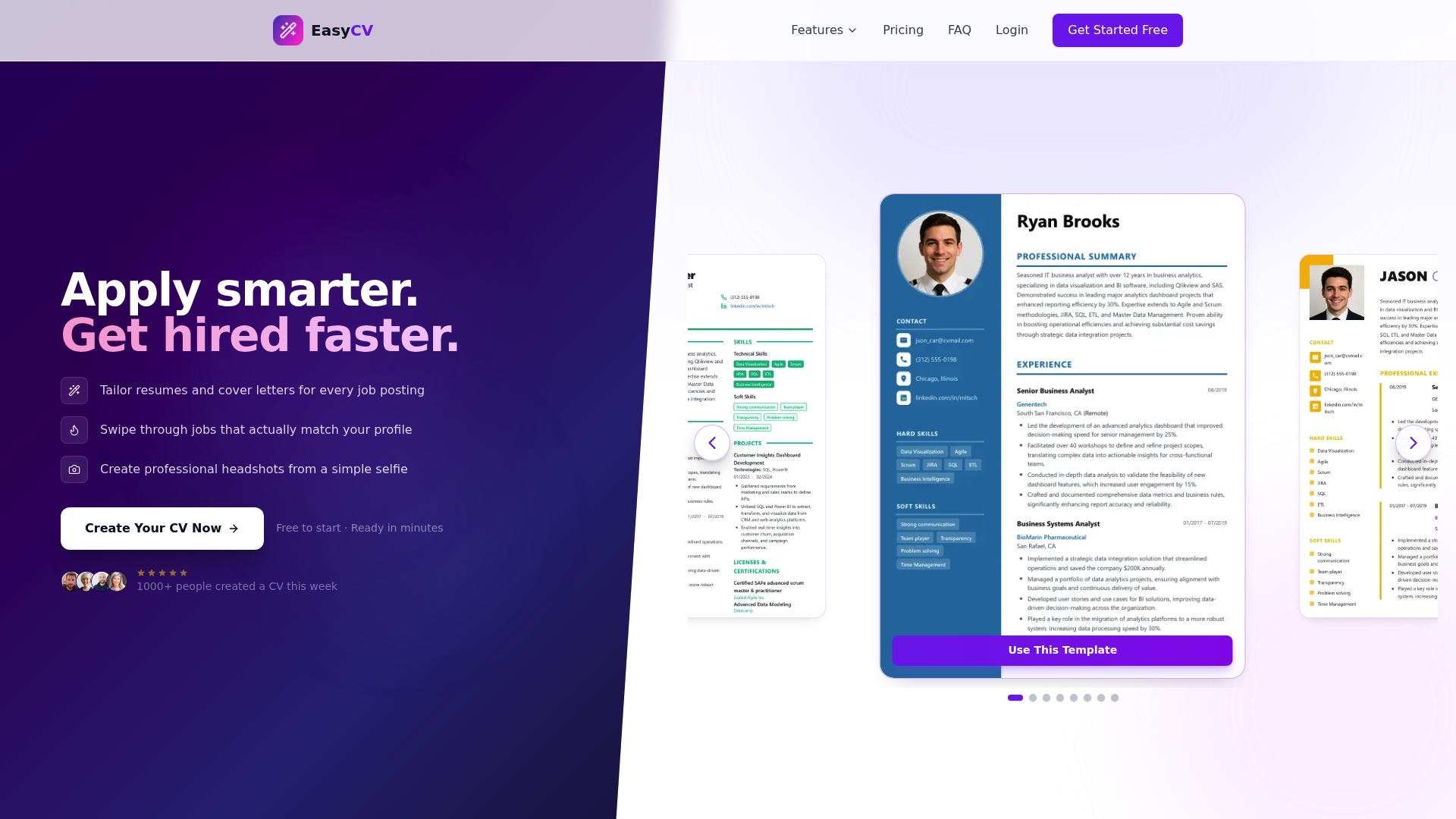
Three ways it helps directly: the AI tailoring feature turns a project summary into achievement bullets phrased around the exact deliverables a posting lists, the job matcher swipes through openings pre-scored against your background so you’re not scrolling through irrelevant sports-medicine listings, and the CV translator helps if you’re applying to international or remote-first employers that expect materials in multiple languages. ATS-friendly templates make sure your certifications and measurable outcomes actually get parsed correctly instead of getting lost in formatting.
If you’re ready to stop rewriting the same resume six different ways, start building a tailored version at Easy-cv and match it against your next target posting today.
Frequently Asked Questions
Is a human performance specialist the same as a personal trainer? No. A personal trainer typically focuses on general fitness coaching for the public, while a human performance specialist works with data-driven assessment, program design, and often a specific population like athletes, military personnel, or corporate executives.
Do I need a master’s degree to work as a human performance specialist? Not always. Many entry-level and coaching-track roles accept a bachelor’s degree plus relevant certifications like the CSCS. Research-heavy or clinical roles typically require a master’s or doctoral degree.
What’s the difference between a sports performance specialist and a strength and conditioning coach? The titles overlap significantly, but a strength and conditioning coach usually focuses more narrowly on training program delivery, while a sports performance specialist may also handle recovery protocols, biomechanics assessment, and injury-risk data.
Can I become a human performance specialist without a sports background? Yes. Corporate wellness, human factors engineering, and cognitive performance roles often value backgrounds in psychology, data science, or industrial engineering just as much as an athletic background.
How competitive is this field for entry-level candidates? It’s competitive because the title is broad and many candidates apply broadly without tailoring materials. Candidates who document measurable outcomes from internships or small projects consistently stand out over those relying on coursework alone.
Sources
- A New Term: Human Performance Specialists | Psychology Today
- About — Dr. Andy Galpin
- Jim Loehr | Performance Psychologist
- Dr Steve Ingham, Performance Scientist & Keynote Speaker