Conceptual Skill: Build Strategic Thinking That Gets You Promoted
A conceptual skill is the ability to see the big picture, connect abstract ideas, and translate them into strategic action. If you want to move from execution to direction, from doing to leading, this is the skill category that separates managers who get promoted from those who stay stuck.
Conceptual skills sit at the core of every leadership role: they let you integrate complex information, spot patterns others miss, and make decisions that hold up under uncertainty. Daniel Katz’s foundational skills framework, later reinforced by HBR research on strategic thinking, shows that the higher you climb, the more these abilities determine your effectiveness. Technical expertise gets you hired. Conceptual thinking gets you promoted.
Key Takeaways
Conceptual skills are the single highest-leverage investment for any professional who wants to move from execution to leadership, and they are fully learnable with structured, consistent practice.
| Point | Details |
|---|---|
| What conceptual skills are | The ability to see the big picture, connect abstract ideas, and make strategic decisions across complex situations. |
| Skill mix shifts with seniority | Entry-level roles demand technical depth; senior roles demand conceptual and human skills above all else (Katz framework). |
| Development requires feedback loops | Techniques like 5 Whys and pre-mortems build skill only when you review outcomes and update your mental model. |
| Resume evidence beats bare labels | Show the problem, the conceptual move, and the outcome in every bullet; avoid listing “strategic thinking” without proof. |
| Easy-cv for application | Easy-cv’s AI writing assistant and job matcher help translate conceptual-skill practice into targeted, ATS-ready applications. |
Table of Contents
- What is a conceptual skill, exactly?
- The core types of conceptual skills, with real examples
- How conceptual, technical, and human skills differ by role level
- Why conceptual skills matter for your career and your team
- Proven techniques to develop conceptual skills
- A realistic 4-week practice plan
- How to show conceptual skills on your resume and in interviews
- The part most guides skip
- Easy-cv helps you turn conceptual-skill growth into a stronger application
- Sources
What is a conceptual skill, exactly?
Conceptual skills are the mental tools you use to understand how parts of a system relate to each other and to the whole. Where a technical skill tells you how to do something, a conceptual skill tells you what to do and why it matters in context.
The distinction Katz drew is still the clearest: technical skills are about methods and mechanics; human skills are about working with and through people; conceptual skills are about grasping the organization, the market, or the problem as an integrated whole. A software engineer who writes clean code is exercising a technical skill. A product manager who decides which features to cut because they conflict with a two-year growth strategy is exercising a conceptual one. The same person can do both, but they are different cognitive modes.
What makes conceptual thinking distinct from just “being smart” is its orientation toward abstraction and synthesis. You are not just analyzing data; you are building a mental model of how the data connects to decisions, trade-offs, and outcomes you cannot yet see.

The core types of conceptual skills, with real examples
Conceptual skills span several distinct categories, each useful in its own right and more powerful in combination:
- Analytical thinking: Breaking a complex problem into its components to find root causes. A financial analyst decomposes a revenue drop into pricing, volume, and mix effects before recommending a fix.
- Creative thinking: Generating novel solutions by combining ideas from different domains. A marketing lead borrows a loyalty-loop model from gaming to redesign a B2B onboarding sequence.
- Systems thinking: Mapping how parts of a system interact and where leverage points sit. A product manager traces how a change to the checkout flow affects customer support volume, refund rates, and repeat purchase behavior.
- Strategic and anticipatory thinking: Looking ahead to identify threats and opportunities before they become obvious. A supply chain director models three demand scenarios for Q4 rather than planning for one.
- Problem framing: Defining the right problem before solving it. A consultant reframes a “we need more sales training” request as a lead-quality problem after reviewing conversion data.
- Communication of complex ideas: Translating abstract analysis into language a non-expert audience can act on. A data scientist presents a model’s output as a business decision, not a technical result.
- Leadership and negotiation: Aligning people around a direction when the path is ambiguous. A cross-functional team lead builds consensus on a product pivot by making the trade-offs visible to every stakeholder.
Some of these are universally useful regardless of role: analytical thinking and problem framing matter whether you are a student, an individual contributor, or a CEO. Others, like strategic anticipation and organizational alignment, become central only as you move into management. Knowing which to prioritize at your current level is itself a conceptual skill.
How conceptual, technical, and human skills differ by role level
Katz’s three-skill model is the most practical lens for understanding which skills to develop when. The core insight: the mix shifts dramatically as you move up.
| Role level | Conceptual skills | Human skills | Technical skills |
|---|---|---|---|
| Entry-level / individual contributor | Low emphasis | Medium emphasis | High emphasis |
| Mid-level manager | Medium emphasis | High emphasis | Medium emphasis |
| Senior / executive leader | High emphasis | High emphasis | Low emphasis |
At the entry level, technical depth is your primary currency. You need to deliver work, and that requires knowing your tools and methods cold. Human skills matter for collaboration, but nobody expects a junior analyst to set organizational direction.
Mid-level managers need both human and emerging conceptual skills. You are translating strategy downward and operational reality upward, which requires understanding both layers. This is where most professionals hit a ceiling: they keep optimizing their technical skills when the role now demands something different.
Senior leaders operate almost entirely in the conceptual and human domains. The technical work is delegated. What they must do is understand the big picture, integrate complex ideas, and form long-term strategies that hold up as conditions change. If you are aiming for a director or VP role, the question is not “how do I get better at my craft?” It is “how do I get better at seeing the whole board?”
Pro Tip: *Map your current role against the table above.
Why conceptual skills matter for your career and your team
The career case is straightforward: roles that require conceptual thinking pay more, carry more authority, and are harder to automate. But the team-level case is equally strong.
Consider a product manager who skips the framing step and jumps straight to solutions. The team builds a feature that solves the symptom, not the cause. Three months of engineering effort, a missed quarter, and a post-mortem that reveals the original problem statement was wrong. That is not a technical failure. It is a conceptual one, and it is common.
The rebuttal to “I just need technical depth” is this: technical depth scales linearly. You get better at one thing. Conceptual skill scales exponentially because it improves every decision you make, across every domain. A manager who frames problems well before delegating them gets better output from the same team. A professional who can communicate complex trade-offs clearly moves faster through organizations because people trust their judgment.
The misconception that soft skills are vague and unmeasurable does not hold for conceptual skills. You can track decision quality, measure how often your framing of a problem turned out to be correct, and get structured feedback from peers on whether your analysis captured the right variables.
Proven techniques to develop conceptual skills
Strategic thinking is learnable, and the techniques below are the ones practitioners and researchers consistently recommend. Each can be practiced in under an hour.
- 5 Whys: Ask “why” five times in sequence to move from symptom to root cause. Takes 15 minutes on any problem you are currently stuck on. Write the chain down; the discipline of writing forces precision.
- Framing questions: Before solving a problem, write three different versions of the problem statement. Which one, if solved, would have the biggest impact? This single habit catches most misdirected effort early.
- Pre-mortem: Imagine it is six months from now and the project failed. Write down every reason it could have gone wrong. Then address the top three before you start. Pairs well with small pilots: test the riskiest assumption first, cheaply.
- Scenario planning: Build two or three plausible futures for a decision you are facing. What would you do differently in each? The goal is not prediction; it is flexibility. You want a plan that holds up across scenarios, not just the most likely one.
- Pattern recognition exercises: Read case studies or post-mortems from industries outside your own. Force yourself to name the underlying pattern: “This is a principal-agent problem.” “This is a coordination failure.” The more patterns you catalog, the faster you recognize them in new situations.
- Structured decision-making: For any significant decision, write down the criteria, the options, and the trade-offs before choosing. Review it afterward. Did the criteria hold? Did you weight them correctly? This is how you build strategic judgment over time.
- Strategic communication practice: Take a complex analysis you have done and explain it in two minutes to someone outside your function. If they cannot act on it, the communication failed. Iterate until they can.
Pro Tip: Pair the pre-mortem with a small pilot whenever stakes are high. Surface your assumptions with the pre-mortem, then design the cheapest possible test of the riskiest one. You learn faster and fail smaller.
Research on strategic leadership skills warns against over-indexing on one technique. The professionals who develop fastest work across a balanced set: anticipating, challenging assumptions, interpreting evidence, deciding, aligning others, and learning from outcomes. No single technique covers all six.
A realistic 4-week practice plan
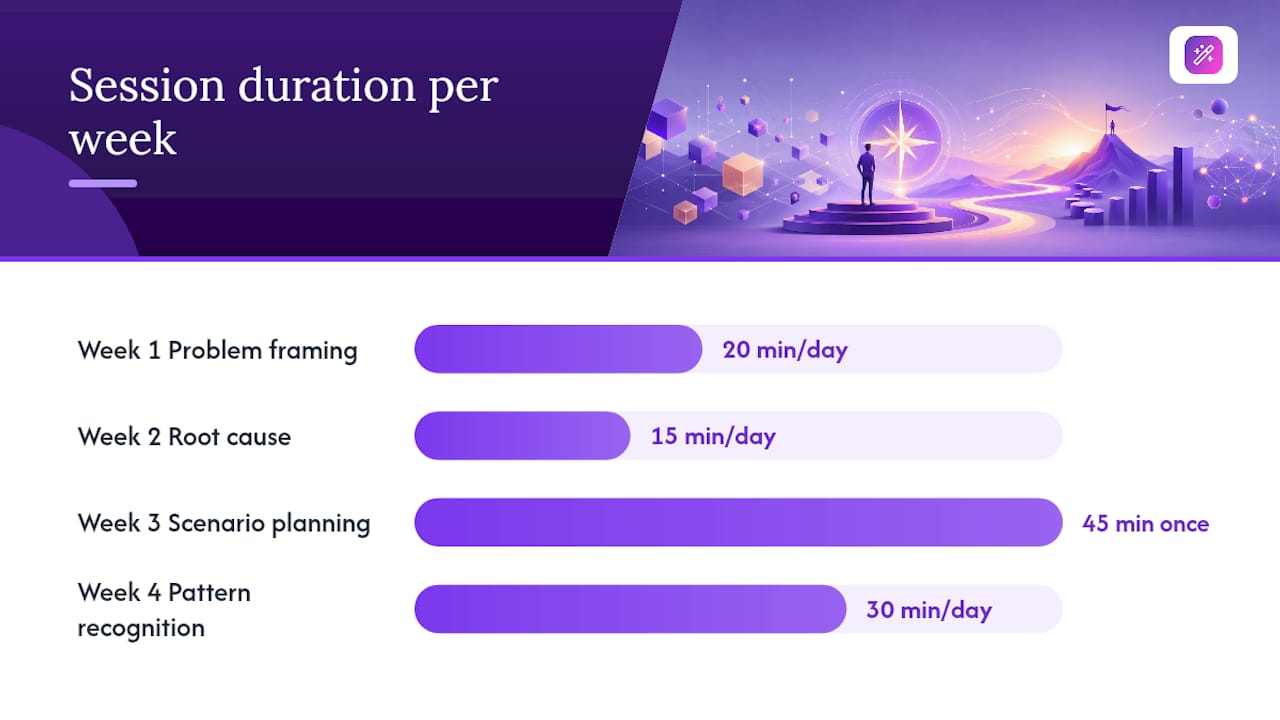
Small, regular practice shows measurable improvement over months, and the plan below is built around that reality. You do not need to block out hours; you need consistency.
| Week | Focus | Daily/weekly exercise | Time |
|---|---|---|---|
| 1 | Problem framing | Write three versions of one current work problem; pick the best framing | 20 min/day |
| 2 | Root cause analysis | Apply 5 Whys to one real decision or setback per day; write the chain | 15 min/day |
| 3 | Scenario planning | Build two scenarios for one upcoming decision; identify the pivot point | 45 min once |
| 4 | Pattern recognition | Read one case study or post-mortem; name the underlying pattern | 30 min/day |
- Weeks 1–2: Focus on framing and root cause. These are the highest-leverage skills for individual contributors and new managers because they improve every piece of work you touch.
- Weeks 3–4: Move to scenario planning and pattern recognition. These require more cognitive load and benefit from the foundation the first two weeks build.
- Measurement: Keep a decision journal. After each significant decision, write: what was the problem, what did I decide, what happened, and what would I do differently? Review it at the end of week 4.
- Peer feedback: Share one framing exercise per week with a trusted colleague. Ask: “Does this capture the real problem?” Their answer tells you more than any self-assessment.
Self-assessment rubric:
- Beginner: Can describe the problem but frames it as the first version that comes to mind; analysis stays at the symptom level.
- Competent: Generates multiple framings, chooses deliberately, and can trace a problem to at least one root cause.
- Confident: Frames problems in ways that others adopt, anticipates second-order effects, and updates mental models based on outcomes.
If you are a student, run this plan on academic projects or case competitions. Individual contributors can apply it to current work tasks. Managers should add a fifth week focused on professional services training and mentoring: watch how a senior leader frames a problem in a meeting, then debrief with them afterward.
How to show conceptual skills on your resume and in interviews
The challenge with conceptual skills on a resume is that they are invisible unless you make the thinking explicit. Translating conceptual-skill practice into resume bullets means showing the problem, the thinking, and the outcome, not just the outcome.
Resume bullet templates:
- Reframed a customer churn problem from a pricing issue to an onboarding gap; led a 6-week discovery sprint that reduced 90-day churn by 18%.
- Mapped cross-functional dependencies for a product launch across four teams; identified two critical path conflicts 8 weeks early, preventing a delayed release.
- Developed three demand scenarios for Q4 inventory planning; the conservative scenario proved accurate, avoiding $200K in excess stock.
- Translated a complex regulatory change into a plain-language brief for non-legal stakeholders; brief was adopted as the company-wide communication standard.
Each bullet follows the same logic: here is the situation, here is the conceptual move I made (framing, mapping, scenario planning, translation), and here is what it produced. The skill is visible in the action, not just the result.
Where to place them: Conceptual skills belong in your experience bullets, not just a skills section. A skills section that lists “strategic thinking” or “systems thinking” as bare terms is easy to ignore. A bullet that shows you applied systems thinking to prevent a launch failure is evidence. For roles where these skills are central, a skill-based CV format groups your experience around competencies rather than job titles, which works well for career changers and those moving into management.
Interview phrases (STAR format):
- “Before we jumped to solutions, I reframed the problem as… which changed the options we considered.”
- “I ran a pre-mortem with the team and we identified three risks we hadn’t accounted for. We addressed two of them before launch.”
- “I built a simple model of how the decision would play out under two different market conditions, which gave the leadership team a clearer basis for the trade-off.”
For ATS-friendly phrasing, use terms like “strategic analysis,” “cross-functional problem framing,” “scenario modeling,” and “systems mapping.” These are searchable and specific. Check the skills section guidance for how to pass ATS filters without keyword stuffing.
For consulting roles specifically, the management consulting resume format is worth studying: it is built almost entirely around demonstrating conceptual thinking through structured problem-solving examples.
The part most guides skip
Most articles on conceptual skills treat them as a checklist: learn these five techniques, practice them, done. What they understate is that the real development happens in the feedback loop, not the technique itself.
The 5 Whys is not useful because it is a clever framework. It is useful because it forces you to write down your assumptions and then test them against what actually happened. The pre-mortem does not prevent failure; it makes your mental model of the future explicit so you can update it when reality diverges. That updating process, treating outcomes as data rather than verdicts, is what HBR’s research on strategic thinking identifies as the core habit of people who actually get better at this over time.
The failure mode I see most often: professionals practice a technique once, get a useful result, and then stop. The technique becomes a tool they pull out for big decisions only. But conceptual skill is built through repetition on small decisions, not heroic application to large ones. The decision journal matters more than the scenario-planning workshop.
One more thing worth saying plainly: you cannot develop these skills in isolation. The fastest path is to find someone whose conceptual thinking you respect, watch how they frame problems in real time, and ask them to explain their reasoning afterward. That debrief, done consistently, compresses years of solo practice into months.
Easy-cv helps you turn conceptual-skill growth into a stronger application
You have done the work of developing these skills. The next step is making sure your CV reflects them clearly enough that a hiring manager or ATS actually sees them.
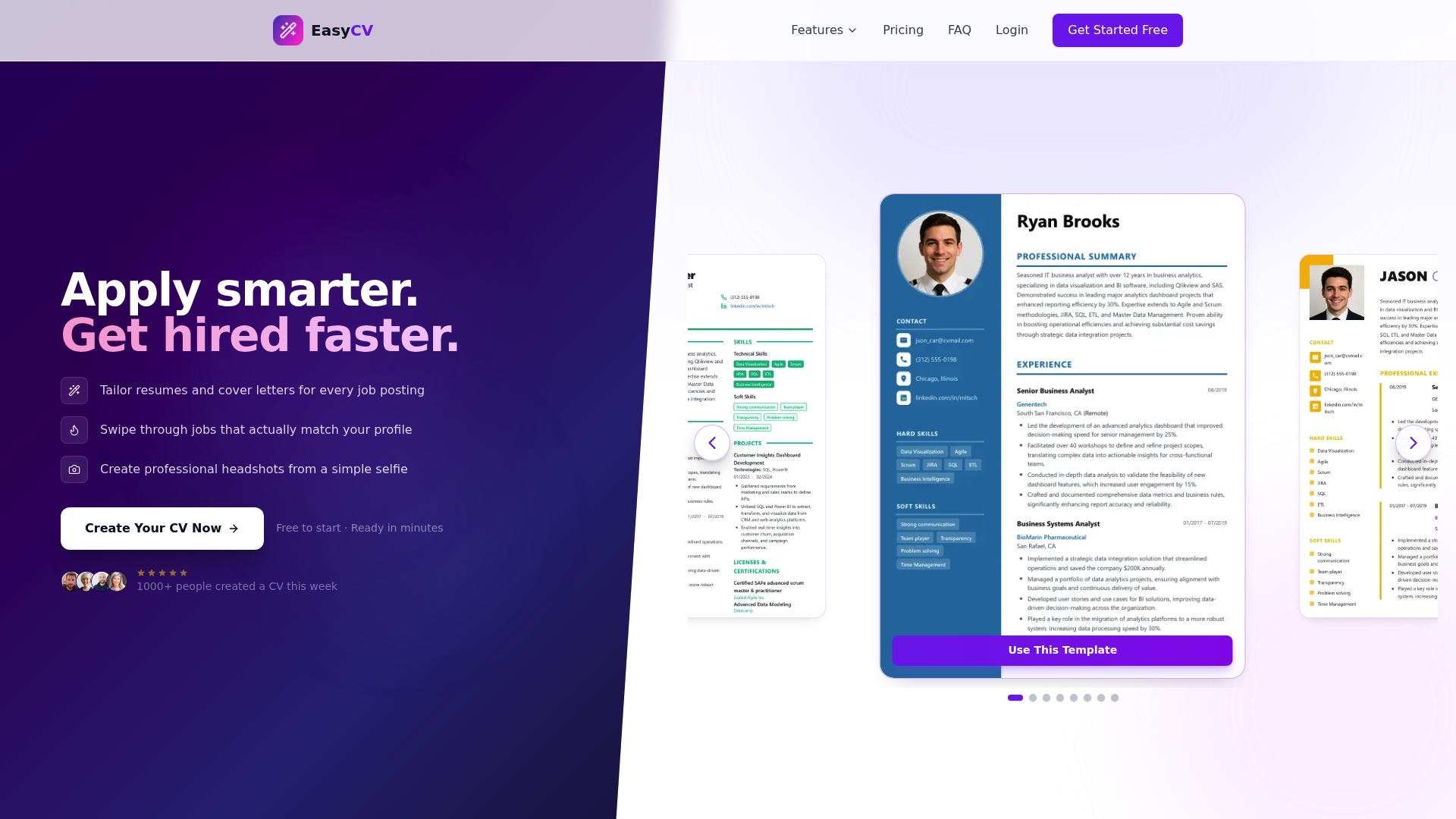
Easy-cv gives you an AI writing assistant that helps you translate experience into sharp, evidence-backed bullets, the kind that show conceptual thinking in action rather than just listing it as a trait. The ATS-friendly templates are built for professionals who need their skills section and experience bullets to work together, and the job matcher surfaces roles where your specific skill profile is a genuine fit. Start with a free account, load your current CV, and let the AI flag where your conceptual-skill evidence is thin and where it lands well.
Sources
- Study
- Conceptual Skills: Definition, Examples, and How to Improve Them | Coursera
- How to become a better strategic thinker | Harvard Business Review
- How to Improve Strategic Thinking for Effective Leadership | Corporate Finance Institute