The Real Advantages of Resume Parsers in Modern Hiring
Resume parsers save recruiters hours per requisition by turning unstructured documents into searchable, structured candidate data, which speeds up screening, sharpens matching, and cuts unconscious bias. Automated parsing can cut candidate screening time by up to 75% compared with manual review, and on clean, standard-format resumes, parsers now hit 94 to 99% extraction accuracy for predictable fields like names and contact details.
The chief gains break down like this:
- Dramatically faster screening and higher applicant throughput
- Structured, searchable candidate profiles instead of buried PDFs
- Context-aware matching that goes beyond keyword scanning
- Configurable fields that help reduce bias at the top of the funnel
- Tighter ATS and HRIS integration
- Lower cost-per-hire from reduced manual data entry
Key Takeaways
Resume parsers cut screening time by up to 75%, hit 94 to 99% accuracy on standard fields, and turn one-time applications into a searchable, reusable talent pool.
| Point | Details |
|---|---|
| Screening time drops fast | Parsing can reduce screening time by up to 75% compared with manual review. |
| Accuracy varies by field | Standard fields reach 94 to 99% accuracy; free-text skills lag behind, so ask vendors for per-field metrics. |
| Bias reduction needs monitoring | Disabling sensitive fields helps only when paired with ongoing governance, not automatic fairness. |
| Integration determines value | Native ATS/HRIS connectors decide whether parsed data saves time or just adds a re-keying step. |
| Measure the right KPIs first | Screening time, shortlist size, and error rate move before time-to-hire or cost-per-hire. |
Table of Contents
- What Are the Advantages of Resume Parsers, Starting With the Basics?
- How Do Resume Parsers Actually Work?
- Top Advantages of Resume Parsers for Recruiting Teams
- How Do You Measure ROI From Resume Parsing?
- What Are the Common Limitations of Resume Parsers?
- Best Practices Checklist for Accurate Resume Parsing
- Should Recruiters Actually Adopt Resume Parsing?
- Sources
What Are the Advantages of Resume Parsers, Starting With the Basics?
Resume parsing is the process of extracting candidate information from a document, PDF, DOCX, TXT, or a scanned image, and converting it into structured fields an ATS or HRIS can read, sort, and search. It sits at the front of your hiring stack: a candidate uploads a resume, the parser reads it in seconds, and a populated profile lands in your system before a recruiter ever opens the file.
Most parsers extract:
- Contact details, job titles, and employment dates
- Skills, certifications, and education history
- Career progression signals like tenure and title changes
Pro Tip: Ask any vendor to show you a parsed output side by side with the original resume before you buy. If the demo only shows clean sample data, that is a red flag, not a feature.
How Do Resume Parsers Actually Work?
Four approaches dominate the market: rule-based parsing, statistical models, machine learning with natural language processing, and OCR for scanned documents. Most serious platforms today run a hybrid setup, ML for context combined with rule-based fallbacks on high-stakes fields like dates and job titles, plus a correction loop that retrains the model instead of quietly guessing.
- Rule-based parsing is predictable and cheap to build, but breaks the moment a resume uses an unusual layout or a two-column design.
- Statistical and ML/NLP models read context rather than just matching keywords, which is how modern parsers understand that “led a team of engineers” implies management experience even without the word “manager” appearing anywhere.
- OCR handles scanned or image-based resumes, but accuracy drops sharply on low-resolution scans or handwritten notes.
Pro Tip: Never accept a single blended accuracy number from a vendor. Ask for per-field accuracy, since names and emails often parse at 98% while free-text skill sections lag well behind.
Top Advantages of Resume Parsers for Recruiting Teams
Here is where the technology earns its place in your stack, ranked by the impact recruiters actually feel first.
Time savings and scale. This is the advantage every recruiter notices in week one. Parsers process hundreds of applications in the time it takes a human to read three resumes carefully, and that speed compounds across a busy hiring season when volume spikes.
By the numbers: Automated parsing has cut screening time by up to 75% in vendor-reported cases, and some organizations report up to 95% less manual parsing work after adoption. The KPI that moves first is screening time per applicant, not time-to-hire, which lags a few weeks behind.
Consistent candidate evaluation. A parser applies the same extraction logic to every resume, so candidate #4 gets read with the same rigor as candidate #400. A recruiter reviewing resumes at 4 PM on a Friday cannot promise that consistency, and nobody should expect them to.
Reduced bias through configurable fields. You can disable sensitive fields, age, gender, university name, during initial screening passes. G2’s analysis of resume parsing notes this configuration step helps reduce unintentional hiring bias, though it only works when paired with ongoing monitoring, not set-and-forget deployment.
Skills-based matching. Because NLP-driven parsers interpret context instead of scanning for exact keyword matches, they surface qualified candidates even when job titles differ from your posting. Someone titled “Growth Lead” at a startup might be your best fit for a “Marketing Manager” role, and a keyword scanner would miss that entirely.

ATS and HRIS integration. Parsed data only pays off when it flows cleanly into your existing systems through native connectors or APIs. Without solid integration, you have just automated the first step and manually re-keyed everything after, which defeats the purpose. This is the KPI most tied to first-pass shortlist quality.
Searchable talent pools. Every parsed resume becomes a permanent, searchable record. Recruiters can resurface candidates who applied six months ago for a role that did not exist yet, turning a one-time application into a durable pipeline asset. This is the sourcing channel most teams underuse.
Better candidate experience. Faster response times and more accurate matching mean fewer good candidates ghosted by a slow process. A parsed profile also feeds cleaner data into tools that tailor applications to specific job listings, which raises match quality on both sides of the table.
Lower cost-per-hire. Less manual data entry means fewer recruiter-hours per requisition, and that shows up directly in cost-per-hire once you track it against baseline.
| Advantage | KPI Most Affected | Quick Example |
|---|---|---|
| Time savings and scale | Screening time per applicant | Processing 500 applications in hours instead of days |
| Consistent evaluation | Match accuracy | Every resume screened against the same criteria |
| Bias reduction | Diversity of shortlist | Sensitive fields hidden during first-pass review |
| Skills-based matching | First-pass shortlist size | Surfacing candidates with equivalent but differently titled roles |
| Searchable talent pools | Cost-per-hire | Rediscovering a strong past applicant for a new opening |
Pro Tip: Don’t just track time saved. Track how many parsed profiles from your database get reused for a second or third role within a year. That number tells you whether you built a talent pipeline or just a faster inbox.
How Do You Measure ROI From Resume Parsing?
The fastest-moving KPIs are screening time per applicant, first-pass shortlist size, and parse-to-profile error rate. All three shift within the first two or three weeks of deployment, well before time-to-hire or cost-per-hire show meaningful movement.
Pro Tip: Run parsing-enabled screening against manual screening in parallel for your first sprint, same requisitions, same reviewers. That side-by-side comparison is the cleanest way to prove the tool’s value to skeptical stakeholders.
What Are the Common Limitations of Resume Parsers?
Parsers are genuinely powerful, but they are not flawless readers. Errors cluster around scanned documents, creative visual layouts, nonstandard role titles, and free-form skill descriptions that do not map neatly to structured fields.
- Scanned or image-based resumes need reliable OCR, and format coverage directly affects real-world accuracy, so a parser tuned only for digital PDFs will stumble on faxed or photographed documents.
- Creative layouts with columns, graphics, or unusual section headers confuse rule-based logic and sometimes trip up ML models too.
- Free-text skill sections parse less reliably than structured fields like dates or emails, since skills phrasing varies wildly between industries.
- Multilingual resumes can misfire when a parser trained mostly on English documents encounters non-English section headers or mixed-language content.
Mitigation is straightforward: build a validation UI where recruiters flag bad extractions, run a human review loop on the first few hundred parsed profiles, and retrain periodically using flagged samples rather than fixing records one by one forever.
Pro Tip: A correction loop that retrains the model beats a correction loop that only patches individual records. Ad hoc fixes solve today’s problem; retraining solves next month’s.
Best Practices Checklist for Accurate Resume Parsing
Configure fields for the roles you actually hire, collect a sample backlog before going live, and monitor per-field accuracy from day one rather than trusting a single blended score.
- Run pre-deployment tests using real resumes from your last hiring cycle, not vendor demo files.
- Check format coverage across PDF, DOCX, and scanned documents before rolling out company-wide.
- Set per-field accuracy thresholds, and flag anything parsing below 90% for review.
- Confirm ATS and HRIS integration sanity checks so parsed data lands where recruiters actually work.
- Build a feedback loop where recruiters can correct bad extractions and feed those corrections back into retraining.
Candidates can help too. Guide applicants toward simple, ATS-friendly formatting with standard section headers, and steer them away from image-heavy templates that look sharp to a human but read as noise to a parser.
- Prefer PDF or DOCX over scanned images whenever possible.
- Use standard section headers like “Experience” and “Education” rather than creative alternatives.
- Avoid embedding critical information inside tables or graphics.
Should Recruiters Actually Adopt Resume Parsing?
Yes, and the conditions matter more than the yes. Parsing earns its place when you pair it with human review early on and treat the parsed database as a long-term asset, not a disposable inbox filter. Start with one requisition type, measure screening time and error rate for a full cycle, then expand once you trust the numbers. Platforms like Easy CV build on this same principle from the candidate side, structuring resume data so it travels cleanly between formats and systems instead of getting lost in translation.
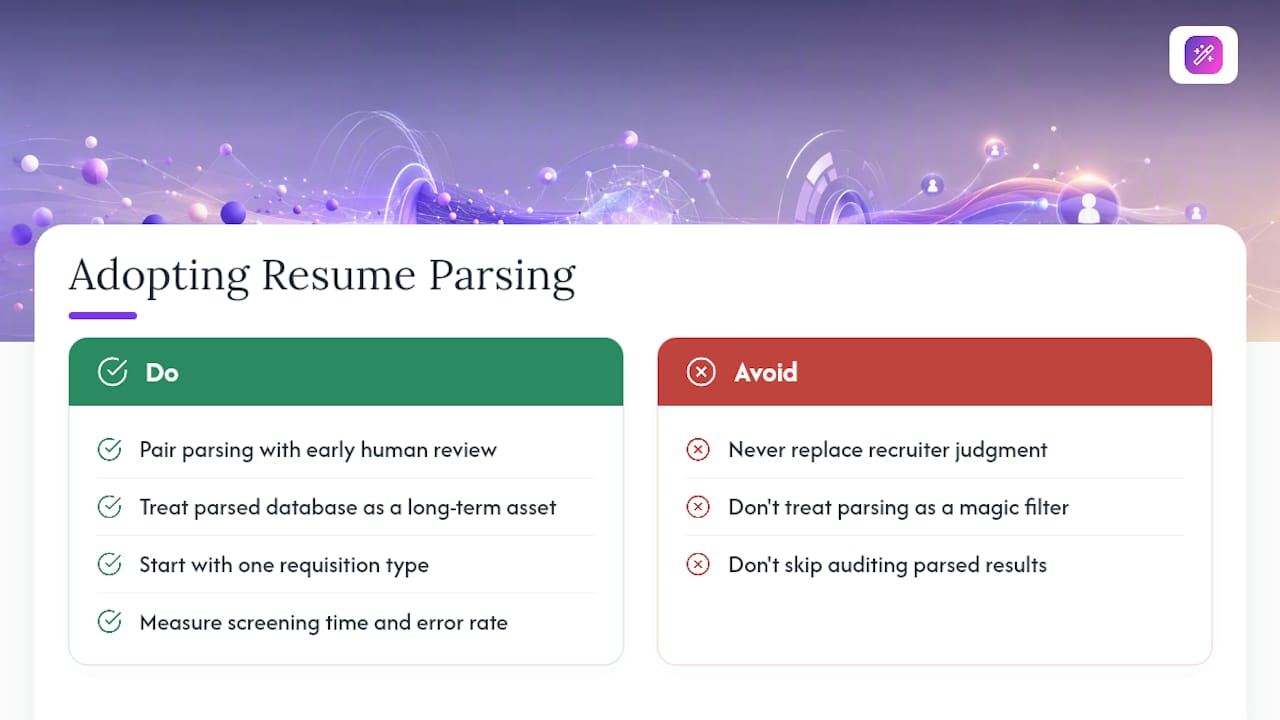
Where I push back on the hype: parsing does not replace recruiter judgment, it replaces the tedious first pass that burns recruiter judgment before it gets used. Treat it as an enabler that shifts your time from admin work toward evaluation and candidate relationships, and it pays off. Treat it as a magic filter you never audit, and it will quietly bake bias or error into your pipeline.
Sources
- Resume Parsing Guide: From Implementation to ROI
- AI Resume Parser Guide: How It Reads a Resume in Seconds
- What is AI-Powered Resume Parsing? | 5 Benefits & Insights - ATLAS
- What Is Resume Parsing? Definition, Benefits, And Challenges
- 7 resume parsing benefits to transform your hiring process | Affinda