Why Soft Skills in Your CV Matter for Getting Hired
Soft skills are the interpersonal traits and behaviors that determine how well you work with others, adapt to change, and lead under pressure. Understanding why soft skills in your CV matter is the difference between a resume that passes screening and one that wins interviews. 69% of U.S. executives prioritize candidates who demonstrate strong soft skills. That single statistic tells you these traits are not optional extras. They are core hiring criteria.
Why do soft skills in a CV make such a difference?
Soft skills are the non-technical abilities that shape how you communicate, collaborate, and solve problems at work. Hard skills, by contrast, are teachable competencies like coding, accounting, or data analysis. Both belong on your CV, but they serve completely different purposes in the hiring process.
89% of new hire failures trace back to soft-skill deficits rather than technical incompetence. That figure reframes the entire conversation. Employers are not just screening for what you can do. They are screening for whether you will thrive in their environment.

Soft skills also drive long-term career growth. Technical knowledge becomes outdated. The ability to communicate clearly, lead a team, or adapt to a new process stays relevant across every role and industry. Job seekers who treat soft skills as an afterthought on their CV are leaving a major competitive advantage on the table.
What role do soft skills play in hiring compared to hard skills?
Hard skills and soft skills serve distinct functions in the hiring funnel. Hard skills get your resume past automated screening. Soft skills win over the hiring manager who reads it.
75% of resumes are filtered out by applicant tracking systems before a human ever sees them. ATS tools scan for technical keywords: programming languages, certifications, tools, and job-specific terminology. If your resume lacks those keywords, it never reaches a recruiter’s desk. That is why hard skills must appear as clear, searchable terms in your skills section.
Once your resume clears ATS, the dynamic shifts. Recruiters and hiring managers look for evidence that you will fit the team and perform under real conditions. Resumes with technical skills show a 20.1% hire rate versus 14.2% for soft-skills-only resumes. Hard skills give you the edge in initial screening, but soft skills determine whether you get the offer.
The strategic balance most hiring experts recommend is roughly 70% hard skills to 30% soft skills on a resume. That ratio reflects the reality of how hiring works: technical competence opens the door, and interpersonal ability closes the deal.
At management levels, the balance shifts further. Soft skills become the primary differentiator as hard skills become baseline expectations. A senior project manager is assumed to know project management software. What sets candidates apart is their ability to manage stakeholders, resolve conflict, and develop their team.
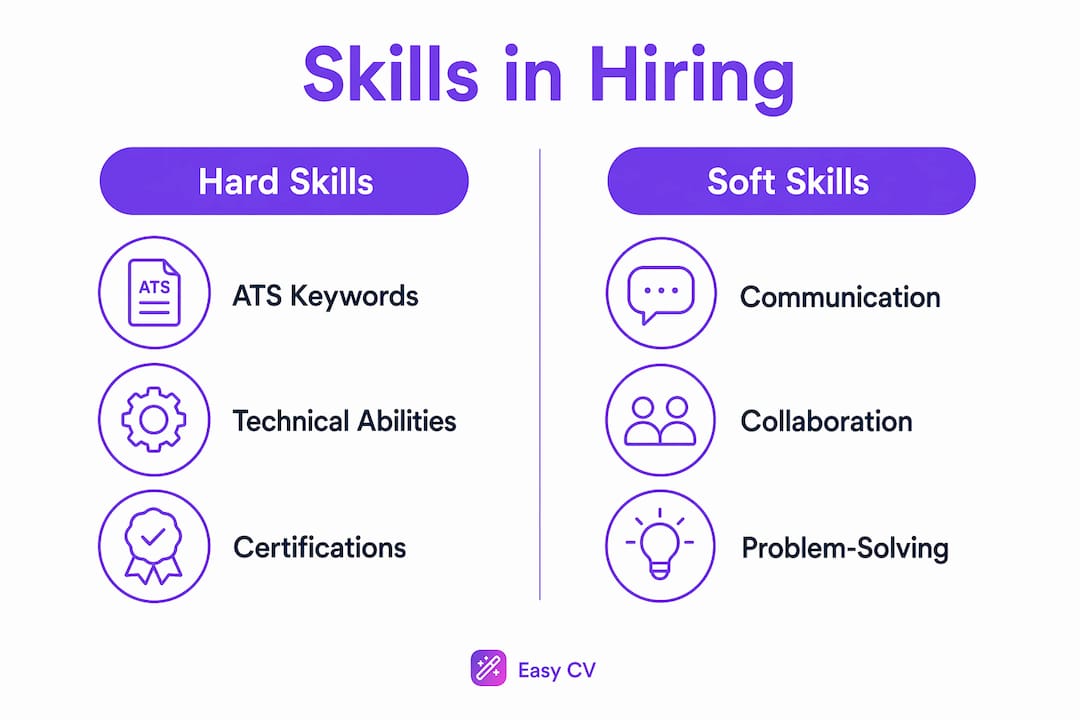
Pro Tip: Tailor your hard skills section to match exact ATS keywords from the job description, then use your work experience bullets to demonstrate soft skills through specific outcomes.
Which soft skills do employers value most?
The most transferable soft skills across industries include communication, teamwork, problem-solving, adaptability, and leadership. These appear consistently in job postings across sectors. However, generic soft skills like “excellent communicator” or “team player” carry the least signal value on resumes. Recruiters see these phrases hundreds of times per week and discount them automatically.
The soft skills that actually move the needle are specific, contextual, and verifiable. Here is how they break down by role type:
- Communication: High value in sales, marketing, PR, and client-facing roles. Show it through presentations delivered, reports written, or stakeholder updates managed.
- Teamwork and collaboration: Critical in hospitality, healthcare, and project-based environments. Quantify team size and outcomes.
- Problem-solving: Valued across all industries, but especially in engineering, consulting, and operations. Tie it to a specific challenge you resolved.
- Adaptability: Increasingly sought after in tech and fast-growth companies. Demonstrate it by referencing a major change you navigated successfully.
- Leadership and stakeholder management: The dominant soft skills at senior levels. At senior roles, decision-making and team development become the primary differentiators over technical ability.
The role of soft skills in resumes is not to fill space. Each skill you list should connect directly to the job you are applying for. A customer service role rewards empathy and patience. A data analyst role rewards attention to detail and clear communication of complex findings. Matching your soft skills to the employer’s actual needs is what separates a targeted CV from a generic one.
Understanding how psychometrics factor into hiring also helps here. Many employers use behavioral assessments to measure the same soft skills they expect to see on your CV. Consistency between your resume and your assessed behavior builds credibility.
How should you present soft skills on your CV to stand out?
The most common mistake job seekers make is listing soft skills as adjectives in a dedicated skills section. Phrases like “strong communicator,” “detail-oriented,” or “proactive self-starter” add no real information. Every candidate claims them. None of them prove them.
Employers expect “before-and-after” accomplishment stories that show soft skills in action. The fix is to move soft skills out of the skills list and into your work experience bullets, expressed through quantified outcomes.
Here are three examples of the transformation:
-
Weak: “Excellent communication skills.” Strong: “Presented quarterly performance reports to a board of 12 executives, reducing decision turnaround time by three weeks.”
-
Weak: “Strong leadership abilities.” Strong: “Led a cross-functional team of eight through a product relaunch, delivering on schedule after a six-week scope change.”
-
Weak: “Adaptable and flexible.” Strong: “Transitioned the customer support workflow to a fully remote model within two weeks during a company restructure, maintaining a 95% satisfaction score.”
Each strong version names the skill implicitly, provides context, and attaches a measurable result. That is the formula. The role of achievements in resumes is precisely this: they convert vague claims into credible evidence.
If you are building a skill-based CV, you can organize sections around your core competencies. In that format, each competency heading becomes the soft skill, and the bullet points beneath it supply the proof.
Pro Tip: Before writing each bullet point, ask yourself: “What changed because of what I did?” The answer to that question is your soft skill in action.
Common pitfalls when integrating soft skills in your CV
Even job seekers who understand the importance of soft skills make avoidable errors. These mistakes reduce the impact of an otherwise strong resume.
-
Overloading with generic terms. Listing eight soft skills in a row, all of them common adjectives, signals that you ran out of real content. Cut any soft skill you cannot back up with a specific example.
-
Ignoring the job description. Every job posting signals which soft skills the employer values most. Words like “collaborative,” “self-directed,” or “client-focused” in the posting are direct cues. Mirror that language in your experience bullets.
-
Treating soft skills as static. Soft skills develop over time. If you led a team two years ago, that experience is still relevant. If you completed a leadership development program, mention it. Showing growth signals self-awareness.
-
Mismatching CV and interview behavior. Employers focus on behavioral attributes like adaptability and problem-solving during interviews after screening hard skills. If your CV claims strong conflict resolution but you struggle to give a concrete example in the interview, the disconnect costs you the offer.
-
Skipping the cover letter. The cover letter is where soft skills breathe. A brief story about how you handled a difficult client or turned around a failing project does more work than any bullet point. Use it.
For C-suite and executive candidates, the stakes are even higher. At that level, soft skills like vision-setting, organizational influence, and board communication are not supporting details. They are the headline.
Key Takeaways
Soft skills are not decorative additions to your CV. They are evidence of how you perform, collaborate, and grow, and employers use them to predict long-term success.
| Point | Details |
|---|---|
| Soft skills drive hiring decisions | 69% of U.S. executives prioritize candidates who demonstrate strong soft skills. |
| Balance hard and soft skills | Aim for roughly 70% hard skills and 30% soft skills to pass ATS and impress recruiters. |
| Show skills through outcomes | Replace adjective lists with quantified achievement bullets that prove soft skills in context. |
| Match skills to the job posting | Mirror the soft skill language in the job description to signal direct relevance. |
| Senior roles demand more | At management level, soft skills like stakeholder management and decision-making become primary differentiators. |
What I have learned from watching candidates win and lose on soft skills
The hiring market has shifted in a way that most job seekers have not fully absorbed. Technical qualifications used to be the primary filter. Now they are the floor. Every shortlisted candidate for a mid-level role has the required technical background. What separates the hire from the runner-up is almost always behavioral.
I have seen candidates with impressive credentials lose offers because their CV read like a list of job duties. No evidence of how they worked with others. No sign of how they handled pressure. Just titles and tasks. And I have seen candidates with less prestigious backgrounds land competitive roles because their CV told a clear story: here is a problem I faced, here is how I approached it, and here is what changed.
The candidates who get hired are not the ones who claim the most soft skills. They are the ones who make those skills visible through specific, credible examples. That takes more effort than filling in a skills box, but the return on that effort is measurable.
My honest recommendation: treat every bullet point on your CV as a mini case study. What was the situation? What did you do? What was the result? That structure forces you to think in terms of evidence, not adjectives. It also prepares you for behavioral interview questions, which follow the same logic.
Soft skill development is also ongoing. If communication or leadership is a gap, address it. Take on a project that stretches you. Volunteer to present. Mentor a junior colleague. Then put it on your CV with a result attached. The CV optimization habits that get people hired in a competitive market are built on exactly this kind of intentional, evidence-first thinking.
— Andras
How Easy-cv helps you showcase soft skills that get noticed
Knowing what to include is only half the challenge. Translating that knowledge into a polished, well-structured CV is where most job seekers lose time and confidence.
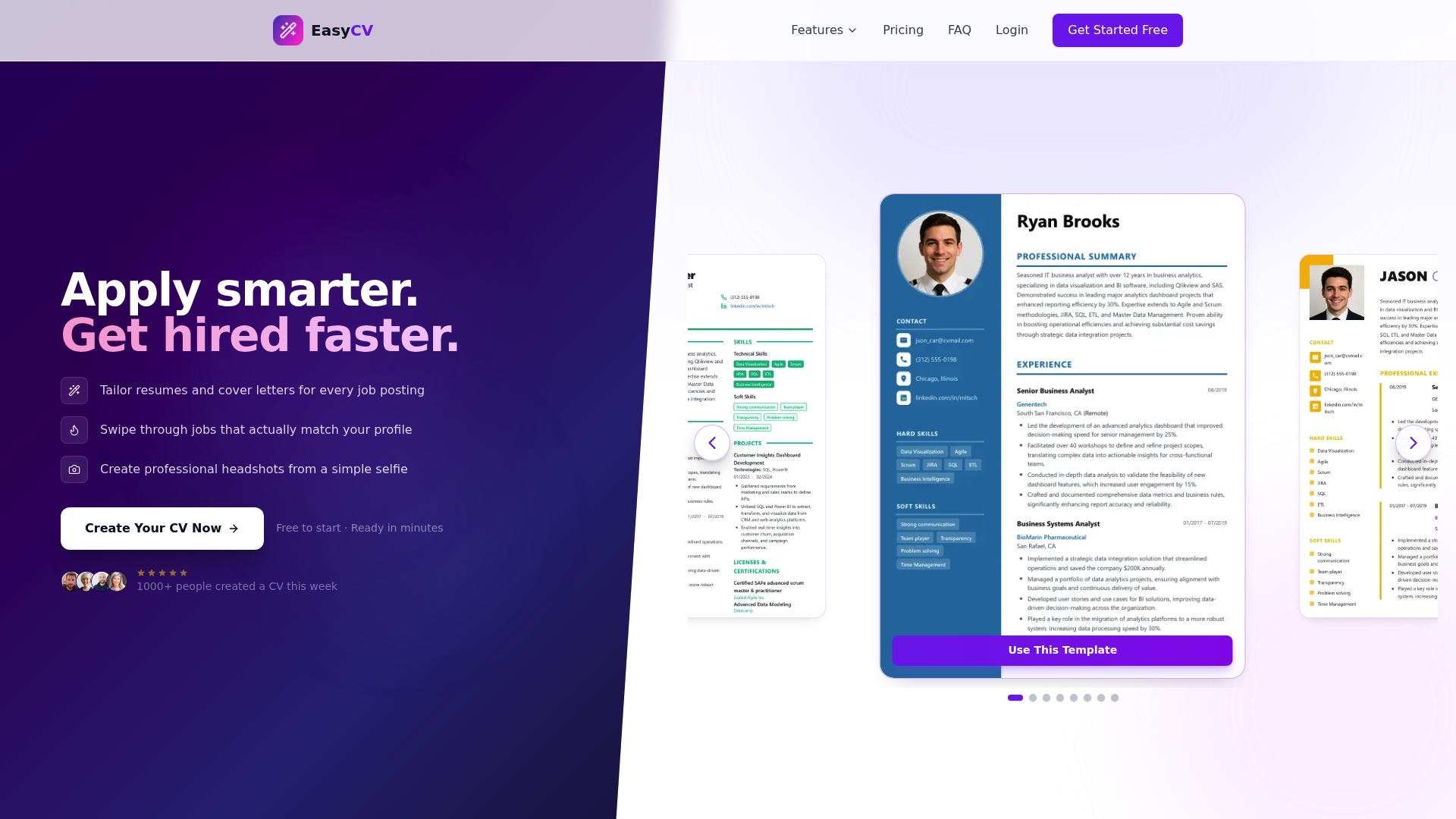
Easy-cv’s AI writing assistant generates achievement-based bullet points that embed your soft skills naturally into your work experience. Instead of staring at a blank page, you get strong draft content you can refine and personalize. The ATS-friendly templates keep your formatting clean so recruiters focus on your content, not your layout. With the Easy-cv AI CV builder, you can tailor every application to the specific job description, matching the soft skill language employers actually use. For job seekers who want a full feature overview before committing, the Easy-cv features page breaks down every tool available.
FAQ
Why should I include soft skills on my CV?
Soft skills show employers how you work, not just what you know. 69% of U.S. executives actively prioritize candidates who demonstrate them, making soft skills a direct factor in hiring decisions.
Where should soft skills appear on a CV?
Soft skills belong in your work experience bullets as demonstrated outcomes, not in a standalone skills list. Showing a result tied to a soft skill is far more credible than listing the skill as an adjective.
How many soft skills should I include?
Include three to five soft skills that are directly relevant to the role. Each one needs a concrete example or quantified result to back it up. More than five without evidence weakens your CV.
Do soft skills matter more at senior levels?
Yes. At management and executive levels, soft skills become the primary differentiator because hard skills are assumed. Stakeholder management, decision-making, and team development carry the most weight.
Can soft skills help me pass ATS screening?
ATS systems primarily scan for hard skill keywords. Soft skills support your application after the ATS filter, when a human reviewer evaluates cultural fit and long-term potential.