Why Resume Gaps Matter More Than You Think
Why do resume gaps matter to employers?
Resume gaps matter because they trigger immediate questions in a hiring manager’s mind about reliability, motivation, and whether your skills are still current. That reaction is not always fair, but it is consistent. Survey data from Harvard Business Review shows that 61% of managers still view resume gaps negatively, with their top concerns being reliability (29%), motivation (27%), retention risk (25%), and skill atrophy (19%).
Employers use your work history as a proxy for risk. A continuous record signals loyalty and predictability. A gap, especially a long one, introduces uncertainty. Without additional context, hiring managers often fill that uncertainty with the worst-case interpretation.
Here is what that means practically for you:
- Reliability concerns: Gaps lead some managers to assume you struggle to hold a position or commit long term.
- Motivation questions: A break from work can read as disengagement, even when the reality is the opposite.
- Skill currency doubts: In fast-moving fields, even a year away from the work can raise questions about whether your knowledge is still relevant.
- Retention risk: Managers worry that someone who left once will leave again, especially if the gap reason is unclear.
- Interview access: Gaps reduce your chances of even reaching the conversation where you can address these concerns.
Understanding these employer concerns is the first step. Once you know what they are reacting to, you can address it directly rather than hoping they will overlook the gap.
What actually causes most resume gaps?

Most gaps have perfectly ordinary explanations, and nearly half of workers have taken some kind of career break at some point. Employers who work with enough candidates know this. The stigma tends to come from hiring systems that default to caution, not from managers who genuinely believe every gap signals a problem.
Common and widely accepted reasons include:
- Caregiving responsibilities: Caring for a child, an aging parent, or a sick family member is one of the most common and sympathetic explanations. Employers generally respond well to it.
- Health issues: A serious illness or recovery period is a legitimate reason that most reasonable hiring managers respect.
- Layoffs and restructuring: Company closures, mass layoffs, and industry downturns are external events beyond any employee’s control. The Bureau of Labor Statistics tracks layoff events regularly, and most hiring managers understand that.
- Education and retraining: Returning to school, completing a certification, or pursuing a degree signals investment in your own growth.
- Career transitions: Moving from one industry to another often involves a deliberate pause to retrain or reassess.
- Travel or personal development: Less universally accepted, but increasingly normalized, especially when framed around skills gained.
Demystifying the gap starts with naming it clearly. Vague explanations invite speculation. Specific ones close the loop.
How resume gaps affect your hiring chances and pay
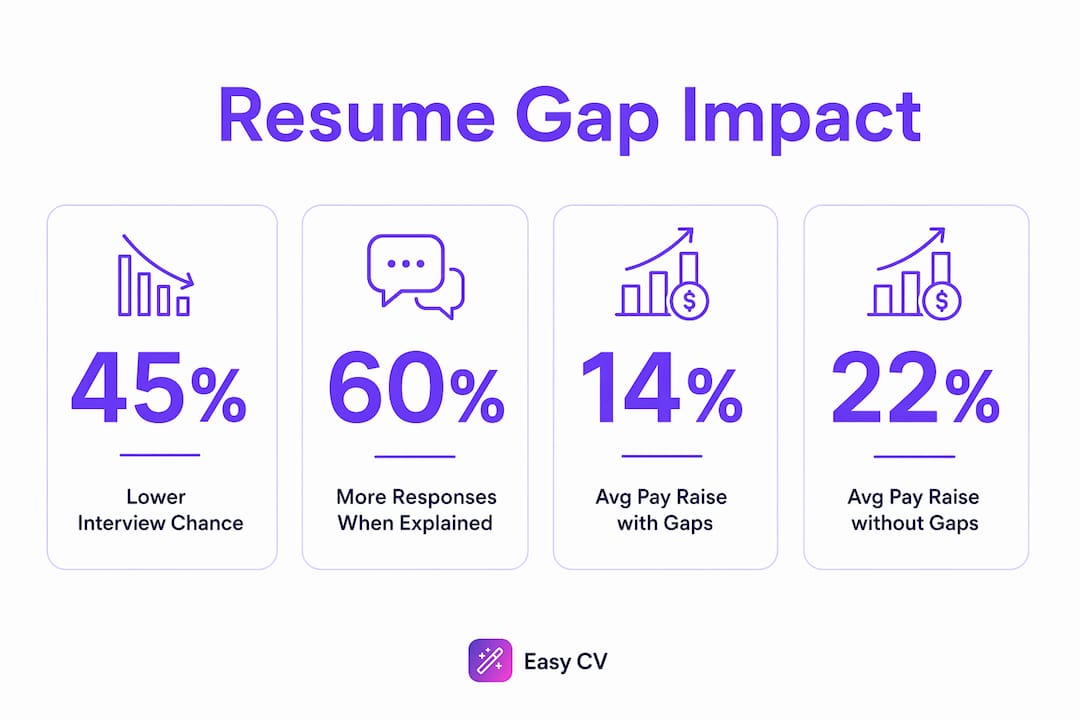
The impact of employment gaps on hiring outcomes is measurable, and the numbers are worth knowing before you send your next application.

Research applying to more than 36,500 job openings found that applicants with gaps had a 45% lower chance of receiving an interview than those without. The drop is sharpest for gaps of two to three years, where interview rates fell from 9.8% to 4.6%. Gaps of three or more years show the steepest decline.
The compensation picture is equally stark. Executives with resume gaps received 14% pay raises, compared to 22% for those without gaps. Women face a 9% penalty for career breaks regardless of employer size, while men tend to experience pay penalties mainly at career transitions.
Larger firms show stronger negative effects than smaller ones. A startup with a lean hiring team may spend more time on a phone screen; a large corporation with hundreds of applicants for a single role is more likely to filter on resume signals before ever speaking to a candidate.
The one number that should give you real hope: applicants who provided a reason for their gap received close to 60% more interviews than those who said nothing. Among those who explained, candidates who cited additional training or education had the highest callback rates of all.
Which industries and roles scrutinize gaps most closely?
Not every sector treats a gap the same way. The weight placed on continuous employment depends heavily on how fast skills expire and how much regulatory oversight the role carries.
- Technology and software development: Skills in this field can become outdated within 18 months. A two-year gap in a developer role raises real questions about whether your stack knowledge is still current.
- Finance and accounting: Regulatory changes, compliance requirements, and software updates mean that time away from active practice can create genuine knowledge gaps, not just perceived ones.
- Healthcare and clinical roles: Safety-critical and regulated industries place the highest value on continuous experience. Licensing boards often require proof of recent practice hours.
- Law: Bar requirements and continuing legal education mandates make extended gaps more consequential here than in most other fields.
- Academia: Tenure-track hiring committees look closely at publication records and research continuity. A gap without clear scholarly output raises questions.
On the other end of the spectrum, creative fields, freelance work, and the gig economy tend to be more forgiving. A graphic designer or writer who spent a year on independent projects often has a portfolio to show for it. The work speaks for itself regardless of whether it was done under an employer’s banner.
Pro Tip: If you work in a technical or regulated field, use your gap explanation to address skill currency directly. Name the specific tools, certifications, or courses you engaged with during the break. That one detail can shift the conversation from “why were you out?” to “what did you learn?”
How to explain resume gaps in a way that actually works
The instinct to hide or minimize a gap usually backfires. Recruiters notice the missing dates. Applicant tracking systems flag inconsistencies. And when a gap surfaces in an interview after you have tried to obscure it, the conversation becomes about the concealment, not the break itself.
Owning your career break and framing it as purposeful shifts the dynamic. Candidates who present their gaps as intentional periods of growth or transition come across as self-aware and forward-looking. Those who apologize for gaps or stumble through explanations confirm the hiring manager’s worst assumptions.
Practical ways to frame your gap:
- Lead with what you gained, not what you missed. “I spent 14 months caring for my father while completing an online project management certification” tells a fuller story than “I was between jobs.”
- Connect the break to your current goals. Show that the gap was a chapter, not a detour. Tie what you did during that time to why you are applying for this specific role.
- Use tailored language for each application. A gap explanation that works for a nonprofit role may need reframing for a corporate finance position. Match the tone and emphasis to the employer’s priorities.
- Be specific about the timeline. Vague references to “some time off” invite more questions. Stating “from March 2023 to September 2024” closes the loop and signals that you are comfortable discussing it.
You can also explore how to approach cv gap explanation from the recruiter’s perspective, which gives you a clearer picture of what hiring managers are actually looking for when they ask about breaks.
Pro Tip: Lead with the value you added during the gap, not with an apology. “I used that time to complete a Google Data Analytics certificate and consult for two small businesses” is a stronger opener than “I know it looks like a long gap, but…”
Practical tips for handling employment gaps in your job search
Knowing why gaps matter is one thing. Knowing what to do about them in your actual application materials and interviews is another.
On your resume:
- Use a functional or hybrid resume format if a chronological layout makes the gap the first thing a reader sees. Functional formats lead with skills and accomplishments, pushing dates into a secondary position.
- Add a brief parenthetical note next to the gap period: “(Career break: family caregiving)” or “(Professional development: AWS certification).” This preempts the question before the interview.
- Highlight freelance projects, volunteer work, or consulting engagements during the gap as separate entries. These show continued activity and transferable skills even without a formal employer.
On your cover letter:
- Address the gap in one or two sentences, early in the letter. Waiting until the interview to explain it can feel evasive. A brief, confident mention in the cover letter signals that you have nothing to hide.
- Frame the explanation around your readiness now, not around the circumstances then. Employers care more about what you bring today than about the details of why you left.
In interviews:
- Prepare a 30-second answer to the gap question and practice it until it sounds natural, not rehearsed. The goal is confidence, not a script.
- Anticipate follow-up questions. If you say you spent time on personal development, be ready to name specific skills or projects.
- Redirect the conversation to your current qualifications after the explanation. “That period gave me X, and I am now ready to apply it in a role like this one” moves the interview forward.
Building a strong profile that stands out, including how you present your experience and skills, is something platforms like NOWJOBS address directly, particularly around gathering external references that reinforce your credibility.
Pro Tip: Practice your gap explanation out loud, not just in your head. The version that sounds polished in your mind often stumbles when spoken. Record yourself once and listen back. You will catch the hesitations and filler words that signal discomfort to a hiring manager.
What hiring experts and career researchers say about gaps
The research on resume gaps points to a consistent finding: the penalty for career breaks has more to do with how hiring systems are built than with actual candidate capability.
Laura Mazzullo, owner of East Side Staffing, a New York City recruitment firm, put it plainly in SHRM: “Historically, hiring managers have felt more comfortable if someone stayed in a job, because it showed loyalty and trust. We need to get managers to the point where they are at least curious about exploring the gaps and not shutting people with gaps down completely.”
That framing matters. The bias against gaps is not primarily about skills. It is about risk aversion baked into hiring committees that default to the candidate who looks safest on paper. Stu Coleman, a senior managing director at WinterWyman, a Boston-based talent acquisition firm, described the recruiter’s job as identifying the best possible candidates, not the ones with the cleanest resumes. “In any market, the practice of assuming there’s something wrong with candidates without really clean resumes is dubious,” he said.
A 2022 LinkedIn survey of 23,000 global workers found that nearly two-thirds had taken some form of career break. LinkedIn responded by introducing a “Career Breaks” feature, letting users highlight non-employment experiences directly on their profiles. That shift reflects a broader recognition that gaps are normal, even if hiring gatekeepers have not fully caught up.
Grant Clough, director of talent acquisition at AARP, offered a practical counterpoint to automatic disqualification: “An employment gap from five years ago is irrelevant. However, if someone is currently in a multiyear gap, I think it’s reasonable to ask about it.” The distinction between a past gap and a current one matters. A gap that ended two years ago and was followed by strong performance is a very different signal than one that is still ongoing.
Career researchers increasingly encourage hiring managers to approach gaps with curiosity rather than judgment. Asking what a candidate was doing, rather than assuming the worst, surfaces information that a resume alone cannot convey. For job seekers, understanding that this curiosity-driven approach is the goal helps you prepare explanations that invite conversation rather than close it down.
Put your best application forward with Easy-cv
A gap in your work history does not have to define your application. What defines it is how you present your full story, and that starts with a resume that puts your strongest material front and center.
Easy-cv gives you an AI-powered CV builder with ATS-friendly templates, an AI writing assistant that helps you frame your experience clearly, and a built-in job tracker so your search stays organized. If you have a gap to explain, the platform helps you build the rest of your application around your genuine strengths, not around the absence.
You can also use Easy-cv’s job matching tool to find roles where your background is a strong fit, scored against your actual CV before you apply. That means fewer long-shot applications and more conversations where your experience speaks for itself.
Key Takeaways
Resume gaps matter to employers primarily because of risk aversion in hiring systems, but candidates who explain their gaps clearly and lead with skills gained can recover most of the callback disadvantage.
| Point | Details |
|---|---|
| Gaps reduce interview odds | Applicants with gaps have a 45% lower chance of receiving an interview than those without. |
| Explanation closes the gap | Providing a reason for your career break increases interview callbacks by close to 60%. |
| Compensation takes a hit | Executives with resume gaps received 14% pay raises, compared to 22% for those without gaps. |
| Industry context shapes scrutiny | Technical, regulated, and safety-critical roles examine gaps more closely than creative or gig-economy positions. |
| Transparency beats concealment | Owning your career break and framing it as purposeful shifts hiring manager perception from concern to curiosity. |