Sales Associate Duties Resume: Bullets That Actually Land Interviews
List your customer-facing duties, but never as flat descriptions. Write each one as an achievement bullet: action verb, specific task, measurable result. That single format shift separates resumes that get skimmed from those that get calls, according to guidance from Coursera and government labor data from the BLS.
Your core duties to include: greeting and engaging shoppers, giving product recommendations, running POS transactions, handling returns, keeping merchandising standards, restocking, and hitting sales goals.
Two quick rewrites show the difference:
- Before: “Helped customers find products.” After: “Guided 40+ customers daily to product matches, lifting department conversion by 15%.”
- Before: “Worked the register.” After: “Processed 200+ transactions per shift with 99% accuracy, reducing drawer discrepancies.”
Pro Tip: If you don’t have exact numbers, use a believable range from your actual shift volume. A specific range beats a vague claim every time.
Key Takeaways
Sales associate resumes get read faster and land more interviews when duties are rewritten as quantified achievement bullets instead of task lists.
| Point | Details |
|---|---|
| Format wins over content alone | Action verb plus task plus metric outperforms a plain duty description every time. |
| Cover the standard duty set | Greeting, POS, returns, merchandising, and loyalty programs are expected across most postings. |
| No hard number is not a dealbreaker | Use shift averages or team outcomes when individual metrics weren’t tracked. |
| ATS formatting still matters | Standard headers, simple fonts, and the requested file type keep your bullets readable by software. |
Table of Contents
- Core Sales Associate Duties Your Resume Needs to Cover
- Turning Duties Into Achievement Bullets That Get Noticed
- Structuring Your Resume So the Duties Actually Get Read
- Sample Bullets and Two Resume Layouts You Can Copy
- Tailor Every Application in 15 Minutes
- How Easy-cv Speeds Up the Rewrite
- What Most Resume Advice Gets Wrong About Sales Duties
- Sources
Core Sales Associate Duties Your Resume Needs to Cover
Hiring managers scan for a familiar set of tasks before they read anything else. Miss the obvious ones and your resume reads thin, even if you were great at the job.
The duties that show up across nearly every sales associate posting include:
- Greeting customers and identifying their needs
- Recommending products based on customer preferences or budget
- Processing sales, returns, and exchanges through POS systems
- Maintaining merchandising and shelf presentation standards
- Restocking inventory and monitoring stock levels
- Promoting loyalty programs, credit cards, or email sign-ups
- Meeting individual and team sales targets
- Opening and closing store procedures, including cash handling
Role type changes the emphasis. A general retail associate leans heavier on stocking and merchandising, per Coursera’s breakdown of the role, while a commissioned sales associate in electronics, furniture, or luxury goods spends more time on product education and closing. Specialty sales, such as jewelry or high-end apparel, often expects deeper product knowledge and longer customer interactions rather than high transaction volume.
Not every duty carries equal weight with hiring managers. Sales performance and reliability rise to the top, followed closely by customer experience. The BLS occupational outlook notes that many roles hire on attitude and trainability rather than tenure, which means a strong bullet about a resolved complaint or a repeat customer can matter as much as a hard sales number.

Turning Duties Into Achievement Bullets That Get Noticed
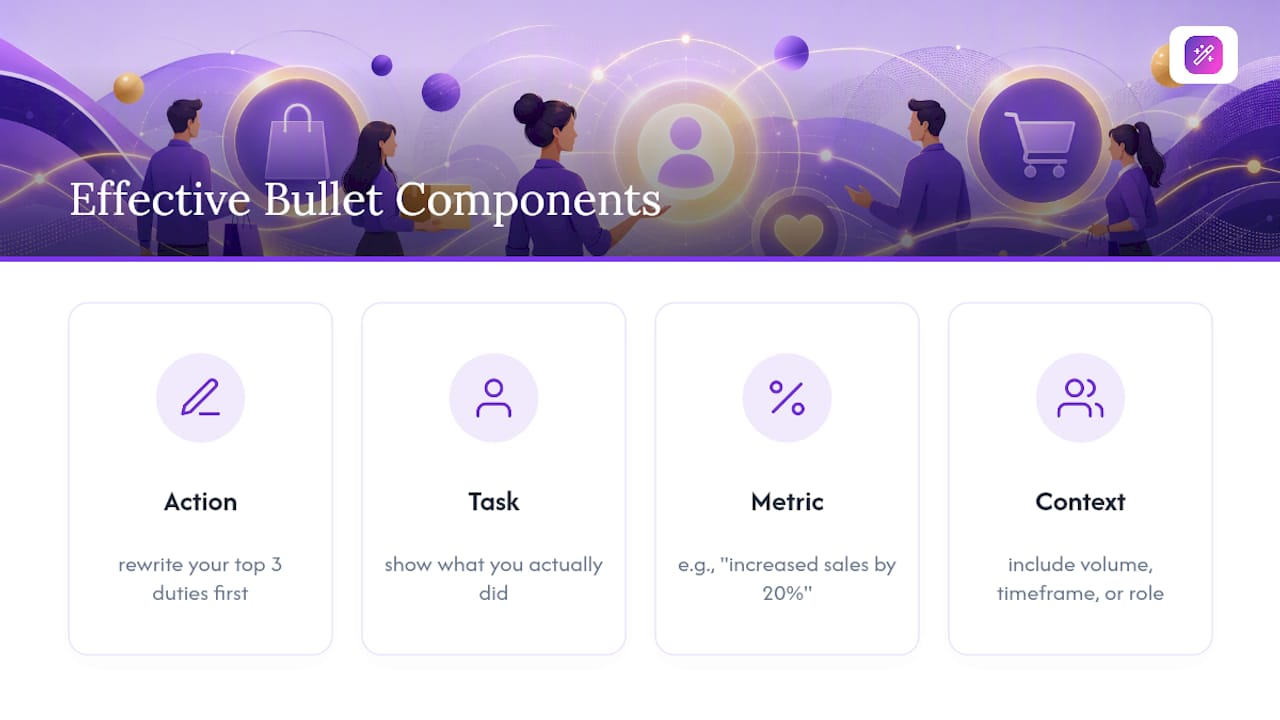
The formula is short: action verb + specific task + measurable result or context. That’s it. Every strong bullet on a sales resume follows this shape, whether the metric is a percentage, a dollar figure, or a customer count.
Start with verbs that carry weight. Skip “helped,” “worked on,” and “responsible for.” Use verbs like:
- Achieved
- Generated
- Exceeded
- Streamlined
- Resolved
- Trained
- Upsold
- Maintained
Washington University’s Career Center recommends this exact substitution pattern, replacing “Helped customers” with “Assisted 50+ customers daily, increasing sales by 20%.”
Here’s the formula applied across common duties:
- Greeting → engaged a typical number of shoppers per shift, converting a portion into same-day purchases.
- Merchandising → “Rebuilt front-of-store displays weekly, raising average order value by 8%.”
- POS accuracy → handled daily transactions with high accuracy over extended periods.
- Returns → resolved return requests regularly, retaining a strong majority of customers with store credit offers.
- Loyalty programs → enrolled multiple customers weekly in rewards programs, exceeding store participation goals.
- Product knowledge → trained new hires on inventory systems, reducing onboarding time significantly.
When you lack a hard number, use a shift average or a team result. “Part of a team that grew monthly sales by 15%” still shows measurable outcome, and it’s honest.
Not every candidate walks away with a personal sales figure. If your store didn’t track individual performance, lean on ranges: “served 30 to 50 customers per shift” or “restocked 200+ units weekly.” A range grounded in reality outperforms a bullet with no number at all.
Structuring Your Resume So the Duties Actually Get Read
Order matters as much as content. Applicant tracking systems and human reviewers both expect a predictable flow: contact information, an optional two-line summary, a skills section, then work experience with your rewritten bullets, followed by education and certifications.
Keep bullets tight:
- Use 3 to 6 bullets per job, prioritizing your strongest achievements first
- Write in past tense for former roles, present tense only for your current job
- Keep each bullet to one line where possible, two at most
ATS software still struggles with fancy formatting, so Indeed’s resume formatting guidance recommends standard section headers like “Experience” and “Skills,” no tables or text boxes, and a common font like Calibri or Arial. Save as a .docx unless the job posting specifically requests PDF.
Pro Tip: If a job posting says “no PDFs,” believe it. Some older ATS platforms mangle PDF formatting and drop your bullets entirely.
Sample Bullets and Two Resume Layouts You Can Copy
Entry-level candidates with limited work history can still write strong bullets:
- “Greeted 40+ customers daily during peak retail season, maintaining positive reviews on customer surveys.”
- “Processed transactions accurately during high-volume holiday shifts, handling up to 100 sales per day.”
- “Restocked and organized merchandise across three departments, improving shelf availability.”
Experienced associates can push further:
- “Exceeded quarterly sales quota by 22% for four consecutive quarters.”
- “Trained and mentored 5 new associates, reducing ramp-up time to two weeks.”
- “Managed opening and closing procedures, including cash reconciliation with zero discrepancies.”
Industry changes the language slightly. Apparel resumes emphasize styling and trend awareness. Electronics resumes highlight technical product knowledge. Cosmetics roles reward bullets about personalized consultations. Luxury and high-ticket sales should foreground relationship building and repeat clientele over transaction volume.
A one-page template runs: header, three-line summary, skills grid (six to eight items), then two jobs with four bullets each, then education. A second layout skips the summary entirely and opens straight into skills and experience, which works well when your job history speaks for itself.
Tailor Every Application in 15 Minutes
Pull three to five keywords directly from the job posting, things like “visual merchandising,” “upselling,” or “POS systems,” and mirror that exact phrasing in your skills section and bullets. ATS software matches text strings, not synonyms, so if the posting says “point-of-sale,” don’t write “register.”
A fast tailoring pass looks like this:
- Swap 2 to 3 bullets to match the posting’s top duties
- Update your summary line with one keyword from the listing
- Add 1 to 2 missing keywords into your skills section
- Reread for accuracy. Never claim a duty or metric you didn’t actually perform
Pro Tip: Keyword stuffing backfires. If a resume repeats “customer service” five times in one page, it reads as padding, not proof.
How Easy-cv Speeds Up the Rewrite
Easy-cv’s AI writing assistant drafts tailored bullets from your duties, then you adjust the numbers to match reality. The platform pairs that with ATS-friendly templates, a job matcher that scores openings against your CV, and a built-in tracker so you’re not juggling spreadsheets.
A practical workflow: draft bullets with the AI assistant, insert your actual metrics, export through one of the ATS-friendly templates, then track the application. The free plan is enough to generate a first draft you can edit against your real numbers.
- AI-generated bullet drafts based on your listed duties
- ATS-friendly template exports in standard formats
- Job matcher scoring for sales associate openings
- Built-in tracker so follow-ups don’t slip
| Point | Details |
|---|---|
| Use the achievement formula | Pair every duty with an action verb and a measurable result, not a task description. |
| Cover the core duty list | Include POS, merchandising, returns, and loyalty programs to match what hiring managers expect. |
| Keep bullets to 3-6 per role | Prioritize your strongest, most specific achievements first. |
| Tailor per posting | Mirror exact keywords from the job listing in your skills section and bullets. |
What Most Resume Advice Gets Wrong About Sales Duties
Most resume guides tell candidates to “quantify everything,” then stop there, as if a number alone fixes a weak bullet. It doesn’t. A bullet that says “increased sales by 20%” with no context about volume, timeframe, or role is barely more useful than no number at all. The real skill is pairing a metric with enough context that a hiring manager believes it and understands what you actually did.
The bigger gap in conventional advice is the assumption that every candidate has clean sales data sitting in a report somewhere. Most don’t. Shift workers, seasonal hires, and associates at smaller stores rarely get individual performance breakdowns. That’s exactly why ranges and team framing deserve more attention than they get. A believable range beats an invented precise figure, and it beats a duty list with zero numbers by a wide margin.
Prioritize this first: rewrite your three most repeated duties into achievement bullets before touching anything else on the page. That’s where most of the improvement lives.
Sources
- Retail Associate: Responsibilities, Skills, and How to Get Started | Coursera
- Top 205 action verbs for your resume | Washington University Careers
- Cashiers and Sales Workers — Occupational Outlook | BLS