Pharmaceutical Rep Career Guide: How to Get Hired
A pharmaceutical sales representative is a trained sales professional who calls on physicians, nurse practitioners, and other healthcare providers to educate them about prescription drugs and medical therapies. The role is commercially demanding and scientifically grounded — and in the U.S., it pays well. Industry reporting cited by Coursera places median total annual pay around $141,000, combining base salary with variable commission. Demand for skilled reps remains steady across primary care, oncology, and specialty therapeutic areas.
If you are researching how to become a pharmaceutical rep, here is where to start:
- Get the right degree (or equivalent sales experience): a bachelor’s in life sciences, business, or a related field is the standard entry point.
- Build measurable sales proof points: hiring managers want numbers, not just job titles.
- Network inside the industry: informational interviews with working reps and recruiters open more doors than cold applications.
Key takeaways
A pharmaceutical sales career in the U.S. is financially strong, intellectually demanding, and genuinely accessible to candidates from science and non-science backgrounds alike — provided you can prove you can sell.
| Point | Details |
|---|---|
| Median total pay | Industry reporting places median annual compensation around $141,000, combining base and variable pay. |
| Degree flexibility | A bachelor’s in any field works; science backgrounds help, but documented sales results matter more to most hiring managers. |
| Certifications that count | CNPR is the standard entry-level credential; CPPR suits experienced reps targeting specialty roles. |
| Resume priority | Lead every bullet with a metric — territory growth, quota attainment, or new accounts won. |
| Easy-cv advantage | Easy-cv’s AI resume builder and job matcher help pharma applicants tailor every application and find role fits faster. |
Table of Contents
- What does a pharmaceutical sales representative actually do?
- What does a typical day look like for a pharma rep?
- Where do pharmaceutical reps work and who hires them?
- What education and qualifications do employers expect?
- What skills and traits do hiring managers actually prioritize?
- What does a pharmaceutical rep earn, and what is the job outlook?
- How do you become a pharmaceutical rep, step by step?
- Which certifications actually help you get hired?
- How to write your resume and find pharma sales jobs
- Where can a pharma sales career take you?
- What hiring managers actually look for in pharma sales candidates
- Easy-cv gives pharma applicants a real edge in a competitive field
- Sources
What does a pharmaceutical sales representative actually do?
The job description is broader than most people expect. According to a Syneos Health posting, core responsibilities include educating healthcare professionals on drug therapies, building professional relationships to drive product adoption, and managing an assigned geographic territory to meet or exceed sales quotas. Day to day, that translates into:
- Scheduling and conducting office visits with physicians, pharmacists, and clinical staff
- Presenting clinical data, study results, and product comparisons in a clear, compliant way
- Managing a CRM system (Veeva is the industry standard) to log calls, track accounts, and plan territory coverage
- Distributing product samples within FDA and company guidelines
- Attending medical conferences, speaker programs, and continuing education events
- Submitting weekly call reports and territory performance updates to district managers
The consultative shift in pharma sales is real. Wikipedia’s overview of the role notes that effective reps now function as evidence synthesizers who must explain clinical trial data to providers while staying within strict promotional compliance frameworks. That means the job is less about persuasion and more about being the most informed, most trusted resource in the room.
Pro Tip: Know the PhRMA Code and the Physician Payment Sunshine Act before your first interview. Hiring managers screen for regulatory awareness because a compliance-naive rep is a liability. Mentioning these frameworks unprompted signals professional maturity.
What does a typical day look like for a pharma rep?
Territory-based selling runs on a rhythm that mixes early preparation, back-to-back provider visits, and administrative follow-up. Here is a realistic daily structure:
- 6:30–7:30 AM: Review the day’s call plan, check CRM notes on target accounts, confirm lunch or speaker event logistics
- 8:00–11:30 AM: Morning call block — office visits to primary-care or specialist practices, often 4–6 calls
- 12:00–1:00 PM: Lunch-and-learn with a physician group or solo lunch while updating call notes
- 1:30–4:30 PM: Afternoon call block — follow-up visits, new account prospecting, pharmacy stops
- 4:30–6:00 PM: CRM data entry, email follow-ups, territory planning for the next day
Weekly and monthly activities add another layer:
- Attending district team calls and reviewing territory KPIs against quota
- Planning multi-visit sequences for high-priority accounts
- Participating in product training updates and compliance refreshers
- Running or supporting speaker programs and patient education events
Travel is a constant. Most territory roles cover a defined geographic area, but that can mean 30,000–50,000 miles of driving per year. Evening events, early-morning hospital rounds, and occasional weekend conferences are part of the job. The Princeton Review’s career profile notes that newcomers frequently underestimate the social selling component and the nontraditional hours. If you need a strict 9-to-5, this role will challenge that expectation quickly.
Where do pharmaceutical reps work and who hires them?
The employer landscape is wider than just the big-name drug companies. Common hiring organizations include:
- Pharmaceutical manufacturers (large integrated companies and mid-size specialty firms)
- Contract commercialization organizations (CCOs) that deploy reps on behalf of smaller biotech companies without their own sales force
- Hospital systems and integrated delivery networks that employ clinical sales specialists
- Specialty distributors and pharmacy benefit managers in adjacent commercial roles
- Medical device and diagnostics companies that hire reps with pharma backgrounds
The distinction between primary-care and specialty roles changes the job significantly:
| Dimension | Primary-care rep | Specialty rep |
|---|---|---|
| Call frequency | High (8–12 calls/day) | Lower (4–6 calls/day) |
| Scientific depth required | Moderate | High (oncology, immunology, rare disease) |
| Base salary range | Generally lower | Generally higher |
| Commission variability | Moderate | Often higher upside |
| Relationship complexity | Broad prescriber base | Narrow, deeply cultivated accounts |
Territory assignment is typically geographic, with boundaries set by zip code clusters or hospital catchment areas. Remote and hybrid patterns exist mostly for medical science liaisons and inside sales roles; field-based pharma reps spend the majority of their time in person.

What education and qualifications do employers expect?
A bachelor’s degree is the baseline for nearly every U.S. pharmaceutical sales role. WGU’s career guide confirms that while science degrees are commonly preferred, many employers accept business or communications degrees and prioritize demonstrated sales aptitude and relevant coursework. Useful majors include:
- Biology, biochemistry, or pharmacology — gives you the clinical vocabulary to discuss drug mechanisms credibly
- Nursing or allied health — clinical experience translates directly into provider credibility
- Business or marketing — strong fit when paired with documented sales results
- Communications or psychology — works when combined with certifications or sales track record
Non-science majors can absolutely break in. The alternate routes that work:
- Two or more years of documented B2B or B2C sales success with measurable outcomes
- A pharmaceutical sales certification (CNPR or CPPR — covered in detail below)
- Experience in clinical liaison, medical device, or laboratory sales roles
- Shadowing or informational interviews that demonstrate genuine therapeutic-area knowledge
Timeline reality: most candidates spend 3–6 months from first targeted applications to a first offer, assuming a relevant degree and some sales experience. An advanced degree (MBA, PharmD) helps most in specialty or managed-care roles, not entry-level territory positions.
What skills and traits do hiring managers actually prioritize?
Syneos Health’s career resources are direct about this: hiring managers prefer candidates who demonstrate measured sales outcomes over those who only list scientific credentials. The skill set splits cleanly into two categories.
Hard skills:
- Clinical knowledge sufficient to discuss mechanism of action, dosing, and side-effect profiles
- CRM proficiency (Veeva CRM is the pharma standard; Salesforce experience transfers)
- Territory analytics: reading call-plan data, identifying white space, prioritizing accounts by prescribing volume
- Regulatory literacy: understanding what promotional claims are permissible under FDA guidelines
Soft skills:
- Relationship building across diverse provider types (MDs, NPs, PAs, pharmacists)
- Consultative selling: listening for clinical needs and matching product evidence to them
- Time management across a self-directed, geographically spread territory
- Resilience: access restrictions, gatekeeper management, and quota pressure are daily realities
Sample resume proof points that actually get attention:
- “Grew territory revenue 22% year-over-year by converting 14 new high-volume prescribers”
- “Ranked #3 of 47 reps nationally in new account acquisition during Q2”
- “Achieved 108% of quota for three consecutive quarters in a competitive primary-care market”
- “Secured formulary addition at two regional health systems, adding $400K in annualized revenue”
To build these skills before your first pharma role, consider shadowing a working rep, completing a clinical terminology short course (Coursera and edX both offer relevant options), or volunteering in a clinical setting to build provider communication fluency.
What does a pharmaceutical rep earn, and what is the job outlook?
Pay in pharma sales is structured around a base-plus-variable model, and the variable component can be substantial. Coursera’s reporting, citing Glassdoor data, indicates that pharmaceutical sales representatives earn a substantial median total annual compensation combining base salary and commissions. That figure covers base salary plus commission; actual totals vary by therapeutic area, geography, and employer size.
Geographic variance is real. A rep covering Manhattan or San Francisco typically earns more in base than one covering rural markets, though territory potential (prescribing volume) also differs. AstraZeneca’s posted roles illustrate how specialty positions in major metro markets carry higher base bands.
For job outlook, BLS occupational projections for wholesale and manufacturing sales representatives are the standard federal reference. Demand in pharma sales specifically tracks with drug pipeline activity, patent expirations, and the ongoing expansion of specialty therapeutics — all of which point to continued hiring in the near term.
How do you become a pharmaceutical rep, step by step?
The path is more structured than most people realize. Here is a realistic sequence:
-
Complete a bachelor’s degree in a relevant field (life sciences, business, or health-related discipline). If you already have a degree, assess whether a certification can substitute for a science background.
-
Build 1–3 years of sales experience in any competitive B2B or B2C environment. Medical device, laboratory, or healthcare IT sales are the most transferable; retail or insurance sales can work if you have strong metrics.
-
Earn a recognized certification (CNPR or CPPR — see the next section) if you lack a science degree or are switching from an unrelated field. This signals commitment and fills knowledge gaps.
-
Target applications strategically. Apply to contract commercialization organizations first if you have no pharma experience — CCOs hire more entry-level reps than large manufacturers and provide structured training.
-
Prepare for the interview process. Expect a multi-round process: phone screen, behavioral interview, ride-along or field ride, and a final panel. Prepare for these questions:
- “Walk me through how you managed a difficult territory or account.”
- “How do you stay organized across 100+ accounts?”
- “Tell me about a time you used data to change your selling approach.”
- “What do you know about [product’s therapeutic area]?”
-
Demonstrate clinical literacy. You do not need to be a clinician, but you need to speak the language. Study the mechanism of action for drugs in your target therapeutic area and be ready to explain them simply.
-
Negotiate and onboard well. First-year reps typically spend 4–8 weeks in product training before going into the field. Use that time to study clinical data aggressively — reps who enter the field with deep product knowledge reach quota faster.
Pro Tip: Before any interview, research the company’s pipeline and recent FDA approvals. Mentioning a newly approved indication or a Phase III trial result shows you are already thinking like a rep, not just a job seeker.
Which certifications actually help you get hired?
Two certifications dominate the entry-level pharma sales market:
-
CNPR (Certified National Pharmaceutical Representative): Offered by the National Association of Pharmaceutical Sales Representatives (NAPSRx), this is the most widely recognized entry-level credential. It covers pharmacology basics, drug classifications, FDA regulations, and selling skills. Useful primarily for career changers and new grads without a science background.
-
CPPR (Certified Professional Pharmaceutical Representative): A more advanced credential that signals deeper clinical and regulatory knowledge. Better suited for candidates targeting specialty roles or seeking to differentiate after a few years in the field.
Beyond these, employer onboarding programs are substantial. Most large manufacturers run 4–8 weeks of classroom and field training, followed by product certification exams. Reps who fail product exams typically cannot call on providers until they pass. AstraZeneca’s career resources reflect this pattern: ongoing CME-style education is built into the role, not optional.
Pro Tip: If you already have 3+ years of pharma sales experience, a CNPR adds little signal. Spend that time instead on a therapeutic-area deep dive or a managed-care course — specialty hiring managers value clinical sophistication over entry-level credentials.
How to write your resume and find pharma sales jobs
Your resume needs to do one thing above all else: prove you can sell. That means numbers in every bullet, not a list of duties.
New grad (science background):
- “Completed 120-hour clinical internship in a hospital pharmacy; developed working knowledge of formulary management and drug interaction protocols”
- “Ranked top 10% in competitive sales simulation during NAPSRx CNPR program”
Career switcher (B2B sales background):
- “Managed 85-account territory generating $1.2M in annual revenue; exceeded quota 4 of 5 years”
- “Cold-called 30+ prospects weekly; converted 18% to active accounts within 90 days”
- “Completed CNPR certification to formalize pharmacology and compliance knowledge”
Experienced pharma rep:
- “Grew oncology territory from $800K to $1.4M in 18 months by targeting 12 high-volume community oncologists”
- “Achieved formulary win at a 400-bed regional hospital, adding $220K in annualized revenue”
- “Mentored two new reps; both reached 100% quota within their first six months”
For your cover letter, lead with a specific metric and connect it to the role’s therapeutic area. One paragraph that works:
“In my current territory, I grew market share by 19 percentage points over two years by converting high-volume prescribers who had not previously used our product. I am drawn to [Company]'s [therapeutic area] portfolio because the clinical evidence is strong and the patient need is clear — the same combination that has driven my best results.”
For job search tactics, NAPSRO’s guidance emphasizes that regulatory awareness is a screening criterion, so weave PhRMA Code and Sunshine Act familiarity into your LinkedIn profile and cover letters. Use ATS-friendly formatting: clean single-column layouts, standard section headers, and keywords pulled directly from the job posting.
Tools like Easy-cv’s swipe-style job matcher pre-score roles against your profile, which cuts the time spent on low-fit listings and keeps your applications targeted. For a field where every application should be customized to the therapeutic area and company pipeline, that kind of pre-filtering matters.
Pro Tip: Metrics-first formatting means your top achievement appears in the first bullet of your experience section, not buried at the bottom. Recruiters spend 6–10 seconds on an initial scan — make the number the first thing they see.
Where can a pharma sales career take you?
The career ladder in pharmaceutical sales is well-defined, and the timeline is faster than most corporate tracks if you hit your numbers.
- Senior Sales Representative (2–4 years): Larger territory, higher quota, more autonomy. Often the first step toward management consideration.
- District Sales Manager (4–7 years): Manage a team of 8–12 reps, own regional P&L, responsible for hiring and coaching. This is where commercial leadership skills become the primary currency.
- Regional Business Director / Regional Sales Director (7–12 years): Multi-district oversight, strategic account planning, cross-functional collaboration with marketing and medical affairs.
- Commercial Leadership (VP, General Manager): Rare but reachable for reps who combine consistent quota performance with strong people management and business acumen.
Lateral moves are equally valuable. Pharma sales experience opens doors to:
- Medical affairs / medical science liaison (MSL): For reps with strong clinical depth who prefer scientific engagement over quota pressure
- Payer strategy and market access: Leverages formulary and account management skills
- Field marketing and brand management: Reps who understand provider behavior make strong brand managers
- Healthcare consulting and professional services: Commercial experience transfers well to advisory roles
Pro Tip: The metrics that get you promoted are not just quota attainment. Retention of key accounts, formulary wins, and share-of-voice gains in competitive markets are what district managers point to when making promotion cases. Track all three from day one.
What hiring managers actually look for in pharma sales candidates
Most candidates who get rejected from pharma sales roles are not rejected because they lack science knowledge. They are rejected because they cannot quantify their impact. A resume that says “responsible for managing a territory” tells a hiring manager nothing.

The second mistake is underestimating the compliance conversation. Hiring managers at regulated companies screen for candidates who understand that what you say to a physician is as important as how you say it. Knowing the PhRMA Code, understanding the Sunshine Act’s reporting requirements, and being able to articulate why off-label promotion is prohibited — these are not advanced topics. They are table stakes. Candidates who bring them up naturally in interviews signal that they will not create legal exposure on day one.
The role combines pharmacology learning with sales strategy in a way that few careers do, and that intellectual appeal is genuine. But the candidates who thrive long-term are the ones who treat the science as a tool for building trust, not a credential to display. Providers respond to reps who listen, synthesize, and show up prepared — not to reps who recite product monographs.
Pro Tip: When preparing for a ride-along or field interview, ask the rep you shadow what their top three accounts look like and why. The answer reveals how experienced reps think about territory prioritization — and gives you a framework to discuss in your debrief with the hiring manager.
Easy-cv gives pharma applicants a real edge in a competitive field
Pharma sales hiring is competitive, and generic applications get filtered out fast. Every role you apply to has a specific therapeutic area, a specific company culture, and specific keywords that ATS systems screen for before a human ever reads your resume.
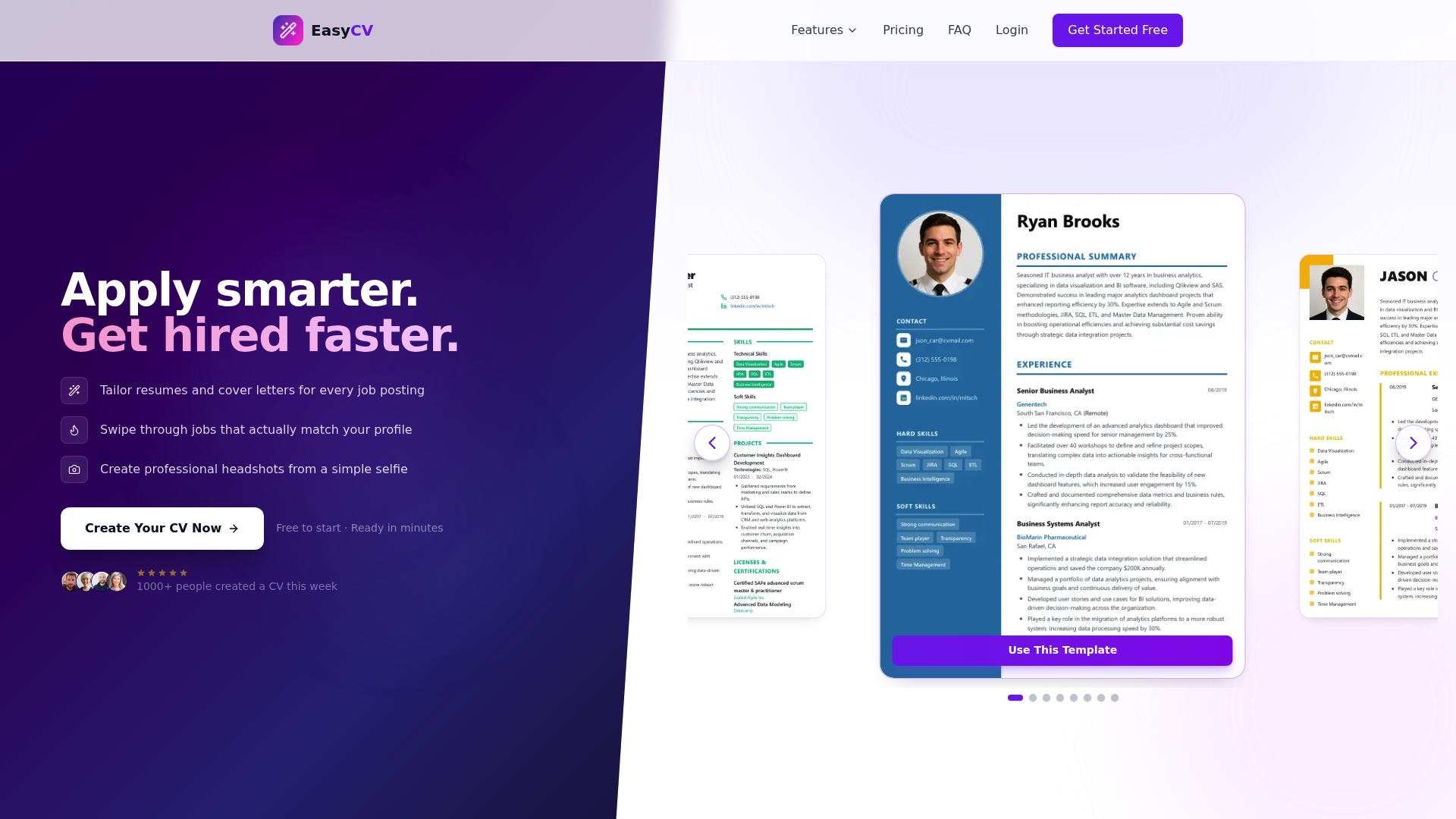
Easy-cv’s AI resume builder generates and refines tailored resume bullets for each application, so your territory metrics and clinical knowledge land in the right context every time. The swipe-style job matcher pre-scores pharma sales listings against your profile, cutting hours of low-fit browsing down to minutes of targeted reviewing. ATS-friendly templates mean your formatting never gets in the way of your content. The cover letter generator helps you frame transferable skills and metrics in the language each employer is actually using.
Free access covers the core builder. Premium unlocks AI-powered tailoring, unlimited exports, the job matcher, and the AI headshot generator. Start building your pharma sales application today and put your best metrics front and center.
This article is general information, not a substitute for advice from a qualified doctor. Consult a qualified healthcare professional about your own circumstances before acting on anything here.
Sources
- Pharmaceutical Sales Representative in Dayton, OH - Syneos Health
- Pharmaceutical Sales: Overview, Pay, and How to Get Started | Coursera
- Data
- Pharmaceutical sales rep career guide | WGU
- Pharmaceutical sales representative — Wikipedia