Letter of Interest: How Career Changers Get Noticed
A letter of interest is a proactive message you send to a company you want to work for, even when no job is posted. It works because it puts your name in front of a hiring manager before a role exists.
Copy-paste template: “I’m [name], and I’m reaching out because [specific reason tied to the company] — I’d bring [one measurable strength], and I’d welcome a conversation about how I could contribute to [department/team].”
Pro Tip: Send it to a named person in the relevant department, not a generic inbox. A specific contact is far more likely to actually read it.
Key Takeaways
A letter of interest works when it targets a named contact, leads with one measurable result, and asks for something specific in the closing line.
| Point | Details |
|---|---|
| Know the difference | A letter of interest is proactive and general; a cover letter responds to a posted job. |
| Find a real name | Addressing a specific contact instead of “Hiring Manager” raises your odds of a reply. |
| Keep it short | Aim for one page or 250 to 500 words, with three to six short paragraphs for email. |
| Lead with evidence | One measurable result beats a long list of duties when there’s no job description to mirror. |
| Follow up once | Wait seven to ten business days, then send a single short follow-up note. |
| Draft it faster | Easy-cv’s AI writing assistant helps personalize letters quickly while keeping formatting ATS-friendly. |
Table of Contents
- What Is a Letter of Interest?
- Letter of Interest vs. Cover Letter: What’s the Difference?
- Why Bother Writing One?
- How to Write a Letter of Interest Step by Step
- How Long Should a Letter of Interest Be?
- Three Quick Examples You Can Adapt
- Common Mistakes That Kill a Letter of Interest
- Final Checklist Before You Hit Send
- Sources
What Is a Letter of Interest?
A letter of interest is a message you send to introduce yourself to a company when there’s no open position to apply for. You’re not responding to a listing. You’re making the case for why you should be on their radar.
A strong one includes:
- Contact information and a direct opening line stating your purpose
- One or two paragraphs connecting your background to the company’s work
- A closing that asks for something specific, like a short call
You’ll sometimes see this called a “letter of inquiry” or “letter of intent,” especially in academic and nonprofit settings, but the structure barely changes.
Letter of Interest vs. Cover Letter: What’s the Difference?
A cover letter answers a specific job posting. A letter of interest doesn’t wait for one. It’s general in nature, built around your overall fit with a company rather than a checklist of listed requirements.
Send a letter of interest when:
- You want to reach a company before it posts anything
- You’re relocating and building connections ahead of a move
- You’re switching industries and want to test interest informally
- You already work there and want to flag interest in another team
If a job is actually posted, skip this approach and write a tailored cover letter instead. Mismatching the two makes you look like you didn’t read the room.
Why Bother Writing One?
You’re not going to get hired off a letter of interest alone, and that’s the wrong goal anyway. The real payoff is relationship building: your name lands in a file that gets pulled the moment a role opens.

Career experts point out that this is a long-term play, not a shortcut to an offer. Done well, it can also open the door to an informational interview or a referral down the line.
Pro Tip: Target one department and one likely champion inside it, not the whole company. A specific pitch to a specific team beats a vague pitch to everyone.
How to Write a Letter of Interest Step by Step
1. Research before you write anything
Find out who runs the team you want to join, what the company has been working on lately, and what problem you’d actually solve for them. Generic praise (“I love your mission”) reads as filler. A specific detail doesn’t.
2. Build the structure
- Header: your name, contact info, and the date (or a clean email subject line if you’re sending it digitally)
- Opening paragraph: who you are and why you’re writing, in one or two sentences
- Body (1–2 paragraphs): the evidence — skills, results, and why they matter to this specific team
- Closing: a direct, specific ask
3. Use openers that actually say something
Skip “I am writing to express my interest in your company.” Try instead:
- “I’ve followed [Company]'s work on [specific project] and wanted to reach out directly.”
- “After five years managing [specific function], I’m looking to bring that experience to a team like [Department].”
- “I increased [metric] by [result] in my last role, and I think that skill set overlaps with what [Department] is building.”
4. Match the format to the channel
Email subject lines should be plain and searchable: “Interest in Marketing Opportunities at [Company]” beats “Hello!” A mailed letter needs a formal date and address block; an email doesn’t.
5. Follow up on a schedule
Wait seven to ten business days, then send a short note: “I wanted to follow up on my note from [date] — happy to share more about my background if useful.” One follow-up is enough. A second one risks annoying the person you’re trying to impress.
How Long Should a Letter of Interest Be?
Keep it to one page or 250 to 500 words; an emailed version should run three to six short paragraphs at most.
- Tone: professional and curious, never demanding or entitled
- Formatting: clear subject line, a real greeting (not “To Whom It May Concern”), short paragraphs, a signature with contact details
- Attachments: include your resume only if the format allows it; don’t restate your whole resume inside the letter itself
Three Quick Examples You Can Adapt
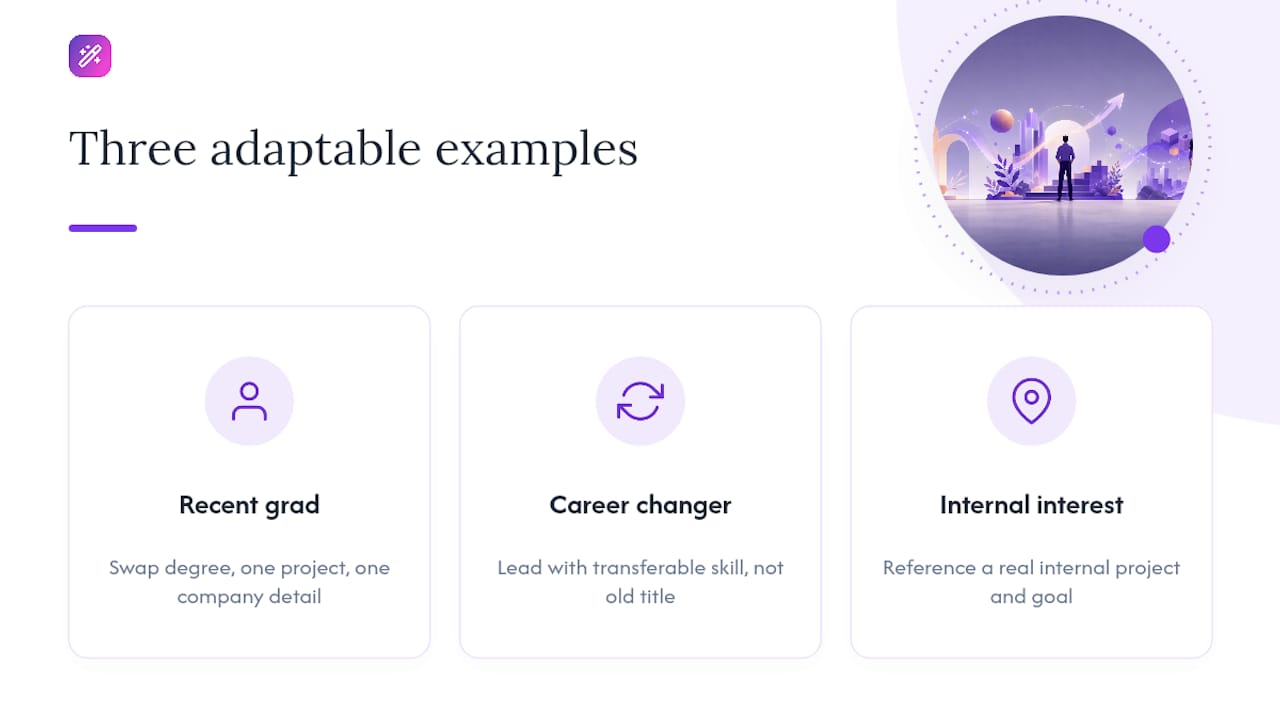
Recent grad: “I’m a recent graduate in [field] with hands-on experience from [internship/project]. I’ve been following [Company]'s work in [area] and would welcome the chance to contribute to your team.” Swap in your degree, one project, and one company detail.
Career changer: “After [X years] in [old field], I’m moving into [new field], bringing [transferable skill] and a track record of [specific result].” Lead with the transferable skill, not your old job title.
Internal interest: “Having spent [time] on the [current team], I’d like to express interest in opportunities on [target team], where I could apply [specific skill] to [specific goal].” Reference a real internal project to show you’re paying attention.
Adjust vocabulary and examples by industry. A finance letter leans on numbers; a creative role leans on named projects, and a cover letter template built for a similar purpose can save you a rewrite from scratch.
Common Mistakes That Kill a Letter of Interest
Avoid these:
- Addressing it to “Hiring Manager” when a real name was findable
- Restating your entire resume instead of picking one strong example
- Vague claims like “I’m a hard worker” with no evidence behind them
- Typos, especially in the company or contact’s name
What actually moves the needle: naming the right contact, leading with a measurable result, and referencing something the company genuinely did recently. Follow up once, politely, after a week or two. Silence after that usually means it’s time to move on, not to send a third message.
Final Checklist Before You Hit Send
Run through this before sending:
- Correct name and title for your contact
- Clear, specific subject line
- Resume attached only if appropriate
- Contact details current and accurate
- Proofread twice, out loud once
- One page or under
Once it’s sent, connect with the contact on LinkedIn and consider requesting a short informational interview. Pick one company this week and send one tailored letter. It’s a small task with an outsized return.
Why This Approach Works
Job seekers often treat a letter of interest as a formality. It isn’t. It’s a research task disguised as a writing task, and the research is what actually gets it read.
Draft It Faster Without Losing the Personal Touch
Writing a genuinely tailored letter for every target company takes real time, especially when you’re aiming it at three or four different departments in the same week. Easy-cv speeds up that personalization: its AI writing assistant helps you draft strong opening lines and evidence paragraphs, then keeps the formatting ATS-friendly so nothing gets lost when a recruiter’s system scans it.
If you’re also job hunting through posted listings at the same time, the job matcher can surface roles that fit your background so you’re not sending letters into the void. Start a draft on Easy-cv and send your first tailored letter of interest before the week is out.
Sources
- How to write a letter of interest
- Here’s How to Write a Perfect Letter of Interest | Grammarly
- Letter of Interest Sample & Writing Guide
- What is a letter of interest and how to write one
Check your school’s career center for discipline-specific templates before sending your first draft.