Grant Cover Letter Guide for Job Seekers
A cover letter for a job application — sometimes called a “grant cover letter” by applicants who mean the personalized letter submitted alongside a CV — is a short document that tells a hiring manager why you, specifically, fit this role. Include one whenever the posting requests it, or whenever you have something meaningful to add that your resume cannot show on its own. MIT Career Advising & Professional Development puts it plainly: an effective cover letter is directed toward a specific position and describes examples from your experience that highlight skills relevant to the role. It complements your resume rather than repeating it.
Paste-ready template (email body or online form):
Applicant Tracking Systems (ATS) parse this text cleanly when you avoid tables, images, and unusual characters. Easy-cv’s AI cover letter builder generates ATS-safe drafts in this format automatically.
Table of Contents
- What do ready-to-use cover letter samples look like?
- How should you format a U.S. business cover letter?
- How do you tailor a cover letter without repeating your resume?
- What style and tone work best for U.S. job applications?
- How do you explain a gap, relocation, or career change briefly?
- What file format and submission rules should you follow?
- Common mistakes and your 60-second pre-send checklist
- Should you put the cover letter in the email body or attach it?
- Easy-cv makes tailored cover letters faster
- Key Takeaways
- Why tailored cover letters still matter more than most people think
What do ready-to-use cover letter samples look like?
Cover letters are most effective when they clarify your narrative and demonstrate fit rather than retell your resume. Below is one master template followed by three annotated samples.
Master template (attached letter, 250–400 words):
- Entry-level / recent graduate
Swap: hiring manager name, company, role, university, platform, and metric.
- Experienced mid-career hire
Swap: name, company, role, process type, metric, and regional detail.
- Gap or career-change example
Swap: gap reason (keep it brief and positive), years of experience, role, company, and the specific skill the posting names.
Pro Tip: Add one micro-detail only you would know — a specific product the company launched, a recent news item, or a named internal team. That single line eliminates the detectable AI-template look faster than any other edit.
How should you format a U.S. business cover letter?
Standard U.S. formatting calls for single-spaced paragraphs, a blank line between paragraphs, and 1-inch margins throughout. Keep fonts to 10–12 point in Times New Roman or Arial.

| Header element | Purpose | Example |
|---|---|---|
| Your name | Identifies the applicant | Jordan Lee |
| Phone number | Primary contact | [Phone] |
| Email address | Professional contact | jordan.lee@email.com |
| LinkedIn URL | Supports credibility | linkedin.com/in/jordanlee |
| City, State | Shows location fit | Columbus, OH |
| Date | Timestamps the letter | [Date] |
| Employer contact block | Addresses the letter formally | Sarah Rivera, Talent Acquisition, Brightline Media |
Salutation: Search LinkedIn or the company website for the hiring manager’s name. “Dear [First Last]:” is always the strongest opener. When you cannot find a name, “Dear Hiring Manager:” is the accepted fallback. Never use “To Whom It May Concern” — it signals a generic, untailored application.
Body structure: Opening paragraph (1–2 lines stating the role and your top qualification), one or two value paragraphs connecting your experience to the job, and a closing paragraph (1–2 lines requesting a conversation). That is the whole structure. Three to four short paragraphs, 250–400 words, one page maximum.
How do you tailor a cover letter without repeating your resume?
Center the letter on a single compelling achievement that directly addresses the job posting’s core need. Pull two or three requirements from the posting, match each to a concrete outcome you have delivered, and write one sentence per match.
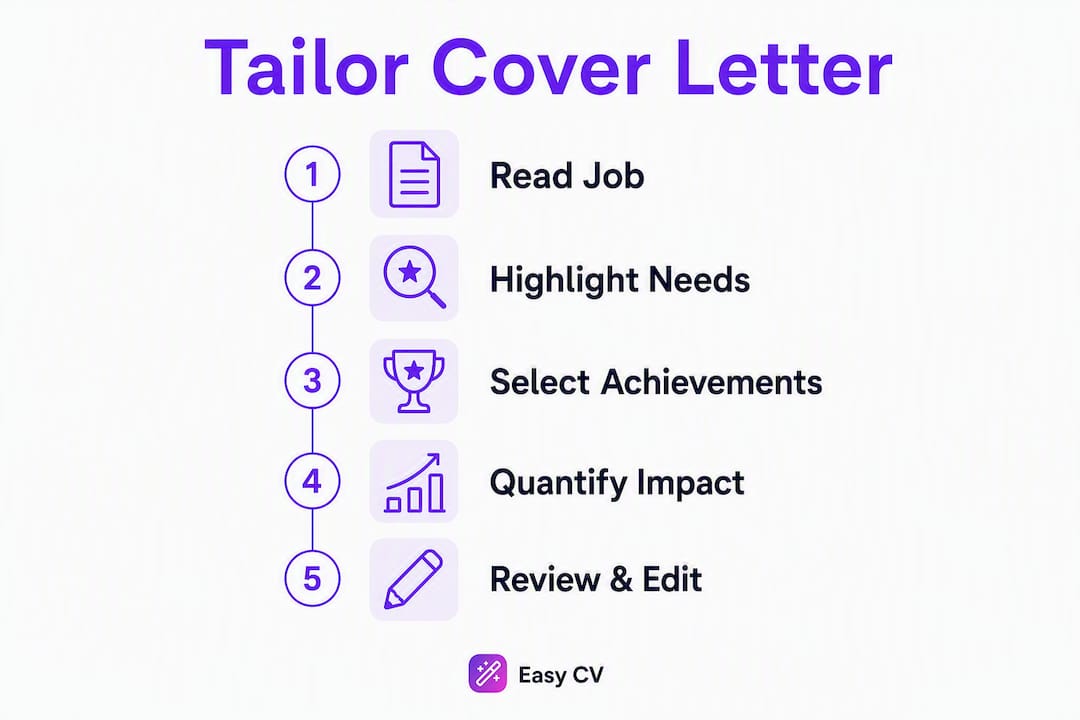
The method: read the job description, highlight the two requirements that appear most prominently, then ask yourself, “What result did I produce that proves I can do this?” Write that result as a sentence, not a duty.
Before: “I have strong communication skills and experience working with clients.”
After: “At Apex Consulting, I managed 12 client accounts and reduced escalation calls by 30% by introducing a weekly status report.”
The revised sentence answers the job requirement (client management), names the employer, and quantifies the impact. Replacing generic phrases with specific metrics — percentages, dollar figures, time saved, team size — is the single most effective edit you can make. Prioritize achievements tied to the core responsibilities listed first in the posting; those are the ones the hiring team cares about most.
What style and tone work best for U.S. job applications?
Lead every sentence with an active verb and keep the focus on impact, not effort. That one rule fixes most tone problems.
- Replace “I was responsible for managing” with “Managed a team of eight engineers.”
- Replace “I helped improve customer satisfaction” with “Raised NPS scores from 61 to 74 over two quarters.”
- Replace “I am a hard worker and team player” with “Collaborated with product and legal to launch a compliance feature three weeks ahead of schedule.”
- Drop clichés (“results-driven,” “passionate about”) and substitute the specific context that proves the claim.
Active voice and targeted metrics make letters read as professional and business-focused in the U.S. market. Minimize “I” as a sentence opener — starting every line with “I” makes the letter feel self-centered rather than employer-focused.
Pro Tip: To signal leadership without overclaiming, use “led,” “owned,” or “drove” for outcomes you directed, and “contributed to” or “supported” for team wins where your role was one of several. The distinction reads as self-aware and credible.
How do you explain a gap, relocation, or career change briefly?
One sentence is enough. Place it in the opening paragraph so it does not linger as an unanswered question, then move on.
Gap: “After a period of family caregiving, I am returning to full-time work and am fully available.”
Relocation: “I am relocating to Austin in July and am targeting roles in the area.”
Career change: “My background in financial analysis gives me a quantitative foundation that translates directly to the data analyst role you have posted.”
Keep the framing positive and forward-looking. Do not over-explain; the cover letter is not the place for a detailed account. If the gap or change needs more context, a brief note in your CV or a fuller explanation at the interview stage is more appropriate.
What file format and submission rules should you follow?
| Scenario | Format | Why it matters | Example file name |
|---|---|---|---|
| Email attachment | Preserves layout across devices | JordanLee_MarketingCoordinator.pdf | |
| Online portal (accepts PDF) | Consistent rendering in ATS | JordanLee_CoverLetter.pdf | |
| Online portal (text field only) | Plain text, pasted | ATS parses text; formatting stripped | N/A |
| Email body | Plain text | No attachment needed; 150–200 words | N/A |
ATS-friendly formatting means no images, no text boxes, no unusual characters, and fonts in the 10–12 point range. When pasting into an online form, remove bullet symbols and replace them with plain dashes or line breaks if the field strips formatting.
Email subject line format: Application: [Job Title] — [Your Name] — concise, searchable, and immediately clear to a recruiter scanning an inbox.
For online application fields, watch word limits. Many portals cap cover letter fields at 500 words; paste your text into a word counter before submitting.
Common mistakes and your 60-second pre-send checklist
The most application-killing errors are addressable in under a minute.
Common mistakes:
- Wrong company name (copied from a previous application)
- Generic salutation when the hiring manager’s name was findable
- Vague claims with no metrics or context
- Letter longer than one page
- Passive verbs throughout (“was responsible for,” “was involved in”)
Pre-send checklist:
- [ ] Company name spelled correctly and matches the posting
- [ ] Hiring manager name verified (LinkedIn, company site)
- [ ] File named with your name and the role title
- [ ] Attachment actually attached before hitting send
- [ ] Read aloud once to catch awkward phrasing
- [ ] Spellcheck run (U.S. English dictionary active)
- [ ] Formatting intact: margins, font, no stray symbols
Pro Tip: If you are applying to multiple roles simultaneously, run a quick Find & Replace on the company name and role title before each submission. One wrong company name disqualifies an otherwise strong letter immediately.
Should you put the cover letter in the email body or attach it?
The rule of thumb: email body letters run 150–200 words; attached letters can reach 250–400 words when the application explicitly accepts them.
Email body example (single paragraph):
Subject line: Application: UX Designer — Jordan Lee
When a portal accepts both an attachment and an email body, keep them consistent in substance. The email body is the summary; the attached letter is the expanded version. Never contradict yourself between the two.
Easy-cv makes tailored cover letters faster
Writing a targeted cover letter for every application is the part of job searching that stalls most people. Easy-cv’s AI cover letter generator reads the job posting and produces a draft matched to your CV in seconds, formatted for ATS and ready to export as a PDF or paste as plain text.
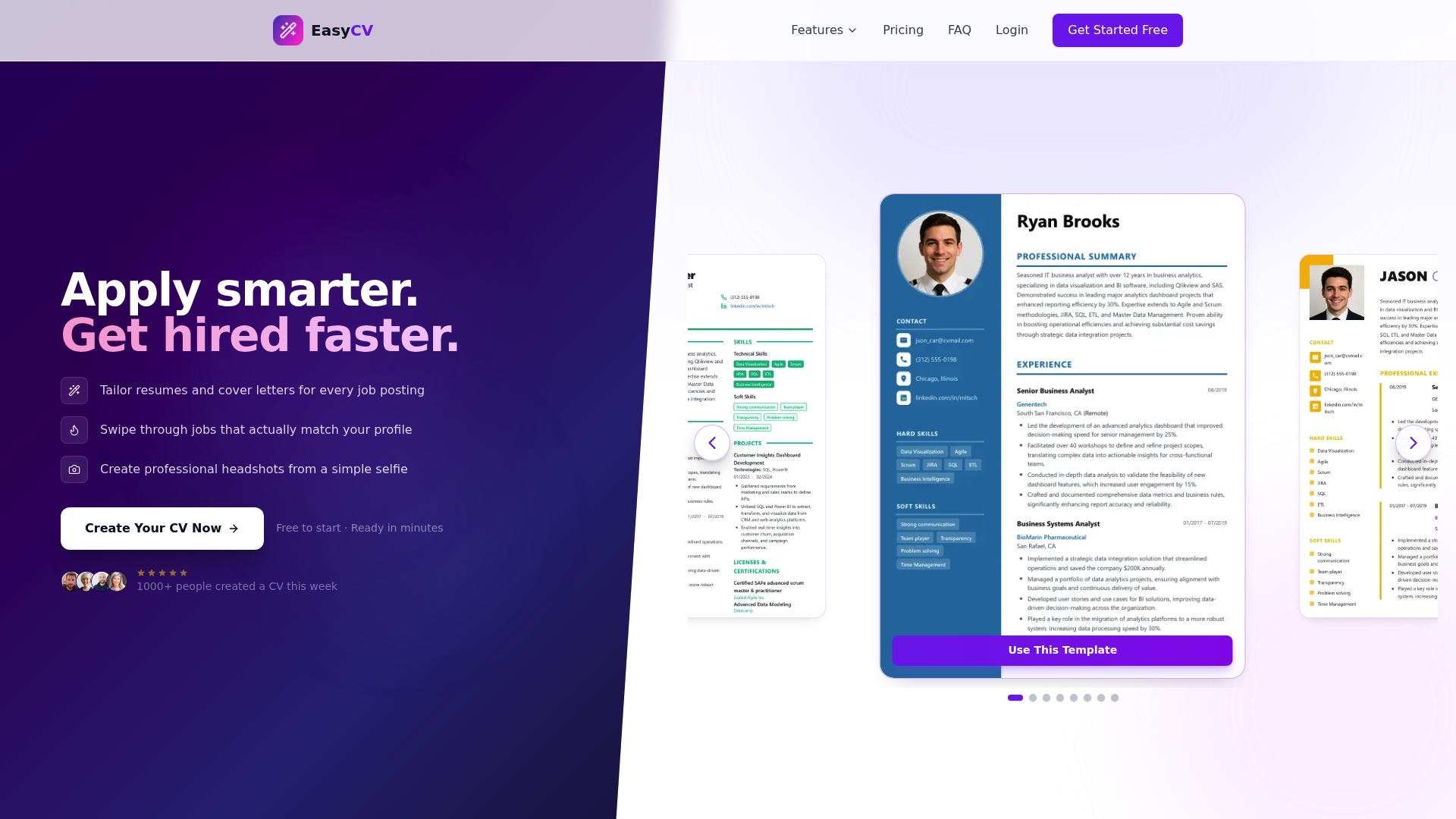
The platform aggregates over 10 million job opportunities per month from major boards, so you can find a role, generate a tailored letter, and track the application without switching tools. ATS-friendly templates, 30+ language options, and an AI writing assistant that refines your content are all included. Premium plans unlock unlimited exports and the full job-matching suite.
Start your first tailored cover letter at easy-cv.ai — the free plan covers the basics, and the AI draft gives you a strong first version to humanize with the micro-edits in this guide.
Pro Tip: Use Easy-cv to generate the first draft, then apply the before/after edits from the language section above: swap one generic phrase for a metric, add one company-specific detail, and cut any sentence that could appear in any other letter. That three-step pass turns an AI draft into something that reads as yours.
Key Takeaways
A tailored, ATS-safe cover letter — one page, active voice, with two or three quantified achievements matched to the posting — is the format that consistently moves applications forward in the U.S. market.
| Point | Details |
|---|---|
| Length and format | Attached letters: 250–400 words; email body: 150–200 words; one page maximum. |
| Tailor, don’t repeat | Match two or three job requirements to specific, quantified outcomes — never summarize your resume. |
| Explain gaps briefly | One sentence, positive framing, placed in the opening paragraph; expand at the interview stage. |
| Submit correctly | PDF for attachments; plain text when pasting into portals; name files with your name and role title. |
| Easy-cv for drafts | Use Easy-cv’s AI cover letter generator for a fast, ATS-ready first draft, then apply the micro-edits from this guide. |
Why tailored cover letters still matter more than most people think
The conventional wisdom says cover letters are dying. Hiring managers skim them, ATS filters them, and half of job postings mark them optional. All of that is true. And yet the candidates who write a focused, specific letter — one that names a real problem the company faces and connects it to a result the candidate has delivered — still get called back at a higher rate than those who skip it.
The mistake most applicants make is treating “optional” as “skip it.” Optional means the bar is lower, not that the opportunity disappears. A letter that takes 15 minutes to write and references something specific about the role or company signals effort that a resume cannot. That signal matters most for career changers, candidates with gaps, and anyone applying to a role where the resume alone does not tell the full story.
The templates in this guide are starting points, not finished products. The micro-edit that makes a letter work is always the one only you could write: the specific metric, the named product, the honest one-sentence explanation of a gap. Run the pre-send checklist before every submission, and use Easy-cv to handle the formatting and ATS compliance so your attention stays on the content.