Raise Your Job Match Score in Under 30 Minutes
A job match score is a number, usually 0 to 100 or a percentage, that measures how closely your resume aligns with a specific job posting’s qualifications, responsibilities, and language. The fastest way to raise it isn’t stuffing in keywords. It’s closing gaps in your actual qualifications and evidence, which is exactly what job-fit research from the Office of Personnel Management points to. A tool such as EasyCV’s Job Matcher can show you those gaps in seconds.
TL;DR:
- Focusing on closing key qualification gaps will significantly boost your job match score more than keyword stuffing or superficial edits.
- Most scoring models prioritize required qualifications and responsibilities, with fewer points awarded for optional skills or less relevant details.
- Formatting issues such as tables or images can lower your score because ATS might not correctly parse your resume content.
- Achieving a score above 75 is usually sufficient; beyond that, efforts to improve yield diminishing returns, so submit once you reach a strong match.
- Using targeted, high-impact changes on critical gaps and tailoring bullets to evidence results is more effective than broad, unsubstantiated skill additions.
Table of Contents
- What a Job Match Score Actually Measures
- How Match Scores Are Calculated
- What Score Should You Aim For?
- How to Check Your Job Match Score
- How to Improve Your Job Match Score
- A Simple Six-Step Application Workflow
- Why I Trust Match Scores, But Never Blindly
- Get a Higher Job Match Score Without the Guesswork
- Sources
What a Job Match Score Actually Measures
Most scoring systems break your resume down into distinct categories, then compare each one against the job posting. The score is a composite, not a single measurement.
- Qualifications — required degrees, certifications, years of experience
- Responsibilities — whether your past duties overlap with what the role demands
- Keywords — specific terms, tools, and technical language from the posting
- Job title match — how closely your current or target title mirrors the one posted
- Culture and preference signals — softer indicators like work environment or values fit
That last category matters more than most job seekers realize. The OPM’s job-fit measures framework treats fit as a two-way comparison between a candidate’s preferences and an organization’s traits, not just a skills checklist. Good scoring systems also read context, not just literal word matches. Cornell’s Job Compatibility Index research shows compatibility can be calculated across multiple skills weighted by importance, which lets a system credit transferable experience even when your job titles don’t match word for word.
How Match Scores Are Calculated
Scoring engines don’t treat every line item equally. Most use a weighted model where “must-have” qualifications carry far more weight than “nice-to-have” extras. Miss a required certification and your score takes a real hit. Miss a bonus skill listed near the bottom of the posting, and it barely moves.
Teamtailor’s documentation offers a clean example: each scored skill or trait gets an average, that average is multiplied by its assigned weight, and a missing score gets treated as the lowest possible value rather than being ignored. That’s why an empty skills section can tank a score even when your experience actually covers it.
Qualifications often carry the largest share of a job match score, according to Huntr’s scoring model, with keywords and title match contributing smaller, supporting portions.
Formatting matters too. ATS parsers can misread tables, text boxes, and headers embedded in images, which means a technically qualified resume can score low simply because the software couldn’t extract the information. And increasingly, matching happens on a semantic layer. Systems built on distance measures across skill descriptors can recognize that “led a cross-functional team of 12” supports a leadership requirement even without the word “leadership” appearing anywhere, according to occupation-matching research. Keyword stuffing doesn’t fool this layer. A skill repeated five times with no supporting evidence usually scores worse than one mentioned once with a real result attached.
What Score Should You Aim For?
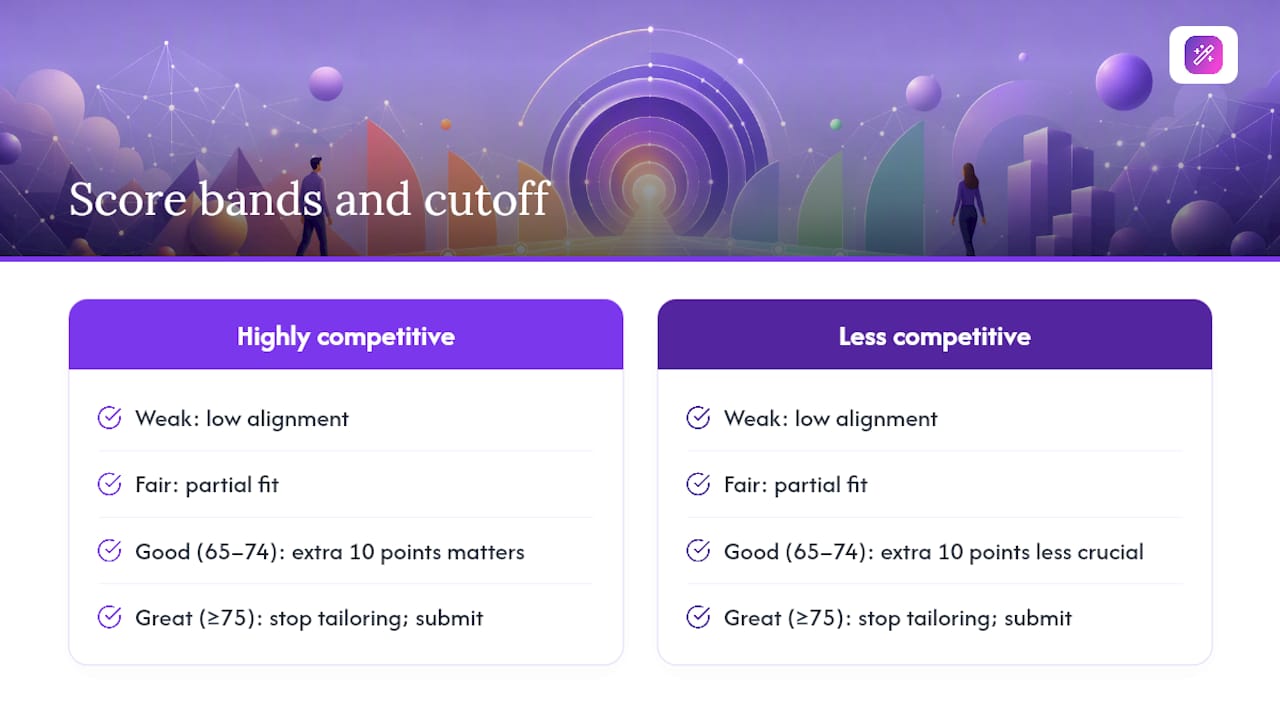
Benchmarks vary by tool and industry, but most scoring systems cluster around bands indicating weak, fair, good, or great match, reflecting increasing levels of alignment and readiness to apply.
A 65 for a senior, highly competitive role isn’t the same as a 65 for an entry-level posting with hundreds of qualified applicants. The more competitive the pool, the more that extra 10 points in the Good range actually matters. If you’re already above 75, stop tailoring and submit. Diminishing returns set in fast once you’ve addressed the major gaps, and a submitted application always beats a perfect one still sitting in drafts.
How to Check Your Job Match Score
Getting an actual number takes a few minutes with the right workflow.
- Upload your resume into a scanning tool.
- Paste the full job description, not just the title, so the system can parse responsibilities and requirements.
- Run the scan and let it generate a composite score.
- Review the breakdown of what’s covered versus not covered, usually organized by qualification, keyword, and responsibility.
- Address the highest-weight gaps first, since fixing a missing keyword rarely moves the needle the way fixing a missing core qualification does.
If you’re checking manually without a tool, focus on three things: does your title roughly mirror the posted title, do you have an explicit skills section that lists the exact terms from the posting, and does each bullet point offer real evidence rather than a vague duty statement. EasyCV’s Job Matcher automates this entire process, pre-scoring jobs against your CV with a swipe-based interface so you can see fit before you invest time tailoring anything.
How to Improve Your Job Match Score
Start with the gaps that carry the most weight, not the ones that are easiest to fix.
- Add missing “must-have” qualifications or clearly map an equivalent you already have. A bootcamp certificate can stand in for a degree requirement if you frame it directly against what the posting asks for.
- Rewrite bullets around outcomes, not duties. “Managed social media” scores worse than “grew Instagram engagement 34% over six months using a content calendar and paid boosts.”
- Update your title and summary to mirror the role’s actual language, as long as it stays truthful to what you did.
- Consolidate your skills section and repeat the most important terms naturally inside your bullet points, not just in a list.
- Fix formatting risks: avoid tables, embedded images, and unusual fonts, and use standard section headers with consistent date formats so parsers can read everything correctly.
- Edit any tool-suggested bullets before you submit. AI-tailored suggestions are a strong starting draft, not a final answer.
Pro Tip: Don’t just add a skill because the job posting mentions it. If you can’t back it up in an interview, leave it off. Scoring systems reward specificity, and specificity only helps you if it’s true.
Small, targeted changes on high-weight items outperform broad rewrites almost every time. For a deeper walkthrough of rewriting individual bullets, see this guide on tailoring your resume to a job description.
A Simple Six-Step Application Workflow
- Capture the job description in full. Two minutes.
- Run an initial scan to get your baseline score. One minute.
- Fix missing must-haves first, mapping equivalents where you can. Ten minutes.
- Tailor two to three bullets for the highest-impact responsibilities. Ten to fifteen minutes.
- Update your skills section and title to reflect the role’s language. Five minutes.
- Re-scan, then export an ATS-safe version. Two minutes.
Before you hit submit, proofread once more, double-check your employment dates are consistent, and confirm the final scan shows your score in the Good range or higher. The whole process usually takes under 30 minutes once you’ve done it a few times, and it beats sending out a generic resume and hoping.
Why I Trust Match Scores, But Never Blindly
A job match score is a compass, not a verdict. I’ve seen job seekers chase a perfect number by padding skills they can’t defend, which backfires the moment an interviewer asks a follow-up question. The better use of a score is diagnostic: it tells you where your resume is thin, not what to lie about. Treat every suggested bullet as a draft you improve, not a script you copy. The goal was never a high score. It was an interview.
— Andras
Get a Higher Job Match Score Without the Guesswork
Easy-cv turns the manual scanning, gap-hunting, and rewriting described above into one workflow instead of five separate tools. The Job Matcher pre-scores swiped job listings against your CV, so you see your fit before you spend time tailoring anything. Once you find a strong match, the AI writing assistant drafts tailored bullets around the gaps the scan flagged, and you edit them for accuracy before exporting on an ATS-friendly template.
The typical workflow inside Easy-cv looks like this: scan a job, accept or edit the suggested tailoring, export a clean ATS-ready version, then let the built-in job tracker keep tabs on where each application stands. If your search spans multiple countries, the platform also translates your CV into more than 30 languages without breaking the formatting. Open the Job Matcher now and run your current resume against a real listing to see where your score actually stands.
Sources
- Job-Fit Measures | U.S. Office of Personnel Management
- The Job Compatibility Index: A New Approach to Defining the Hospitality Labor Market (Cornell)
- Occupation recommendation research using worker profile distance (PMC)
- Job match score | Teamtailor Support Center