Hit 150–400 Words: Cover Letter Length and Paste In Templates

Aim for a half page to one page, split into three or four tight paragraphs. Most roles do better with the shorter end of that range, since a survey of 205 HR professionals found 40% preferred letters shorter than half a page and 42% preferred half a page to one page. Only if the job posting explicitly asks for more, or your background genuinely needs the room, should you write a longer letter.
TL;DR:
- Recruiters often prefer cover letters shorter than one page, with 18% of HR professionals surveyed favoring letters over that length.
- Short cover letters consisting of 150 to 250 words are standard for most entry-level roles, while more senior or technical positions may justify up to 400 words.
- Proper formatting, including fonts like Arial or Times New Roman at 10 to 12 points and 1-inch margins, significantly influences perceived length and readability.
- Each paragraph should have a clear purpose: an opening stating the role and value proposition, a body with quantified results linked to job needs, and a concise closing with a follow-up statement.
- Using templates or automatic generators for half-page and one-page structures helps maintain optimal length and ensures content aligns with applicant tracking system requirements.
Table of Contents
- How Long Should a Cover Letter Be for Your Situation?
- What Formatting Choices Actually Change How Long a Letter Feels?
- What Goes in Each Paragraph of a Cover Letter?
- When Is a Longer Cover Letter Acceptable?
- What Does the Data Say About Recruiter Reading Habits?
- Copy These Two Cover Letter Length Templates
- Why Concise Cover Letters Win
- Write a Precisely Sized Cover Letter Without Starting From Scratch
- Sources
- FAQ
How Long Should a Cover Letter Be for Your Situation?
The right cover letter length depends on the role, not a fixed rule. A junior marketing coordinator applying to a high-volume posting needs far less space than a research scientist explaining a five-year academic gap.
Use this as your default decision tree:
- Half page (roughly 150 to 250 words): the standard for most modern applications, especially high-volume roles like retail, customer service, or entry-level corporate jobs.
- One page (roughly 300 to 400 words): reserved for senior, technical, or career-change situations where you need one real story to prove fit.
- Short-form response (50 to 150 words): increasingly common on application portals that ask a single screening question instead of a full letter.
- Whatever the job posting specifies: if a listing caps you at 200 words or asks for “a brief paragraph,” that instruction overrides every general guideline in this article.
What Formatting Choices Actually Change How Long a Letter Feels?
Word count only tells half the story. A 400-word letter crammed into narrow margins with 9-point type looks like a wall of text, while the same content at 11-point font with breathing room reads as short and confident.
Stick to fonts like Arial, Calibri, Helvetica, or Times New Roman at 10 to 12 points. Keep margins around 1 inch on every side, and use single or 1.15 line spacing. Anything smaller or tighter starts to look like you’re hiding length problems rather than solving them, a pattern MIT’s career office flags in its formatting guidance.
- Break text into short paragraphs, three to five sentences at most.
- Leave a blank line between paragraphs instead of indenting.
- Skip decorative headers, icons, or colored text blocks that confuse applicant tracking systems.
Pro Tip: Paste your draft into a plain text editor before submitting. If it still reads clearly with no bold, no bullets, and no special characters, it will survive almost any ATS parser intact.
What Goes in Each Paragraph of a Cover Letter?
Every paragraph in a short cover letter has one job. Waste a sentence on throat-clearing and you’ve burned space you don’t have.
- Opening (1 to 2 sentences, about 25 to 40 words): name the role and deliver a one-line value proposition. Skip the “I am writing to apply for” framing entirely.
- Body (1 to 2 short paragraphs, about 80 to 180 words total): lead with one concrete, metric-backed example, then connect that result directly to what the job needs.
- Closing (1 sentence, about 15 to 25 words): thank the reader and state your availability for a follow-up conversation.
For a half-page letter, that adds up to roughly 150 to 250 words across three paragraphs. A one-page version stretches the body to two paragraphs and lands closer to 350 to 400 words. Either way, the structure stays the same. Only the depth of the example changes.
When Is a Longer Cover Letter Acceptable?
Some situations genuinely call for more than one page, and pretending otherwise does readers a disservice. Academic and research positions often expect a fuller narrative covering methodology, publications, or teaching philosophy. Fellowship and grant applications frequently require a detailed personal statement. Portfolio-driven creative roles sometimes need space to walk through a body of work.
If you’re in one of those categories, keep the letter scannable rather than dense:
- Open with a one-sentence summary of your core qualification, before the reader has to hunt for it.
- Use bolded section headers sparingly, maybe two or three, to break up long narrative blocks.
- Link to a portfolio or attach a work sample instead of describing projects in paragraph form.
Applicants writing grant or research narratives can find more detail in this grant cover letter guide, which walks through structuring longer, purpose-built letters without losing the reader halfway through.
What Does the Data Say About Recruiter Reading Habits?
Recruiters do not read cover letters the way applicants imagine. They skim.
Career coaches consistently advise writing letters recruiters can read in under a minute, which means your first two sentences carry more weight than your entire third paragraph.
Only 18% of the 205 HR professionals surveyed preferred letters longer than one page, according to The Muse’s research.
That preference is reshaping how companies ask for cover letters in the first place. Applications are increasingly using short-form response prompts of 100 to 250 words instead of open-ended letters, partly to speed up screening and partly because many of these systems now check for AI-generated boilerplate. Generic, padded writing gets flagged faster than specific, metric-driven writing does.

Copy These Two Cover Letter Length Templates
A half-page template runs three paragraphs. Open with the role and a one-line value statement (roughly 30 words). Close with a one-sentence thank-you and availability note (roughly 20 words). Total: around 170 words.

A one-page template runs four paragraphs. Keep the opening the same length. Split the body into two paragraphs, one covering your strongest quantified result and a second connecting your skills directly to the role’s stated requirements (roughly 250 words combined). Close the same way. Total: around 320 words.
Before sending either version, check that:
- Every sentence in the body ties back to something in the job description.
- You’ve cut any sentence that restates your résumé instead of adding new information.
- The closing states a clear next step, not just “thank you for your consideration.”
For editable versions of both formats, Easy-cv’s cover letter generator builds these structures automatically and adjusts them to the specific job posting you paste in.
Why Concise Cover Letters Win
Templates are often built directly around the half-page and one-page structures outlined above. Each template locks in paragraph roles first, then fills content, so the letter never accidentally drifts into page two because a user kept adding sentences without a length target in mind.
That structural discipline matters more than most job seekers realize. In a market moving toward AI-screened applications and shorter response prompts, the applicants who get read are the ones who respect the format the employer actually asked for, not the ones who write the most impressive-sounding paragraph. Formatting for length isn’t a workaround. It’s the actual skill.
— Andras
Write a Precisely Sized Cover Letter Without Starting From Scratch
Getting the word count right is easy to explain and hard to execute under a deadline, especially when you’re tailoring the same story for a dozen different job postings. That’s a common problem cover letter generators solve.
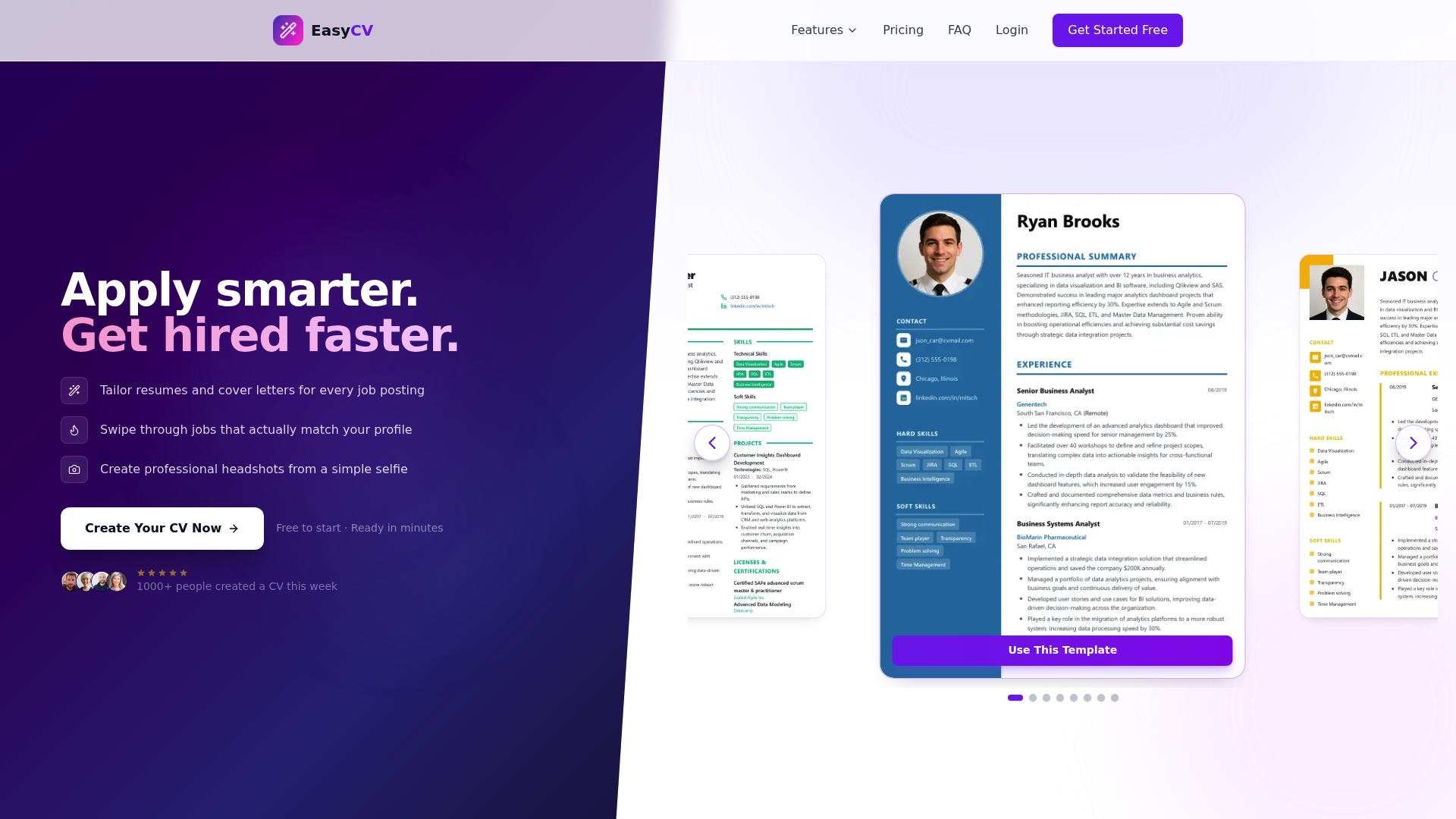
The tool builds letters using the half-page and one-page structures covered above, so you’re not manually counting words or guessing at paragraph breaks. A few things it handles for you:
- Generates a draft sized to the role, then lets you tighten or expand specific paragraphs.
- Pulls from your existing CV content so examples stay consistent across every application.
- Applies ATS-friendly formatting automatically, matching the font, margin, and spacing standards covered earlier.
Pair it with the full Easy-cv feature set to tailor both your CV and cover letter from one workspace instead of juggling separate documents for every application. Start a draft now and see how close you land to your target word count on the first pass.
Sources
- What’s the Ideal Length for a Cover Letter? —Plus Tips to Get Yours There | The Muse
- How Long Should a Cover Letter Be? Why Shorter is the New Trend | Coursera
- How to write an effective cover letter (with samples) | MIT
- What’s the Ideal Length for a Cover Letter? —Plus Tips to Get Yours There | The Muse
FAQ
Is 500 words too long for a cover letter?
Yes, in most cases.
Is a two-page cover letter too long?
Almost always. A two-page letter exceeds what recruiters can skim in under a minute, and it signals you haven’t prioritized your strongest example. Academic or grant applications are the rare exception.
What is the recommended length of a cover letter?
Half a page to one full page, or roughly 150 to 400 words across three to four paragraphs. Shorter, half-page letters are increasingly the default for standard job applications.
Is a 1.5-page cover letter okay?
It’s borderline. A page and a half usually means you’re carrying content that should be cut, so review each paragraph and remove anything that repeats your résumé instead of adding new detail.
Does EasyCV help me hit the right cover letter word count?
Yes. A cover letter generator can build drafts sized to half-page or one-page formats and let you adjust individual paragraphs to stay within your target range.