Job Seekers: Translate Your Resume into Spanish Without Breaking Layout
Translating your resume to Spanish means running it through an AI translation tool built for resumes, then getting a native speaker to check tone, keywords, and formatting. Skip the free web translators for anything you plan to submit. Save certified human translation for legal or immigration paperwork, where speed matters less than a signature and an accuracy statement someone official will accept.
TL;DR:
- Using an AI resume translator designed for documents improves layout preservation and incorporates industry-specific terminology better than generic web tools.
- Study target job ads to identify common keywords and local job titles, then adapt your resume accordingly to increase relevance and visibility to ATS.
- A professional native review ensures tone, idiom, and formatting are appropriate, but full certified translation is usually unnecessary unless for legal or immigration documentation.
- Format your resume with a single-column layout, standard headings, and plain text bullets to avoid ATS parsing issues caused by complex formatting or embedded images.
- Spend a few minutes comparing keywords from three relevant job listings to optimize your resume’s term usage and boost callback chances significantly.
Table of Contents
- How to Translate a Resume to Spanish: Comparing Your Options
- How Do You Localize a Translated Resume Step by Step?
- Will ATS Software Read Your Translated Resume Correctly?
- When Do You Actually Need a Certified Translation?
- How Do You Choose the Right Translator or Service?
- How EasyCV Handles Translation Without Breaking Your Layout
- A Quick Word From Andras
- Sources
How to Translate a Resume to Spanish: Comparing Your Options
Not every method deserves your trust with a job application. Here’s how the three real options stack up.
Free machine translation (Google Translate, DeepL) is instant and costs nothing, but it translates words, not resumes. It doesn’t know that “managed a team of 12” should read differently in a Mexico City job ad than a Madrid one, and it regularly mangles section headers and bullet formatting when you paste from a PDF.
AI/CV-focused translators built for resumes do better because they’re trained on document structure, not just sentence pairs. They preserve layout, recognize resume-specific terms like “spearheaded” or “cross-functional,” and usually run on a freemium model, meaning your first translation costs nothing and upgrades unlock more languages or exports. Turnaround is minutes.
Professional and certified human translators cost the most, typically $20 to $100 or more per page, with turnaround from 24 to 72 hours or longer depending on demand. You’re paying for judgment: a real person deciding whether “led” translates better as “dirigió” or “lideró” for your industry.
For most job seekers, the smartest path is a hybrid one:
- Run the resume through an AI tool built for CVs, not a generic translator.
- Have a native Spanish speaker review the draft for tone, idioms, and section headings.
- Reserve full certified translation for anything an embassy, school, or government office will read.
This combination gets you a document that reads like it was written by a Spanish speaker for a Spanish-speaking employer, not translated by software and hoped for the best.
How Do You Localize a Translated Resume Step by Step?
A resume translated word for word almost always reads foreign, even when the grammar is flawless. Localization adapts format, tone, and keywords to local hiring norms, and that adaptation is what actually gets your application read past the first ten seconds. Here’s the order that works:
- Study three to five job postings in your target market. Note which words repeat, how experience is described, and whether the ads expect a photo or personal details many US resumes omit.
- Rename headings and job titles to match local terminology. “Sales Associate” might become “Asesor de Ventas” in one market and “Ejecutivo de Ventas” in another. Match the ad, not the dictionary.
- Rewrite bullets so they lead with results, not duties. “Responsible for customer service” becomes something closer to “Increased customer retention by streamlining response times.” Spanish speaking employers still want numbers.
- Fix formatting details: dates (day before month is standard in most Spanish speaking countries), decimal commas versus periods, and any American idiom that doesn’t translate (“hit the ground running” means nothing in Spanish and confuses more than it impresses).
- Keep the original layout and file type intact through every editing pass. A translation that breaks your template forces a recruiter to work harder to read it.
- Get a final native speaker review before sending anything. This step catches the errors AI tools and non native reviewers miss.
Pro Tip: Pull three job ads for the exact role you’re applying to and highlight every repeated term. Six to eight recurring words, translated correctly and worked into your bullets, will do more for your callback rate than any grammar fix.
Will ATS Software Read Your Translated Resume Correctly?
Applicant tracking systems choke on things that look fine to the human eye. Tables, text boxes, columns, and embedded images often get scrambled or skipped entirely once you translate and reformat a resume, because the underlying text layer shifts during translation. The safe alternative is a single column layout with standard headings and plain text bullets.
Local keywords matter just as much as clean formatting, so review advice from the AI Skill Assessment guide to phrase technical skills and keywords correctly. An ATS scans for the terms recruiters typed into the job description, so “gestión de proyectos” needs to appear if the posting uses that phrase, not just “administración de proyectos” because your translator picked a synonym. Run your translated resume through an ATS preview tool or keyword scanner before submitting, and compare it against the actual job ad.
On file format: DOCX is generally safer for ATS parsing because most systems extract text more reliably from it than from PDF, though a well built PDF from a template designed for ATS friendly export usually holds up fine too.
A few safe heading translations to know:
- “Work Experience” → “Experiencia Laboral”
- “Education” → “Educación” or “Formación Académica”
- “Skills” → “Habilidades” or “Competencias”
- “Resume” itself is best translated as “currículum” or “currículum vitae”, never “resumen,” which means summary and reads oddly to a hiring manager
When Do You Actually Need a Certified Translation?
Most job applications don’t require a certified translation. A handful of situations do, and getting this wrong can delay a filing by weeks.
You need certified human translation when submitting documents to U.S. Citizenship and Immigration Services or a similar immigration authority, when a university requires official transcripts or credential translations for admission, or when a legal proceeding requires a sworn or notarized document. A resume you’re sending to a hiring manager in Buenos Aires almost never falls into this category.
A certified translation typically includes a signed statement of accuracy, the translator’s identification or credentials, and sometimes notarization depending on the receiving institution’s rules. Before you pay for one:
- Ask the vendor for a sample statement of accuracy.
- Confirm whether notarization is included or billed separately.
- Contact the receiving institution first to confirm they’ll accept that vendor’s certification format.
Skipping that last step is the single most common reason people pay for a certified translation twice.
How Do You Choose the Right Translator or Service?
Ask the right questions before you hand over your resume, and you’ll avoid most of the bad outcomes people run into.
- Is the translator a native Spanish speaker with resume or recruitment experience? Fluency alone doesn’t guarantee they know what a hiring manager expects to see.
- Does a second linguist review the work? A second set of eyes catches errors the original translator won’t see in their own text.
- Will they preserve your layout and formatting, or will you get back a plain text dump you have to rebuild?
- Do they offer a certified option if you later need one for an official filing?
- What’s their revision policy? A vendor who won’t guarantee at least one round of revisions is a red flag.
Check credentials against something concrete, like the ATA member directory, and look up customer history on BBB business profiles before paying anyone. Opaque pricing and no sample work are the two biggest warning signs.
Pro Tip: Ask any vendor for one free sample paragraph translated before you commit to the full resume. It tells you more about their quality than any review score.
How EasyCV Handles Translation Without Breaking Your Layout
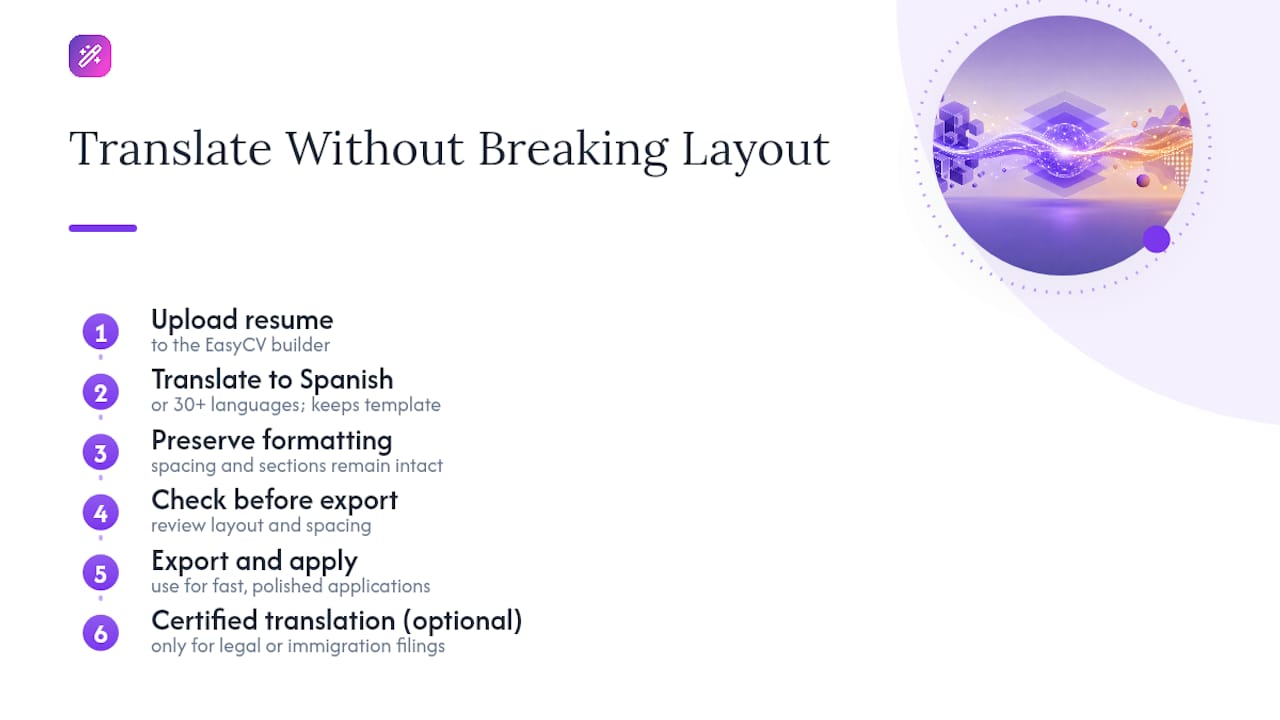
Most of the friction in resume translation isn’t the language. It’s watching your carefully built layout collapse the moment you run it through a translator. The CV translator on EasyCV is built specifically to avoid that: it translates your resume into Spanish (and 30-plus other languages) while keeping your template, spacing, and section structure intact.
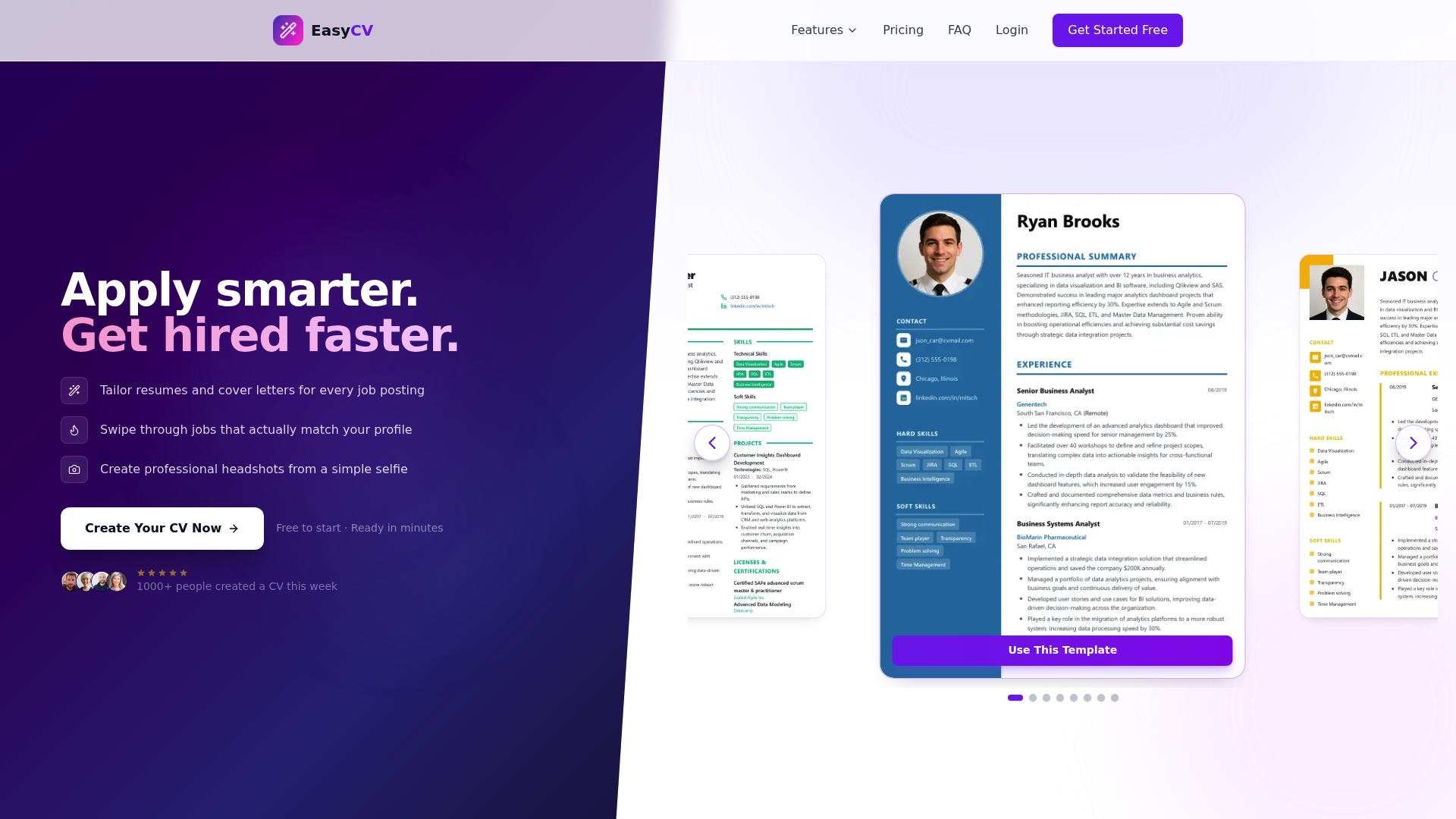
Pair that with ATS-friendly templates and AI writing assistance, and you get a translated resume that still reads like a resume, not a machine’s best guess. Use EasyCV when you need a fast, polished draft for an active application. Save certified human translation for the narrow cases, immigration paperwork, legal filings, that require a signed accuracy statement.
Start by uploading your existing resume to the EasyCV builder, translate it into Spanish, and check the formatting before export. If you’re already applying across multiple markets, pair the translated resume with the job matcher to find postings that fit your background without combing through five job boards by hand.
A Quick Word From Andras
The AI-draft-plus-native-review workflow beats either extreme, pure machine output or a slow, expensive certified translation, for nearly every job application. Spend twenty minutes scanning three job ads in your target market for repeated terms before you translate anything. That single step does more for your callback rate than a perfect grammar pass ever will.
— Andras
Sources
- résumé in Spanish | SpanishDict
- How to translate a resume or CV for a job application abroad | Bluente Blog
- U.S. Citizenship and Immigration Services (USCIS)