Search Multiple Job Boards at Once Without Losing Your Mind

The fastest way to search multiple job boards is to pick one of three methods: a job-board aggregator for broad coverage, RSS feeds or APIs for full control over the data, or advanced Boolean search strings when you need speed with zero setup. Aggregators win on breadth, feeds and APIs win on customization, and manual search strings win when you’re chasing one specific role fast. An integrated platform like Easy-cv folds all three into a single workflow, which is where most job seekers should eventually land.
TL;DR:
- Aggregators provide broad job listing coverage and relevance sorting but can have inconsistent metadata and coverage gaps for niche roles.
- Feeds and APIs offer greater control and customization but require maintenance for broken links, rate limits, and data normalization.
- Manual Boolean searches are precise and quick for targeted roles but do not scale well for daily broad searches or multiple boards.
- Organizing results by recency, skills fit, and active hiring signals improves the quality of applications and reduces time spent on stale listings.
- Building a simple, multi-source automated search system needs regular adjustment of search strings and careful management of duplicates and data quality.
Table of Contents
- Approach A: Use a Job Board Aggregator
- Approach B: Feeds, APIs, and Light Automation
- Quick, No-Tool Options: Boolean Search and Browser Tricks
- Turning Noisy Results Into a Short List
- Build a Repeatable Search to Application Pipeline
- Why an Integrated, AI-Assisted Workflow Beats Piecing It Together
- Setting Up Searches, Alerts, and a Tracking Routine
- Comparing Aggregators, Feeds, and Manual Search by What They’re Good At
- Building Your Own Multi-Board Search With Simple Tools
- Organizing What Comes In From Every Direction
- Is Scraping Job Listings Legal?
- Author Perspective: Pick One Approach and Actually Use It
- How Easy-cv Simplifies the Whole Search
- Sources
Approach A: Use a Job Board Aggregator
A job-board aggregator pulls listings from dozens or hundreds of sources into one searchable feed. The better ones don’t just scrape LinkedIn and Indeed. They also crawl applicant tracking system (ATS) pages like Greenhouse and Lever, plus direct company career sites that never make it onto the big boards. Some tools, like TheirStack, index hundreds of thousands of sources and layer on 25 or more filter criteria, along with freshness metadata that tells you how recently a listing was verified.
That combination matters because coverage without freshness is just noise. A posting that’s been live for six weeks has probably already collected 200 applications.
Aggregators earn their keep on:
- A single search box instead of ten open tabs
- Relevance ranking that surfaces closer matches first
- Built-in alerts for new postings matching your criteria
- Deduplication logic that hides repeat listings from the same job
The limitations are real too. Some aggregators sit behind paywalls for advanced filters, metadata is often inconsistent between sources (one board tags “remote,” another doesn’t), and coverage gaps still exist for niche industries or smaller regional employers. Before committing to one, check three things: how often it refreshes listings, whether it indexes ATS pages or just public boards, and whether it lets you export results instead of trapping them in its own interface.
Approach B: Feeds, APIs, and Light Automation
Feeds and APIs let you pull job data directly, without depending on someone else’s search interface. Many boards and aggregators expose RSS feeds or REST APIs that return structured listings, complete with title, company, location, and posting date. Open-source aggregator projects such as ever-jobs demonstrate this at scale, pulling from over a hundred sources and returning normalized results through a single API call.
A basic setup looks like this:
- Subscribe to an RSS feed from a board or company career page using a free reader or an email digest service.
- Connect an API endpoint to a no-code automation tool like Zapier or Make, and route new matches straight into a Google Sheet.
- Use a lightweight open-source script to normalize fields (title, company, location) so listings from different sources line up in the same columns.
The upside is control. You decide the filters, the update cadence, and where the data lands. The downside is maintenance: feeds break, APIs change their rate limits, and a script that worked in January might silently stop pulling data by March. This approach fits people comfortable tinkering, or anyone who wants their search history to stay private rather than living inside a third-party dashboard.
Quick, No-Tool Options: Boolean Search and Browser Tricks
Sometimes you don’t need a new tool. You need a sharper search string. Boolean and site-specific search operators turn a generic Google search into a scalpel:
site:linkedin.com "product manager" "remote" -"senior"excludes seniority levels you don’t want- Adding
"$90,000" OR "$100,000"near a title can surface listings that mention salary floors - Excluding a company name with a minus sign filters out recruiters who keep reposting the same role
Combine location, salary language, and exclusions in one string, and you’ll cut through most of the repetitive noise a broad aggregator search produces. Pair that with browser habits: pin tabs for your top three boards, save search URLs as bookmarks so you’re not retyping filters daily, and install a duplicate-detection extension if you’re checking the same boards multiple times a week.
Manual search strings shine for niche roles, small-company hunts, or when you’re targeting a specific employer rather than casting wide.
Pro Tip: Save your best Boolean strings in a plain text note. Job titles and skills evolve, but the search structure rarely does, so you’ll reuse the same template for months.
Turning Noisy Results Into a Short List
Aggregating ten sources means dealing with the same job posted ten times. Duplicates usually come from staffing agencies reposting a client’s role, or a company syndicating one listing across several boards. The cleanest fix is a dedupe key: match on the exact URL first, then fall back to a hash of normalized title plus company plus location, a method documented in open-source aggregator code.
Here’s a workable three-step routine if you’re tracking results in a spreadsheet:
- Sort by company and title, then flag rows with matching normalized values.
- Keep the listing with the most recent posted date and delete the rest.
- Run a second pass filtering by required skills, posted-within-14-days, and remote versus on-site, in that order.
Some platforms go further and layer an AI-fit score on top, reordering results by how closely your background matches the listing rather than by posting date alone. That reordering is often the difference between scanning 40 listings and scanning 400.
Build a Repeatable Search to Application Pipeline
A search only pays off if it turns into tracked action. Set up a tracker, whether a spreadsheet or a dedicated tool, with fields for status, source, contact name, and a follow-up date. Skipping the follow-up date is the single most common reason job seekers lose track of promising leads.
Connect your alerts directly to that tracker where you can:
- Route RSS or API matches into a spreadsheet row automatically using Zapier or Make
- Tag each entry with its source so you know which channel is actually producing interviews
- Review new matches once daily and process your full pipeline once weekly
Safety matters here too. Fake postings and job-related fraud are common enough that the FBI’s Internet Crime Complaint Center publishes annual guidance on verification steps. Never send a full Social Security number, bank details, or scanned ID to a company before a verified interview.
Pro Tip: If a “recruiter” wants your CV and a copy of your driver’s license before a first phone call, that’s a red flag, not a formality.
Why an Integrated, AI-Assisted Workflow Beats Piecing It Together
Running an aggregator, a spreadsheet, and a separate tracker in parallel works, but it’s three systems to maintain. Easy-cv folds discovery and organization into one flow, aggregating over 10 million job listings monthly, with new postings appearing within minutes of going live. Instead of manually rewriting your CV for each application, the platform’s AI tailors your CV and cover letter to the specific listing you’re viewing.

That matters because AI-driven query expansion, demonstrated in open-source projects that parse CVs into optimized search terms, catches role variants a manual Boolean string misses. A search for “growth marketer” alone won’t surface a listing titled “demand generation lead,” but a system that expands skills and title synonyms will.
A practical four-step loop looks like this:
- Discover: Browse aggregated listings or swipe through AI-matched roles
- Tailor: Generate a customized CV and cover letter for each application
- Track: Log status and follow-up dates in a built-in tracker
- Follow up: Revisit stale applications before they go cold
| Step | Manual approach | Integrated approach |
|---|---|---|
| Discovery | Search 5+ boards separately | One aggregated search |
| Tailoring | Rewrite CV by hand | AI-tailored per listing |
| Tracking | Separate spreadsheet | Built-in tracker |
Setting Up Searches, Alerts, and a Tracking Routine
The system that actually works has three moving parts: a saved search, an alert that fires when new listings match it, and a tracker that catches what the alert produces. Skip any one of the three and you’ll either miss postings or lose track of the ones you found.
Start by saving two or three search configurations rather than one broad one. A search for “remote data analyst” behaves differently than “data analyst, Chicago, hybrid,” and each surfaces a different slice of the market. Set alerts on both, whether that’s a native board notification, an RSS subscription, or an aggregator’s email digest.
When an alert lands, resist the urge to apply immediately. Drop it into your tracker first, tagged with the source and the date you saw it. This ten-second habit is what separates people who apply to 60 relevant jobs from people who apply to 60 random ones. Weekly, review what’s stalled: any application sitting untouched for more than ten days needs either a follow-up message or an honest “not moving forward” tag so it stops cluttering your active list.
Treat your search terms as a living document, not a one-time setup. Revisit them every two weeks. Titles drift (a “customer success manager” role might get reposted as “client experience lead”), and a search string that worked in January can go quiet by March if you don’t adjust it.
Comparing Aggregators, Feeds, and Manual Search by What They’re Good At
Each method solves a different problem, and picking the wrong one for your situation wastes more time than it saves. An aggregator search across hundreds of sources is unbeatable for breadth. If you want to see everything that exists for “supply chain analyst” without opening ten tabs, that’s the tool for the job. The tradeoff is less granular control. You’re working within whatever filters the aggregator gives you, and some, like TheirStack, offer 25 or more filter criteria while others offer five.
Feeds and APIs sit at the opposite end. You get complete control over what data you pull and how you store it, but you own the maintenance burden. A feed that breaks silently can leave you thinking you’ve seen everything new when you’ve actually seen nothing for two weeks.
Manual Boolean search costs nothing and takes minutes to set up, but it doesn’t scale. Running the same string across five boards manually every morning is a habit that fades by week three for most people. It’s a precision tool for a specific hunt, not a daily driver.
The practical answer for most job seekers isn’t picking one lane. It’s using an aggregator as the daily default, keeping one or two Boolean strings in reserve for a specific target company, and skipping the DIY feed setup unless you’re already comfortable with spreadsheets and automation tools.
Building Your Own Multi-Board Search With Simple Tools
If you want a custom setup rather than an off-the-shelf aggregator, the build is more approachable than it sounds. You don’t need to write a scraper from scratch. Several open-source projects already handle the hard part.
Start by picking your sources. Most boards and many ATS platforms (Greenhouse, Lever, Workday) expose either an RSS feed or a documented API endpoint. A project like ever-jobs shows the pattern: a single query endpoint that accepts a list of target sites, search terms, and country, then returns normalized results.
From there, the flow is:
- Pick three to five sources with public feeds or APIs rather than trying to cover everything at once.
- Write or copy a normalization step that maps each source’s fields (title, company, location, date) into one consistent format.
- Push results into a Google Sheet or lightweight database using a no-code connector like Zapier, or a short Python script if you’re comfortable with one.
- Add a dedupe check before anything gets added, using the URL or a title-company-location hash as your key.
- Schedule the whole thing to run daily, either through a cron job or an automation platform’s built-in scheduler.
Expect the first version to be rough. Field names won’t match across sources, and you’ll spend more time cleaning data than searching it in week one. That evens out once your normalization step is solid.
Organizing What Comes In From Every Direction
Once listings start flowing in from three or four channels, organization becomes the actual bottleneck, not discovery. The instinct is to apply to everything that looks decent. Resist it. A tighter, prioritized list beats a long unsorted one every time.

Rank incoming listings by three signals in order: how recently it was posted, how closely your skills match the stated requirements, and whether the hiring company shows real signals of active hiring (multiple open roles, a growing team page) rather than a listing that’s been recycled for months. A recruitment-industry review of multi-board job seeking makes a similar point: breadth of search only pays off if you also have a system for triaging what it produces.
Group listings into three tiers instead of one flat list: apply this week, watch and revisit in two weeks, and pass. That third tier matters as much as the first. Actively rejecting a listing takes it out of your mental rotation, which frees attention for the ones actually worth your time. Employment data from the Bureau of Labor Statistics can help here too. If hiring in your sector is cooling, expect fewer fresh postings and lean harder on the “watch” tier rather than expecting a flood of new options weekly.
Is Scraping Job Listings Legal?
Whether scraping job listings is legal depends on the site’s terms of service and how the data gets used, not on some blanket rule about scraping in general. Most job boards explicitly restrict automated collection in their terms of service, even when the same data is technically visible to anyone browsing the page. Violating those terms can expose you, or a tool built on your behalf, to a cease-and-desist or account suspension, even if no law is directly broken.
There’s also a meaningful difference between building a personal tool that pulls a handful of listings for your own search and running a service that redistributes scraped data commercially. The former sits in far friendlier territory than the latter. If you’re using an open-source tool or script, check whether it respects robots.txt directives and rate limits. Hammering a site with rapid requests is both a courtesy issue and a fast way to get your IP blocked.
The ethical side matters just as much as the legal one. Scraped listings sometimes go stale, get pulled by the employer, or turn out to be fraudulent postings designed to harvest personal information. That’s part of why verification steps matter before you apply, not just before you scrape. Treat any aggregated or scraped listing with a healthy dose of skepticism until you’ve confirmed it against the company’s own careers page.
Author Perspective: Pick One Approach and Actually Use It
Most job seekers don’t fail at searching. They fail at finishing the loop from search to tracked application. If you want breadth with minimal setup, use an aggregator. If you want control and don’t mind occasional maintenance, build a feed-based system. If you’re chasing one specific role at one specific company, skip both and write a sharp Boolean string.
Here’s a 30-minute starter: pick one aggregator, save two search configurations, set up alerts for both, and create a five-column tracker before you apply to a single job. Then measure it. After two weeks, check which source actually produced interviews, not just listings, and drop whatever isn’t pulling its weight.
— Andras
How Easy-cv Simplifies the Whole Search
Easy-cv is the shortcut past juggling five browser tabs, a spreadsheet, and a separate CV for every application. It aggregates listings from all major job boards, adding millions of opportunities each month with new postings appearing within minutes, then layers a swipe-based matcher on top so you see AI-scored roles instead of scrolling raw search results.
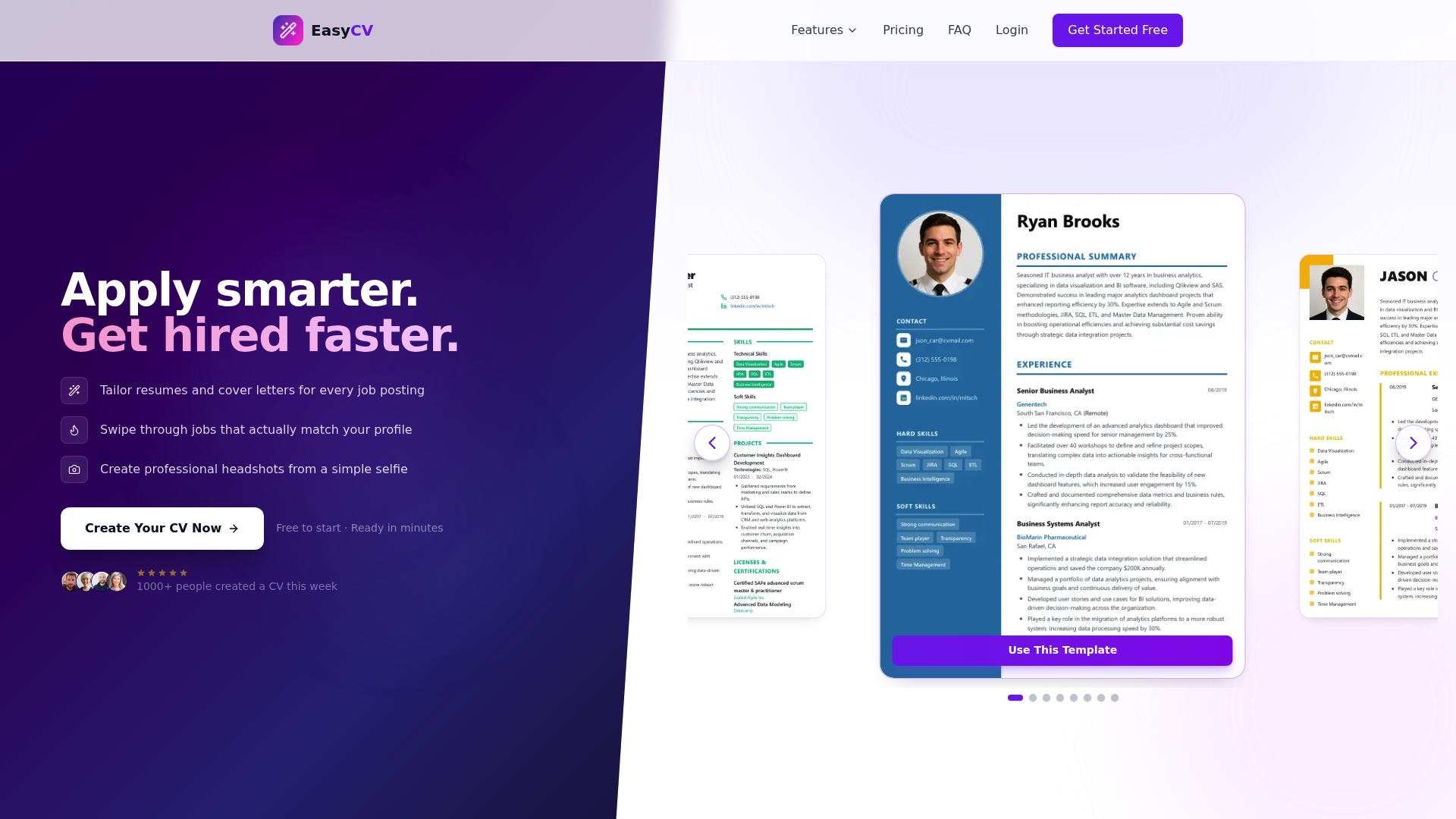
Once you swipe on a role that fits, the AI writing assistant tailors your CV and cover letter to that specific listing, and the built-in tracker logs it automatically so nothing slips through. If you’re applying across borders, the CV translator handles that in 30-plus languages without breaking your formatting. Try the job matcher and see your first batch of scored matches in under five minutes.
Sources
- venbrinoDev/ever-jobs
- Find companies with open positions | TheirStack
- IC3 2025 Annual Report
- Bureau of Labor Statistics — Employment Situation news release