Five Minute Resume Builder Privacy Test and EasyCV's Data Protection
Most resume builders are not automatically safe: many retain your data indefinitely, share it with analytics and marketing partners, and stay vague about whether your text trains their AI models. The fix takes two minutes: redact identifiers like your address and birth date before uploading anything, or pick a tool with a local-first architecture and a written no-training promise, like the standard EasyCV follows.
TL;DR:
- Choosing local-first or open-source resume builders that do not share data with third parties significantly reduces privacy risks.
- Always redact personal identifiers like address, date of birth, and salary before uploading resumes to any platform.
- Verify that privacy policies specify clear data retention periods, explicit non-use for AI training, and options for real data deletion.
- Use browser DevTools to detect suspicious third-party trackers or session recordings before submitting sensitive information.
- Prefer tools that let you control AI API keys and encrypt your resume data locally, minimizing exposure even if the service claims privacy protections.
Table of Contents
- What information does a resume builder actually collect?
- How do resume builders store, retain, and share your data?
- What architecture actually protects your resume data?
- A five-minute privacy checklist before you upload anything
- How to redact and protect your resume before you hit submit
- Where EasyCV lines up with these privacy checks
- How I actually test a resume builder’s privacy claims
- Get AI resume help without handing over more than you should
- Sources
What information does a resume builder actually collect?
A resume holds more personal detail than most people realize until they see it listed out. Beyond your name and phone number, you’re typically handing over your full work history, employer names, education dates, certifications, sometimes a headshot, and in some templates, salary expectations or previous compensation.

That combination is unusually rich for identity theft or targeted phishing. An attacker with your employer history, graduation year, and email address has almost everything needed to run a convincing “HR verification” scam or a fake recruiter pitch. Add a photo and a home address, and you’ve created a dossier that’s far more dangerous than a leaked email and password.
Here’s what a typical resume builder form collects, directly or indirectly:
- Contact details: full name, phone number, personal email, sometimes a home address
- Employment history: company names, job titles, exact dates of employment, sometimes direct supervisor names
- Education records: schools attended, degrees, graduation years
- Certifications and licenses: professional credentials that can reveal industry and seniority
- Photos: headshots uploaded directly or generated from a selfie
- Salary history: current or past compensation, entered in some templates as a formatting field
An audit of popular free resume builders found that some platforms run proxied analytics and session recording that can capture form inputs even when a browser’s privacy tools are active. Session recording is the highest-risk pattern here because it doesn’t just log that you filled out a field. It can replay every keystroke, meaning a security incident on the vendor’s end exposes far more than a static database entry.
The realistic harms aren’t hypothetical. Leaked resume data feeds phishing lists, gets scraped by data brokers who resell “job seeker” segments to marketers, and in some hiring pipelines can even factor into discrimination if employment gaps or ages become visible to systems that shouldn’t have them. A tool that treats your resume as just another data asset to monetize is a tool worth scrutinizing before you paste in a decade of career history.
How do resume builders store, retain, and share your data?
Once your resume data sits on a company’s servers, three questions determine your exposure: how long they keep it, who else touches it, and whether it feeds an AI model. Vendor privacy policies vary wildly on all three, and the vague ones are usually vague for a reason.
Retention windows are the first tell. Some policies state a specific deletion timeline after account closure. Many say nothing at all, which functionally means indefinite storage. Independent reviews have flagged long retention windows and broad third-party sharing as recurring red flags across multiple audited platforms, not isolated incidents.
AI training language deserves its own read-through. Phrases like “used to improve our services” or “helps train our models” can mean your resume text, including your name and work history, becomes training data for a language model with no clear way to opt out later. A trustworthy vendor states plainly that user content is not used for model training, not just that it’s “handled securely.”
Third-party sharing is where “partners” becomes a loaded word. Recruiters, data brokers, and analytics vendors all qualify as partners in most privacy policies, and that single word can cover a lot of downstream exposure you never agreed to explicitly.
When you’re checking a privacy policy, search (Ctrl+F works fine) for these terms specifically:
- “Retention” or “how long we keep”
- “Train” or “improve our models”
- “Third party” or “partners” or “service providers”
- “Delete” or “right to deletion”
Pro Tip: If a privacy policy uses the word “partners” more than twice without naming a single one, that’s usually a sign the sharing arrangements are broader than the company wants to spell out.
What architecture actually protects your resume data?
The technical setup behind a resume builder matters more than its privacy policy’s tone. Some architectures make a data breach nearly impossible; others make it a matter of when, not if.

Local-first, client-side tools store your resume data in your browser using IndexedDB or localStorage instead of a remote database. Open-source projects like private-cv build entirely around this model: your information never leaves your device unless you explicitly export or sync it, which eliminates most server-side breach risk by design. A related project, resume-forge, pairs that same local storage with user-supplied AI API keys, meaning any AI assistance runs through a key you control rather than a shared account the vendor manages.
That API-key pattern deserves attention on its own. When a tool asks you to supply your own API key for AI features instead of routing every request through its own backend account, your content talks directly to the AI provider under your credentials, not through a company-owned pipeline that could log, store, or repurpose it.
Encrypted publishing is another pattern worth knowing. Some open-source builders, including BuildMyResume, let you publish a shareable resume link where the encryption key lives in the URL fragment rather than on the server. The server only ever stores unreadable ciphertext. It’s a clever setup, but it has a real trade-off: anyone who gets that full link, fragment included, can decrypt the resume, so a leaked or forwarded link is effectively a leaked password.
Watch for the opposite signals too: server-side analytics proxying, session recording scripts, and AI features with no visible key management are the patterns that suggest your data is routed through infrastructure you can’t inspect or control.
A five-minute privacy checklist before you upload anything
Run this before you type a single word into a new resume builder. It takes less time than filling out the contact-information field.
- Search the privacy policy for “retention.” If there’s no specific timeframe for deleting your data after account closure, treat retention as indefinite.
- Search for “train” or “AI model.” Look for an explicit statement that your content is not used to train models. Silence on this point is not reassurance.
- Search for “third party” and “partners.” Note whether the policy names specific partners or just uses the vague collective term.
- Check for a deletion mechanism. Confirm there’s an actual account-deletion or data-deletion option, not just a support email you’d have to hope gets answered.
- Open your browser’s DevTools and check the Network tab. Look for requests going to third-party analytics domains, and check if any script matches known session-recording tools.
- Test the export function before committing personal details. A tool that locks basic PDF export behind a paywall while collecting your full resume upfront is worth questioning, since free tools that restrict useful exports can be monetizing your data as the actual product.
If the policy names its retention window, explicitly excludes your content from AI training, and offers real deletion, you can generally proceed. If the language is vague on all three but the tool still seems useful, redact sensitive fields first. If you find active session recording or no deletion path at all, walk away.
Pro Tip: In Chrome DevTools, open the Network tab, filter by “XHR” or “Fetch,” and reload the page. Session-recording scripts often show up as requests to domains you don’t recognize, firing every few seconds while you type. That pattern alone is worth investigating before you enter real information.
How to redact and protect your resume before you hit submit
Redaction is the fastest privacy control you actually have, and it costs nothing. Security-first guidance on AI resume tools consistently recommends stripping identifiers before pasting content into any tool you haven’t fully vetted.
Before uploading, remove or placeholder these specific fields:
- Home address: use just city and state, or omit entirely
- Date of birth: rarely needed on a resume and easy to leave off
- Salary history: replace with a range if the template demands a number
- Full SSN or ID numbers: never belong on a resume regardless of the platform
You can reinsert the real details manually into your final exported PDF once you’re confident the tool is trustworthy, or leave them out entirely, since most employers don’t need your birth date or a specific salary figure at the application stage.
For exports and backups, prefer client-side PDF generation over server-rendered exports when a tool offers the choice, and keep your own encrypted backup of the final file rather than relying solely on the vendor’s cloud copy.
When using AI writing features, supply your own API key where the option exists, or run a local model if you’re comfortable with that setup. Either way, avoid pasting your full name, address, or employer contact details directly into an AI prompt field. Keep the identifiers out of the text you’re asking an AI assistant to rewrite.
Where EasyCV lines up with these privacy checks
EasyCV builds its AI resume and cover letter tools around the same protections outlined in the checklist above, treating them as defaults rather than optional settings.
- Retention and deletion: your account and its data are removable, not locked behind an indefinite retention clause with no exit
- AI assistant behavior: EasyCV’s writing assistant generates and refines content for your document without repurposing your resume text to train unrelated models
- Export and translation controls: you can export finished resumes and translate them across 30-plus languages without the platform gatekeeping your own document behind additional data requests
The headshot generator follows the same principle: it processes an uploaded selfie to produce a studio-style photo for your profile, and you control whether that image is ever included in an export at all. None of this replaces reading a policy yourself, but it means the features you’d reach for, AI drafting, translation, exporting, don’t require handing over more than the checklist above says is reasonable.
How I actually test a resume builder’s privacy claims
My process is simple: open DevTools before I open the sign-up form. I check the Network tab for third-party trackers, search the privacy policy for “retention,” “train,” and “third party,” and see whether deletion is a real button or a support ticket.
There’s a genuine trade-off between convenience and airtight privacy. A fully local, offline tool is the safest option technically, but it sacrifices the cloud sync and AI polish most job seekers actually want during a search. The checklist above, and the way EasyCV maps onto it, is meant to get you most of the way to both.
— Andras
Get AI resume help without handing over more than you should
EasyCV is built for job seekers who want AI-assisted resume writing without treating that resume like a data giveaway. You get the AI writing assistant, ATS-friendly templates, and translation into 30-plus languages, and the account controls to manage or remove your data when you’re done with your search.
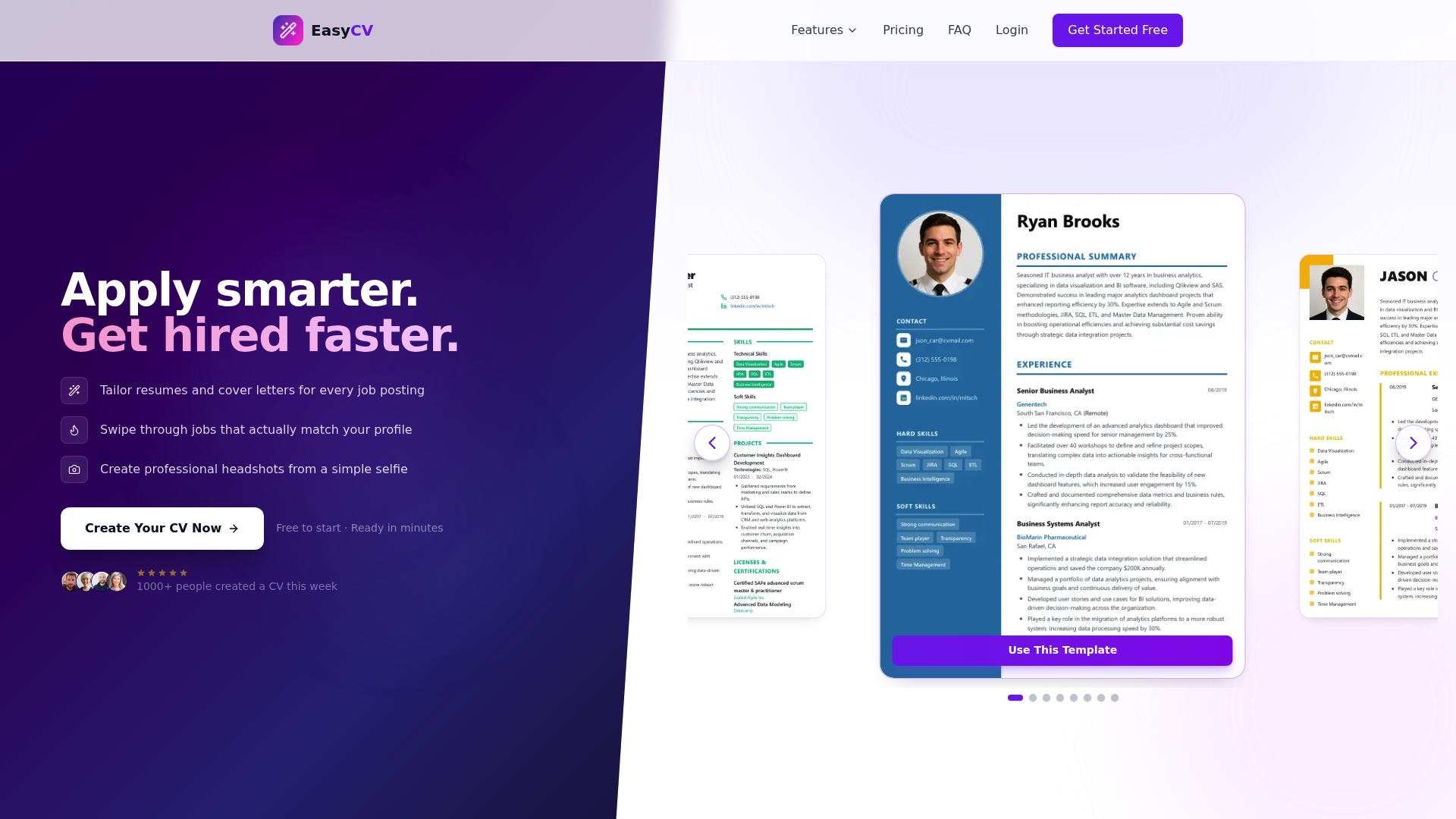
Three things worth knowing before you start: your account data is removable, not stuck in permanent storage; exports are yours to download and back up on your own terms; and the AI writing assistant works within your document, not as a pipeline for repurposing your career history elsewhere. If you’re weighing whether to redact fields first or just use a tool built with these defaults, start by exploring the EasyCV builder and see how the templates and AI tools work before you commit a full resume to it. If job matching is part of your search too, the job matcher runs on the same account protections.
Sources
For readers who want to verify any of this directly rather than take a vendor’s word for it, a few places are worth bookmarking. The private-cv and BuildMyResume repositories let you inspect open-source, privacy-first resume builder code firsthand, including exactly how local storage and encrypted publishing work under the hood. For a broader look at showcasing work publicly without over-exposing personal details, Alloquy’s guide on proof without exposure covers techniques that apply well beyond portfolios. Independent audits like the ToolBox review of major free builders are worth rereading periodically, since vendor policies change.
- Best AI Tool for Resume: A Security-First Guide
- Free Resume Builders Are Selling Your Career Data - I Audited resume.io, Zety, and Novoresume | ToolBox
- 1arunjyoti/private-cv