2 Week Notice Template: Write Yours Professionally

Leaving a job is stressful enough without having to stare at a blank page wondering how to say it in writing. A solid 2 week notice template gives you a professional starting point so you can focus on the transition instead of the wording. A two week notice letter formally communicates your intent to leave and identifies your exact last working day. It protects you, keeps your employer informed, and signals the kind of professional you are, even on your way out. This guide covers everything you need to write one confidently.
Table of Contents
- Key Takeaways
- What goes into a good 2 week notice template
- How to personalize your two week notice template
- Common mistakes to avoid in your notice letter
- Template examples for different situations
- My take on why this letter matters more than you think
- Ready for your next role? Easy-cv can help
- FAQ
Key Takeaways
| Point | Details |
|---|---|
| Use an exact last working day | State a specific calendar date in your letter to prevent payroll and scheduling confusion. |
| Keep it short and professional | The most effective resignation letters are 150-250 words focused on intent, date, and transition. |
| Talk to your manager first | Deliver verbal notice before the written letter to show courtesy and avoid surprises. |
| Match the tone to your workplace | Choose between formal, friendly, or neutral templates based on your company culture. |
| Avoid negativity entirely | Brief, positive messages protect your reputation and preserve future professional connections. |
What goes into a good 2 week notice template
Before you start writing, you need to know what belongs in the letter. Most people overthink this. The truth is that a two weeks notice letter has a simple, repeatable structure. Once you understand the components, filling them in takes less than 20 minutes.
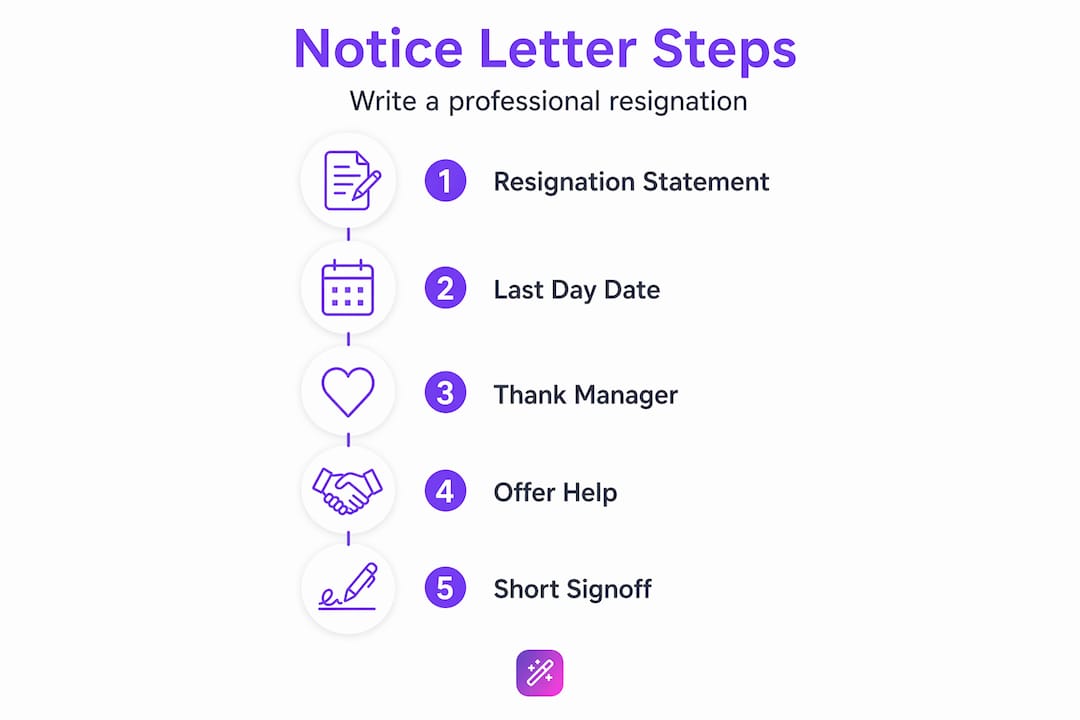
Here are the core elements every professional resignation letter should include:
- A clear resignation statement. Open with a direct sentence confirming you are resigning from your position and your job title. No ambiguity, no buildup.
- An exact last working day. Specify your last day as a specific calendar date, such as “Friday, July 18, 2026.” Vague phrases like “in two weeks” create payroll errors and scheduling headaches.
- A brief expression of gratitude. One or two sentences acknowledging what you valued about the role or team. It does not need to be elaborate. It just needs to be genuine.
- An offer to help with the transition. Offering to train a replacement or document your responsibilities shows professionalism. Even a single line goes a long way.
- A professional closing and signature. Use “Sincerely” or “Best regards.” Sign with your full name, and include your contact information if you are sending the letter by email.
The reason exact dates matter so much is practical: vague terms cause confusion for HR, managers, and payroll departments. “Two weeks from today” means something different to everyone reading it. A calendar date means the same thing to all of them.
A written resignation letter also serves as official documentation of your intent and last day. If there is ever a dispute about your notice period, that letter is your evidence. Do not skip it even if you give verbal notice first.
Pro Tip: Keep your letter between 150 and 200 words. Shorter letters are easier to read and harder to misinterpret. If you cannot say it in that space, you are probably including things that do not belong.
How to personalize your two week notice template
A template is a starting point, not a script. The goal is to take the structure and make it feel like it came from you, addressed to your specific situation. Here is how to do that well.
-
Address the right person. Your letter should go to your direct manager, not HR (unless company policy says otherwise). Use their full name and title. “Dear Ms. Carter” is cleaner and more respectful than “To Whom It May Concern.”
-
Calibrate your tone. A startup with a casual culture calls for a warmer, friendlier tone. A corporate law firm warrants something more formal. Match the language to the environment you are leaving. Keeping the letter warm but professional maintains dignity and keeps future doors open.
-
Decide whether to include your reason for leaving. You are not obligated to explain why you are resigning. Common reasons include a new opportunity, relocation, or personal circumstances. If you mention a reason, keep it brief and neutral. “I have accepted a new opportunity” is sufficient.
-
Write a specific transition offer. Generic offers like “I am happy to help” carry less weight than specific ones. If you can train your replacement, document workflows, or brief your team, say so. Specificity signals that you mean it.
-
Choose the right format. A printed letter works for in-person submissions. An email works for remote teams or as a follow-up to an in-person conversation. Either way, the content should be the same.
-
Proofread before sending. Typos in a resignation letter feel careless. Read it twice. Then read it aloud. Small errors in a short letter are surprisingly easy to miss.
Pro Tip: Tell your manager in person before submitting the written notice. HR experts consistently recommend verbal resignation first. It prevents surprises and gives your manager time to process the news before the formal paperwork arrives.
Common mistakes to avoid in your notice letter
Even a short letter can go wrong. These are the most common errors that undermine an otherwise professional resignation.
- Vague last day language. “In approximately two weeks” is not acceptable. It opens the door to misunderstandings. Use a specific date, every time.
- Negativity or oversharing. Complaints about management, toxic coworkers, or a bad work environment have no place in a resignation letter. They travel further than you expect and stay longer than you intend.
- Delaying written notice after verbal resignation. If you have already told your manager verbally, submit the written letter the same day or the next morning. Waiting several days creates ambiguity about when your notice period officially started. Calculate your last day from the date you actually submit the letter, not the date of your verbal conversation.
- Letters that are too long or too informal. A resignation letter is not a performance review or a therapy session. Keep letters focused on intent and date. Anything beyond that risks diluting the message.
- Omitting a transition offer when one is possible. Not every role allows for a two-week handover, but if yours does, leaving that line out reads as indifferent. A single sentence offering help costs nothing and means a lot.
- Not accounting for early dismissal. Employers may ask you to leave before your stated last day. Keep your letter professional regardless, since it may be reviewed by HR even after you have left.
Template examples for different situations
Selecting the right template depends on your workplace culture, your relationship with your manager, and how much you want to say. Here is a breakdown of the most useful variations.

| Template type | Best used when | Tone |
|---|---|---|
| Simple and direct | Any workplace; especially if you prefer brevity | Neutral and factual |
| Formal corporate style | Traditional industries like finance, law, or government | Polished and structured |
| Friendly and grateful | Close-knit teams or long-term roles | Warm and personal |
| Short notice or neutral | When leaving quickly or under strained circumstances | Professional and minimal |
Simple and direct template
Dear [Manager’s Name], I am writing to formally resign from my position as [Job Title] at [Company Name]. My last working day will be [Date]. Thank you for the opportunities during my time here. I am happy to assist with the transition in any way that helps. Sincerely, [Your Name]
Formal corporate style template
Dear [Manager’s Name], Please accept this letter as formal notice of my resignation from my role as [Job Title], effective [Date]. I appreciate the professional development and opportunities I have received during my tenure at [Company Name]. I am committed to completing all outstanding responsibilities and supporting a smooth handover process before my departure. Best regards, [Your Name]
Friendly and grateful template
Dear [Manager’s Name], I wanted to let you know that I have decided to resign from my position as [Job Title], with my last day being [Date]. This was not an easy decision. Working with this team has genuinely meant a lot to me, and I am grateful for the experiences and relationships I have built here. I would love to help with training or documentation over the next two weeks in any way I can. Warmly, [Your Name]
The right choice comes down to two things: how you want to be remembered and what your workplace considers appropriate. When uncertain, lean toward the formal or simple option. Professionalism is never the wrong call.
My take on why this letter matters more than you think
Resignation letters tend to feel like a formality. I used to think the same thing. After watching dozens of people leave companies well and badly, I changed my mind entirely.
The way you leave a job stays with people longer than almost anything you did while you were there. I have seen talented professionals lose strong references because their exit felt abrupt or resentful. I have also seen people with average performance history walk away with glowing referrals simply because they handled the last two weeks with grace.
What I find most interesting is how few people treat the resignation letter as a reputational asset. They put enormous effort into their resume and cover letter to get the job, then dash off three careless lines when they leave. That asymmetry does real damage, especially in industries where people know each other.
My advice is straightforward: write the letter like someone important will read it. Because they will. HR keeps it on file. Your manager may forward it. Future colleagues may hear about it. A clear, professional, and generous notice period notice letter takes 20 minutes to write and pays dividends for years.
— Andras
Ready for your next role? Easy-cv can help
Once you have sent your resignation letter, the next step is landing your next opportunity fast. Easy-cv is built for exactly that moment.
With the Easy-cv AI CV builder, you can create a polished, ATS-friendly resume tailored to every role you apply for, without spending hours on formatting or rewrites. The platform aggregates over 10 million job listings per month, matches you to roles using AI, and keeps your entire search organized in one place. Whether you are pivoting industries or moving up in your field, Easy-cv makes the transition from resignation to offer letter faster and less stressful. Explore the full feature set and see what fits your next move.
FAQ
What should a two week notice letter include?
A two week notice letter should include a clear resignation statement, your exact last working day as a calendar date, a brief thank-you, and an offer to help with the transition. Keep it under 200 words.
How do I calculate my last working day?
Count 14 calendar days from the date you submit the written letter, not from the date of any verbal conversation. Use a specific date in the letter to avoid confusion.
Do I have to give a reason for resigning?
No. You are not required to explain why you are leaving. If you choose to mention a reason, keep it brief and neutral, such as “I have accepted a new opportunity.”
Can I use a short notice resignation template if I cannot give two weeks?
Yes. A short notice or neutral template focuses on your intent, your last day, and a professional tone without dwelling on the shortened timeline. Be honest but keep the language positive.
Should I email or hand-deliver my resignation letter?
Either works, but the format should match how your workplace communicates. Remote teams often use email. In-person offices may prefer a printed letter. In both cases, speak to your manager verbally first before the written notice arrives.