What cover letters really do for your job search

Most job seekers assume that cover letters are a formality nobody reads. That assumption is costing people interviews. The reality is that 83% of hiring managers read cover letters even when they are optional, and 81% will reject a candidate based on a poor one. Cover letters are still shaping hiring decisions every single day, quietly sorting serious candidates from the noise. This guide explains exactly how they work, when to use them, what hiring managers actually think, and how to write one that does real work for your application.
Table of Contents
- What is a cover letter—and why does it matter?
- How do cover letters actually impact your job application?
- When to include—or skip—a cover letter
- What hiring managers and recruiters really think
- The anatomy of an effective cover letter
- Why most cover letters miss the mark—and how yours can stand out
- Take the next step: Write stronger cover letters—faster
- Frequently asked questions
Key Takeaways
| Point | Details |
|---|---|
| Cover letters show real interest | A thoughtful cover letter signals effort and research, giving you an edge over generic or absent applications. |
| Most hiring managers still read them | Even if optional, 83% of hiring managers consider cover letters when making decisions. |
| Generic letters are a risk | A poorly written cover letter can harm your chances more than not submitting one. |
| Customize for each job | Tailoring your cover letter for the specific role and company is essential for maximum impact. |
What is a cover letter—and why does it matter?
A cover letter is a one-page document submitted alongside your resume that speaks directly to a specific employer about a specific role. Think of it as a personal marketing tool. Where your resume is a structured list of facts, dates, and accomplishments, your cover letter is your voice. It tells the story behind the bullet points.
The distinction matters because resumes are designed to be scanned. They answer “what” and “when.” A cover letter answers “why” and “how.” Why are you drawn to this company? How did your previous experience prepare you for this exact challenge? Those are questions a resume simply cannot answer on its own.
According to research from Frontline Source Group, cover letters provide context beyond what a resume can show, including personality, communication ability, evidence of company research, and the unique qualifications that set you apart. Recruiters and hiring managers are not just evaluating your skills when they read a cover letter. They are evaluating your judgment, your writing ability, and how well you understand the role you are applying for.
“A cover letter is often your first real chance to show a hiring manager who you are, not just what you have done. It signals motivation, attention to detail, and genuine interest in a way that no resume ever could.” — Frontline Source Group
The cover letter benefits extend beyond first impressions, too. They help contextualize gaps in employment history, career changes, or unconventional backgrounds. If your resume raises questions, your cover letter can proactively address them before a recruiter even picks up the phone.
How do cover letters actually impact your job application?
Knowing the purpose of a cover letter is one thing. Understanding its measurable effect on hiring decisions is where many job seekers gain a real edge. The numbers tell a clear story.
| Metric | Statistic |
|---|---|
| Companies that require cover letters | 60% |
| Hiring managers who read them even if optional | 83% |
| Hiring managers who reject based on a poor cover letter | 81% |
| Average initial time spent reviewing a cover letter | Under 30 seconds |
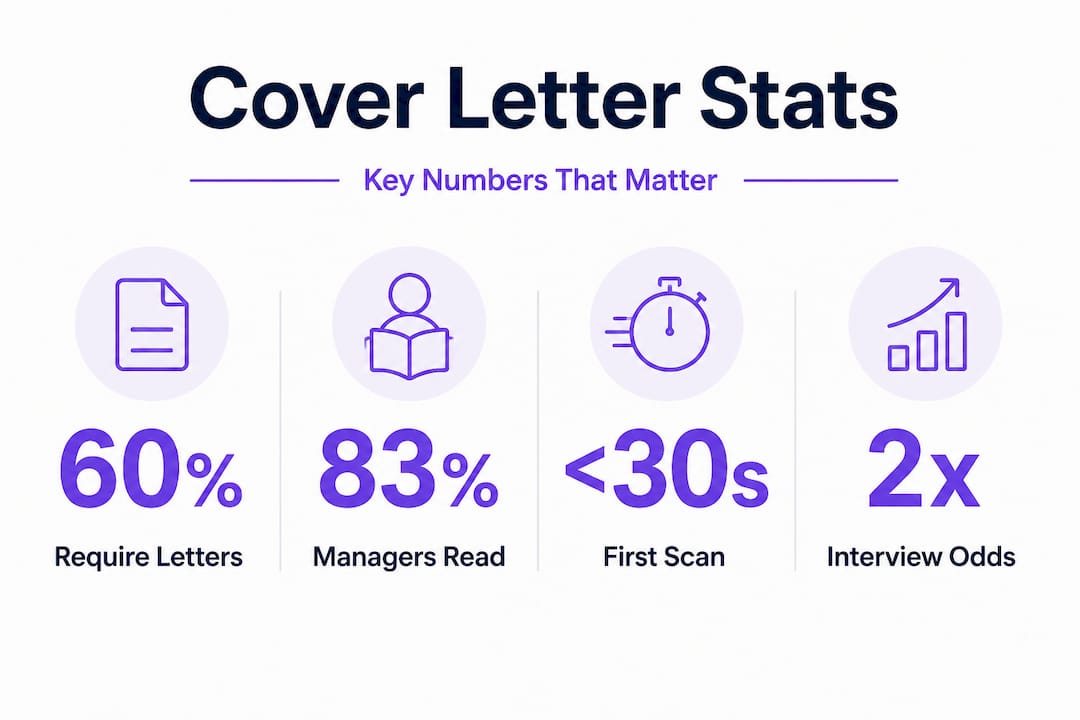
These figures from Frontline Source Group research make it clear: cover letters are not optional in the way many people think. Even when a job posting says “cover letter optional,” most hiring managers still open and read them. And if that letter is generic, full of clichés, or clearly copied from a template with the company name swapped in, the damage is real.
The 30-second initial scan is critical to understand. Hiring managers are not reading word for word at first glance. They are looking for relevance, clarity, and a reason to keep reading. That means your opening paragraph needs to hook immediately. It also means that understanding how cover letters affect job success requires thinking about format and content together.

Cover letters also play a powerful tiebreaker role. When two finalists have nearly identical resumes and qualifications, a strong cover letter can be the factor that decides who gets the offer. It communicates motivation and culture fit in a way that no skills list can.
Pro Tip: A generic cover letter can hurt your application more than no cover letter at all. If you cannot write something specific and genuine for a role, it is often better to apply without one than to submit boilerplate text that signals low effort to the reader.
When to include—or skip—a cover letter
Not every job application calls for a cover letter, and applying one universally can waste your time. Understanding when to include one, and when to leave it out, is part of applying strategically.
Research from Harvard Business Review notes that generic cover letters harm applications in competitive candidate pools, where 250 or more people apply for a single role. In those situations, a tailored letter signals effort and genuine research, while a generic one signals the opposite.
| Situation | Include a cover letter? |
|---|---|
| Cover letter explicitly required | Always |
| Posting says “optional” for a competitive role | Yes, always |
| Senior or leadership positions | Yes, strongly recommended |
| Career change or employment gap | Yes, use it to explain |
| High-volume tech or software applications | Usually not needed |
| Hourly or shift-based roles | Not typically unless required |
| Recruitment agency or staffing firm submissions | Depends on agency guidance |
Here is a simple decision process to follow before every application:
- Read the job posting carefully and note whether a cover letter is required, optional, or not mentioned.
- Research the company size and culture. Startups and smaller companies often value personal communication more than large enterprises with automated screening systems.
- Assess the competition level. If it is a widely promoted role or a recognized brand, the applicant pool will be large. A tailored letter gives you a real advantage.
- Consider your own situation. If you are changing careers, returning from a gap, or applying for a role slightly outside your experience, a cover letter is your chance to bridge that gap before anyone asks.
- Check industry norms. Creative fields often expect a distinctive, personality-driven cover letter. Finance and law expect precision and formality. Tech varies widely.
Pro Tip: When a job posting says “optional,” treat it as “recommended.” Most candidates skip it, which means submitting a strong, targeted letter instantly separates you from a large portion of the applicant pool. Use the opportunity when deciding when to use a cover letter to your advantage rather than defaulting to the path of least effort.
What hiring managers and recruiters really think
The debate about cover letters is not settled even among the people who do the hiring. Attitudes vary significantly depending on role, industry, and personal preference, and understanding these differences helps you make smarter application decisions.
Research from Business Insider covering LinkedIn’s CEO commentary reveals contrasting recruiter views: roughly 51% of recruiters skip cover letters during early screening stages, but hiring managers and HR professionals at the decision stage read them far more often. Among finalists, 78% of hiring managers report reading cover letters carefully before making a final call.
Arguments for reading cover letters:
- They reveal communication skills and written clarity that a resume cannot show.
- They demonstrate company-specific research and genuine interest.
- They help contextualize career moves, gaps, or non-traditional backgrounds.
- They can signal cultural fit and alignment with company values.
- They provide insight into how a candidate thinks and prioritizes.
Arguments against spending time on them:
- High application volumes make reading each one impractical during early screens.
- Automated applicant tracking systems (ATS) often parse only resumes, not letters.
- Many candidates submit templated letters that provide no meaningful signal.
- Some industries and roles simply do not have the review culture for them.
The reality is that the most important readers of your cover letter are often not the first screeners. They are the insights from hiring managers who have already narrowed the field and are deciding between you and one or two other people. That is when your cover letter carries the most weight. Writing a strong one is, in many cases, writing for the final decision stage.
“The candidates who take the time to write a genuine, specific cover letter stand out because most applicants simply do not bother. When you are deciding between two equally qualified people, that letter can be the difference.” — HR director perspective on finalist selection
The anatomy of an effective cover letter
Now that you understand the landscape, here is how to write a cover letter that actually works. Each section has a specific job to do.
-
The opener. Skip “I am writing to apply for.” That sentence tells the reader nothing and signals a template immediately. Instead, open with a specific observation about the company or a direct statement about why this particular role excites you. For example: “When your team announced the launch of your new sustainability initiative last quarter, I recognized exactly the kind of challenge I have been working toward for the past four years.” Specific, direct, and immediately different.
-
The middle. This is where you connect your experience to their needs. Do not summarize your resume. Instead, pick one or two achievements that are directly relevant to the role and explain the context behind them. What problem did you solve? What did you learn? How does that prepare you for what they need? Think of this as your evidence paragraph. Make it concrete.
-
The skills and culture fit paragraph. This is where you demonstrate company research. Reference something real: a recent product launch, a company value statement, a challenge specific to their industry. This signals that your interest is genuine rather than transactional. Research shows that cover letters providing company-specific context consistently outperform generic submissions in hiring evaluations.
-
The close. Be direct. State clearly that you are enthusiastic about the opportunity and that you welcome the chance to discuss further. Avoid desperate language like “I hope to hear from you” in favor of confident language like “I look forward to exploring how I can contribute.” Small word choices signal confidence.
Pro Tip: Before you write a single word, spend 10 minutes reading the company’s website, recent press releases, and the LinkedIn profiles of your potential team members. Use their own language back to them. If they talk about “customer obsession,” use that phrase. If they prioritize “data-driven decisions,” echo that framing. It shows you did the work.
Why most cover letters miss the mark—and how yours can stand out
Here is the honest truth that most articles skip: the majority of cover letters are not just forgettable, they are actively harmful. Research published by Harvard Business Review confirms that generic letters harm more than their absence in competitive applicant pools. Yet candidates keep submitting them because submitting something feels safer than submitting nothing.
The problem is a mindset issue. Most people write cover letters about themselves when the best cover letters are written for the reader. A hiring manager does not want to read about your passion for growth and your “excellent communication skills.” They want to know what problem you will solve for them and why you are the right person to do it.
What actually separates a memorable cover letter from a mediocre one:
- Storytelling over listing. One specific, vivid achievement beats a list of five vague skills every time.
- Company research that shows. Mentioning a recent news item or specific product makes it impossible to dismiss your letter as a template.
- A distinct voice. You do not need to be funny or clever. You need to sound like a human being, not a press release.
- Brevity with substance. Three strong paragraphs beat five weak ones. Hiring managers will not reward length.
- A confident, direct close. Passive endings undermine everything that came before them.
You can explore differentiating your cover letter with the right tools, but the mindset shift has to happen first. Stop writing what you think a cover letter is supposed to say. Start writing what this particular hiring manager actually needs to hear.
“Your cover letter is not a courtesy document. It is a persuasion document. Every sentence should earn its place by moving the reader closer to believing you are the right person for this role.”
The candidates who internalize this shift write letters that get read, remembered, and acted on. Everyone else fills inboxes with noise.
Take the next step: Write stronger cover letters—faster
Knowing what makes a cover letter work is a solid foundation. Putting it into practice under job search pressure is a different challenge. That is where the right tools make a real difference.
The Easy CV tool was built specifically to help job seekers avoid the pitfalls covered in this article. Instead of staring at a blank page or recycling a generic template, you can generate tailored, role-specific cover letters using AI that understands job descriptions and adapts content to match. It is not about replacing your voice. It is about removing the friction so your voice comes through faster and more clearly. You can also explore more Easy CV features like resume optimization, AI headshots, and job matching tools, or check Easy CV pricing to find the plan that fits where you are in your job search. A stronger application starts with a smarter process.
Frequently asked questions
Do cover letters still matter in 2026?
Yes. The data is clear that most hiring managers read cover letters even when they are not required, and they remain an important differentiator for serious candidates in competitive hiring situations.
Is it better to skip a cover letter than submit a generic one?
Yes. A poorly written or templated cover letter can actively damage your application. Research confirms that generic letters signal low effort and can eliminate candidates from consideration in competitive pools.
How long do hiring managers spend on a cover letter?
Most spend under 30 seconds during the initial review, which means clarity, a strong opener, and relevance to the specific role are far more important than length or decoration.
Are there jobs or industries where a cover letter is not needed?
Yes. For high-volume tech or hourly roles, cover letters are generally unnecessary unless a posting specifically requests one. In these cases, a strong resume and portfolio do more work than a letter would.